The Psychological Barrier of Japanese Conjugation
When first diving into Japanese verb conjugation, many learners experience what can only be described as a profound linguistic shock. It’s a moment where the neatly organized rules of previously studied languages seem to evaporate, replaced by what appears to be an endless, arbitrary labyrinth of endings and transformations. This initial encounter often leaves students feeling utterly overwhelmed, as if staring up at an impossible mountain range of grammatical forms, each peak demanding individual ascent. The sheer volume of new patterns can be incredibly daunting, leading to a common misconception that Japanese verbs are inherently chaotic and defy systematic understanding. It’s completely normal to feel this way, but rest assured, this perception is where the real barrier lies, not in the verbs themselves.
The traditional approach of rote memorization, often effective for simpler conjugation tables in European languages, quickly proves to be an insurmountable obstacle in Japanese. Trying to commit every single conjugated form – from plain past to polite negative potential passive – for every single verb is not only an inefficient strategy but a recipe for burnout. Imagine attempting to individually recall dozens of unique forms for hundreds, if not thousands, of verbs; the mental load is simply unsustainable. This method treats each new conjugation as an isolated fact, demanding precious cognitive space for unconnected pieces of information, rather than recognizing them as components of a larger, cohesive structure. Consequently, learners often feel stuck, constantly forgetting rules and making errors, which erodes confidence and enjoyment.
However, the true challenge often lies not in the complexity itself, but in the mindset with which we approach it. The key to unlocking Japanese verb conjugation isn’t about memorizing an exhaustive list of individual forms, but rather about shifting your perspective from viewing it as an arbitrary burden to understanding it as a logical, predictable machine. Instead of a chaotic jumble of exceptions, Japanese verbs operate within a highly systematic framework where specific, predictable changes occur based on a verb’s inherent characteristics and the grammatical function you wish to express. Once you grasp this underlying logic, the seemingly infinite variations begin to coalesce into a manageable, interconnected system.
This systemic understanding is rooted in what linguists call morphosyntax – the study of how word structure (morphology) interacts with sentence structure (syntax). In the context of Japanese verbs, this means recognizing that each conjugation isn’t a random new word, but rather a verb stem combined with a specific suffix or set of suffixes, each carrying a precise grammatical meaning. Whether you’re forming the te-form, the passive voice, or a conditional clause, you’re essentially applying a set of consistent, rule-governed operations to a base form. By learning these operational rules and understanding how different suffixes attach and sometimes slightly modify the stem, you gain the power to generate any required form on demand, rather than struggling to recall it from memory. This shift transforms the intimidating task of conjugation into an engaging process of building and understanding a sophisticated linguistic mechanism.
Deconstructing the Verb Groups: A Structural Approach
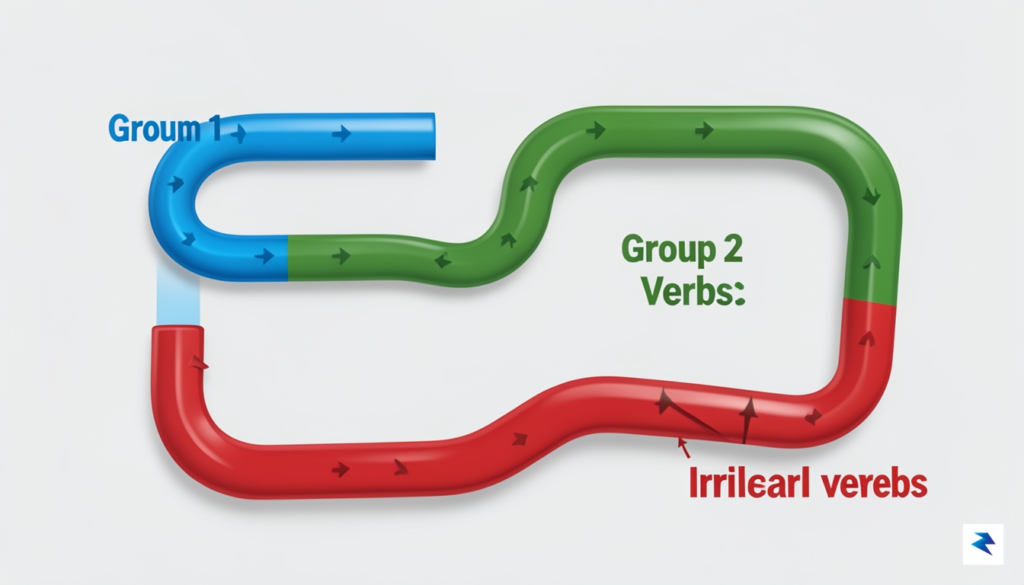
Before you can begin to conjugate verbs with confidence, you must first master the art of classification. In Japanese, every verb is sorted into one of three distinct categories, and correctly identifying these groups is the fundamental bridge between rote memorization and true linguistic intuition. Think of these groups as your operating system; if you choose the wrong one, your conjugation “software” will inevitably produce errors. While the sheer number of verbs can feel overwhelming at first, the structural markers for each group are remarkably consistent, providing a reliable compass for any learner willing to look closely at the dictionary form.
Group 1: The Godan (Five-Step) Verbs
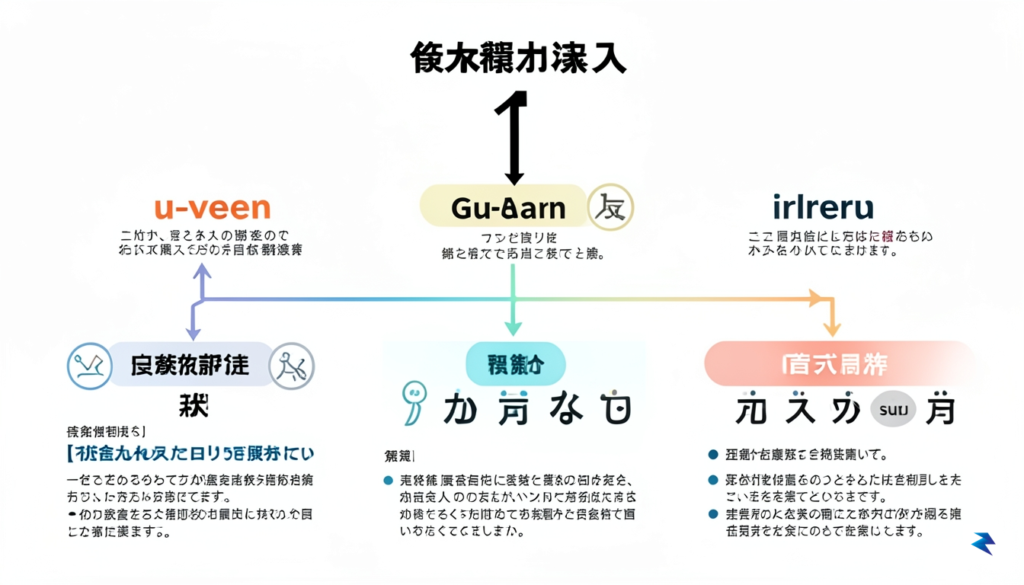
Godan verbs are the most numerous and, fortunately, the most predictable once you understand their phonetic patterns. To identify a verb as Group 1, look at the final character of the dictionary form: it will always end in an u-sound vowel (e.g., u, ku, su, tsu, nu, bu, mu, or ru). Unlike other groups, these verbs do not follow a singular, uniform conjugation path, but rather shift through the five vowel sounds—a, i, u, e, and o—to create various tenses. A helpful mnemonic is to remember that Godan verbs are “the ones that change their vowel,” acting as the versatile workhorses of the Japanese language.
Group 2: The Ichidan (One-Step) Verbs
Ichidan verbs are arguably the easiest to conjugate because they operate under a single, streamlined rule. To spot an Ichidan verb, look for dictionary forms ending in -iru or -eru. However, there is a small catch: the vowel immediately preceding the ru must belong to the i-column or the e-column of the kana chart. For example, taberu (to eat) ends in beru, making it an Ichidan verb. Because these verbs simply drop the final ru and attach the appropriate suffix, they are often referred to as “vowel-stem” verbs. If you remember that Ichidan means “one step,” you will always recall that conjugation here requires only one simple movement: removing the end and adding the new ending.
Group 3: The Irregular Verbs
While Japanese is famously logical, every language requires a few exceptions to the rule. In Japanese, there are only two primary irregular verbs that you must memorize by heart: suru (to do) and kuru (to come). These verbs do not follow the patterns of the other groups and instead change their internal structure entirely when conjugated. Because there are only two, they are easy to isolate; once you have identified these outliers, you can rest assured that every other verb in the language will fit neatly into the Godan or Ichidan categories. Consider these the “VIPs” of your vocabulary list—they don’t play by the standard rules, so they deserve a special spot in your long-term memory.
Key Takeaway: If a verb ends in
-iruor-eru, it is usually Ichidan. If it ends in any otheru-sound, it is almost certainly Godan. If it issuruorkuru, it is Irregular. When in doubt, check the dictionary form’s final kana character first.
The Logic Behind Inflection: Why It Isn't Just Memorization

Many learners approach Japanese verbs as a daunting mountain of rote memorization, fearing that every new tense requires a fresh entry in their mental dictionary. However, the secret to fluency lies in recognizing that Japanese is not a language of endless exceptions, but rather a language of precise, mathematical substitutions. At its core, conjugation functions like a modular engine: you have a stable base, known as the stem, and you simply snap different functional suffixes onto it to change the verb’s entire personality. Once you perceive the verb as a root plus an ending, the process stops being about brute-force memorization and starts being about structural logic.
The mechanics of this system rely heavily on the five-vowel foundation of the Japanese syllabary: a, i, u, e, and o. Every standard verb ends in a u-sound, which serves as the “dictionary form” or the plain present tense. To modify the verb, you are essentially sliding along these vowel rows to reach a specific stem. For instance, shifting the final kana from the u-column to the i-column often prepares the verb for polite endings or noun-like transformations, while moving to the a-column is the gateway for negative forms. This vowel-shifting isn’t random; it is a systematic map that dictates how the verb behaves in a sentence.
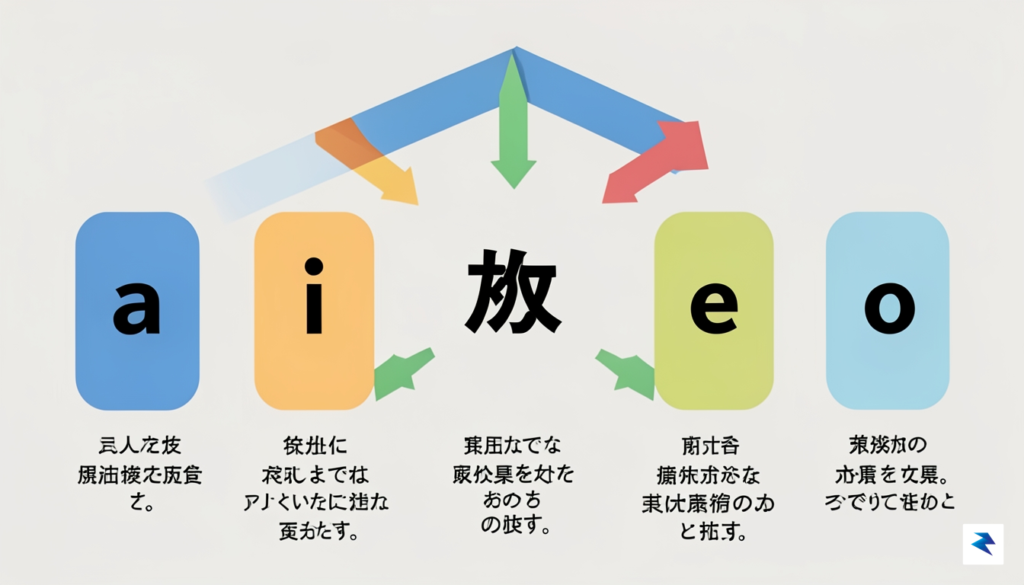
Consider the verb kaku (to write). By stripping away the final u and shifting the vowel sound, you unlock the entire functional range of the word. If you shift to the i-column, you arrive at kaki, which serves as the bridge for adding the polite suffix -masu. If you shift to the a-column, you arrive at kaka, which allows you to attach the negative suffix -nai. This process is strikingly similar to solving an equation: you identify the constant root (in this case, kak-) and apply the variable suffix required by your intent. Because this pattern remains consistent across the vast majority of verbs, you no longer need to learn “write,” “don’t write,” and “polite write” as three separate words. Instead, you learn one root and the rules for swapping the tail.
The genius of Japanese conjugation is that it transforms verbs into predictable building blocks. By mastering the movement between vowel columns, you cease to be a passive observer of grammar and become an active engineer of the language.
This logical framework extends even to the most complex tenses. Whether you are forming the causative, the passive, or the conditional, the underlying vowel-based “math” remains the same. By focusing on the stem-based nature of the language, you gain the ability to derive forms for verbs you have only just encountered. Rather than panicking when you see an unfamiliar word, you can analyze its ending, identify its vowel column, and confidently predict its conjugation. This shift in perspective turns the “simple hard way” of Japanese into a manageable, highly rewarding skill set that prioritizes understanding the system over memorizing the output.
Practical Strategies for Mastering Conjugation Patterns

The transition from understanding the rules of Japanese grammar to speaking with fluidity requires moving beyond static memorization. While flashcards are excellent for building vocabulary, they often fail to bridge the gap between recognizing a te-form and producing one under the pressure of a conversation. To truly master conjugation, you must force your brain to process these patterns in real-time. This is where active transformation exercises become your most valuable tool for shifting knowledge from passive recognition into an intuitive, reflexive skill.
The Power of Sentence Transformation
The most effective way to internalize verb endings is to adopt a cyclical transformation strategy. Rather than drilling individual words in isolation, select a simple, base sentence—such as “I eat an apple” (りんごを食べます)—and systematically rotate the verb through every conjugation pattern you have learned. By taking that single root and cycling it through the negative, past, past-negative, conditional, and volitional forms, you create a neural pathway that associates the verb’s root with its functional suffix automatically. This method prevents the “isolated word” trap, forcing you to maintain the grammatical context of the entire sentence while you manipulate the verb form.
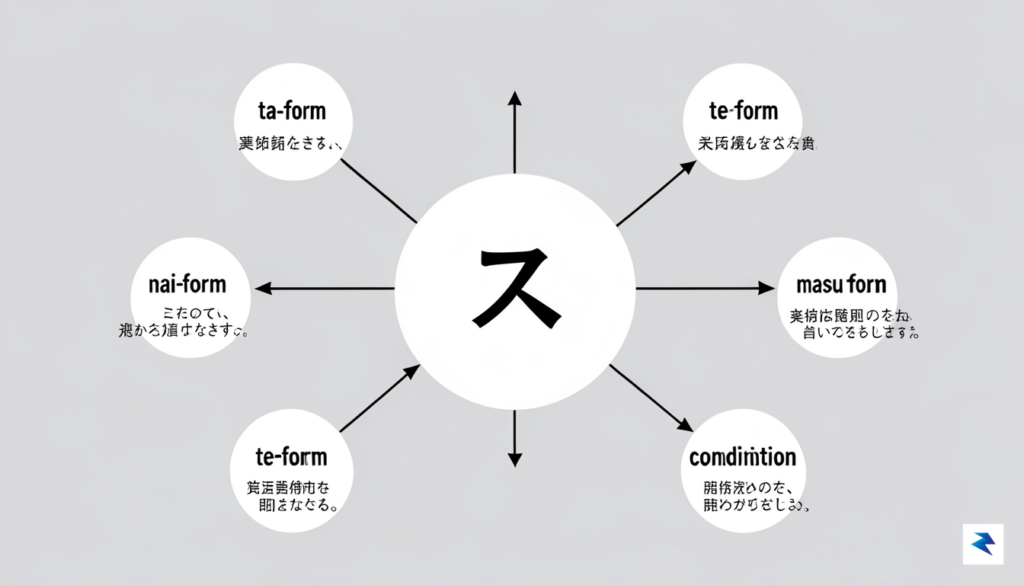
As you progress, try to increase the speed of these transformations until you can cycle through a verb’s entire paradigm without hesitation. If you find yourself pausing to “calculate” the ending, that is a sign that the pattern has not yet been internalized. By consistently practicing these transformations, you train your brain to stop viewing conjugations as complex puzzles to be solved and start seeing them as natural, interchangeable building blocks of your spoken vocabulary.
Rhythmic Chanting and Auditory Memory
In addition to active transformation, incorporating rhythmic chanting can significantly enhance your ability to recall verb endings. Japanese is a language built on consistent, melodic patterns, and many learners find that tapping into that rhythm helps the endings “stick” more effectively than reading them on a page. Try chanting conjugations in a consistent cadence, grouping verbs by their specific conjugation class—such as Godan or Ichidan—to highlight the sound shifts. When you vocalize the patterns, you engage your auditory memory, which acts as a secondary layer of reinforcement that helps you catch mistakes before they even leave your mouth.
Success in Japanese conjugation is not found in knowing the rules perfectly; it is found in the ability to produce the correct form without consciously thinking about the grammar.
Finally, pair these techniques with a personalized system of spaced repetition. Instead of just reviewing definitions, use your spaced repetition software (SRS) to test yourself on verb transformations. If you are prompted with a dictionary form and a specific target tense, you are actively practicing the retrieval process required for natural communication. By combining the rhythmic flow of chanting with the rigorous discipline of sentence transformation, you will eventually reach a point where the conjugation process happens in the background, leaving your conscious mind free to focus on the actual message you intend to convey.
Common Pitfalls and How to Overcome Them

Navigating the intricate landscape of Japanese verb conjugation can often feel like traversing a minefield, even for those who have spent considerable time studying the language. While the underlying rules provide a solid framework, specific ‘traps’ frequently snag learners, leading to frustration and common errors. These pitfalls typically stem from over-generalizing rules from one verb group to another, or from struggling to internalize the subtle nuances that differentiate similar-sounding forms, particularly in the realm of colloquial speech versus formal grammar. Overcoming these hurdles requires a combination of focused practice, an understanding of the underlying logic, and a keen ear for natural usage.
One of the most frequent stumbling blocks for learners is mastering the **Te-form** of verbs. This versatile form, crucial for connecting clauses, making requests, indicating ongoing actions, and much more, is notorious for its irregular sound changes, particularly among *u-verbs* (Group 1). Instead of a simple suffix addition, many *u-verbs* undergo specific phonetic shifts (e.g., *kaku* becomes *kaite*, *nomu* becomes *nonde*, *tsukau* becomes *tsukatte*). The temptation to simply append *~te* to every verb stem often leads to incorrect forms like *kakite* or *nomute*, which immediately betray a learner’s struggle. The pathway to mastery here lies in systematic exposure and practice, perhaps by grouping verbs with similar sound changes together, and dedicating time to rote memorization for high-frequency verbs until the patterns become intuitive.
Furthermore, distinguishing accurately between negative and past-negative forms can present a significant challenge. While *tabenai* (don’t eat) and *tabenakatta* (didn’t eat) seem straightforward in isolation, the complexity escalates when these forms are embedded in more elaborate sentences or when the nuance of potential forms comes into play. For instance, understanding the difference between *ikanai* (don’t go) and *ikanakatta* (didn’t go) is vital, but so is grasping the distinction when combined with other grammar, such as *tabenai de kudasai* (please don’t eat) versus *tabenakatta hou ga yokatta* (it would have been better if I hadn’t eaten). The key to overcoming this particular hurdle is to first solidify the foundation of the *nai* form and then systematically learn how the past-negative *nakatta* is derived directly from it, practicing the conjugation of verbs through all these tenses until they feel natural.
Ultimately, the most profound pitfall often lies in the chasm between textbook grammar and the organic flow of spoken Japanese. While textbooks meticulously outline the grammatical rules for each conjugation, they sometimes present forms that, though technically correct, might sound overly stiff or unnatural in everyday conversation. For example, while *taberu koto ga dekimasu* is a perfectly valid way to say “I can eat,” a native speaker might more naturally opt for the potential form *taberemasu* or *taberareru* depending on the specific nuance and context. Learning to discern which conjugation is “most natural” often transcends strict grammatical rules, instead requiring an understanding of social context, formality levels, and regional variations. The corrective pathway here involves extensive exposure to authentic Japanese through media, conversations, and immersion, training your ear to pick up on the subtle preferences of native speakers rather than solely relying on a literal translation of grammatical structures.
>
**Key Takeaway:** Mastering Japanese verb conjugation isn’t just about memorizing rules; it’s about internalizing patterns, understanding subtle nuances, and developing an ear for natural usage that goes beyond strict textbook definitions. Embrace mistakes as stepping stones to deeper comprehension.
Integrating Conjugation into Natural Conversation

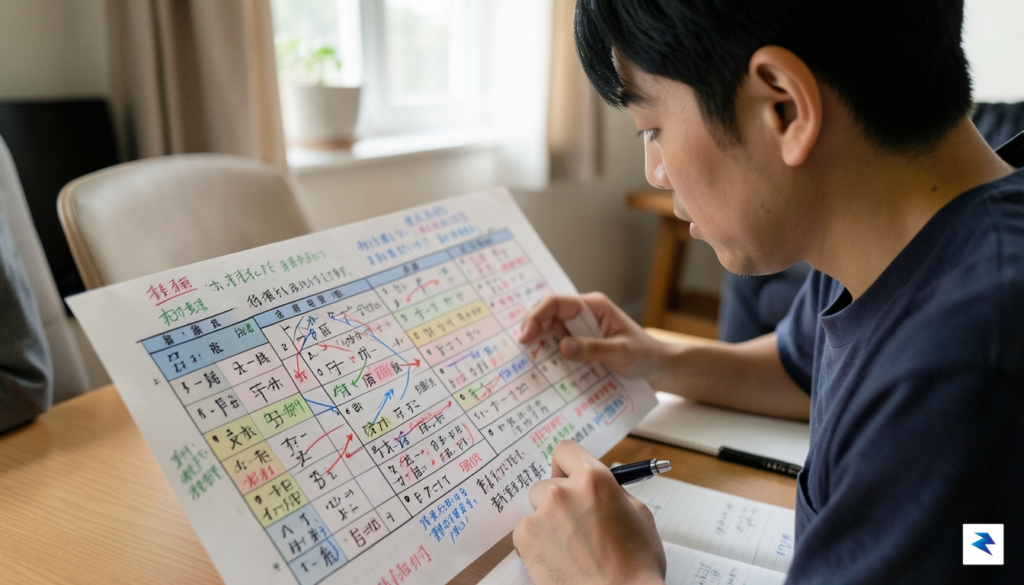
Treating Japanese grammar as a rigid academic exercise often leads to the dreaded “analysis paralysis,” where you know the rules on paper but freeze when it comes time to speak. To truly master verb conjugation, you must shift your mindset from studying grammar as a subject to viewing it as a tool for expression. Think of conjugation patterns as the skeleton of your language ability; while the skeleton provides the necessary structure, it is only through the fluid motion of conversation that your language truly comes to life. By adopting an “output-first” approach, you force your brain to move past rote memorization and toward the immediate, intuitive application of verbs in real-time scenarios.
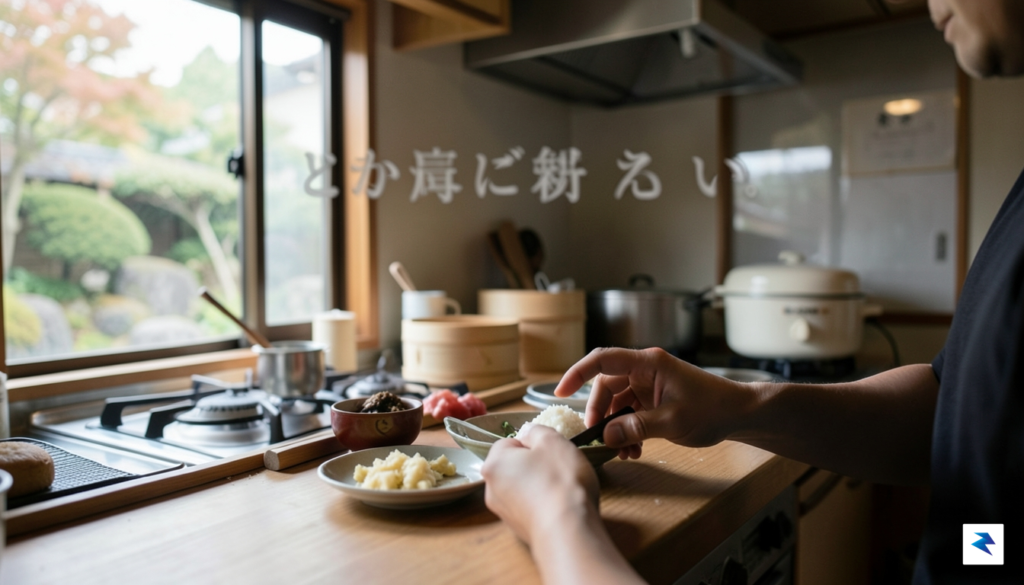
One of the most effective ways to bridge this gap is to adopt the practice of narrating your daily life in your head. As you go about your morning routine—making coffee, commuting to work, or opening your laptop—try to describe your actions using the conjugations you are currently studying. If you are practicing the te-form, narrate the sequence: “I am waking up (okite), I am brewing coffee (koohii o irete), and I am heading out (dekakete).” By continuously narrating your own reality, you create a personal feedback loop that anchors these complex grammatical patterns to physical actions and concrete memories. This turns mundane moments into high-leverage practice sessions where you are forced to retrieve the correct verb forms without the safety net of a textbook.
Furthermore, you must leverage active listening as the primary method for confirming that your internal conjugation patterns are actually correct. Textbooks provide the logic, but native speakers provide the living context. When you watch Japanese media or engage in conversation, pay close attention to the rhythm and flow of verbs. Do not just listen to the words; listen to the shape of the verbs. Notice how a speaker transitions from a base form to a conditional or a potential form, and ask yourself why that specific choice was made. When you hear a pattern repeatedly, it stops being a grammatical rule you have to calculate and starts becoming a sound you instinctively expect to hear.
The goal of conjugation is not to pass an exam, but to communicate your thoughts with precision and confidence in the heat of the moment.
Ultimately, your ability to speak Japanese naturally depends on your willingness to embrace the messiness of live conversation. It is perfectly normal for your speech to be imperfect while you are building this muscle memory. By integrating these conjugations into your internal monologue and using real-world interactions as your final arbiter of truth, you will eventually find that you no longer need to translate back and forth in your head. You will reach a point where the language simply flows, transforming from a collection of abstract rules into a natural, intuitive medium for your own thoughts and personality.