The Evolution of AI in Scientific Discovery
For the past several years, the narrative surrounding artificial intelligence has been dominated by the spectacle of language fluency. We have marveled as models learned to mimic human prose, draft emails, and engage in casual conversation. However, the novelty of these “linguistic curiosities” is rapidly fading, giving way to a more pragmatic era where the true value of AI lies in its ability to contribute to rigorous scientific inquiry. Scientists are increasingly realizing that a chatbot, no matter how eloquent, is ill-equipped to navigate the high-stakes, data-intensive landscapes of biology, chemistry, and physics. The transition currently underway marks a departure from general-purpose assistants toward specialized, domain-aware environments designed to solve complex, real-world problems.
The limitation of the “chat-first” paradigm becomes glaringly apparent when researchers attempt to apply generic models to laboratory workflows. A general-purpose AI may excel at summarizing a news article, but it often falters when tasked with analyzing multi-dimensional experimental data or synthesizing obscure scientific literature without succumbing to the pitfalls of hallucination. In fields where precision is non-negotiable, the margin for error offered by standard chatbots is simply too wide. Researchers require tools that do not merely “talk” about science but actively participate in the scientific method by maintaining context, validating references, and integrating seamlessly into existing technical pipelines.
The next generation of scientific AI is defined not by how well it can mimic human conversation, but by how effectively it can reduce the friction between raw data and actionable discovery.
This evolution represents a strategic pivot in how we conceive of AI utility. Instead of chasing ever-larger language models that boast broader general knowledge, industry leaders like Anthropic are increasingly focusing on the workflow. By building environments that prioritize the procedural needs of the scientist—such as automated literature review, hypothesis generation, and computational analysis—these tools act as force multipliers for human intellect. This shift toward functional utility signals that the AI industry is moving beyond the hype cycle of generative text. We are entering a phase where the most successful AI tools will be those that can be reliably embedded into the daily, methodical routines of researchers, turning the computer from a simple interface into a collaborative, evidence-based research partner.
Beyond the Chatbot: Why Workflow Integration Matters
For most scientists, the modern digital landscape is less of a laboratory and more of a digital labyrinth. While the sheer intelligence of large language models has reached unprecedented heights, the daily reality for a researcher remains defined by a fragmented ecosystem of disparate databases, clunky coding environments, and isolated visualization tools. This creates what researchers often call the “context-switching tax”—a hidden, compounding drain on cognitive energy where the time spent moving data from a PDF to a spreadsheet, or translating a result from a Python script back into a collaborative document, slowly erodes the momentum of deep, analytical thought.
When a scientist has to toggle between four different applications to verify a single hypothesis, they are not just losing minutes; they are losing the “flow state” that is essential for high-level creative problem-solving. This constant mental fragmentation forces the brain to reset its focus, turning what should be a continuous stream of discovery into a series of disjointed, administrative hurdles. In this context, simply adding a “smarter” AI model to the mix is insufficient. If the model is an engine, the scientist still needs a functional, integrated vehicle to actually drive the research forward.
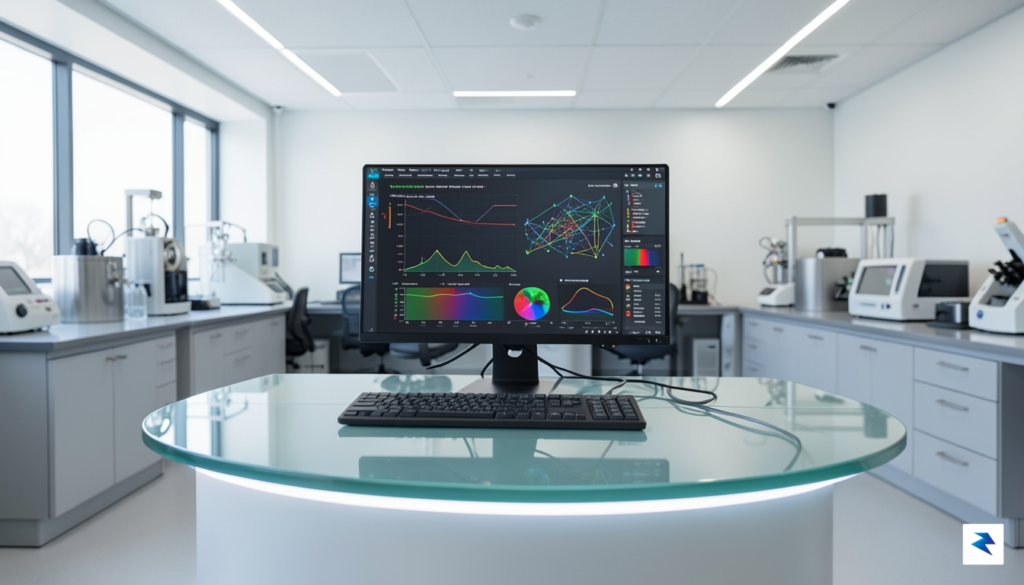
This is precisely why shifting the focus from individual models to integrated workbenches represents such a significant pivot in scientific computing. A workbench approach treats the AI not as a chatbot that resides in a browser tab, but as an invisible, persistent layer that manages the movement of information across the entire research stack. By embedding the AI directly into the environment where the actual work happens—the coding IDE, the data repository, and the document editor—the friction of manual data transfer is effectively eliminated.
The true multiplier for scientific output is not found in the raw parameter count of an algorithm, but in the seamlessness of the environment in which that algorithm operates.
By prioritizing workflow integration, platforms like Claude Science aim to transform the AI from a mere assistant into a cohesive research environment. This approach recognizes that the bottleneck to discovery is rarely a lack of information, but rather the structural inability to synthesize that information efficiently. When the tools of analysis are unified, researchers can spend less time acting as manual conduits for their data and more time iterating on the hypotheses that actually move the needle. Ultimately, this workflow-centric model shifts the burden of orchestration from the scientist back to the system, reclaiming the mental bandwidth required for genuine breakthrough innovation.
How Claude Science Centralizes Computational Research

At its core, Claude Science represents a fundamental shift in how computational research is conducted by treating the scientific process as a continuous, unified flow rather than a fragmented series of isolated tasks. Traditionally, researchers have been forced to bounce between disjointed environments—moving data from spreadsheets to Python notebooks, then exporting those results into visualization software, only to find that a tweak in the initial parameters requires repeating the entire manual cycle. Claude Science eliminates this friction by serving as an all-in-one workbench that integrates data processing, pipeline execution, and predictive analysis directly into the model’s environment.
The architectural genius of this platform lies in its ability to maintain context across the entire research lifecycle. Instead of merely acting as a chatbot that provides static answers, Claude Science functions as an active participant that can orchestrate complex computational workflows. By embedding data analysis tools directly within the interface, the platform allows researchers to execute code, manipulate large datasets, and generate visual representations without ever needing to export sensitive information to third-party applications. This “in-place” execution model not only accelerates the pace of discovery but also drastically reduces the risk of data corruption or human error that often occurs during manual file transfers.
Furthermore, the platform is engineered to handle the iterative nature of scientific inquiry with high precision. When a researcher tests a hypothesis, the system tracks the lineage of the data and the logic applied to it, ensuring that every step is reproducible and transparent. Because the environment supports the execution of complex scripts, scientists can iterate on their models in real-time, receiving immediate feedback on how changes in variables influence their projections. This creates a feedback loop where the model acts as both a computational engine and a collaborative partner, allowing for rapid hypothesis refinement that would otherwise take hours or days to validate in a disconnected technical environment.
The true value of Claude Science is not just in the intelligence of the underlying model, but in its capacity to act as a persistent, stateful workspace that understands the scientific method as an evolving narrative.
Ultimately, this approach prioritizes the continuity of the researcher’s train of thought. By removing the technical barriers that often distract scientists from the actual work of exploration, the platform empowers users to stay in a “flow state,” where they can focus on interpreting data and formulating conclusions rather than managing the overhead of software interoperability. By centralizing these computational tools, Anthropic is essentially building a digital laboratory that scales with the complexity of modern science, ensuring that the transition from a raw data set to a finalized scientific insight is as seamless and fluid as possible.
Breaking Down Data Silos in Modern Laboratories
In the contemporary scientific landscape, the greatest barrier to innovation is often not a lack of data, but the inability to access and harmonize it. Scientific research frequently suffers from the fragmentation of information across legacy software, disconnected electronic lab notebooks, and disparate cloud storage solutions. These data silos act as formidable walls, preventing researchers from cross-referencing findings or identifying patterns that span across multi-year studies. When critical insights remain locked in siloed repositories, the pace of discovery grinds to a halt, forcing scientists to spend more time performing manual data retrieval and cleaning than conducting actual hypothesis testing.
The introduction of a centralized AI-driven workflow serves as a crucial bridge, effectively dismantling these structural barriers by standardizing how data is accessed, cleaned, and interpreted. By routing information from diverse sources into a unified workbench, researchers can finally achieve a holistic view of their experimental landscape. This consolidation does more than just save time; it fundamentally changes the nature of laboratory collaboration. With a single source of truth, teams can share data seamlessly, ensuring that every member—from the principal investigator to the junior analyst—is working with the same current, validated parameters. This environment fosters a culture of transparency where insights are no longer sequestered by department or project.
The most dangerous phrase in science is not “Eureka!” but “I can’t seem to find the raw data for that experiment.” A unified AI platform transforms disorganized archives into a living, searchable foundation for future breakthroughs.
Furthermore, this centralized approach addresses one of the most pressing crises in modern science: the challenge of reproducibility. When data is scattered and fragmented, the provenance of a specific result—the “who, what, and how” behind a discovery—is notoriously difficult to verify. A unified AI platform enforces rigorous standardization, automatically logging the lineage of data from initial capture to final analysis. This inherent auditability ensures that experiments can be traced back to their origins with precision, making it significantly easier to replicate results and validate findings before they reach the publication stage.
By streamlining the underlying data architecture, these AI-enhanced workflows allow researchers to shift their focus back toward the scientific method itself. Instead of troubleshooting software compatibility or reconciling inconsistent formatting, scientists can leverage the AI to detect anomalies or suggest correlations that might have been invisible to the human eye. Ultimately, the move toward centralized, AI-integrated workflows is not merely about technological efficiency; it is about raising the standard of scientific rigor. As labs adopt these unified systems, the entire community moves closer to a future where discovery is limited only by the quality of our questions, rather than the state of our databases.
The Future of AI-Driven Scientific Collaboration
The true promise of platforms like Claude Science lies not in replacing the intellect of the researcher, but in liberating it from the relentless drag of administrative and computational “plumbing.” For decades, the scientific process has been bogged down by the friction of data cleaning, environment configuration, and the tedious management of fragmented digital tools. By automating these foundational tasks, AI-driven workflows allow the modern scientist to return to their most vital role: that of a thinker, a dreamer, and a strategist. When researchers are freed from the technical overhead of running a simulation or organizing a multi-terabyte dataset, they can dedicate their cognitive energy to the nuance of hypothesis generation, the elegance of experimental design, and the profound interpretation of complex phenomena that machines alone cannot grasp.
Looking ahead, the widespread adoption of standardized AI workbenches will likely trigger a seismic shift in how scientific institutions operate and compete. As the barriers to entry for complex computational research lower, we can anticipate a transformation in institutional funding models, where the focus moves away from maintaining massive, siloed IT infrastructures toward supporting interdisciplinary collaboration. This shift will inevitably reshape research training, as future generations of scientists will need to be as fluent in human-AI interaction as they are in their respective technical disciplines. Furthermore, these standardized platforms promise to flatten the geography of discovery; when powerful, cloud-integrated workflows become the baseline, international collaboration will no longer be hampered by disparate computational capabilities, allowing researchers from vastly different regions to co-author breakthroughs on a shared, equitable digital foundation.
The future of science is not a race between humans and machines, but a synergistic partnership where artificial intelligence acts as the ultimate research collaborator, handling the complexity so that humanity can focus on the discovery.
Ultimately, the path forward is defined by a redefined partnership between human curiosity and algorithmic scale. While the AI handles the iterative heavy lifting and pattern recognition at speeds previously unimaginable, the human element—rooted in ethics, creative intuition, and the ability to ask the right questions—remains the driving force of innovation. As these tools become more deeply embedded in the research lifecycle, the pace of scientific discovery will likely accelerate, turning months of manual labor into hours of insight. By narrowing the gap between a breakthrough idea and its validation, we are not just making science faster; we are making the pursuit of knowledge more accessible, more collaborative, and profoundly more capable of solving the defining challenges of our time.