
US Traders Funnel $571 Million into Polymarket Despite Strict Bans
The Rise of Polymarket in the American Political Landscape In recent election cycles, the traditional landscape of political forecasting has…


The fundamental mechanics of wireless power transfer using microwaves commence with a crucial transformation: converting conventional electrical energy into a form that can travel efficiently through space. This journey begins by taking direct current (DC) electricity, much like what powers our household electronics from a battery or a wall adapter, and feeding it into specialized electronic devices. These advanced components, often high-power solid-state amplifiers, klystrons, or magnetrons, are meticulously engineered to convert DC into high-frequency alternating current, thereby generating electromagnetic waves specifically within the microwave spectrum. The paramount goal here is not merely to generate energy, but to do so in an exquisitely controlled and coherent manner, ensuring that the generated waves are perfectly aligned in phase and frequency, creating a unified wavefront ideally suited for efficient and directional transmission across significant distances. This initial conversion step sets the stage for the subsequent journey of power through the air, laying the groundwork for spatial energy delivery.
Once converted into coherent microwave energy, this power is then channeled into a highly sophisticated transmission system, typically centered around what is known as a “phased-array antenna.” Unlike a traditional parabolic dish that broadcasts energy in a relatively wide cone, a phased array comprises numerous individual antenna elements, each capable of independently emitting microwave energy. The true innovation lies in the technique of “beamforming,” where engineers precisely control the timing, or phase, of the microwave signals emitted from each of these individual elements. By meticulously adjusting these phases, the emitted waves can be made to constructively interfere in a specific direction, effectively focusing the microwave energy into an incredibly tight, highly directional beam. This unparalleled precision in focusing is absolutely critical for minimizing energy loss over vast distances and ensuring that the transmitted power reaches its intended receiver, known as a rectenna, with maximal efficiency, much like a laser focuses light rather than scattering it in all directions.
The deliberate choice of microwave frequencies for this ambitious endeavor is a cornerstone of its feasibility, stemming from a deep understanding of atmospheric physics. Microwaves, which occupy a strategic segment of the electromagnetic spectrum generally ranging from 300 MHz to 300 GHz, possess a unique set of characteristics that make them ideal for long-range power transmission. Their wavelength is short enough to allow for the precise beamforming capabilities achieved by phased arrays, even with antenna sizes that are practical for large-scale deployment. Crucially, these frequencies are also long enough to largely circumvent significant atmospheric absorption and scattering, which plague other parts of the spectrum. Unlike visible light, for instance, which readily scatters off atmospheric particles like water vapor, dust, and aerosols, or lower radio frequencies that can be reflected or absorbed by the ionosphere, microwaves can penetrate the Earth’s atmosphere and even the vacuum of space with remarkable efficiency. This inherent property dramatically minimizes energy loss during transit, ensuring that a substantial portion of the transmitted power reliably reaches the receiving rectenna, whether it’s powering a remote terrestrial installation or even beaming energy from a space-based solar power satellite. This judicious selection of frequency is not just an engineering preference; it is a fundamental enabler that transforms the theoretical concept of wireless power into a viable and tangible engineering challenge.
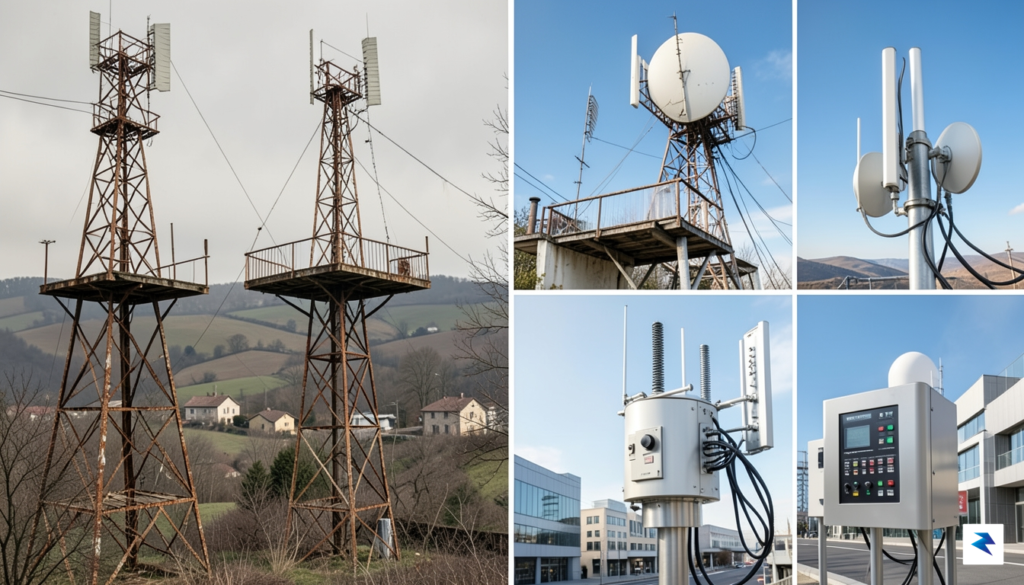
The profound idea of transmitting electricity without the need for physical wires is far from a new concept, harkening back to the turn of the 20th century and the audacious vision of Nikola Tesla. His ambitious Wardenclyffe Tower, erected on Long Island, stood as a monumental testament to his dream of a global system for broadcasting power and information wirelessly. While a truly revolutionary concept for its time, Wardenclyffe ultimately failed, not only due to financial constraints but also because the underlying technology and the understanding of efficient, long-distance power transmission via electromagnetism were simply not mature enough to realize Tesla’s grand design.
Decades later, during the mid-20th century, the concept resurfaced, albeit in a different guise, fueled by advancements in microwave technology developed primarily for radar and communications during the Cold War. Scientists began to experiment with using microwave beams to transmit power, often envisioning scenarios like powering remote outposts or even satellites. Early experiments, such as those conducted in the 1970s, successfully demonstrated the basic principles of converting microwave energy back into usable electricity using devices called rectennas (rectifying antennas). However, these pioneering efforts faced significant hurdles, including substantial power loss over distance, the bulky nature of the transmitting and receiving equipment, and relatively low conversion efficiencies, keeping the idea firmly rooted in the realm of theoretical possibility rather than practical application.
The true inflection point, moving this ambitious concept from speculative theory to tangible experimental reality, has arrived only in recent years, primarily through a confluence of breakthroughs in material science, advanced semiconductor technology, and sophisticated digital signal processing. These modern innovations have systematically addressed the historical limitations that plagued earlier attempts, making the dream of ubiquitous wireless power an increasingly attainable goal.
At the heart of this modern renaissance are advanced semiconductor materials, particularly Gallium Nitride (GaN) transistors. Unlike their traditional silicon counterparts, GaN devices can operate at much higher frequencies and temperatures, handle significantly greater power densities, and switch electrical currents far more rapidly and efficiently. This leap in performance allows engineers to design vastly smaller, more efficient, and more powerful microwave emitters and receivers. Furthermore, the ability of GaN technology to manage high frequencies means that microwave beams can be generated and controlled with extraordinary precision, enabling tighter focus and reducing energy dispersion over distance, a critical factor for boosting transmission efficiency.
Coupled with these hardware advancements, sophisticated signal processing algorithms now allow for dynamic beam steering and adaptive power control. This means that microwave power can be precisely directed and modulated, ensuring that energy is delivered only where and when it’s needed, minimizing waste and enhancing safety. These combined innovations have finally moved wireless power transmission via microwaves from the pages of science fiction into serious experimental reality, with prototypes now demonstrating the capability to transmit substantial power levels over meaningful distances, paving the way for applications that were once considered impossible.


The transition from theoretical physics to a functional wireless power grid hinges on the complex architecture of the rectenna, or rectifying antenna. Unlike a standard antenna designed merely to receive signals, a rectenna must perform a sophisticated double duty: capturing electromagnetic waves at high frequencies and immediately converting them into usable direct current (DC). This conversion process relies on specialized semiconductor diodes that must flip between states millions of times per second. Achieving high conversion efficiency remains a formidable engineering hurdle; any energy lost during this transformation—typically dissipated as heat—represents a direct reduction in the system’s economic and environmental viability. Currently, engineers are struggling to optimize these materials to handle high power densities without suffering from thermal degradation or impedance mismatches.

Beyond the challenges of the receiver, the physics of wave propagation imposes strict limitations on how we get energy from point A to point B. Even with highly sophisticated phased-array transmitters, microwave beams are subject to the inexorable law of diffraction. As a beam travels over long distances, it naturally diverges, spreading its energy over an increasingly wide area. To maintain high power density at the receiving end, the transmitter must employ extremely precise beamforming techniques to keep the energy tightly focused. If the beam spreads too significantly, the rectenna array—regardless of its individual efficiency—will capture only a fraction of the total emitted power, leading to massive transmission losses that render the system inefficient for utility-scale deployment.
The core engineering challenge is not just transmission, but the maintenance of power density over kilometers of atmosphere. Without near-perfect beam collimation, the energy dissipates long before it ever touches the ground.
Furthermore, the environmental interaction between the microwave beam and the atmosphere cannot be overlooked. Atmospheric moisture, rain, and even air density fluctuations can scatter or absorb microwave energy, necessitating advanced real-time calibration systems. These systems must be capable of adjusting the phase and amplitude of individual antenna elements in the transmitter array to compensate for atmospheric turbulence instantly. By continuously monitoring the feedback loop between the receiver and the transmitter, engineers hope to lock the beam onto the rectenna with surgical precision. Successfully mastering these variables is the only way to ensure that wireless power can compete with the reliability and low costs of our traditional, wired electrical infrastructure.

The prospect of beaming megawatts of electricity through the air naturally invites scrutiny regarding the safety of the invisible conduits powering our future. At the heart of these concerns lies the physics of non-ionizing radiation. Unlike ionizing radiation, which carries enough energy to strip electrons from atoms and damage biological DNA, the microwave frequencies utilized for power transmission interact with matter primarily through thermal excitation. Regulatory bodies, such as the International Commission on Non-Ionizing Radiation Protection (ICNIRP), have established rigorous safety standards that dictate maximum permissible exposure levels. By operating well below these thresholds, engineers can ensure that the ambient electromagnetic field remains no more intrusive than the background signals generated by modern telecommunications infrastructure.
Central to managing these risks is the precise control of power density—a measurement of how much energy is concentrated within a specific cross-sectional area. In a wireless power system, the beam is tightly focused from a transmitter to a dedicated rectifying antenna, or “rectenna.” Because the energy is delivered in a highly collimated path, the power density outside the immediate transmission corridor remains negligible. Engineers utilize phased-array technology to maintain this focus, ensuring that the beam does not “bloom” or dissipate into hazardous levels in the surrounding atmosphere. Furthermore, the atmosphere itself absorbs very little of this energy, minimizing concerns about unintended atmospheric heating or weather pattern disruption.
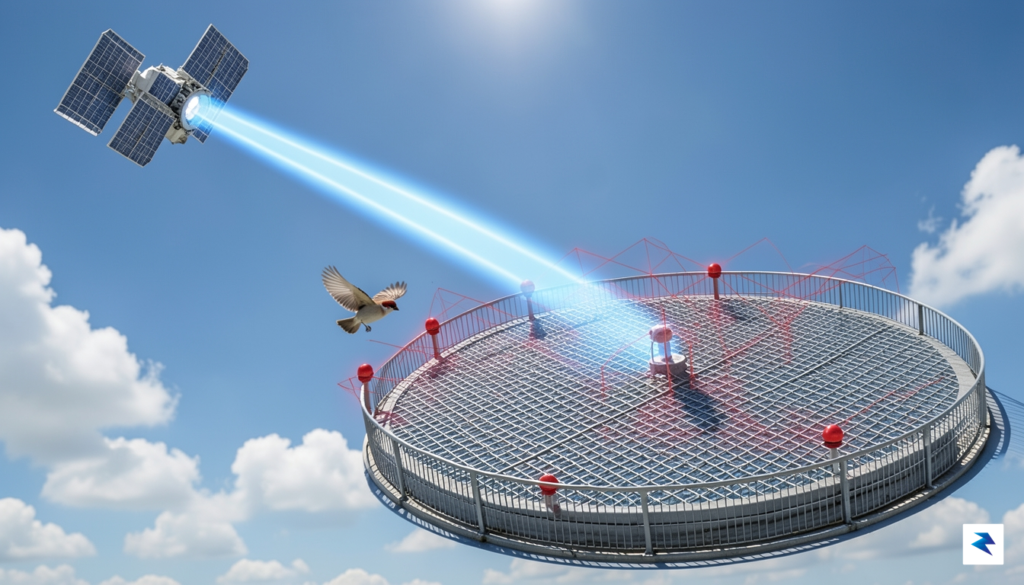
Rigorous safety is built into the architecture: the system is designed to be “fail-safe” by nature, meaning any disruption in the connection causes an instantaneous cessation of the energy flow.
Beyond human safety, the ecological impact—specifically the potential interaction with local fauna—is a critical area of ongoing research. To mitigate the risk of birds or other wildlife flying through the beam, developers are implementing sophisticated “keep-out” zones equipped with rapid-response sensors. These automatic shut-off systems function in milliseconds; if a foreign object, such as a bird or a drone, breaks the path of the beam, the transmitter immediately de-energizes or steers the beam away from the obstruction. This capability ensures that the ecological footprint remains minimal, allowing for a harmonious integration of high-capacity wireless power into natural environments.
Ultimately, the transition to microwave power transmission is not merely a technical challenge but a commitment to responsible engineering. By adhering to international safety protocols, maintaining strict control over power density, and prioritizing autonomous safety mechanisms, the industry aims to neutralize the fear of the unknown. As we move closer to large-scale deployment, transparent data sharing and continued environmental monitoring will remain essential to proving that high-voltage wireless energy can be as safe as the wired grid we rely on today.

The transition toward a wireless power architecture promises to do for electricity what Wi-Fi did for data: liberate devices from the tether of physical infrastructure. As our reliance on autonomous systems grows—ranging from fleets of warehouse robots and precision agricultural drones to persistent environmental sensor networks—the logistical burden of manual battery charging becomes a significant bottleneck. Microwave power transmission offers a transformative solution, enabling these machines to operate indefinitely by drawing energy directly from targeted beams. By eliminating the downtime associated with docking stations or battery swaps, we can unlock a new era of 24/7 operational efficiency across industrial and scientific sectors.

Beyond terrestrial applications, this technology serves as the critical linchpin for space-based solar power (SBSP). Harvesting solar energy in orbit, where the sun shines continuously without interference from clouds or night cycles, is a long-held dream of energy engineers. Microwave transmission provides the missing link, allowing us to beam vast quantities of clean, carbon-free energy down to rectifying antennas—or “rectennas”—on Earth. This could revolutionize the energy landscape, providing base-load power to isolated communities or disaster-stricken regions where traditional grid infrastructure has failed or was never established in the first place.
Wireless power transmission is not merely an incremental improvement in charging technology; it is a fundamental shift in how we conceive of energy distribution, moving from a rigid, wire-dependent model to a flexible, broadcast-based ecosystem.
The timeline for this integration will likely unfold in phases, beginning with specialized, high-value industrial and military applications where the cost of wireless deployment is justified by the mission criticality. Within the next decade, we can expect to see pilot programs for drone charging “highways” that allow aerial vehicles to traverse long distances without landing. Following these niche deployments, the regulatory and safety frameworks for high-frequency energy beaming will mature, paving the way for wider infrastructure integration. As the technology scales, the socio-economic implications are profound; by democratizing access to energy in remote locations, we can effectively bypass the need for expensive, centralized power plant construction in developing regions. Ultimately, the successful deployment of microwave-based power could bridge the global energy divide, fostering economic growth and environmental sustainability on a scale previously thought impossible.
You must be logged in to post a comment.