
SpaceX Joins the Nasdaq 100: Why History Warns Investors to Tread Carefully
The Nasdaq 100 Milestone: SpaceX Joins the Elite The landscape of elite technology and innovation indices has welcomed a new, groundbreaking…


In the relentless pursuit of building ever more sophisticated and intelligent AI models, a foundational truth often gets overshadowed: the ultimate quality of a model’s output is rigorously bounded by the quality of its input data. The vast, dynamic, and often chaotic expanse of the web serves as an unparalleled reservoir of information, yet it is also a minefield of noise. Websites are cluttered with ephemeral elements like advertisements, omnipresent navigation menus, intrusive sidebars, and legal disclaimers, all of which are extraneous to the core content a user truly seeks. When this raw, unfiltered web data is fed directly into large language models (LLMs) and Retrieval Augmented Generation (RAG) systems, it invariably leads to a classic “garbage in, garbage out” scenario, fundamentally undermining the promise of advanced AI.
This deluge of irrelevant information has profound implications, particularly for the performance and cost-efficiency of LLMs. Every character of input data consumes valuable tokens within the model’s context window, which is a finite and often expensive resource. When a significant portion of these tokens is wasted on parsing and processing advertisements or footer links rather than genuine, insightful content, it dramatically dilutes the model’s ability to grasp the true essence of a query. Consequently, the LLM struggles to generate intelligent, coherent, and relevant responses, leading to a noticeable degradation in its overall utility and a substantial increase in operational costs due to inefficient token usage.
Perhaps the most insidious consequence of feeding noisy data into LLMs is the increased propensity for hallucinations. These models, in their attempt to construct a coherent answer, can inadvertently incorporate or “learn” from the peripheral, often misleading, elements present in the training data. For RAG pipelines, which are designed to retrieve specific, relevant documents to inform an LLM’s response, this problem is acutely felt. If the retrieval mechanism pulls in entire web pages laden with ads and navigational junk, the LLM can easily become confused, misinterpreting these extraneous details as part of the primary information, thereby generating factually incorrect or nonsensical outputs that erode user trust and model reliability.
Consider a practical example that recently surfaced from the developer community: the frustrating experience of asking an AI assistant a question, only to have its response inadvertently tainted by “Gemini on Pixel” advertisements. This real-world scenario perfectly illustrates how even advanced RAG pipelines, when fed raw HTML, struggle to differentiate between the core content intended to answer a query and the surrounding commercial or structural noise. The AI, instead of providing a pristine, focused answer, might weave in references to unrelated product promotions, demonstrating a clear failure in discerning signal from noise. Such incidents highlight a critical vulnerability in current web data processing methodologies, proving that basic HTML parsing is simply not enough for the discerning needs of modern AI.
The inherent complexity and variability of web page structures demand a more sophisticated approach than conventional text extraction methods. Relying on simple parsers to strip HTML tags often leaves behind a significant amount of clutter, as they lack the semantic understanding to distinguish between legitimate content and surrounding cruft. There is an undeniable and urgent need for specialized preprocessing tools that can intelligently identify, filter, and extract only the truly meaningful content from web pages. By focusing on robust content extraction that understands the layout and intent of web elements, we can significantly enhance the quality of data provided to LLMs, thereby unlocking their full potential for accurate, intelligent, and cost-effective performance, ultimately delivering a superior user experience.
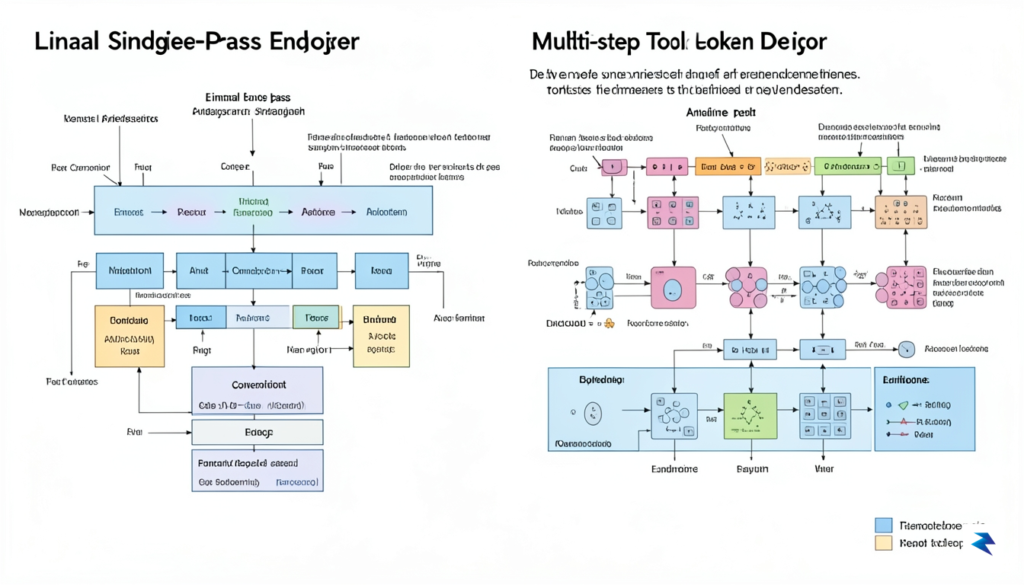
Web data extraction has long presented a unique set of computational challenges, often compounded by the sheer volume and varied structure of the internet. Traditionally, many sophisticated approaches for parsing and cleaning web content have gravitated towards large language models, particularly those built on a decoder-only architecture. These models, familiar from their prowess in generative AI applications like chatbots and content creation, operate by predicting the next “token” in a sequence. They incrementally build up the desired output—be it coherent text, code, or structured data—one piece at a time, based on the context they’ve generated so far.
While remarkably powerful for creative and complex generation tasks, this token-by-token generation process inherently carries significant computational overhead when applied to the sprawling, often messy, structure of HTML documents. The fundamental limitation of decoder-only models in this context stems from their “memory-bound” nature. Each subsequent token generation requires constant access to the entire preceding context, which translates into frequent and extensive data transfers between the GPU’s processing units and its high-speed memory banks. This continuous back-and-forth, fetching and storing large tensors representing the model’s internal state and the growing output sequence, often saturates the GPU’s memory bandwidth. Consequently, even the most powerful GPUs can spend more time waiting for data than actually computing, leading to substantial bottlenecks and significantly slower processing times, especially for long or intricate web pages.
Pulpie introduces a refreshing and impactful paradigm shift, moving decisively away from this generative, token-by-token approach to embrace an encoder-based architecture specifically tailored for web content extraction. Unlike decoders, which are primarily tasked with generating new content, encoders excel at understanding, classifying, and extracting features from existing input. This fundamental difference allows Pulpie to process an entire HTML document in a single, highly efficient forward pass, rather than laboriously building an output sequence incrementally. Crucially, the model doesn’t generate “cleaned” HTML; instead, it directly *labels* the existing HTML elements with their semantic roles.
At its core, Pulpie’s encoder operates as a sophisticated block-labeler. It ingests the raw, often verbose HTML structure and, in one comprehensive pass, assigns specific labels to different sections or “blocks” of the document. This means the model can instantly and accurately distinguish between crucial core content—such as an article’s main body text, a product description, or a news headline—and extraneous boilerplate elements like navigation menus, intrusive sidebars, advertisements, or page footers. By classifying each HTML element or a logical chunk of elements as either “relevant” or “boilerplate,” the model effectively prunes the noise, leaving only the valuable data behind. This direct, discriminative labeling mechanism is vastly more efficient and less resource-intensive than attempting to regenerate the core content from scratch while simultaneously trying to filter out the irrelevant parts.
The computational efficiency gains derived from this architectural shift are substantial, particularly concerning the critical metric of GPU memory bandwidth. Encoder-based models, especially when performing classification or labeling tasks, typically exhibit a much lower memory footprint during inference compared to their generative counterparts. They do not need to maintain and constantly update a large, growing output sequence state in memory. Instead, they perform a single, focused forward pass, processing the entire input and producing a set of labels, which involves significantly less data movement and fewer memory access operations. This reduction in memory bandwidth saturation directly translates to markedly faster processing speeds and the ability to handle a greater number of web pages concurrently on the same hardware, thereby drastically shifting the computational bottleneck from memory access to actual processing power.
This fundamental re-engineering of the web data extraction process represents a significant leap forward for efficient web data cleaning and organization. By intelligently leveraging the inherent strengths of encoder models, Pulpie bypasses the traditional limitations associated with generative approaches, offering a more robust, scalable, and environmentally
Cost efficiency often lurks as the silent killer of even the most innovative AI projects, especially those requiring massive data ingestion like large-scale web scraping. While the allure of advanced models is strong, the underlying infrastructure costs for extracting and cleaning vast amounts of web data can quickly escalate, turning promising initiatives into unsustainable drains on resources. This challenge becomes particularly acute when aiming for high-quality, precise data extraction, where traditional methods demand significant computational horsepower, directly impacting a project’s long-term viability and scalability.
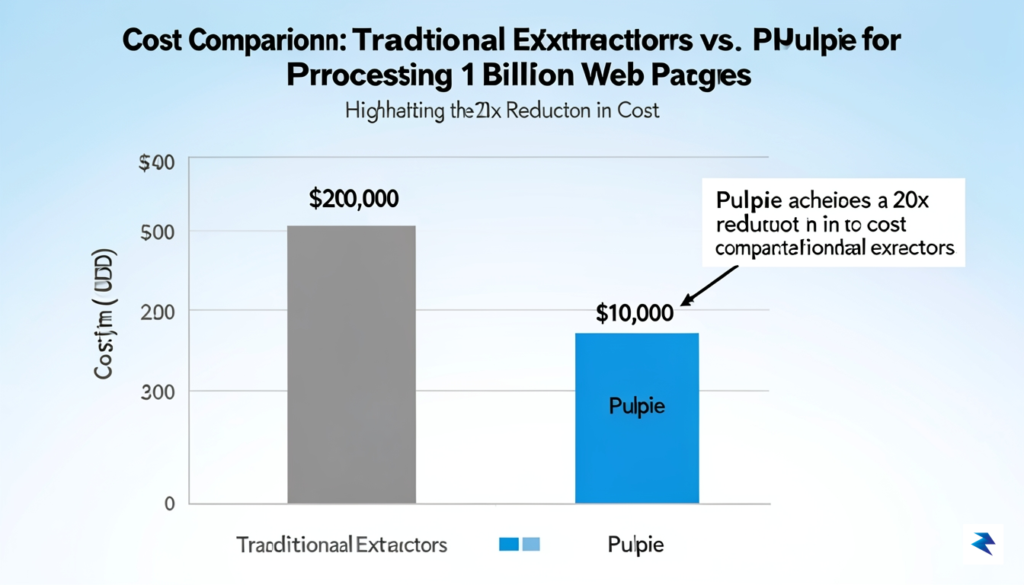
Pulpie addresses this fundamental economic hurdle by re-architecting the data extraction process itself. Conventional industry-leading extractors typically rely on memory-bound decoders, which are highly resource-intensive due to their need to hold large language models (LLMs) and extensive context in GPU memory. Pulpie, on the other hand, shifts this paradigm by moving from these memory-hungry decoders to compute-bound encoders. This subtle yet profound change means that instead of requiring vast amounts of high-bandwidth memory, the system prioritizes raw processing power, fundamentally altering the hardware requirements and, consequently, the operational costs.
The economic implications of this architectural shift are staggering, translating into a dramatic 20x reduction in operational costs compared to current industry standards. Consider a large-scale web scraping operation that might incur an annual cost of approximately $159,000 using a top-tier extractor like Dripper, primarily due to the demanding hardware and associated energy consumption. With Pulpie, the estimated annual cost for achieving comparable, high-quality data extraction drops precipitously to just $7,900. This isn’t merely a marginal improvement; it represents a complete re-evaluation of the financial viability for projects that depend heavily on continuous, large-scale web data acquisition.
This significant cost reduction is directly attributable to Pulpie’s ability to operate efficiently on far less expensive hardware. Because its core operations are compute-bound rather than memory-bound, Pulpie can effectively leverage smaller, more affordable GPUs that would be insufficient for decoder-heavy systems. Instead of requiring top-of-the-line GPUs with immense amounts of VRAM, which are both costly to acquire and expensive to run, Pulpie thrives on more modest setups. This means businesses can achieve robust, high-performance data cleaning and extraction without the prohibitive capital expenditure or ongoing cloud computing costs typically associated with such intensive tasks.
Ultimately, Pulpie’s innovative approach democratizes access to high-quality web data extraction. This unprecedented cost-to-performance ratio makes sophisticated data cleaning and processing accessible to a much broader range of organizations, from lean startups with tight budgets to large enterprises seeking to optimize their substantial infrastructure investments. By eliminating the silent killer of exorbitant costs, Pulpie empowers more teams to build and scale AI projects with reliable web data, ensuring that innovation isn’t stifled by the price tag of necessary infrastructure.
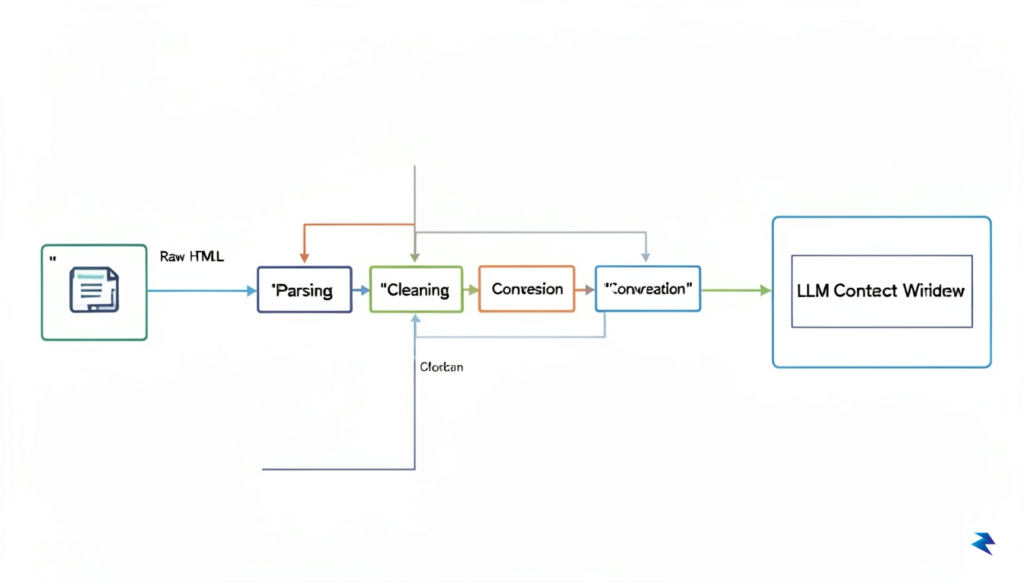
In the quest to build increasingly reliable and accurate AI systems, particularly those powered by Large Language Models (LLMs), the quality of input data stands paramount. Integrating a specialized extraction layer into your data pipeline is no longer merely an optimization; it’s an essential step for success. Raw web data, while abundant, is inherently noisy, laden with advertisements, navigational elements, footers, and stylistic clutter that offers little to no semantic value for an LLM trying to extract core information. This is precisely where solutions like Pulpie become indispensable, serving as an efficient gatekeeper that meticulously strips away this extraneous noise, ensuring your LLM receives only the high-signal content it needs to perform accurately and effectively.
Consider the architecture of a typical Retrieval-Augmented Generation (RAG) system, which has become a cornerstone for grounding LLMs in up-to-date and domain-specific knowledge. Traditionally, the retrieval phase might involve indexing web pages directly or after minimal processing. However, by inserting Pulpie as a pre-processing step, we fundamentally elevate the quality of the documents entering your vector database. Pulpie works by intelligently identifying and extracting the primary content from a web page, discarding all the surrounding visual and functional elements that would otherwise pollute your embeddings. This means that when your RAG system retrieves information, it’s pulling from a repository of clean, relevant text, rather than a mishmash of advertisements and boilerplate, leading to far more precise and semantically aligned retrieval results.
One of the key advantages of Pulpie lies in its ability to output this cleaned content in structured Markdown format. Markdown is an ideal intermediate representation for LLM ingestion because it preserves essential document structure—such as headings, lists, code blocks, and bold text—without the verbosity and complexity of raw HTML. This structured yet clean input allows LLMs to better understand the hierarchy and relationships within the text, which is crucial for tasks like summarization, question answering, and content generation. Unlike flat text, Markdown provides a lightweight semantic framework that guides the LLM’s comprehension, enabling it to focus on the content’s meaning rather than struggling to parse presentation layers.
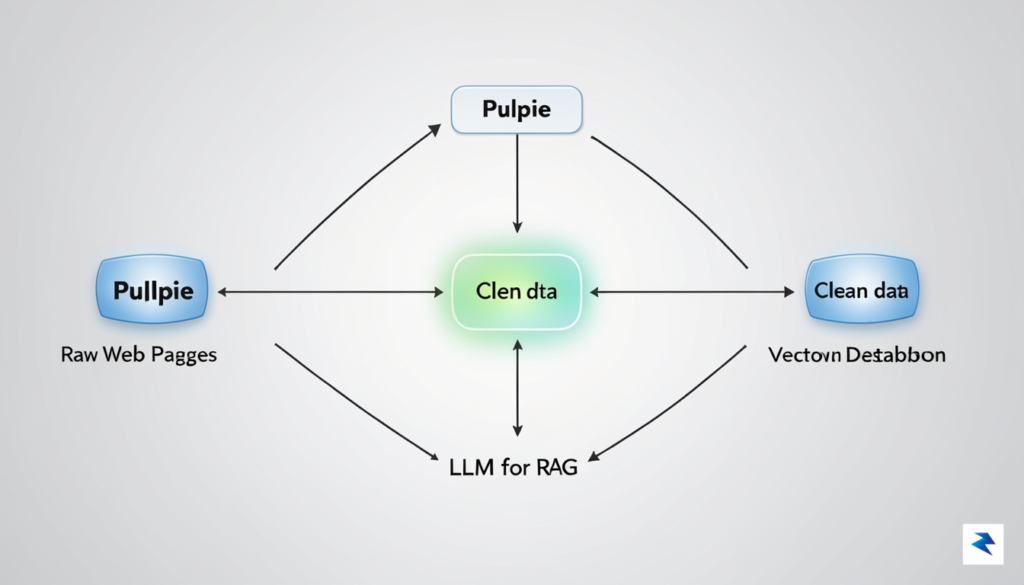
The immediate benefit of using Pulpie to generate clean Markdown is a significant reduction in ‘noise’ within the LLM’s context window. LLMs have finite context windows, meaning there’s a limit to how much information they can process at once. When raw web pages are fed in, a substantial portion of this valuable context window is consumed by irrelevant tokens representing ads, navigation, empty HTML tags, and other junk. By providing a streamlined, high-signal Markdown output, Pulpie ensures that every token within the context window contributes meaningfully to the LLM’s understanding. This efficiency directly translates into improved final model performance, as the LLM can dedicate its computational resources to reasoning over pertinent information, leading to more coherent, accurate, and less hallucinatory outputs.
Ultimately, by integrating Pulpie into your AI research harness, you’re not just cleaning data; you’re fundamentally enhancing the foundation upon which your AI systems are built. The investment in a specialized extraction layer pays dividends in the form of superior data quality, which propagates throughout the entire AI workflow. From more accurate embeddings and precise retrieval to optimized context window utilization and, finally, to more reliable and trustworthy LLM generations, Pulpie facilitates a robust pipeline that empowers AI developers to build cutting-edge applications with confidence, leveraging the web’s vast information without its inherent clutter.

For developers keen on elevating the quality of their web data processing, the journey with Pulpie begins today, offering a robust and accessible pathway to cleaner datasets. With its powerful open-source models readily available on Hugging Face, integrating Pulpie into your existing infrastructure is not just a future prospect but an immediate opportunity. This means that whether you are currently building the next-generation search engine, refining a sophisticated sentiment analysis tool, or curating a massive research dataset, Pulpie provides the essential components to streamline your data cleaning workflows with remarkable efficiency. The design philosophy behind Pulpie prioritizes a Pareto optimal balance of speed and precision, ensuring that you achieve high-quality results without compromising on processing time, a critical factor for large-scale operations.
The strength of the modern AI ecosystem lies significantly in its commitment to open-source contributions, and Pulpie proudly stands within this ethos. By making its cutting-edge models freely available, Pulpie not only democratizes access to advanced web data cleaning capabilities but also fosters a collaborative environment for continuous improvement and innovation. This approach allows developers worldwide to scrutinize, adapt, and enhance the models, ensuring transparency and building collective intelligence around the challenges of messy web data. Furthermore, the open-source nature means that teams can customize Pulpie to their specific needs, integrating it seamlessly into diverse technological stacks and proprietary systems without vendor lock-in, thus accelerating development cycles and reducing operational costs.
Embarking on your Pulpie implementation journey is straightforward, primarily leveraging the Hugging Face platform as your gateway to the models. Developers should navigate to the Hugging Face Hub and search for Pulpie’s official model repositories, typically identifiable by names suchuding `pulpie-cleaner` or similar designations. These repositories provide not only the model weights but often include detailed documentation, example usage scripts, and licensing information to facilitate a smooth integration process. The platform’s intuitive interface makes downloading and loading these models into your preferred machine learning framework, such as PyTorch or TensorFlow, a relatively simple task, allowing you to begin experimenting almost immediately.
Once you have identified and accessed the relevant models, the next step involves integrating them into your application’s data pipeline. This typically involves loading the pre-trained Pulpie model, feeding it raw HTML or text data, and then processing the output to extract the clean, relevant information. For instance, if you’re building a content aggregation service, you might pass entire web pages through Pulpie to strip away navigation elements, advertisements, and boilerplate text, leaving only the core article content. This direct integration capability empowers developers to quickly enhance the quality of their input data, leading to more accurate downstream analyses and improved user experiences.

To truly appreciate Pulpie’s capabilities and fine-tune its performance for your specific use cases, leveraging the provided side-by-side comparison tools is highly recommended. These tools enable you to input raw, uncleaned web content and observe Pulpie’s output alongside the original, offering an immediate visual and textual comparison. This direct feedback loop is invaluable for understanding how the models identify and eliminate irrelevant content, formatting inconsistencies, and extraneous elements, giving you concrete insights into the transformation process. By actively engaging with these comparison features, developers can quickly ascertain the effectiveness of Pulpie for their particular data sources and content types.
Beyond initial evaluation, these tools also serve as an excellent starting point for any necessary refinement or customization. While Pulpie delivers a high level of out-of-the-box performance, every web dataset has its unique quirks. Consequently, developers might choose to fine-tune the models on their specific domain data or combine Pulpie’s output with additional post-processing rules to achieve an even higher degree of precision. Ultimately, by providing both robust open-source models and practical evaluation tools, Pulpie empowers developers not just to adopt a solution, but to actively participate in shaping the cleanliness and utility of the vast ocean of web data for their specific, mission-critical applications.
You must be logged in to post a comment.