
How to Transform Your Spare Mac into an AI-Powered Coding Agent
Introduction: Turning Your Spare Mac into an AI Powerhouse We have all reached that point in our tech journey where a previous-generation…


Have you ever been in a meeting where a simple decision, like the color of a button or the naming convention for a variable, consumed an hour of spirited debate, while a much larger, more critical architectural choice was waved through in minutes? This all-too-common scenario is a perfect illustration of a phenomenon known as ‘bikeshedding,’ a term derived from a concept first articulated by British historian and author C. Northcote Parkinson. Understanding the underlying psychology behind this behavior is crucial for any team aiming to reclaim its productivity and focus on truly impactful work.
At the heart of bikeshedding lies Parkinson’s Law of Triviality. Parkinson originally observed this in the context of a committee tasked with approving plans for a nuclear power plant. The committee spent disproportionate time debating trivial issues, like the design of the staff bicycle shed, which cost a mere fraction of the reactor’s budget, rather than the complex, high-stakes reactor itself. His insight, often paraphrased, suggests that the amount of time an organization spends on an issue is inversely proportional to its complexity or cost.
“The time spent on any item of the agenda will be in inverse proportion to the sum of money involved.” — C. Northcote Parkinson
The reason for this gravitational pull towards the trivial is deeply rooted in human psychology and our cognitive comfort zones. When confronted with a monumental, complex problem—such as designing a fault-tolerant distributed system, optimizing a database for petabytes of data, or architecting a secure, scalable cloud infrastructure—many individuals, even experts, can feel overwhelmed. These problems are abstract, require deep specialized knowledge, and the potential for error is significant, pushing us outside our immediate intellectual comfort zone. The solutions aren’t obvious, the implications are vast, and the risk of making a ‘wrong’ decision feels substantial, leading to a natural hesitancy or even paralysis.
Conversely, debating issues like coding style, the exact placement of a file in a repository, or the specific wording of a log message presents a ‘safe’ intellectual playground. These problems are concrete, immediately understandable, and accessible to everyone, regardless of their specific expertise level. Everyone feels they have a valid opinion, can easily grasp the parameters of the discussion, and contributing feels productive, even if the actual impact on the project’s overall success or the business bottom line is negligible. This allows individuals to demonstrate their perceived competence, exert influence, and participate actively without grappling with the daunting uncertainties of truly hard problems, thereby satisfying a fundamental human need for agency and contribution.
In software engineering, this manifests as teams spending countless hours on exhaustive code style guides, minor refactoring suggestions during code reviews that don’t impact functionality, or prolonged debates over minute details of configuration files. These are problems that offer immediate, understandable solutions and a sense of mastery, providing a stark contrast to the often nebulous and challenging high-impact architectural decisions. By recognizing this ingrained human tendency—this gravitational pull towards the cognitively comfortable and easily debatable—we take the crucial first step toward re-directing our collective intellectual energy. It’s not about disparaging engineers; it’s about acknowledging a fundamental psychological pattern that can silently erode productivity and innovation. Understanding why we bikeshed is the key to fostering an environment where deep, impactful work can thrive instead of being overshadowed by trivial squabbles.

Technical teams frequently find themselves stuck in what feels like an endless loop of minor debates, often about trivial details that have minimal impact on the overall product. This phenomenon, colloquially known as bikeshedding, isn’t merely a sign of petty disagreements; it’s often a symptom of deeper, systemic issues rooted in how decisions are made, or rather, not made, within an organization. Without a clear, well-defined framework for decision-making, even the simplest choices can balloon into protracted discussions, consuming valuable time and mental energy that could be better spent on genuine innovation and problem-solving.
A common culprit is the pervasive consensus-based culture, where every team member is expected to agree on every single detail before progress can be made. While collaboration is undeniably vital for fostering shared understanding and buy-in, an insistence on universal consensus, particularly for low-stakes decisions, can severely hamper a team’s velocity. This approach often leads to an exhaustive exploration of every conceivable option, not because each option has significant merit, but because no one feels empowered or responsible enough to make a definitive call without group affirmation, even on the color of a button or the precise wording of a log message.
Compounding this issue are vague or incomplete requirements handed down from higher levels. When the overarching goals, user needs, or architectural principles are fuzzy, teams naturally gravitate towards nitpicking at the lowest possible level. Lacking clarity on the ‘why’ and the ‘what’ of a feature, engineers might spend hours debating the ‘how’ in minute detail, simply because these are the concrete elements they can grapple with. This low-level focus provides a false sense of productivity, as teams invest considerable effort into optimizing aspects that might be irrelevant if the foundational requirements were solid and unambiguous from the outset.
Underlying much of this trivial debate is a profound fear of making the ‘wrong’ decision, especially in high-stakes environments where project failure or costly rework can have severe repercussions. The pressure to deliver flawless solutions can paralyze teams, making it safer to endlessly discuss alternatives than to commit to a path that might later prove suboptimal. Bikeshedding, in this context, becomes a defense mechanism: by focusing on minor, easily reversible details, teams can avoid confronting the truly difficult, high-impact architectural or design choices that carry greater risk and require more profound technical expertise and leadership.
Indeed, this avoidance often intertwines with a reluctance to address existing technical debt or tackle truly complex engineering challenges. Arguing about indentation styles or the precise naming convention for a trivial variable is considerably less intimidating than proposing a major refactor of a monolithic legacy system, or designing a scalable solution for a complex new feature. The bikeshed provides a convenient distraction, allowing teams to expend energy on superficial issues while deferring the daunting, yet crucial, work that could genuinely move the product forward and alleviate future problems. This perpetual deferral only exacerbates the underlying technical debt, creating a vicious cycle of increasing complexity and dwindling morale.
Ultimately, the trap of bikeshedding is a multifaceted problem, born from a confluence of unclear decision pathways, an overreliance on consensus, ambiguous project mandates, and an understandable, yet counterproductive, fear of failure. Until organizations cultivate environments with clear leadership, well-defined scope, robust decision-making frameworks, and a culture that embraces calculated risks rather than endless deliberation, technical teams will continue to find themselves cycling through trivial debates, hindering their true potential for innovation and efficiency.

The pursuit of universal agreement often feels like a sign of a healthy, democratic engineering culture, but in reality, it is frequently a silent engine of stagnation. Every hour spent debating the merits of a specific CSS naming convention or agonizing over a trivial library choice is a tangible asset liquidated for no gain. When engineering teams prioritize consensus over momentum, they inadvertently treat their most valuable resource—cognitive bandwidth—as if it were infinite. In truth, every minute consumed by bikeshedding is a minute stolen from solving complex architectural challenges or delivering actual value to the end user, creating a deficit that compounds over time.

Decision fatigue acts as a corrosive force within high-performing teams, where the cumulative weight of thousands of minor choices eventually degrades the quality of major ones. When engineers are forced to justify every stylistic preference or minor tool selection in an open forum, their capacity for deep, analytical thinking is rapidly depleted. By the time the team reaches a critical juncture—such as a complex refactor or a high-stakes security update—the mental reserves required for rigorous judgment have already been exhausted by the performative bureaucracy of “consensus-seeking.” This leads to a dangerous irony: teams that agonize over the small stuff often find themselves making sloppy, impulsive decisions when the stakes are at their highest.
The cost of a meeting is not just the hourly rate of the participants; it is the opportunity cost of the innovation that died in that room.
Beyond the immediate loss of hours, the long-term impact on team morale is arguably more damaging. Ambitious engineers are rarely motivated by endless rounds of deliberation; they are driven by the desire to build, ship, and iterate. When project momentum is repeatedly throttled by the need to appease every stakeholder, the most talented individuals begin to disengage, viewing the environment as one where bureaucracy stifles creativity. This culture of constant compromise effectively kills the pursuit of bold, non-trivial engineering goals, as teams become risk-averse, favoring the “safe” path that happens to be the one everyone can agree upon, rather than the innovative path that actually solves the problem.
To break this cycle, organizations must recognize that consensus is not a prerequisite for progress. True agility requires a transition from a culture of “all-hands agreement” to one of “informed autonomy.” By empowering individual engineers or small, focused pods to make decisions within their domain—and accepting that minor mistakes are far less costly than the inertia caused by total consensus—teams can reclaim their focus. Moving forward, the goal should not be to reach the perfect decision, but to reach a good-enough decision quickly, thereby preserving the mental energy necessary to tackle the challenges that truly define a product’s success.

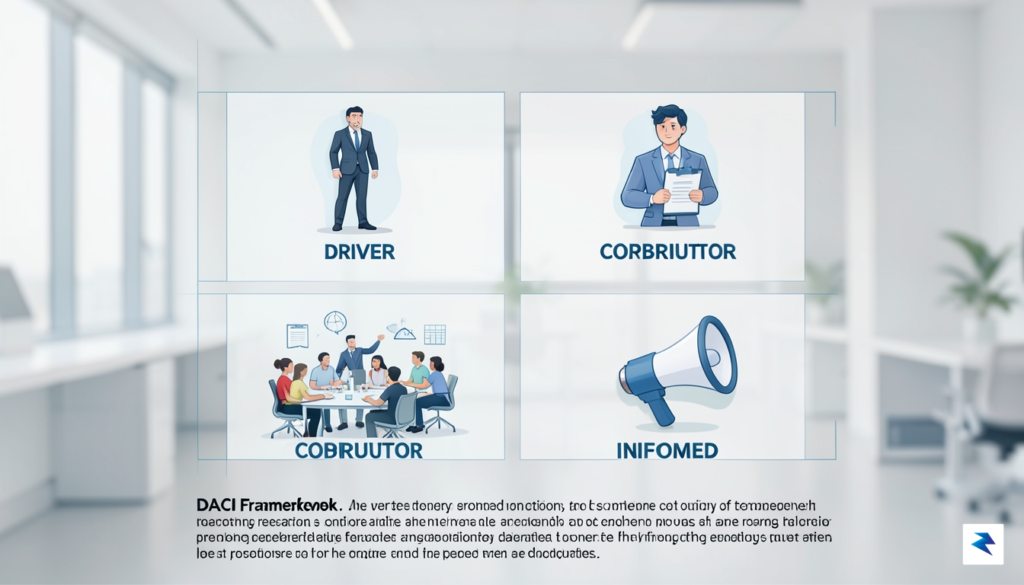
To break the cycle of endless debate over minor technical details, teams must shift from consensus-seeking patterns toward structured decision-making frameworks. A primary culprit in organizational stalling is the lack of role clarity, which often leads to “design by committee.” By implementing the DACI model—identifying a Driver, Approver, Contributor, and Informed party—you immediately define who owns the outcome and who is merely providing input. The Driver is responsible for gathering data and keeping the project moving, while the Approver holds the ultimate authority to make the final call. This structure prevents the common pitfall where every team member feels entitled to veto a decision, effectively stripping the “bikeshedding” process of its ability to paralyze progress.
Even with clear roles, tension is inevitable; this is where the principle of “Disagree and Commit” becomes essential. Not every decision will satisfy every engineer, and that is perfectly acceptable. When a team adopts this philosophy, they agree that once a decision is finalized by the Approver, the entire group will support it with full enthusiasm, regardless of their initial reservations. This prevents the “slow-burn” of passive-aggressive resistance or lingering resentment that often plagues teams stuck in loop-based discussions. It transforms the culture from one of endless deliberation to one of decisive action, recognizing that the speed of execution often outweighs the marginal benefits of a “perfect” technical choice.
True velocity in engineering is not just about writing code faster; it is about reaching a firm decision and moving forward with collective alignment.
To further curb the tendency to over-analyze trivial features, teams should rigorously apply time-boxing to their deliberations. If a decision is not mission-critical, assign a strict deadline for the discussion; if no consensus is reached within that window, the Driver must make an executive decision based on the information at hand. Often, the “good enough” solution that is implemented today is infinitely more valuable than the “perfect” solution that remains trapped in a Slack thread for three weeks. Distinguishing between core infrastructure, which demands deep scrutiny, and non-core UI or utility features allows your best talent to save their cognitive energy for the challenges that actually define your product’s success.
Ultimately, the goal is to cultivate a culture where clarity is valued over total agreement. By reducing the friction associated with low-stakes choices, you empower your team to focus their intellect on complex architectural problems rather than the color of a button or the naming convention of a temporary variable. When leadership sets the expectation that action is a virtue, the team naturally stops looking for reasons to delay and starts looking for ways to ship.

Shifting a team toward pragmatism requires more than just a change in workflow; it necessitates a fundamental reorientation of what the team considers “success.” When teams spend hours debating the merits of a specific folder structure or the aesthetic nuances of a secondary UI component, they are often performing a form of intellectual procrastination. To break this cycle, leadership must aggressively redirect focus toward customer value and measurable outcomes. Instead of asking, “Is this solution technically elegant?” teams should be trained to ask, “Does this solution solve a real problem for our user, and can we measure its impact?” By anchoring every technical decision to a concrete business goal, you transform the conversation from a subjective battle of opinions into an objective assessment of utility.

The most effective antidote to the paralysis of perfectionism is the practice of shipping and iterating. Perfection is often a moving target that recedes the closer you get to it, while “done” is a concrete milestone that allows for real-world feedback. When a team adopts an experimental mindset—viewing code as a hypothesis to be tested rather than a monument to be chiseled—the stakes of any single decision drop significantly. If a feature is launched and fails to move the needle, the team learns something valuable; if it is debated for three weeks in a conference room, the only thing learned is how to waste time. Encouraging a “ship to learn” culture effectively kills the urge to bikeshed, because team members know they will have the opportunity to refine their work based on actual usage data later.
“The goal of software development is not to write perfect code, but to solve human problems. Every hour spent debating the trivial is an hour stolen from the customer.”
Ultimately, this cultural shift must be modeled from the top down. If project leads or managers intervene to demand excessive polish on non-critical tasks, the team will quickly revert to seeking perfection over progress. Leadership needs to be the first to say, “This is good enough for now—let’s ship it and see what happens.” By explicitly rewarding speed and the ability to pivot, managers validate the pragmatic approach and create a psychological safety net for engineers to prioritize impact over vanity. When the team sees that their leaders value tangible progress over the appearance of meticulousness, they will feel empowered to abandon the trivial debates that once stalled their momentum, allowing the entire organization to focus on the work that truly drives value.
You must be logged in to post a comment.