
Understanding Anthropic’s New Identity Verification Policy

The landscape of artificial intelligence is shifting from a Wild West of anonymity toward a more structured, regulated environment, and Anthropic’s recent policy update serves as a prime example of this evolution. For users who have grown accustomed to interacting with Claude without providing personal documentation, the updated privacy framework introduces a notable friction point: the possibility of being asked to present government-issued identification. This move represents a significant departure from the company’s previous hands-off approach to user identity, signaling that as LLMs become more integrated into daily life, platforms are increasingly prioritizing accountability over total user privacy.

Anthropic has clarified that these requests will not be indiscriminate; rather, they are reserved for “certain circumstances” that necessitate a higher level of trust. These triggers are primarily rooted in platform integrity and legal compliance. For instance, if a user’s activity patterns flag concerns related to safety or platform abuse, Anthropic may invoke these protocols to confirm that the user is an actual human being rather than an automated bot or a malicious actor. Furthermore, jurisdictional legal requirements play a massive role in this shift. As various countries and regions roll out stricter regulations regarding the use of generative AI, Anthropic must ensure that it remains compliant with local laws, which often include age-gating requirements for minors and strict verification processes for sensitive professional tools.
The integration of identity verification is framed by Anthropic as a necessary trade-off to maintain a safe, secure, and legally compliant environment for all users in an era of increasing AI-driven misinformation and automated harm.
When the platform does trigger a request for identification, it typically requires standard documents such as a passport or a government-issued driver’s license to verify a user’s identity and age. While this may feel like an intrusive departure for early adopters, the company frames this as a foundational step for long-term sustainability. By verifying that users are who they claim to be, Anthropic aims to mitigate the risks associated with impersonation and unauthorized system access. Ultimately, this change reflects a broader industry trend where the “anonymous-by-default” era of AI is being replaced by a model that demands proof of identity to unlock the full, secure capabilities of sophisticated LLMs, forcing users to weigh the convenience of anonymous access against the necessity of these new security layers.
Why AI Companies Are Moving Toward Mandatory Verification
The push for identity verification across the generative AI landscape is far more than a localized experiment by a single developer; it represents a fundamental shift in how the tech industry balances innovation with systemic accountability. As large language models become increasingly capable of generating high-fidelity text, imagery, and code, they have naturally attracted the attention of global regulators. Governments are no longer content to treat AI as a burgeoning frontier of wild experimentation. Instead, they are actively pushing for age-appropriate design codes and strict safety frameworks to ensure that minors are protected from mature content and that these powerful tools are not used to undermine public safety. By mandating identity checks, companies like Anthropic are preemptively aligning with these shifting legal tides, effectively transforming the platform from an open sandbox into a regulated environment.

Beyond the immediate pressure of compliance, identity verification serves as a critical frontline defense against the proliferation of automated bot networks. Malicious actors have long leveraged AI to scale disinformation campaigns, mass-produce spam, and scrape sensitive data, often using thousands of non-human personas to mask their activities. By requiring a government-issued ID, companies introduce a “human-in-the-loop” friction that makes the cost of operating bot farms prohibitively expensive. When every account is anchored to a verified real-world identity, the anonymity that bad actors rely on to operate with impunity begins to evaporate, forcing a higher barrier to entry that discourages low-effort, high-impact abuse of the platform.
Requiring identity verification is not merely an administrative hurdle; it is a strategic deterrent designed to raise the personal stakes for those who intend to weaponize generative AI for illicit gain.
This verification process also functions as a powerful psychological and practical deterrent against the misuse of models for high-stakes harm, such as the generation of non-consensual deepfakes or the facilitation of illegal activities. When a user knows that their access to a cutting-edge tool is directly linked to their legal identity, the propensity to engage in prohibited or harmful behavior decreases significantly. It transforms the user experience from one of untraceable interaction to one of personal responsibility. As these models continue to evolve in power, the industry is betting that creating a culture of accountability—rather than relying solely on post-hoc moderation—is the most sustainable path toward keeping AI safe, ethical, and aligned with the values of the broader public.
The Data Security Implications of Uploading Personal IDs

Entrusting a tech company with a scanned passport or driver’s license is a significant leap of faith, one that shifts the burden of security from your physical wallet to the digital infrastructure of a third-party provider. When Anthropic or similar AI developers integrate identity verification, they typically rely on specialized partners—such as Stripe Identity or Persona—to handle the actual processing of sensitive documents. This architecture is designed to compartmentalize risk: the AI platform itself often receives only a confirmation token—a “yes” or “no” verifying that you are who you claim to be—rather than the raw image file of your ID. However, this raises the critical question of data retention and who exactly maintains access to the decrypted biometric data once the verification process concludes.

Users must carefully distinguish between “proof of life” verification and long-term data storage. In a best-case scenario, the verification service performs an instantaneous check, comparing your selfie against the document in real-time, and then discards the high-resolution images immediately. Yet, the reality of modern centralized data repositories is often more complex. Even when companies claim to delete data, the underlying logs, backups, and metadata associated with the verification request can linger in servers for months. When dealing with permanent identifiers like birth dates and government ID numbers, a single breach—or even a policy shift regarding data usage for model training—can lead to irreversible identity theft risks that far outweigh the convenience of accessing advanced AI features.
The permanence of identity theft is the primary danger here; unlike a compromised password, your government ID number and biometric data cannot be reset once they have been exposed in a data breach.
Before you hit “upload,” it is essential to scrutinize the privacy policy for specific clauses regarding data lifecycle management. You should be looking for clear, non-ambiguous language detailing exactly how long the third-party processor keeps your document and whether that data is ever shared with the AI developer for “service improvement” or “machine learning training.” If a company is vague about whether your ID data is used to fine-tune their LLMs, you should assume the worst: that your personal information could potentially be ingested into a model’s latent space. To protect yourself, always prioritize services that offer an explicit, manual “delete my data” button and look for verification providers that emphasize edge processing, where the analysis happens locally on your device rather than on a remote server.
Ultimately, the utility of sophisticated AI tools must be weighed against the potential for long-term digital vulnerability. While the convenience of instant verification is undeniable, users should treat their government-issued identification as the highest tier of private information. If the policy does not explicitly state that your raw ID images are purged within a strictly defined, short window—such as 24 to 48 hours—you are essentially consenting to a permanent digital footprint that could become a liability in the event of a future security failure.
Navigating the Balance Between Safety and User Privacy
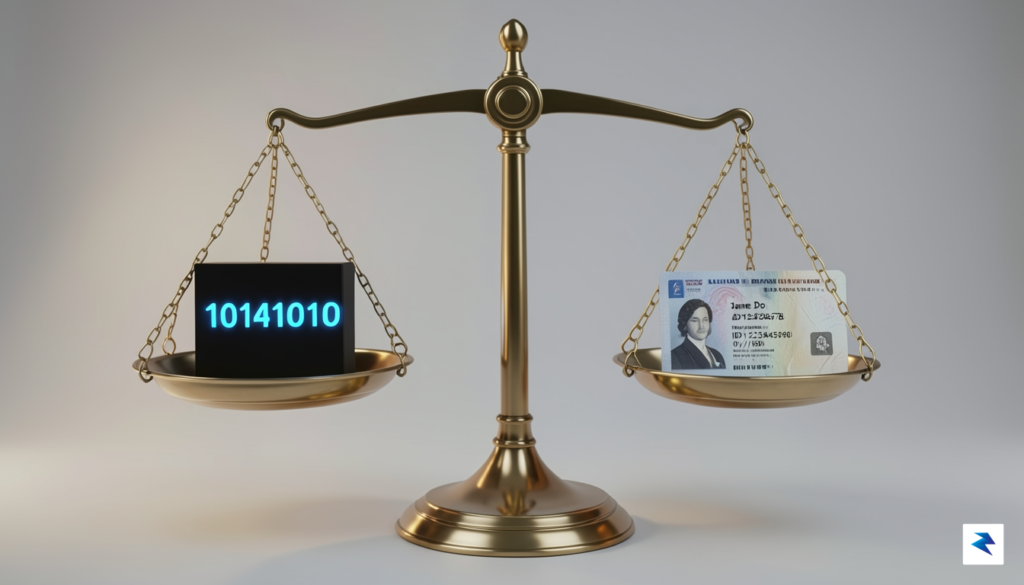
The early days of the internet promised a new frontier of boundless information and, crucially, a degree of anonymity that allowed users to explore, create, and interact without the immediate scrutiny of their real-world identities. This digital veil fostered a sense of liberation, enabling individuals to experiment with new personas, engage in open discourse, and challenge norms without fear of direct repercussion. However, this digital utopia soon revealed its shadows, as anonymity also provided cover for spam, harassment, fraud, and more recently, the potential misuse of powerful artificial intelligence for malicious purposes. The growing demand for a safer, more accountable online environment has led to an inevitable push towards identity verification, fundamentally altering the landscape of digital interaction.
This shift from anonymous web usage to verified digital identities creates what can be described as an “identity trail”—a digital breadcrumb of personal data linked to every online action. While verification undeniably curtails bad actors by making them traceable, it also subtly but significantly shifts the power dynamic between the platform and the individual user. When platforms know who you are, they gain unprecedented insight into your behavior, preferences, and potentially your vulnerabilities, raising legitimate concerns about surveillance, data misuse, and the chilling effect on free expression that might occur when every word is tied directly to a real person. The convenience and safety offered by verification come at the cost of surrendering a fundamental aspect of digital freedom.
Amidst this evolving landscape, a promising technological concept known as ‘zero-knowledge proofs’ (ZKPs) offers a potential path forward that could allow for verification without exposing raw document data. Imagine being able to prove you are over 18 without revealing your birth date, or confirming you’re a unique individual without handing over your government ID. ZKPs achieve this by allowing one party to prove that they know a certain piece of information to another party, without revealing the information itself. This cryptographic technique could enable AI platforms to verify essential user attributes—like age, unique identity, or even jurisdiction—without requiring users to upload sensitive personal documents, thus maintaining a crucial layer of privacy while still fulfilling safety requirements.
The core question, then, becomes a delicate balancing act: do the undeniable benefits of a safer AI ecosystem justify the erosion of digital anonymity? On one hand, robust verification processes are crucial for preventing sophisticated AI models from being weaponized for deepfakes, disinformation campaigns, or targeted harassment, protecting individuals and society from significant harm. On the other hand, digital anonymity remains a vital shield for whistleblowers, activists, marginalized communities, and anyone wishing to exercise their right to free speech without fear of reprisal or discrimination. The choice is not merely technical; it’s a profound philosophical and societal debate about the kind of digital future we wish to inhabit—one where safety reigns supreme, or one where privacy and individual liberty are meticulously protected. The path forward demands innovative solutions like ZKPs, coupled with transparent policies and robust ethical frameworks, to navigate this complex tension effectively.
Practical Steps to Protect Your Identity in the AI Era

In an era where artificial intelligence platforms are increasingly transitioning from experimental toys to essential productivity tools, the threshold for verifying human identity is rising. As companies like Anthropic implement more stringent verification measures, the burden of data stewardship inevitably falls back onto the user. To maintain control over your digital footprint, you must adopt a proactive gatekeeper mindset. Start by scrutinizing the privacy policy of any AI service before you even consider creating an account; look specifically for clauses regarding how your submitted identification documents are stored, encrypted, or shared with third-party verification providers. If a service does not clearly articulate its data retention schedule, or if it reserves the right to use your biometric or identity data to train its models, you should treat it with significant caution.
Before handing over sensitive documents, perform a quick triage to determine if the AI tool is truly essential for your workflow or if a less invasive alternative exists. Not every task requires a high-level, cloud-based AI that demands government-issued identification. For low-stakes brainstorming, draft writing, or general research, consider using secondary email addresses or platforms that do not require identity verification. By compartmentalizing your digital activities, you effectively contain the risk; should one platform suffer a data breach, your primary identity remains shielded behind a layer of separation. Furthermore, always check if the service allows for “data minimization,” which is the practice of limiting the amount of personal information you provide to only what is strictly necessary to enable the service’s core functionality.
True digital sovereignty in the age of AI requires more than just strong passwords; it requires a deliberate, informed choice about which platforms earn the privilege of accessing your personal data.
If you decide that a particular AI platform no longer serves your needs, your responsibility for your data does not end at simply clicking “delete account.” Many platforms retain user data in their backups or training sets long after an account has been deactivated. You must be diligent in navigating the settings menu to formally request the permanent deletion of your data, including any uploaded identity documents. If the platform lacks a clear mechanism for this, do not hesitate to contact their support team directly to request confirmation that your personal records have been purged. Remember that you have the right to ask these companies what specific information they hold about you and, in many jurisdictions, the legal right to demand its erasure. By treating your identity as a valuable asset rather than a commodity to be traded for convenience, you can continue to leverage the power of AI without compromising your long-term security.