The Current State of the Frontier Gap

The artificial intelligence landscape has undergone a seismic shift over the last eighteen months, moving from a period where proprietary systems held a near-monopoly on high-level reasoning to an era where the divide between open weights and closed-source models is increasingly scrutinized. Projects like Meta’s Llama series and Mistral’s high-efficiency architectures have effectively democratized access to powerful large language models, allowing developers to run sophisticated AI locally or within private cloud environments. However, despite these monumental strides in accessibility, a persistent “frontier gap” remains. While open-weight models have reached parity with older proprietary iterations, the current generation of frontier models—such as GPT-4o and Claude 3.5 Sonnet—continues to demonstrate a level of nuance, reasoning depth, and multimodal cohesion that open-weight alternatives have yet to fully replicate.
This discrepancy is not merely a matter of parameter count or raw data volume, as many modern open-weight models are impressively large and trained on vast, high-quality datasets. Instead, the gap is fundamentally rooted in the “special sauce” of proprietary training pipelines. Frontier labs like OpenAI, Anthropic, and Google possess unique advantages in closed-loop reinforcement learning from human feedback (RLHF), massive-scale synthetic data generation, and proprietary infrastructure orchestration. These companies treat their pre-training methodologies as closely guarded trade secrets, refining their post-training alignment processes through iterative, multi-stage cycles that require immense compute resources and specialized human-labeling ecosystems that are difficult for the open-source community to mirror at scale.
The frontier gap isn’t just a performance delta; it represents the difference between a model that can follow instructions and one that can reliably navigate complex, multi-step logical reasoning tasks in high-stakes environments.
For researchers and developers, this gap is highly significant because it dictates the ceiling of what can be built without relying on expensive, restrictive APIs. When a project requires the absolute pinnacle of multimodal integration—where vision, audio, and text must synchronize with near-zero latency—the current frontier models remain the only viable choice. Conversely, the open-weights ecosystem is evolving at an unprecedented velocity, often closing the gap by half every few months. As we examine this divide, it becomes clear that the distinction is shifting from a binary “good vs. bad” comparison to a strategic choice: developers must weigh the data sovereignty, cost-efficiency, and customizability of open weights against the raw, unmatched cognitive bandwidth provided by the proprietary frontier.
Defining the Performance Divide

When we discuss the “frontier” of artificial intelligence, we are rarely talking about a singular, monolithic metric. Instead, frontier performance represents a high-water mark of model intelligence that manifests across three critical dimensions: deep reasoning, technical execution, and instruction adherence. While open-weights models have made staggering progress, proprietary models like GPT-4o or Claude 3.5 Sonnet maintain a distinct lead in their ability to handle “out-of-distribution” tasks—scenarios that the model hasn’t specifically been trained to solve. This gap is most visible in benchmarks like MMLU (Massive Multitask Language Understanding) and GPQA (Graduate-Level Google-Proof Q&A), where frontier models demonstrate an uncanny ability to synthesize disparate pieces of knowledge to solve problems that would baffle even highly capable open-source alternatives.
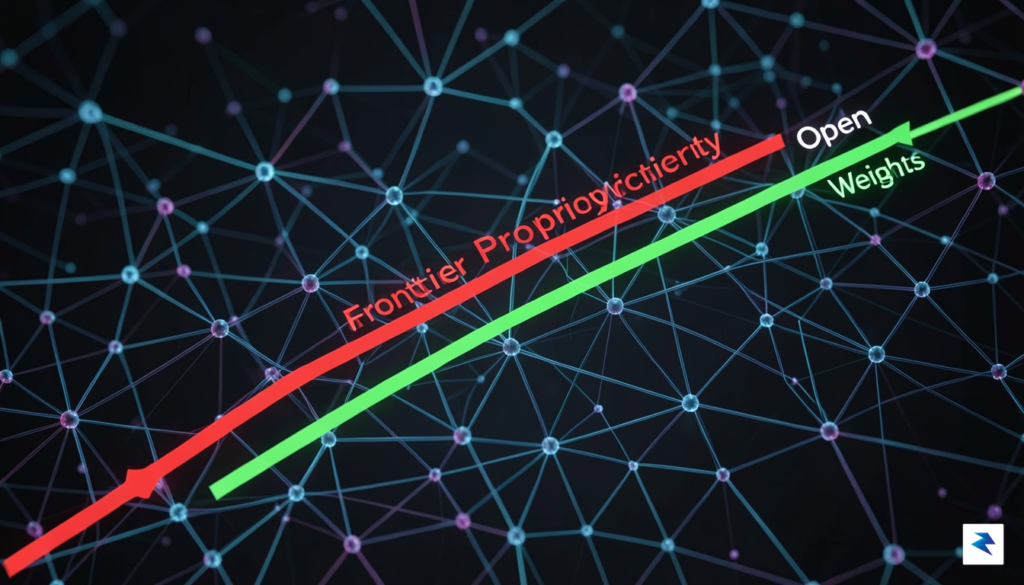
The discrepancy often boils down to what researchers call “emergent capabilities.” These are behaviors or logical proficiencies that appear only once a model reaches a certain scale of parameter count and high-quality training data. Proprietary models benefit from massive infrastructure investments, allowing them to undergo extensive post-training phases—such as Reinforcement Learning from Human Feedback (RLHF)—that are both computationally expensive and labor-intensive. Consequently, these models exhibit a form of “reasoning fluidity” that allows them to maintain a complex thread of logic over long contexts, whereas open-weights models may start to lose the plot or default to generic, less accurate boilerplate text when pressed with multi-step, nuanced instructions.
“True frontier performance isn’t just about getting the right answer; it’s about the reliability of the process used to arrive there, especially when the task involves ambiguity or high-stakes complexity.”
Furthermore, there is a fundamental divide between “chat-ready” models and “production-grade” proprietary APIs. A model that performs well in a casual sandbox environment often falters when integrated into complex software pipelines that require rigid adherence to system prompts or structured output formats like JSON. Frontier APIs are heavily optimized for these constraints, ensuring that the model doesn’t just “chat” but acts as a reliable component of a larger technical architecture. While open-weights models are rapidly closing the gap in standard creative writing and basic assistance, the proprietary ecosystem currently offers a level of stability, safety guardrails, and deterministic behavior that remains the gold standard for enterprises building mission-critical applications.
- Reasoning Depth: Frontier models demonstrate better performance on “chain-of-thought” tasks, effectively self-correcting during the generation process.
- Instruction Fidelity: Proprietary models show higher precision in following negative constraints and complex, multi-layered formatting requirements.
- Coding Proficiency: Large-scale models often possess a deeper understanding of obscure libraries and architectural patterns, leading to more functional, less buggy code snippets.
The Role of Data Quality and Scale

While much discussion around advanced large language models often gravitates towards architectural innovations and increased parameter counts, the true differentiator for many closed-source front-runners lies less in novel model designs and more in the unseen, proprietary datasets they leverage. Publicly available web-scraped data, while vast, is inherently noisy, rife with biases, and often lacks the specific, high-quality, and diverse content necessary to push models to their peak performance. In contrast, leading labs invest immensely in curating vast, meticulously cleaned, and often domain-specific datasets, ranging from extensive code repositories and scientific literature to carefully vetted creative writing and internal documents. This superior data allows their models to learn incredibly nuanced patterns, develop robust reasoning abilities, and achieve a level of coherence and factual accuracy that is simply unattainable with raw, unfiltered internet content alone.
Beyond the initial foundational training, these proprietary labs also benefit from a powerful ‘data fly-wheel’ effect. They extensively utilize their existing, highly capable models to generate vast quantities of high-quality synthetic data, a process that significantly augments their human-curated reserves. This involves instructing their advanced LLMs to create new text examples, dialogues, problem sets, or even code, which are then carefully filtered, refined, and often validated by human experts. This iterative process allows them to overcome the natural scarcity of certain types of data, target specific weaknesses in their models, and continuously expand their training corpus with content tailored precisely to their developmental goals. Essentially, their best models contribute to creating even better training data, accelerating their progress in a self-reinforcing cycle that open-weight initiatives struggle to replicate due to resource constraints and the lack of comparable foundational models.
This iterative advantage is further amplified by sophisticated post-training techniques, most notably Reinforcement Learning from Human Feedback (RLHF). This crucial step involves a massive, continuous effort where human annotators evaluate and rank model outputs based on criteria like helpfulness, harmlessness, truthfulness, and adherence to instructions. By learning from these human preferences, models are meticulously refined to align more closely with human values and expectations, dramatically improving their conversational quality and safety. However, the sheer scale and cost of implementing effective RLHF are staggering, requiring thousands of skilled human raters, advanced annotation platforms, and continuous feedback loops. This immense investment in human oversight and fine-tuning represents another formidable barrier to entry, solidifying the performance gap and serving as a testament to the comprehensive, multi-faceted approach proprietary labs take beyond just raw computational power.
Inference Efficiency and Hardware Constraints
While the initial training of a Large Language Model often captures the headlines, the true competitive advantage of proprietary providers lies in the grueling, invisible work of inference. When a company like OpenAI or Anthropic serves a request, they are not merely running a model on a generic server; they are deploying it across a highly orchestrated, bespoke inference stack. These proprietary environments are designed to squeeze every microsecond of latency out of the hardware, utilizing custom kernels and memory management techniques that remain largely inaccessible to those attempting to run open-weight models on commodity cloud infrastructure or local hardware.
The core bottleneck in this domain is often memory bandwidth rather than raw compute power. Large models are massive, and the process of shifting their parameters from high-speed memory to the processor creates a physical limit on how fast a token can be generated. Proprietary providers have mastered the art of “speculative decoding” and complex batching strategies that allow them to handle thousands of concurrent requests while maintaining fluid response times. Conversely, an individual developer or an enterprise team self-hosting an open-weight model frequently struggles with the overhead of standard frameworks, which lack the sophisticated, hardware-level optimizations that keep closed-source models feeling instantaneous.
Furthermore, the gap is exacerbated by the sheer complexity of the deployment lifecycle for open-weight models. To achieve performance comparable to a closed-source API, developers must often resort to quantization—a process of reducing the precision of model weights to fit them into smaller memory footprints. While techniques like 4-bit or 8-bit quantization are impressive, they inevitably introduce a trade-off between speed and model intelligence. Proprietary providers avoid this compromise by maintaining massive, dedicated clusters of high-end GPUs, ensuring that their models run at full precision without the performance degradation typically associated with local deployment.
The “performance moat” surrounding proprietary models is built as much on engineering prowess in the inference layer as it is on the size of the initial training dataset.
Ultimately, the ease of making a simple API call belies the mountain of engineering effort required to replicate that experience locally. When a user queries a closed-source model, they benefit from an ecosystem where the hardware and software are tuned to work in perfect harmony. For those relying on open weights, the journey involves managing the complexities of fine-tuning, navigating the limitations of commodity GPUs, and constantly tweaking deployment configurations to mitigate latency. Until open-source tooling reaches parity with these bespoke, proprietary inference stacks, the “frontier” gap will remain a significant barrier for those seeking top-tier performance outside of the walled gardens of AI giants.
The Future Trajectory of Open Weights

The persistent discourse surrounding the divide between proprietary “frontier” models and their open-weights counterparts often ignores the velocity at which the open ecosystem is evolving. Rather than viewing this gap as a permanent chasm, it is more accurate to characterize it as a shifting horizon. Through the widespread adoption of community-driven innovations like Low-Rank Adaptation (LoRA) and Quantized LoRA (QLoRA), developers can now fine-tune massive models on consumer-grade hardware with startling efficiency. These methods have democratized the ability to tailor general-purpose intelligence to specific, high-value tasks, effectively nullifying the need for a massive, multi-billion parameter model for the vast majority of enterprise applications.
A significant driver of this convergence is the tactical use of model distillation. By leveraging the reasoning capabilities of closed-source giants to generate synthetic training data, smaller open-weights models are being “taught” to punch well above their weight class. This process creates a virtuous cycle: the smaller, more efficient models inherit the nuanced logic of their larger predecessors, while retaining the portability and cost-effectiveness that open-source advocates demand. As this practice matures, the delta in raw performance between a proprietary model and a distilled, highly optimized local model is narrowing at an exponential rate.

Looking ahead, we should expect the definition of “performance” to undergo a radical shift. While proprietary models may continue to claim the absolute peak of benchmark scores for complex, multi-modal reasoning, the open-weights ecosystem is rapidly approaching a “good enough” threshold for 99% of real-world use cases. For most businesses, the ability to host a secure, private, and customizable model locally far outweighs the marginal gains of calling an external, opaque API. When a model becomes sufficiently capable to handle complex coding tasks, sentiment analysis, and summarization with near-human accuracy, the competitive edge of the proprietary model begins to diminish.
The future of AI is not a singular race to the top of a leaderboard, but a diversification of deployment where the most accessible and adaptable models become the industry standard for daily operations.
Ultimately, the gap will likely persist in the realm of extreme, frontier-level research, where the cost of compute required to train the next generation of foundational models remains prohibitive for the public. However, for the average developer and enterprise, the gap is effectively closing. We are entering an era where the most important AI is not the one with the most parameters, but the one that can be integrated, audited, and deployed with the most agility. In this context, the open-weights movement is not just catching up; it is redefining the baseline for what constitutes a useful, powerful, and scalable intelligence.