
The Genesis of BitTorrent: Solving the Bandwidth Bottleneck

At the dawn of the new millennium, the internet was a fragile ecosystem defined by rigid, centralized architecture. In 2001, if a piece of content—a software update, a rare video, or a massive document—suddenly gained popularity, it triggered what engineers called a “flash crowd.” As thousands of users attempted to download the same file simultaneously from a single server, that server’s outbound bandwidth would inevitably saturate, leading to agonizingly slow speeds or a complete system crash. The prevailing client-server model was essentially a bottleneck by design; the more popular a file became, the more likely the infrastructure hosting it would fail under the weight of its own success.
Bram Cohen, a young programmer with a vision for a more efficient web, looked at this broken system and saw a logical fallacy in the way we treated data distribution. Rather than viewing downloaders as passive recipients, Cohen reimagined them as active participants in a collaborative swarm. His invention, BitTorrent, fundamentally inverted the traditional model by ensuring that every person downloading a file was simultaneously uploading the pieces they had already acquired to others. This transformation turned the “flash crowd” from a destructive force into a self-scaling engine of efficiency: as more people joined the effort to download a file, the total bandwidth available for the swarm increased exponentially, rather than collapsing under the demand.
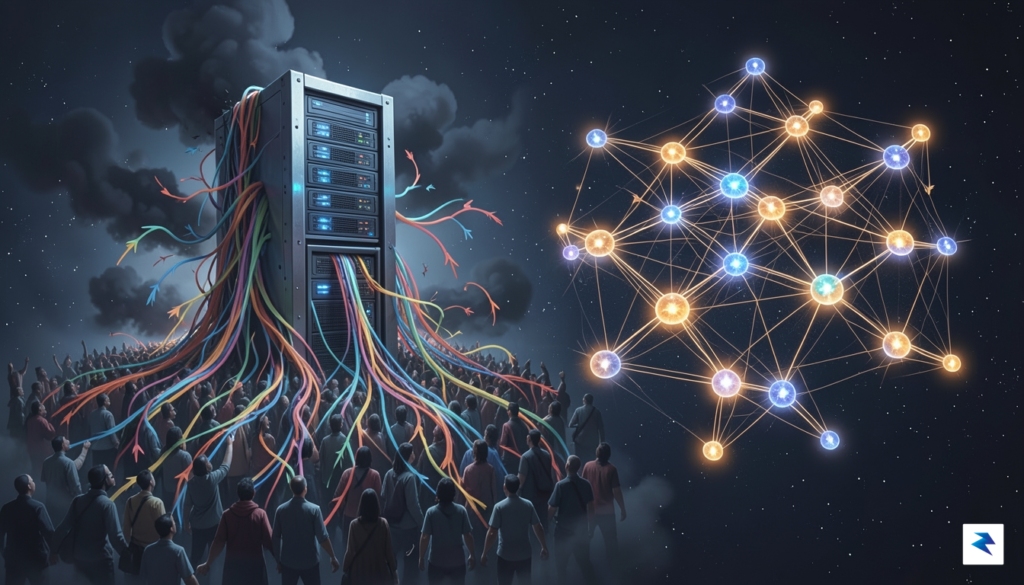
The elegance of Cohen’s architecture lay in its granular approach to data. Instead of forcing a user to download a monolithic file from a single source, BitTorrent broke the data into thousands of tiny, manageable “chunks.” This allowed clients to request different pieces from different peers simultaneously, making the download process incredibly resilient to connection drops or server outages. Furthermore, Cohen introduced a brilliant economic incentive known as “tit-for-tat.” To prevent the common peer-to-peer problem of “freeloading”—where users download data without contributing back—the protocol prioritized high-speed transfers to those who were actively uploading to others. It was a gamified system of cooperation that ensured the health of the network.
The genius of BitTorrent wasn’t just in moving files; it was in creating a digital society where participating in the network was more rewarding than simply consuming from it.
By leveraging the collective idle bandwidth of the internet, Cohen effectively solved the problem of distribution at scale. The software did not just provide a faster way to share data; it challenged the very notion of how information should flow across the digital landscape. It shifted the paradigm from a top-down, vulnerable hierarchy to a robust, distributed mesh, setting the stage for everything from modern game distribution platforms to decentralized content delivery networks that power the modern web today.
How BitTorrent Redefined Digital Distribution


Before the advent of BitTorrent, the internet operated on a rigid client-server model that struggled under the weight of high-bandwidth demands. When a single server hosted a massive file, every individual user attempting to download it created a bottleneck, inevitably leading to crashed servers and agonizingly slow speeds. Bram Cohen’s brilliant innovation was to invert this dynamic entirely through the concept of the “swarm.” Instead of relying on a centralized source, BitTorrent breaks files into tiny, manageable pieces. As users download these fragments, they simultaneously upload the pieces they have already acquired to other users. This creates a self-sustaining ecosystem where the more people who download a file, the faster and more efficient the distribution becomes for everyone involved.
At the heart of this orchestration is the “tracker,” a specialized server that acts as a matchmaker for the swarm. While the tracker does not host the actual data, it keeps a ledger of which users—known as peers—possess which specific segments of a file. By facilitating these connections, the protocol allows a massive file to be reconstructed on a user’s machine from dozens, or even hundreds, of different sources simultaneously. This democratization of bandwidth effectively offloaded the immense costs of data delivery from the content creator to the network itself. Suddenly, a single individual with a standard home internet connection could distribute gigabytes of data to thousands of people without needing a fleet of expensive, enterprise-grade servers.
Because of this unparalleled efficiency, BitTorrent quickly transcended its reputation as a tool for illicit media sharing to become the backbone of legitimate, large-scale digital distribution. Open-source communities, most notably Linux distributions like Ubuntu and Debian, adopted the technology as the gold standard for delivering operating system images. For these organizations, the protocol provided a way to push massive files to millions of users globally without incurring astronomical bandwidth bills. Similarly, game developers and software companies discovered that using peer-to-peer distribution for massive updates and patches was not only cheaper but significantly more reliable during high-traffic launch windows.
The genius of BitTorrent lies in the realization that the users themselves are the most valuable infrastructure a network can possess. By turning every downloader into an uploader, the internet became a collaborative engine rather than a static library.
Ultimately, the protocol fundamentally altered the economics of the internet by proving that decentralization is a viable solution for high-volume traffic. It transformed the “crowd” from a liability that could crash a server into a collective asset that improves the experience for every participant. Today, the legacy of this technology lives on in everything from modern game launchers to internal corporate data synchronization tools, cementing its status as one of the most transformative inventions in the history of digital infrastructure.
The Piracy Paradox: A Tool for Both Creation and Chaos


When BitTorrent emerged in the early 2000s, it arrived in a digital landscape already reeling from the disruptive aftermath of Napster and Kazaa. While its predecessors relied on centralized servers or inefficient peer-to-peer searching that often clogged network bandwidth, BitTorrent introduced a revolutionary swarming protocol. By breaking files into tiny, distributable fragments and allowing users to download and upload simultaneously, it turned every downloader into a distributor. This architecture was undeniably brilliant, yet it arrived at a time when the entertainment industry was desperate to contain the hemorrhaging of digital media. Consequently, BitTorrent was almost immediately cast as the successor to the “piracy menace,” becoming the primary target for anti-piracy crusades that sought to hold the protocol responsible for the mass copyright infringement of blockbuster films, music, and software.
The moral and legal ambiguity of the technology created a strange, dual-use reality that defined the mid-2000s internet. On one hand, the protocol was the backbone of a shadowy, underground culture that allowed users to bypass retail paywalls and regional release delays, effectively democratizing access to content at a speed never before seen. On the other hand, this same engine of “chaos” was simultaneously solving a massive technical bottleneck for legitimate organizations. Major software developers, open-source projects, and game studios quickly realized that BitTorrent was the most efficient way to distribute gigabytes of data to millions of users without crashing their own private servers. By offloading the distribution burden onto the users themselves, companies like Blizzard Entertainment and various Linux distributions transformed the protocol from a pirate’s tool into an essential pillar of global software logistics.
The technology itself remained entirely neutral, indifferent to the bits it moved; it was merely a pipe that could carry a pirated Hollywood blockbuster just as easily as it could carry a critical security patch for an operating system.
Ultimately, the controversy surrounding BitTorrent serves as a quintessential case study in how society reacts to disruptive innovation. Because the protocol was designed to be decentralized and censorship-resistant, it could not be easily “turned off” or controlled by any single entity. This inability to regulate the technology led to a prolonged war of attrition between copyright holders and the file-sharing community, leaving the protocol trapped in a perpetual state of legal grayness. Yet, despite being branded as a vehicle for digital theft, the efficiency of the BitTorrent protocol ultimately won out, proving that the tools we label as destructive are often the very instruments required to scale the modern internet to its current, massive proportions.
Legal Battles and the Evolution of P2P Technology

For the better part of a decade, the legal landscape surrounding peer-to-peer (P2P) file sharing was defined by a scorched-earth campaign waged by major media conglomerates. Iconic platforms like The Pirate Bay became the primary theater of this conflict, enduring high-profile raids, servers being seized by authorities, and founders facing imprisonment. These legal onslaughts were intended to dismantle the infrastructure of digital piracy, yet they inadvertently catalyzed a technological arms race that favored decentralization. As centralized trackers—the servers that acted as digital phonebooks for file locations—were systematically targeted for closure, the BitTorrent protocol was forced to mature into a more robust and evasive architecture.

The most significant turning point in this evolution was the implementation of Distributed Hash Tables (DHT) and the introduction of magnet links. Before these innovations, if the primary server hosting a torrent file went offline, users were left stranded, unable to find the peers necessary to complete their downloads. DHT eliminated this vulnerability by allowing the network itself to store the location of files, effectively removing the need for a central authority. Coupled with the invention of magnet links—which use unique cryptographic hashes to identify content rather than relying on a static file—the protocol became nearly impossible to fully extinguish. Even if a website hosting these links was taken down by court order, the underlying data remained accessible through the distributed network of users.
The resilience of BitTorrent proved that once a decentralized protocol reaches a critical mass of users, it ceases to be a target that can be defeated through litigation alone; it becomes a permanent, self-sustaining feature of the internet.
This transition marked a shift from the era of “Napster-style” vulnerability to a new standard of internet infrastructure that prioritized survival above all else. By decoupling the distribution of metadata from the storage of actual content, BitTorrent developers ensured that the protocol could no longer be easily dismantled by attacking its hosts. This technological pivot did not just save the protocol from obsolescence; it transformed it into a foundational tool used today by everything from legitimate software distribution platforms, like Linux distributions and game updates, to decentralized web initiatives. Ultimately, the relentless legal pressure meant to destroy BitTorrent inadvertently accelerated its transformation into an indestructible piece of digital plumbing, proving that the architecture of the internet is far more difficult to regulate than the websites that utilize it.
The Legacy of Bram Cohen's Innovation

Two and a half decades have passed since Bram Cohen first introduced his elegant solution to the bottleneck of centralized file sharing, yet the architecture of the modern internet remains deeply indebted to his breakthrough. Before BitTorrent, the internet operated largely on a client-server model, where a single host carried the weight of every downloader, inevitably leading to sluggish speeds and server crashes. By introducing a protocol that allowed users to simultaneously download and upload pieces of a file, Cohen transformed the end-user from a passive recipient into an active node in a distributed network. This paradigm shift proved that decentralization was not merely a theoretical curiosity, but a robust and hyper-efficient method for managing the massive data loads that define our contemporary digital existence.

The fingerprints of this innovation are visible in virtually every corner of today’s cloud infrastructure. Modern content delivery networks (CDNs) and streaming services utilize concepts pioneered by BitTorrent to optimize bandwidth usage and reduce latency; by caching data closer to the user and distributing traffic loads, these platforms mimic the efficiency of peer-to-peer swarming. Furthermore, the rise of blockchain technology and decentralized finance owes a significant debt to the underlying logic of the BitTorrent protocol. The fundamental idea that a distributed, trustless network can verify and exchange complex data packets without relying on a singular central authority serves as the bedrock upon which modern decentralized ledgers are built. What began as a tool for sharing digital media has evolved into the blueprint for a more resilient, censorship-resistant, and scalable internet architecture.
The true genius of the BitTorrent protocol was its ability to turn the problem of high demand into a solution; the more people who wanted a file, the faster that file could be shared across the entire network.
Beyond the technical infrastructure, BitTorrent fundamentally altered the psychology of global data consumption. It democratized access to information and entertainment, challenging the gatekeepers of traditional distribution channels and forcing the industry to adapt to a world where digital assets are fluid and ubiquitous. Bram Cohen’s initial, unassuming post to a mailing list in 2001 did not just create a file-sharing tool; it ignited a transformation in how we perceive ownership, bandwidth, and the collective power of a connected global community. As we look back on twenty-five years of progress, it is clear that his innovation was the catalyst that moved us away from a fragile, centralized web toward the distributed, high-speed ecosystem that powers our lives today.