
5 Key Takeaways from Google’s Nano Banana 2 Lite and the Future of AI Imaging
The Shift Toward Efficient On-Device AI For years, the gold standard of artificial intelligence has been defined by sheer scale. Developers…

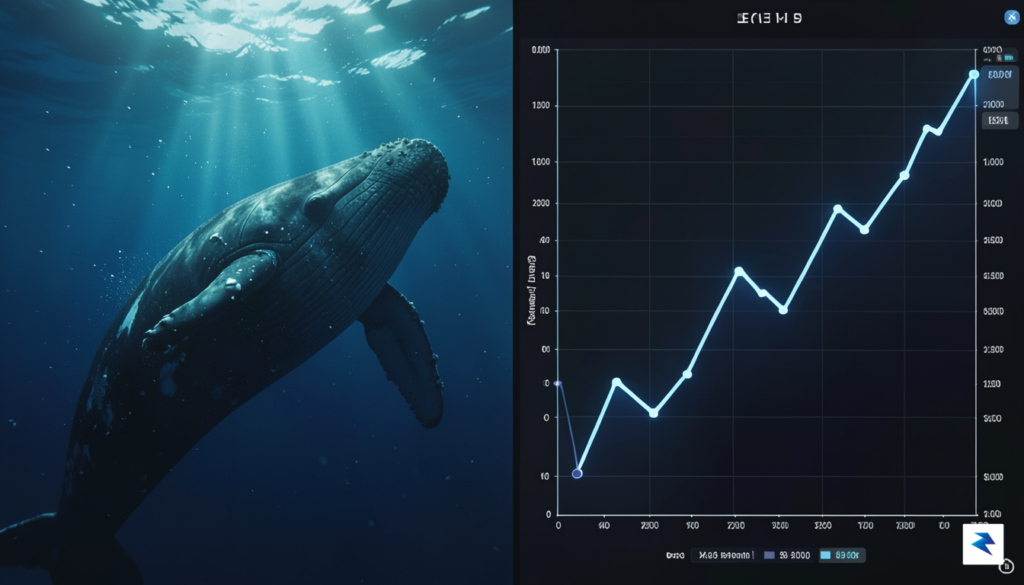

The current Bitcoin landscape is defined by a striking paradox that has left market analysts scrambling to interpret the underlying sentiment of the digital asset economy. While the headlines have been dominated by the cooling enthusiasm surrounding U.S. spot Bitcoin ETFs—which recently suffered a staggering $4 billion in net outflows—the deeper, on-chain reality reveals a much more aggressive narrative. Behind the scenes, Bitcoin “whales,” or those holding massive quantities of the asset, have quietly absorbed $16.7 billion worth of Bitcoin in just a two-week span. This massive accumulation suggests that while institutional “hot money” might be retreating due to short-term volatility and macroeconomic uncertainty, the long-term conviction of high-net-worth individuals and private entities remains unshaken.
This divergence signals a fundamental shift in how different classes of investors perceive value. Institutional ETF flows are often driven by fund managers, automated portfolios, and retail-oriented brokerage platforms that prioritize liquidity and short-term performance metrics. When these entities sell, it often reflects a broader risk-off sentiment in traditional finance rather than a lack of belief in Bitcoin’s long-term utility. In contrast, the whale cohort typically operates with a multi-year horizon, viewing price dips not as a reason to exit, but as a rare window of opportunity to increase their position size. By purchasing roughly four times the amount of Bitcoin that left the ETFs, these large holders are effectively acting as a “backstop” for the market, preventing a deeper cascade in price.
The ongoing tug-of-war between institutional outflows and whale accumulation suggests that Bitcoin is transitioning from a speculative asset into a supply-constrained store of value that is increasingly held by those with the highest conviction.
The mechanics of this supply absorption are crucial for understanding future market liquidity. When whales move large quantities of Bitcoin off exchanges and into cold storage, they effectively remove that supply from the immediate, tradeable market. As these assets become “illiquid” or locked away, the remaining supply available on exchanges becomes thinner, which historically paves the way for higher price sensitivity when demand eventually returns. This behavior suggests that while the mainstream institutional narrative may fluctuate with interest rates and regulatory news, the “smart money” is focused on the scarcity of the protocol. If this rate of accumulation continues, the market may find itself in a state of supply shock, where the available float is insufficient to meet even a modest increase in global buying pressure.

The record-breaking $4 billion outflow from Bitcoin ETFs throughout June represents a fascinating, if somewhat jarring, pivot in market sentiment. At the heart of this exodus lies a complex interplay of macroeconomic pressures that have dampened the appetite for speculative risk among institutional investors. Persistent inflationary data and the Federal Reserve’s “higher for longer” interest rate stance have forced many large-scale funds to re-evaluate their allocations. When the cost of capital remains elevated, institutional portfolios often tilt toward traditional yield-bearing assets, treating volatile digital assets as a primary source of liquidity to cover margin calls or rebalance exposure toward safer, fixed-income instruments.

Furthermore, the behavior of this “paper” institutional money stands in stark contrast to the seasoned, on-chain activity observed among high-net-worth individuals and long-term holders. While ETFs are often managed by algorithmic, sentiment-driven desks that react swiftly to short-term volatility or regulatory uncertainty, private whales operate with a longer time horizon. These entities appear to view the current price suppression not as a warning sign, but as an opportunistic entry point. By accumulating $16.7 billion in assets while the public markets were hemorrhaging, these whales are effectively absorbing the supply dumped by institutional ETFs, suggesting a fundamental disconnect between short-term liquidity management and long-term value accumulation.
The divergence between institutional ETF outflows and whale accumulation highlights a maturation phase for Bitcoin, where speculative “hot money” is being cycled out and replaced by conviction-based, long-term capital.
This “risk-off” posture among ETF issuers is likely exacerbated by the inherent structure of these products. Because ETFs are subject to daily reporting and retail-driven flows, they are prone to exaggerated reactions during moments of market indecision. Conversely, private wallets—often held by early adopters, family offices, or institutional players with a higher risk tolerance—are not bound by the same quarterly performance metrics. As these whales continue to scoop up available supply, they are effectively tightening the circulating float of Bitcoin. This dynamic suggests that while the broader market may be experiencing a period of institutional fatigue, the underlying scarcity of the asset remains a potent driver for those capable of looking past the immediate noise of macroeconomic headwinds.

When large-scale investors—commonly referred to as whales—accumulate 270,000 BTC in a mere two-week window, they are not reacting to the daily ticker tape or the impulsive sentiment of retail traders. Instead, they are operating within a disciplined framework known as an accumulation phase. In this strategic cycle, seasoned market participants view periods of stagnation or price dips not as warnings to exit, but as lucrative windows of opportunity to increase their position size at a discount. By absorbing massive amounts of supply while the broader market is clouded by uncertainty or the net outflow of institutional exchange-traded funds, these holders effectively consolidate their influence, essentially positioning themselves for the next upward cycle before the majority of the market realizes the trend has shifted.
The logic behind this aggressive buying lies in the fundamental disconnect between short-term market noise and long-term conviction. While ETFs might experience record outflows due to macroeconomic concerns or shifting investor mandates, whales often look at Bitcoin through the lens of scarcity and programmatic supply issuance. To a holder of this magnitude, a multi-million—or even billion—dollar dip is simply a mathematical entry point that improves their cost basis over a multi-year horizon. They are not concerned with the volatility of the coming week or even the coming quarter; rather, they are playing a long game where the objective is to secure as much of the circulating supply as possible before the next inevitable supply crunch.

The true hallmark of a whale is the ability to ignore the immediate price action in favor of structural market positioning. When the crowd sells in fear, the whale buys in silence.
This “HODLing” at the institutional level is a sophisticated exercise in risk management and patience. These entities understand that market sentiment is cyclical and that the periods of deepest pessimism are historically where the most significant wealth is built. By deploying capital while the market is “bleeding” from ETF outflows, whales are effectively acting as the final line of defense for Bitcoin’s price floor. Their conviction serves as a stabilizing force, demonstrating that despite the transient flows of retail or institutional trading vehicles, the underlying demand from long-term, high-conviction players remains robust and unabated. Ultimately, this behavior confirms a singular truth: those with the deepest pockets are rarely interested in timing the bottom to the dollar; they are interested in capturing the asset before the inevitable return of institutional mania.

Market history rarely offers a perfect map, but it frequently provides a reliable compass for those willing to look past the day-to-day noise of exchange outflows. When we analyze the current behavior of Bitcoin whales—who have aggressively accumulated $16.7 billion worth of the asset while retail-focused ETFs experienced significant outflows—we see a familiar pattern echoing the inflection points of 2016 and 2020. In those cycles, large-scale holders consistently demonstrated a contrarian mindset, stepping in to absorb supply exactly when institutional sentiment was at its most pessimistic. By decoupling their strategy from the frantic buying and selling of short-term speculators, these “smart money” entities have historically signaled that a cycle bottom is not merely a price level, but a period of aggressive asset consolidation.
This divergence between institutional ETF flows and private whale accumulation is a classic hallmark of a market transition phase. In previous cycles, we observed that when whales increase their holdings during periods of broader market uncertainty, it creates a “supply shock” that eventually chokes off the available liquidity on exchanges. As the supply of accessible Bitcoin tightens, even modest increases in demand can trigger outsized price reactions. This phenomenon has served as a consistent precursor to the parabolic phases of past bull runs, suggesting that today’s heavy accumulation is not a desperate gamble, but a calculated move based on the long-term scarcity model that has defined Bitcoin’s performance for over a decade.
The most significant market movements often occur in the shadows of institutional apathy, where whales methodically build positions while the general public is distracted by temporary price volatility.

Furthermore, evaluating the 2016 and 2020 cycles reveals that whale behavior acts as a leading indicator for long-term price stability. During the accumulation phases of those years, the rapid removal of Bitcoin from liquid exchange wallets reduced the circulating supply, effectively creating a floor that prevented deeper corrections. Today, we are witnessing a similar tightening of the market. While ETFs may experience record bleeding due to macro-economic fears or profit-taking, the fact that private whales are absorbing that supply at such scale indicates a high level of conviction among those with the deepest pockets. By accumulating when prices appear stagnant or bearish, these holders are essentially front-running the next inevitable supply crunch, confirming that historical cycles are not just patterns on a chart, but reflections of a maturing investor class that views Bitcoin as an essential long-term store of value.

The current landscape of the Bitcoin market reveals a fascinating divergence in behavior between institutional fund vehicles and private, high-net-worth entities. While exchange-traded funds have faced significant outflows, suggesting a temporary cooling of interest among retail-adjacent institutional investors, the quiet accumulation of $16.7 billion by private whales indicates that “smart money” is actively absorbing the available supply. This redistribution of assets suggests that the primary price discovery mechanism is shifting away from the immediate volatility of ETF inflows and back toward the long-term conviction of large-scale, self-custody holders. As these whales tighten their grip on the circulating supply, the market is effectively creating a floor, setting the stage for a potentially aggressive supply crunch once institutional sentiment inevitably pivots back toward accumulation.
Looking toward the coming months, the trajectory of Bitcoin’s market structure will likely be defined by the resolution of this standoff. For investors, the risk remains centered on macro-economic headwinds that could force further liquidations from risk-averse institutional portfolios. However, the opportunity lies in the fact that Bitcoin’s scarcity is being tested in real-time; should ETF outflows stabilize, the lack of available liquidity on exchanges—caused by the whales’ aggressive buying—could lead to a rapid price appreciation. The market is essentially undergoing a maturation process where the influence of short-term traders is being offset by the structural accumulation of entities that view Bitcoin as an immutable store of value rather than a speculative instrument.
The divergence between ETF outflows and whale accumulation serves as a powerful indicator that while institutional sentiment may fluctuate with interest rates and macroeconomic policy, the long-term belief in Bitcoin’s fundamental scarcity remains unshaken among its most influential stakeholders.
For both retail and institutional participants, the road ahead requires a nuanced understanding of these capital flows. Investors should be prepared for continued volatility as the market reconciles the conflicting signals of institutional hesitation and private-sector confidence. Those observing this tug-of-war should focus less on the daily noise of ETF redemptions and more on the long-term trends in wallet distribution. If historical patterns hold, the current period of consolidation and accumulation by large holders will likely be remembered as the foundation for the next major market cycle, proving that even when liquidity seems to be leaving the system, it is often merely changing hands into more patient, long-term reserves.
You must be logged in to post a comment.