
DNSGlobe: How to Monitor Global DNS Propagation in Your Terminal
The Critical Role of DNS Propagation Visibility When you update a DNS record, you are essentially whispering a secret to the internet, hoping…


As artificial intelligence rapidly embeds itself into the core of software development, the role of AI coding agents transcends mere utility; they are becoming integral collaborators in the creation process. This evolution prompts a fascinating and critical inquiry: does the deeply human-centric discipline of writing ‘clean code’ hold any significance for an artificial intelligence? While large language models (LLMs) are fundamentally sophisticated pattern-matching engines, their interaction with source code is far more nuanced than simply parsing syntax. Emerging insights reveal that the architectural integrity, legibility, and logical structure of a codebase profoundly impact an AI agent’s ability to reason effectively, generate accurate solutions, and ultimately, produce high-quality output.
Indeed, AI coding agents do not merely execute instructions; they interpret the underlying intent and relationships within the code they process. Think of clean code as a powerful contextual signal for these agents. Just as a well-structured book with clear chapters, headings, and a coherent narrative makes it easier for a human to understand complex ideas, a codebase with consistent naming conventions, modular functions, well-defined responsibilities, and minimal redundancy provides a clearer map for an AI. This clarity allows the AI to build a more accurate internal model of the software’s architecture and purpose, moving beyond superficial pattern recognition to a deeper, more semantic understanding. It’s the difference between memorizing phrases in a foreign language and truly grasping its grammar and cultural nuances.
The implications of this “contextual signal” are far-reaching for AI agent performance. When confronted with a convoluted, spaghetti-code mess, an AI agent is more prone to misinterpretations, leading to higher error rates in generated code, irrelevant suggestions, or an inability to complete complex refactoring tasks correctly. Conversely, a clean, well-organized codebase significantly reduces the cognitive load on the AI, enabling it to infer programmer intent more accurately, identify relevant sections for modification, and synthesize new code that aligns seamlessly with existing patterns and conventions. This enhanced comprehension translates directly into more reliable code generation, fewer bugs, and a more efficient development cycle, making the case for code quality even stronger in an AI-assisted world.
This dynamic shifts the paradigm of human-AI collaboration in profound ways. Historically, developers were the primary authors, with tools assisting in compilation and debugging. Now, with AI coding agents increasingly capable of generating substantial portions of code, humans are transitioning into roles that emphasize editing, reviewing, and guiding the AI’s output. For this partnership to be productive, the AI needs to generate code that humans can easily understand and iterate upon, and equally important, the human-written code that the AI learns from and operates within must be comprehensible to the agent. Clean code, therefore, becomes the common language, a shared understanding that facilitates effective collaboration, ensuring that humans can efficiently correct and refine AI-generated solutions while simultaneously providing high-quality training data for future AI iterations.
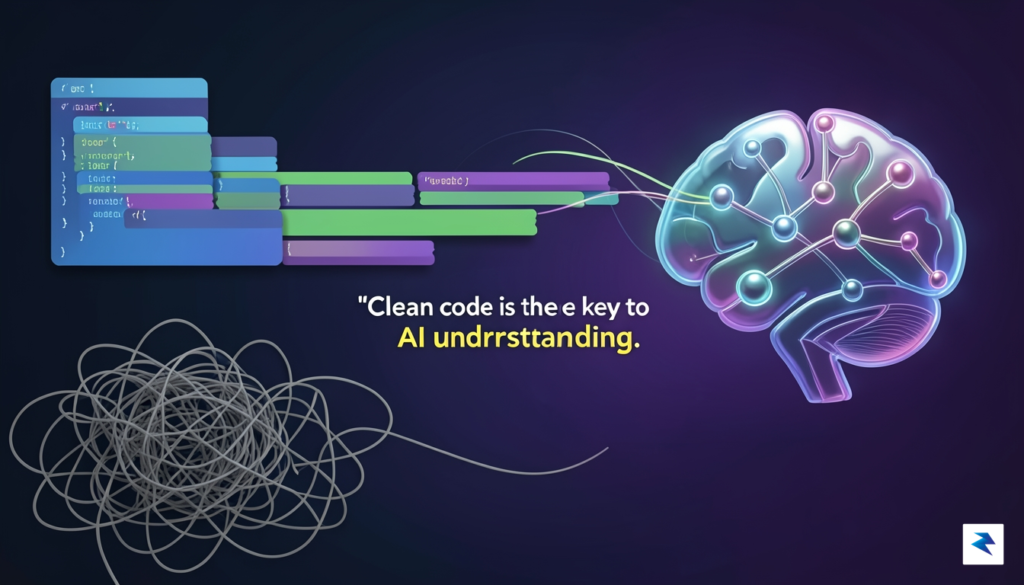

At the architectural level, Large Language Models (LLMs) do not “read” code in the way a human developer parses logic, structure, or intent. Instead, they process code as a sequence of tokens—numerical representations of characters and sub-word units. When an agent is tasked with modifying a codebase, it relies on its attention mechanism to weigh the importance of these tokens. In an ideal environment, the model focuses on the relevant function calls, variable definitions, and architectural patterns. However, when a codebase is burdened with significant technical debt, this mechanism becomes overwhelmed by the sheer volume of “noise” present in the context window.
Excessive technical debt—characterized by dead code, deeply nested conditionals, and inconsistent naming conventions—effectively dilutes the agent’s signal-to-noise ratio. Because the model must ingest every line of code provided to it, bloated or unused modules consume a disproportionate share of its limited “attention.” When the agent attempts to predict the next logical token for a new feature, it is forced to navigate a labyrinth of legacy artifacts. Consequently, the probability of the model latching onto irrelevant patterns increases significantly, leading the agent to prioritize archaic, deprecated logic over modern, intended workflows.

This struggle manifests most dangerously in the form of hallucinations and logical failures. When an agent is forced to process contradictory naming conventions or fragmented documentation, it creates a fractured internal representation of the system’s state. If a function is named inconsistently or buried within redundant, poorly documented wrappers, the model may hallucinate dependencies that do not exist or attempt to invoke parameters that have long since been deprecated. Essentially, the model is trying to perform a complex puzzle while half of its visual field is obstructed by irrelevant data, leading it to invent “missing” pieces that seem statistically probable but are functionally catastrophic.
The quality of the input data dictates the reliability of the output; when code is cluttered with technical debt, the agent’s focus is diverted away from core business logic, transforming a simple refactoring task into a high-risk gamble.
Ultimately, the impact of messy code on AI agents is cumulative. As the agent attempts to build on top of poorly maintained foundations, it frequently compounds the existing debt by introducing new code that mimics the flaws of the old. By failing to maintain a clean, modular structure, development teams inadvertently train their agents to prioritize bad habits. For these systems to function with high precision, they require a clean, well-documented environment where the most important architectural signals are clear, distinct, and free from the distraction of legacy decay.
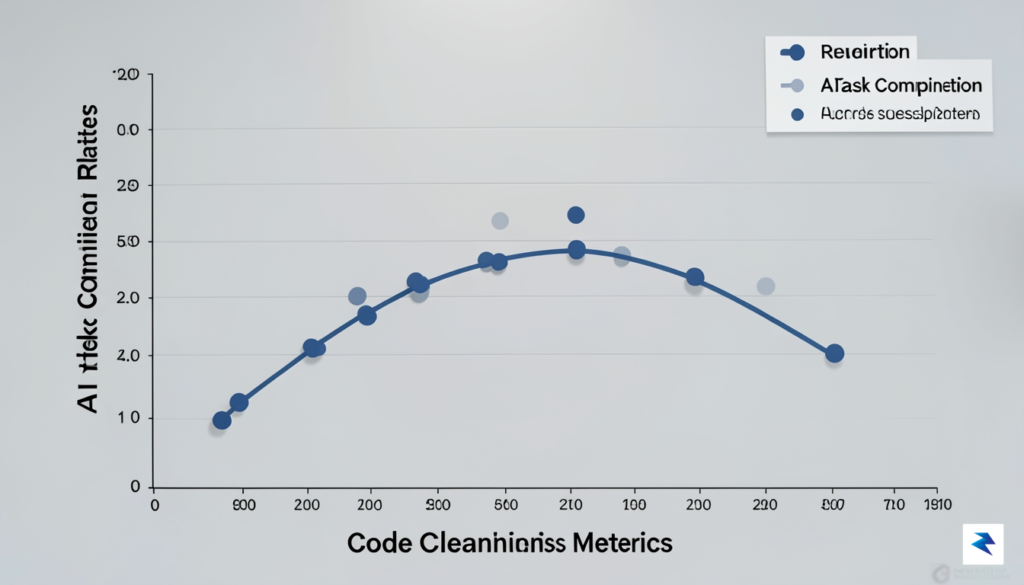
Recent groundbreaking research, exemplified by the arXiv preprint 2605.20049, offers compelling empirical evidence that the cleanliness and structure of a codebase directly correlate with the performance of AI coding agents. This research meticulously demonstrates that when agents are tasked with operating on repositories characterized by modular design, clear documentation, and consistent coding standards, their efficiency skyrockets. Specifically, the study observed a significant increase in agents’ ability to accurately interpret complex logic flows, navigate intricate codebase structures, and ultimately generate valid pull requests (PRs) that require minimal human intervention. Conversely, forcing these sophisticated AI models to grapple with sprawling, undocumented, or inconsistently styled code leads to frustrating cycles of trial-and-error debugging, significantly hindering their ability to contribute meaningfully and prolonging development cycles.
The correlation between modularity and agent success is profoundly intuitive once examined through the lens of an AI. Just as a human developer struggles to grasp a monolithic function spanning hundreds of lines, an AI agent finds it exponentially harder to parse unstructured logic. Modular code, with its clearly defined functions, classes, and components, provides distinct semantic boundaries and predictable interaction patterns that agents can readily understand and leverage. Furthermore, comprehensive docstrings and inline comments act as crucial context clues, guiding the agent through the intended purpose and behavior of various code segments, effectively reducing ambiguity and accelerating the agent’s problem-solving process. This clarity translates directly into fewer misinterpretations by the agent, resulting in more accurate code generation and a higher success rate for automated tasks.
This new understanding forces us to reconsider the traditional “cost” of maintaining clean code. While the upfront investment in refactoring legacy code, writing thorough documentation, and adhering to strict style guides might initially appear to slow down development, the downstream benefits for AI agents are profound. The research implies that this initial “tax” pays dividends by dramatically reducing the iterative cycles of an agent attempting to understand and modify messy code. Instead of the agent spending valuable compute cycles on inferring intent or debugging its own misinterpretations, it can swiftly move from problem identification to solution generation. This ultimately translates into faster feature delivery, fewer bugs introduced by automated agents, and a significant boost in overall developer productivity, where human developers can focus on higher-level architectural challenges rather than babysitting AI outputs.
The emergence of AI coding agents also necessitates the evolution of our code quality standards towards what might be termed ‘AI-readable’ code. Beyond human-centric principles of maintainability and readability, AI-readable code emphasizes elements that make a codebase optimally parseable and understandable for large language models. This could involve stricter adherence to semantic naming conventions, the consistent use of type hints, and perhaps even structured comment blocks that explicitly outline preconditions, postconditions, and edge cases for functions. Imagine a future where static analysis tools not only flag human-unreadable code but also highlight sections that are likely to confuse an AI agent, suggesting improvements tailored for optimal machine comprehension. This paradigm shift encourages developers to not just write code for their peers, but also for the intelligent systems that will increasingly interact with and contribute to their projects.


Preparing a codebase for an AI-integrated future requires a fundamental shift in how we approach technical debt. While humans have long relied on intuition to navigate messy legacy systems, AI agents are strictly bound by the quality of the context they are fed. To ensure your project remains an asset rather than a liability for future automation, you must treat strict type safety as a non-negotiable standard. By implementing comprehensive type hints and utilizing static analysis tools, you eliminate ambiguity for the agent. When an AI understands exactly what data structures are expected in a function—and what they return—it drastically reduces the likelihood of hallucinated parameters or runtime errors that could derail an automated refactoring task.
Beyond type safety, the clarity of your documentation serves as the primary “training manual” for any agent interacting with your repository. An AI cannot ask a colleague for the historical context behind a specific architectural decision, so your docstrings must evolve into exhaustive explanations. It is no longer sufficient to document what a function does; you must articulate the why behind your implementation. If you use JSDoc or Python docstrings to explain edge-case handling or the business logic rationale, you provide the agent with the necessary constraints to make safe, informed code changes without accidentally breaking hidden dependencies.
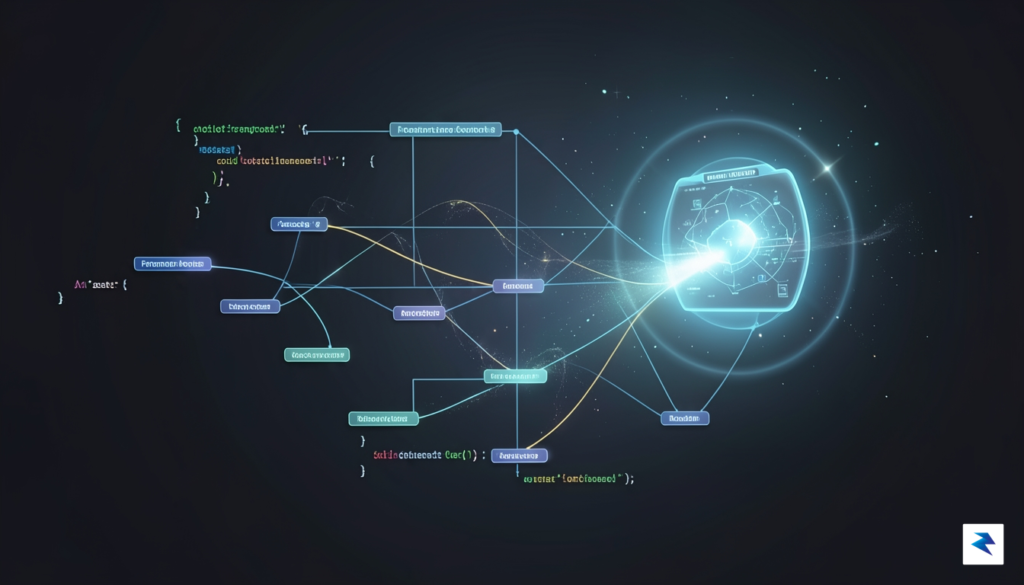
The physical structure of your project is just as vital as the syntax within your files. Agents often struggle when tasked with navigating monolithic files that contain thousands of lines of unrelated logic, as these create high “noise-to-signal” ratios that can confuse the model’s attention mechanism. To mitigate this, prioritize single-responsibility functions and modular file structures. When code is decoupled into smaller, purpose-driven modules, the agent can isolate the specific scope of a task. This modularity allows the AI to perform surgical updates to a single service or utility without needing to load and parse the entire application state into its context window.
Think of your directory structure as an index for an AI. If your folders are logically grouped by feature or domain rather than just technical type, an agent can more easily navigate to the relevant context, reducing the risk of context-window overflow and improving the accuracy of its modifications.
Finally, consistency in naming conventions remains a hidden superpower for AI integration. Because LLMs rely on probabilistic patterns, an inconsistent codebase—where variables are named user_data in one module and clientInfo in another—creates cognitive friction for the model. By enforcing strict linting rules and consistent naming schemas across the entire repository, you create a predictable environment. When the agent encounters a new, unfamiliar module, it can leverage the established patterns of the existing codebase to infer logic, effectively using your own style as a guide for generating new, high-quality code that mirrors your team’s established standard.

The historical narrative of technical debt has shifted dramatically with the emergence of automated coding assistants. In the past, poorly structured code was merely a tax on human cognitive load—a burden that slowed down feature delivery and increased the risk of regressions. Today, that same debt acts as a significant “friction coefficient” for AI agents, effectively limiting their reasoning capacity and increasing the likelihood of hallucinations within the codebase. As we look toward the future, the quality of our software architecture will no longer be viewed as a luxury for human maintainers, but as a prerequisite for the effective deployment of autonomous coding systems. When an AI agent traverses a repository, it relies on clear abstractions and modular design to orient itself; without this clarity, the agent’s performance degrades, leading to brittle patches rather than robust solutions.
We are rapidly approaching an era where the industry will pivot toward the development of specialized “Agent-Compatible” linters and architectural standards. These tools will go beyond checking for syntax errors or basic style violations; they will validate whether a codebase is semantically navigable for large language models. Imagine a development environment that flags “AI-opaque” code—logic that is too deeply nested, overly coupled, or lacking sufficient documentation for an agent to interpret safely. By enforcing these rigorous standards, development teams will essentially be “pre-compiling” their systems for AI, ensuring that the interface between human intent and machine execution remains as frictionless as possible. In this new paradigm, clean code acts as the foundational language that bridges the gap between human architectural vision and machine-generated implementation.

The mastery of clean code is shifting from a craft of human readability to a strategic necessity for machine orchestration.
Ultimately, the human developer’s role is evolving from that of a manual laborer to that of a high-level architect and curator of clarity. While agents are increasingly capable of writing and refactoring vast swaths of logic, they still lack the contextual intuition required to define the long-term vision of a system. By doubling down on clean, intentional, and modular design, we provide the essential guardrails that allow AI to operate at peak efficiency. Those who succeed in this new era will be the developers who view their repositories as a collaborative dialogue with their AI partners, treating code quality as the most critical input for sustainable innovation. As we delegate the heavy lifting of syntax and boilerplate to our digital counterparts, our primary responsibility remains the maintenance of the architectural integrity that keeps these complex systems cohesive, reliable, and fundamentally human-centric.
You must be logged in to post a comment.