
Why Michael Saylor Warns Against Bitcoin’s New ‘Clean-Up’ Proposal
Understanding the BIP-110 Proposal: A Bid to Declutter the Blockchain At its core, Bitcoin Improvement Proposal 110 (BIP-110) represents a…


Before the arrival of the GENIUS Act, the digital asset landscape was often described as a digital “Wild West,” characterized by a fragmentation of state-level oversight and a profound lack of federal guidance. For years, crypto-native firms and traditional financial institutions alike operated in a state of regulatory purgatory, where the rules of the road were dictated by sporadic enforcement actions rather than coherent, forward-looking policy. This environment created a significant barrier to institutional adoption, as the inherent uncertainty made it difficult for major players to integrate blockchain technology into their core operations without fear of future litigation or abrupt policy shifts.
The primary intent of the GENIUS Act was to dismantle this ambiguity by establishing a robust, consistent federal framework. By codifying specific requirements for stablecoin issuers, the legislation sought to transform the sector from a space of speculative volatility into a structured pillar of modern financial innovation. Legislators recognized that stablecoins—the bridge between traditional fiat currency and decentralized blockchain ecosystems—required a unique set of guardrails to prevent systemic risk and ensure consumer protection. This shift was not merely an administrative exercise; it was a fundamental recognition that for digital assets to achieve mainstream legitimacy, they needed to be anchored by transparent, verifiable reserves and rigorous governance standards.
The GENIUS Act didn’t just regulate stablecoins; it redefined the dialogue between innovators and policymakers, moving the needle from skepticism to collaborative stability.
Stablecoins were chosen as the primary focus of the legislation because they serve as the lifeblood of crypto trading, acting as the primary liquidity mechanism for global digital asset markets. Given their role in enabling high-frequency trading and cross-border settlements, the collapse or failure of a major stablecoin issuer would have sent shockwaves throughout the entire global financial system. By mandating that issuers maintain adequate reserves and adhere to strict reporting requirements, the Act effectively neutralized the existential risks that had previously haunted the market. This structural move brought the industry into alignment with broader financial principles, such as asset backing and liquidity management, which are foundational to investor confidence.
As we reflect on the past twelve months, it is clear that the implementation of these standards has had a profound impact on the broader crypto market. The transition from chaotic uncertainty to a regulated environment has acted as a catalyst for institutional participation, allowing capital to flow into the ecosystem with greater security and clarity. While the industry continues to evolve, the GENIUS Act has undeniably succeeded in laying the groundwork for a more mature, stable, and sustainable future for digital finance. The question now is no longer whether crypto can exist within the traditional financial system, but rather how this new regulatory framework will shape the next generation of innovation in the years to come.

Before the passage of the GENIUS Act, the stablecoin market resembled a “wild west” of fragmented state-level oversight, where issuers could cherry-pick jurisdictions with the most lenient reporting requirements. This regulatory patchwork created significant systemic risk, as investors often had little insight into the actual composition of the assets backing their digital holdings. The GENIUS Act fundamentally dismantled this environment by establishing a unified federal framework that mandates rigorous transparency. By requiring issuers to maintain detailed, publicly accessible audits of their reserve assets, the Act has transformed stablecoins from opaque financial products into entities that function closer to traditional regulated money market funds.

At the heart of this transformation are three non-negotiable pillars: reserve transparency, absolute redemption rights, and mandatory capital buffers. Previously, issuers were often vague about whether their “reserves” consisted of high-quality liquid assets like U.S. Treasury bills or riskier commercial paper. Under the new federal mandate, issuers must now hold 1:1 backing in high-liquidity, low-risk assets, and these holdings must be verified by independent third-party auditors on a quarterly basis. Furthermore, the Act codifies the right of redemption, ensuring that users can exchange their digital tokens for fiat currency without being subjected to arbitrary delays or liquidity-based hurdles. This shift has forced a maturation of the sector, weeding out undercapitalized projects that relied on financial engineering rather than actual asset backing.
The GENIUS Act turned “trust me” into “show me,” effectively setting a floor for institutional-grade reliability in the digital asset space.
The transition from state-led oversight to federal authority has been the most significant legal shift in the crypto industry’s history. While state regulators historically focused on money transmitter licenses, the GENIUS Act imposes a federal standard that prioritizes consumer protection and systemic financial stability. This duality—where federal agencies now oversee the systemic risk while state authorities manage day-to-day licensing—has created a clearer, albeit more demanding, path for issuers. While some critics initially argued that such stringent requirements would stifle innovation, the result has been a flight to quality. Established players have embraced these compliance benchmarks as a competitive advantage, signaling to institutional investors that the stablecoin sector is no longer a peripheral experiment, but a foundational component of the modern financial infrastructure.

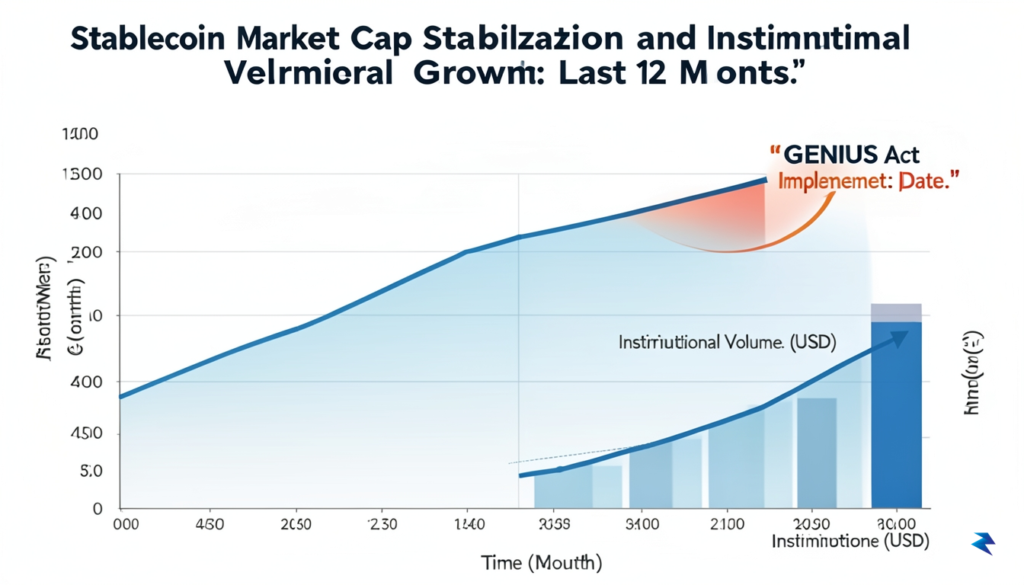
When the GENIUS Act was signed into law one year ago, the primary objective was to transform the volatile stablecoin landscape into a bedrock of digital finance. Looking back at the data, the impact has been far more than symbolic. By mandating rigorous reserve transparency and establishing clear redemption protocols, the legislation has effectively mitigated the systemic risks that once plagued the industry—most notably the catastrophic “de-pegging” events that previously triggered widespread market panics. As a result, the correlation between the Act’s implementation and the stabilization of total stablecoin market capitalization has become increasingly apparent, providing a predictable anchor for traders even during periods of broader macroeconomic uncertainty.
This newfound stability has served as a catalyst for institutional adoption, effectively bridging the gap between legacy financial systems and decentralized protocols. Institutional investors, who were once wary of the opaque nature of stablecoin reserves, now view the regulatory safety net provided by the GENIUS Act as a prerequisite for long-term capital allocation. This transition is evident in the integration of stablecoins into mainstream financial instruments, ranging from cross-border settlement layers to tokenized money market funds. By establishing a framework that treats stablecoin issuers with a level of oversight comparable to traditional payment processors, the Act has successfully lowered the barrier to entry for risk-averse entities that demand both liquidity and compliance.
The GENIUS Act has effectively transitioned stablecoins from a speculative asset class into a foundational utility, proving that regulatory clarity is the most potent tool for fostering market maturation.
Furthermore, the reduction in market volatility during recent crypto cycles speaks to the efficacy of these new standards. Historically, stablecoin instability acted as a multiplier for market-wide crashes; however, the post-GENIUS era has demonstrated a marked decoupling of stablecoin performance from the extreme price swings of the broader crypto market. Liquidity depth has improved significantly, as major exchanges and liquidity providers now operate with a clearer understanding of their legal obligations and reserve requirements. This structural resilience not only protects retail participants from the threat of sudden insolvency but also creates a more efficient marketplace where capital can flow seamlessly, unencumbered by the persistent fear of underlying asset failure.
Ultimately, the past twelve months have served as a stress test for the regulatory framework, and the results suggest that the market has evolved beyond its “wild west” origins. Confidence is no longer built on blind faith in decentralized algorithms alone, but on the verifiable reality of audited reserves and enforced accountability. As institutional players continue to expand their footprint, the GENIUS Act stands as the definitive mechanism that transformed the promise of stablecoins into a reliable instrument for the future of global finance.

While the first year of the GENIUS Act has undoubtedly ushered in a new era of consumer protection and market transparency, it has simultaneously introduced a complex web of operational hurdles for industry participants. The transition from a loosely regulated landscape to a structured federal framework has imposed a substantial cost of compliance that many smaller, emerging issuers were simply not prepared to shoulder. These firms are now tasked with maintaining rigorous, real-time reporting standards and undergoing frequent, independent audits, all of which require significant capital investment and specialized legal expertise. Consequently, what was initially envisioned as a safety net has inadvertently transformed into a barrier to entry, forcing many grassroots projects to pivot their business models or exit the market entirely.
This financial pressure has catalyzed a noticeable trend toward market consolidation, where dominance is increasingly concentrated in the hands of a few well-capitalized, institutional-grade players. Because only the largest issuers can comfortably absorb the recurring costs of high-level compliance infrastructure, the diversity of the stablecoin ecosystem has diminished. Smaller, innovative teams that once brought unique utility to the space are finding themselves squeezed out, unable to match the deep pockets of their larger competitors. This shift is particularly concerning for proponents of decentralization, as it suggests that the regulatory cost of doing business may be fostering an oligopolistic environment rather than a competitive, level playing field.

The paradox of the GENIUS Act lies in its dual nature: by mandating higher standards to ensure solvency, it has effectively raised the floor for participation, thereby shrinking the pool of available innovators.
Operational friction remains a significant point of contention as well, particularly for teams struggling to keep pace with evolving federal guidelines. The ambiguity surrounding certain technical mandates has forced engineering departments to allocate valuable development time toward administrative compliance rather than product innovation. Teams are often caught in a cycle of constant iteration, attempting to retrofit legacy codebases to satisfy shifting regulatory interpretations. This environment creates a culture of reactive development, where the focus is shifted away from building decentralized financial solutions and toward satisfying the granular, often rigid, requirements set forth by federal examiners. Ultimately, while the industry is undeniably more stable than it was a year ago, the path forward requires a more nuanced approach to regulation that encourages security without stifling the very competition that makes the crypto sector thrive.

The first year of the GENIUS Act has served as a vital stress test for the intersection of emerging technology and legislative oversight. While the Act provided a necessary foundation for standardizing reporting requirements and consumer protections, it is increasingly clear that this is merely the opening chapter of a much longer regulatory saga. As the crypto ecosystem pivots toward increasingly complex decentralized finance (DeFi) protocols and the infrastructure for cross-border digital asset movement, policymakers will face the challenge of reconciling rigid, localized legal frameworks with the inherently borderless and permissionless nature of blockchain technology. The current legislation provides a blueprint, but the next phase of policy will likely require a shift from reactive oversight to proactive, technology-neutral standards that can evolve alongside the code itself.

Looking ahead, we can expect future legislative efforts to center on the delicate tension between fostering homegrown innovation and mitigating systemic financial risks. Critics and proponents alike argue that the GENIUS Act, while stabilizing, may inadvertently create a “compliance moat” that favors established incumbents over lean, experimental startups. Consequently, forthcoming amendments or follow-up acts will likely emphasize “regulatory sandboxes”—controlled environments where developers can test new DeFi instruments under the supervision of regulators without the immediate burden of full-scale institutional compliance. This approach aims to preserve the spirit of decentralization while ensuring that the guardrails protecting retail participants remain robust.
The true success of the GENIUS Act lies not in its initial rigidity, but in its ability to spark a global conversation about how sovereign nations can harmonize their digital asset policies to prevent regulatory arbitrage.
Furthermore, the path forward must address the persistent issue of cross-border interoperability. As different jurisdictions attempt to impose their own versions of the GENIUS Act, the industry risks becoming fragmented, which would ultimately stifle the global liquidity that makes crypto unique. It is highly probable that the next stage of policy will involve international cooperation agreements, seeking to create a unified framework for digital identity and anti-money laundering (AML) protocols that function across borders. By treating the GENIUS Act as a flexible template rather than a static rulebook, global regulators have the opportunity to build a resilient, inclusive financial system that bridges the gap between traditional banking and the decentralized future.
You must be logged in to post a comment.