Understanding the UsbLiteR8 Vulnerability
The core of the UsbLiteR8 exploit lies within the device’s SecureROM, which serves as the immutable, read-only memory responsible for the very first stage of the iPhone’s boot process. Because this code is physically burned into the processor hardware during the manufacturing phase, it exists beneath the layer of the operating system that Apple’s engineers can typically reach. In standard scenarios, Apple pushes over-the-air (OTA) updates to patch software vulnerabilities, but because UsbLiteR8 exists at the hardware level, it remains permanently accessible to those who know how to trigger it. Consequently, this creates a situation where the affected devices are essentially “hard-wired” with a security flaw that no amount of code-based patching can ever truly erase.
To understand the implications for everyday users, it is essential to recognize the mechanism of the exploit itself. UsbLiteR8 functions by intercepting the communication protocols used during the initial startup sequence, allowing an attacker to bypass the signature checks that normally ensure only authorized code runs on the device. By exploiting this gap, a malicious actor can gain elevated privileges before the operating system even finishes loading. This effectively grants the attacker control over the device’s kernel, potentially allowing them to decrypt sensitive data or circumvent security restrictions that protect user privacy. Because the vulnerability is baked into the silicon, every iPhone model shipped with this specific SecureROM architecture remains susceptible to this technique for the remainder of its functional lifespan.
Despite the severity of the threat, the primary prerequisite for an UsbLiteR8 attack is the requirement of physical access to the device. Unlike remote exploits that can be deployed through a malicious website or a compromised email attachment, this vulnerability cannot be triggered wirelessly or from a distance. An attacker must have the physical iPhone in their hands and be able to connect it to a specialized interface, such as a laptop or a malicious charging station, to execute the exploit code. This significantly lowers the risk for the average consumer who keeps their device under their personal control at all times; however, it remains a critical concern for high-value targets, journalists, or travelers who might leave their devices unattended in potentially insecure environments.
The permanence of the UsbLiteR8 flaw means that older hardware—even if running the latest compatible version of iOS—will always harbor this entry point, shifting the burden of security from software updates to physical device management.
Ultimately, while the discovery of UsbLiteR8 is a significant milestone in the world of mobile security research, it does not mean that every older iPhone is currently being compromised. Instead, it serves as a stark reminder that as hardware ages, it inevitably falls behind the rapidly evolving landscape of cybersecurity defenses. Users holding onto older devices should remain vigilant about where they charge their phones and who handles their hardware, as the physical security of the device has now become just as important as the digital security of the apps installed upon it.
How SecureROM Exploits Bypass Traditional Security
To truly grasp the gravity of this vulnerability, one must first understand the architecture of the “chain of trust” that governs every Apple device. In a healthy system, the startup process is a strictly controlled sequence where each stage verifies the digital signature of the next before handing over control. This chain begins with the SecureROM—a read-only piece of code etched directly into the silicon during the manufacturing process. Because it is physically immutable, the SecureROM serves as the immutable Root of Trust, acting as the foundation upon which the entire security architecture of the iPhone is built. By compromising this initial link, an attacker effectively gains a “god-mode” level of access before the operating system, or even the initial security checks, ever have a chance to run.
When a vulnerability exists at the SecureROM level, it bypasses the traditional software-based defenses that keep iOS secure. Typically, bugs are discovered within the operating system itself, which means they are subject to sandboxing, kernel protections, and code-signing requirements that Apple can patch via over-the-air updates. However, because the SecureROM is hardware-locked, it is nearly impossible for Apple to issue a traditional software fix to address the flaw once the device has left the factory. An attacker exploiting this stage can force the device to run arbitrary, unsigned code, effectively blinding the device’s security sensors before the passcode protections, encryption keys, or system integrity monitors are even initialized.
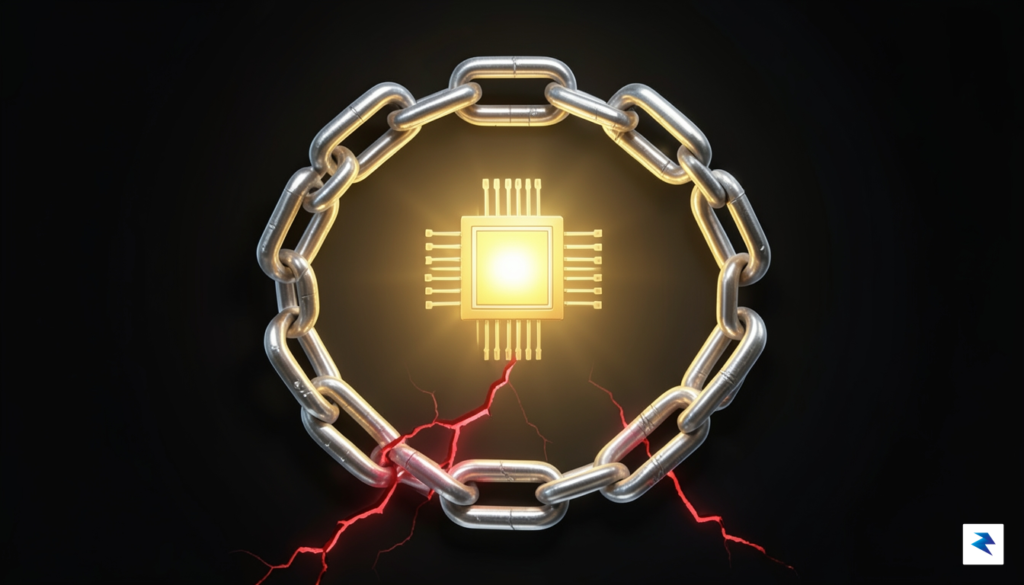
By gaining control at the boot level, the attacker essentially hijacks the iPhone’s identity before it can verify its own integrity.
This level of compromise is significantly more dangerous than standard malware or application-layer exploits. While a typical virus might struggle to gain administrative privileges within the iOS environment due to strict permission models, a boot-level exploit operates beneath the OS, rendering those permissions irrelevant. An attacker with this level of access can potentially bypass the passcode lock, extract sensitive encrypted data that is usually protected by the Secure Enclave, or disable remote management features. Because the exploit occurs during the very first milliseconds of the boot sequence, the device is already compromised by the time the Apple logo appears on the screen, making the entire ecosystem of software-based security updates essentially ineffective against this specific threat vector.
The Risk Profile: Why Older Devices Are Targets
A recent revelation concerning a hardware-level exploit has understandably generated significant concern, with headlines often highlighting that “millions” of devices are potentially vulnerable. However, it’s crucial to contextualize this news to understand the genuine risk to your personal devices. This particular exploit targets a specific component known as SecureROM, which is embedded directly into the silicon of older Apple chips. Consequently, the affected hardware generations span from the A5 chip all the way up to the A11 Bionic chip. This means iPhones ranging from the iPhone 4S up to the iPhone X, and numerous iPads including the iPad 2, various iPad mini models, and some iPad Pro generations, are inherently susceptible to this vulnerability due to their foundational hardware design.
Crucially, the nature of this exploit defines its threat model: it is a “physical access” vulnerability. This is a critical distinction, as it means a remote attacker cannot exploit your device over the internet, through a malicious link, or via Wi-Fi. Instead, for an attacker to leverage this exploit, they must have your device in their physical possession, connect it to a computer via USB, and then manually put the device into a specific diagnostic mode (DFU mode). This significantly raises the bar for exploitation compared to software vulnerabilities that can often be triggered without direct interaction, dramatically narrowing the practical scenarios where most users would face an immediate threat.
Therefore, the real-world likelihood of an attack hinges almost entirely on whether your device falls into the wrong hands. Scenarios where this vulnerability becomes a tangible risk primarily involve lost or stolen devices. If your older iPhone or iPad is taken, an individual with the requisite knowledge and tools could potentially bypass its security to gain access to the underlying operating system and, by extension, your data. Furthermore, in high-security environments, such as corporate espionage or state-sponsored surveillance, where hardware tampering is a calculated risk, this type of unpatchable exploit represents a more pronounced concern, as adversaries are equipped and motivated for such sophisticated attacks.
Given its hardware-rooted nature, Apple cannot issue a software update to patch this specific vulnerability on the affected devices. This means that any device with an A5 to A11 chip will perpetually carry this inherent susceptibility. For the average user, the most effective mitigation remains robust physical security measures: never leave your device unattended, use strong passcodes, and consider enabling “Find My” features to enhance recovery chances if lost. While the news of millions of vulnerable devices can seem alarming, understanding that physical access is the gateway to exploitation fundamentally changes the risk assessment, reassuring most users who diligently protect their devices that their day-to-day risk remains relatively low.
Security Best Practices for Legacy Hardware

If you find yourself holding onto an older iPhone that is no longer eligible for the latest security patches, you do not necessarily need to rush out and discard your device. However, relying on hardware that is susceptible to vulnerabilities like UsbLiteR8 requires a significant shift in your digital hygiene. Because these exploits often rely on physical access to the device’s charging port, your primary defense strategy must revolve around strict physical custody. You should treat your phone as you would a physical wallet or a set of house keys; never leave it unattended in public spaces, shared offices, or even in the pockets of coats hanging in unsupervised areas. By keeping the device on your person at all times, you effectively eliminate the window of opportunity that an attacker needs to interface with your hardware.

Beyond physical custody, it is time to reconsider the complexity of your device’s access credentials. While biometric authentication like Touch ID or Face ID offers undeniable convenience, it can sometimes be bypassed or compelled in ways that a strong, alphanumeric passcode cannot. Transitioning from a simple four or six-digit PIN to a long, complex alphanumeric password significantly increases the time and computational power required to brute-force your device’s encryption. This added layer of friction makes it much more difficult for an adversary to extract sensitive data, even if they manage to gain temporary physical control of your hardware. By prioritizing entropy over ease of access, you turn your device into a much harder target for automated exploitation tools.
It is also essential to perform an honest assessment of the data you choose to store on legacy hardware. If you frequently handle highly sensitive information—such as corporate credentials, unencrypted personal financial documents, or private communications—it is prudent to migrate that data to a newer, fully supported device that receives regular security updates. For users who cannot upgrade immediately, consider using your older iPhone strictly for non-sensitive tasks, such as offline media consumption or basic utility functions, while keeping sensitive data off the device entirely. Understanding this trade-off between the convenience of an older device and the risks of aging hardware is a crucial step in maintaining a robust security posture in an era of sophisticated, hardware-level exploits.
To maximize protection on legacy hardware, prioritize physical security, adopt complex alphanumeric passcodes, and restrict the storage of sensitive data to devices that remain within the active support lifecycle.
Ultimately, security is not a static state but a continuous process of risk management. If you must use an older device, remain hyper-vigilant about the physical environments where you charge your phone, as public USB ports and unverified charging cables are primary vectors for hardware-based attacks. By staying informed about the limitations of your hardware and adjusting your usage habits accordingly, you can continue to use your older iPhone effectively without leaving your personal data unnecessarily exposed to modern threats.
The Future of Hardware-Level Security Patching

The recent emergence of hardware-level vulnerabilities highlights a fundamental, industry-wide tension: the conflict between the immutability of physical silicon and the fluid, constantly evolving landscape of cybersecurity. For decades, manufacturers have relied on the assumption that once a chip leaves the factory, its logic is set in stone, providing a stable foundation for software to run upon. However, as software-based defenses have become increasingly sophisticated, attackers have shifted their focus downward, targeting the very bedrock of the device architecture where traditional patching mechanisms often cannot reach. This transition forces us to confront the reality that when a flaw is baked into the physical circuitry, the cost of remediation shifts from a simple digital download to a potentially massive logistical and financial burden.
In response to these persistent threats, companies like Apple have pioneered the use of highly specialized components, such as the Secure Enclave, to isolate critical cryptographic processes from the main operating system. By creating these hardware-backed “vaults,” manufacturers hope to create a hardened perimeter that remains resilient even if the primary software is compromised. Yet, the UsbLiteR8 incident serves as a stark reminder that even these fortresses are not invincible. When a vulnerability exists within the hardware design itself, it creates an architectural blind spot that software updates are fundamentally incapable of closing. This leaves millions of users with a difficult choice: accept a permanent security deficit or upgrade to newer hardware that has been redesigned to mitigate the specific flaw.

The Path Toward Resilient Architectures
Moving forward, the industry must fundamentally rethink how it approaches hardware design by prioritizing “agile security” models. Rather than relying on rigid, hard-coded logic, the next generation of semiconductors must incorporate more robust, updateable hardware security modules (HSMs) that allow for a greater degree of post-market modification. By introducing programmable logic gates or microcode-updateable security controllers, manufacturers could potentially patch vulnerabilities at the firmware level without requiring a complete hardware recall. This evolution would essentially bring the flexibility of software updates down to the silicon level, effectively shrinking the “window of vulnerability” that currently plagues aging devices.
True hardware security in the modern era will no longer be defined by the permanence of a chip, but by its capacity to adapt to threats that were unforeseen at the time of its manufacturing.
Ultimately, the burden of security must be shared between the manufacturer’s commitment to longevity and the consumer’s understanding of hardware lifecycles. While it is technically impractical to make every aspect of a processor infinitely updateable, the industry must strive for a middle ground where critical security layers are decoupled from the core CPU. As long as security remains tethered to fixed physical designs, the cat-and-mouse game between hardware engineers and malicious actors will continue to escalate. By investing in modular, updateable security architectures, the tech industry can begin to transition away from a model of “planned obsolescence” toward one of “enduring resilience,” ensuring that even older devices retain a baseline of safety in an increasingly hostile digital environment.