The New Frontier of Stadium Security

For decades, the standard blueprint for securing a major sporting event was built on the foundation of physical containment. Stadium operations focused on the “hard perimeter”—a collection of concrete barriers, heavy vehicle checkpoints, and exhaustive bag checks designed to funnel thousands of fans through a series of human-centric filters. While metal detectors and ticket scanners effectively neutralized threats originating from the ground, the rapid proliferation of unmanned aerial systems (UAS) has rendered these traditional security models increasingly obsolete. The looming arrival of the World Cup has forced a radical reimagining of what it means to protect a crowd, shifting the focus from the stadium floor to the skies directly above it.
The challenge posed by drones is uniquely disruptive because they bypass the physical geometry of a venue entirely. Unlike a disgruntled individual attempting to breach a gate, a drone can be deployed from miles away, traversing urban landscapes at high speeds to deliver a payload or capture sensitive surveillance data without ever triggering a terrestrial alarm. This shift requires security planners to think in three dimensions. Modern threat actors no longer need to navigate a dense police presence to exert influence; they simply need a line of sight and a remote controller. Consequently, the invisible threat of UAS has forced cities to treat the airspace above their stadiums as a critical, vulnerable extension of the venue itself.
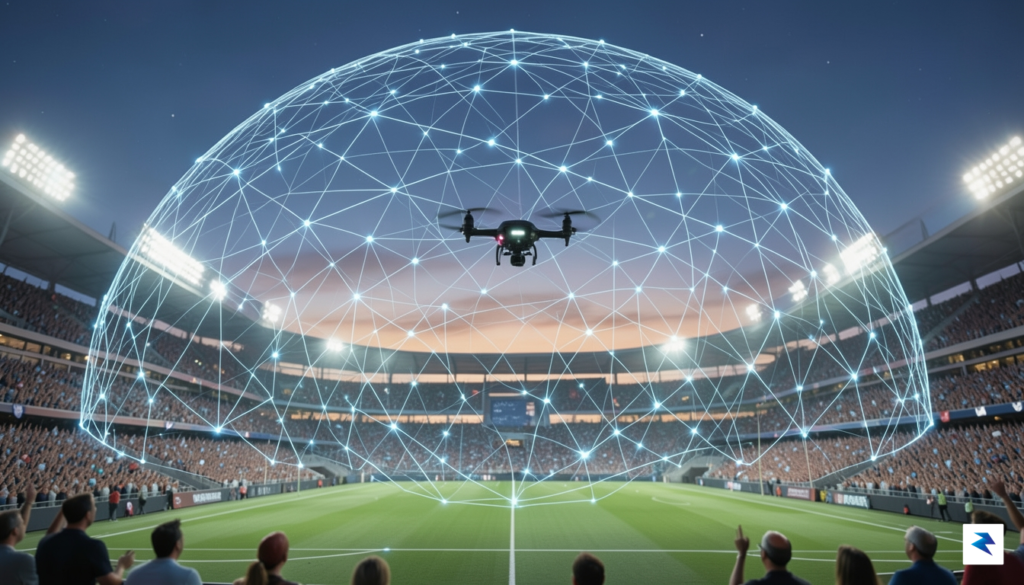
To combat this, the infrastructure of match-day security is undergoing a technological metamorphosis. We are seeing a move away from simple, reactive measures toward a proactive, sophisticated ecosystem of airspace monitoring. Cities are now integrating multi-layered sensor suites that include radio frequency analyzers, acoustic sensors, and optical tracking systems capable of identifying a drone’s make, model, and pilot location within seconds of takeoff. This represents a fundamental change in philosophy: security teams are no longer just waiting to see if something happens at the gate; they are actively patrolling the electromagnetic spectrum to neutralize potential incursions before they ever reach the stadium atmosphere.
The integration of counter-drone technology is not merely an upgrade to existing equipment; it is a complete restructuring of the security perimeter to include the vast, previously unmonitored space above our heads.
Ultimately, this pivot toward counter-drone defense reflects a broader acknowledgment that the future of public safety is inextricably linked to technological sophistication. As we look toward the 2026 World Cup, the success of these security measures will depend on the seamless fusion of artificial intelligence, real-time data processing, and rapid inter-agency communication. By investing heavily in these invisible shields, host cities are attempting to stay one step ahead of a new generation of threats, ensuring that the spectacle on the pitch remains the primary focus while the skies above remain secure.
Understanding the $250 Million Federal Investment
The United States is gearing up to host one of the world’s most watched sporting events, and with it comes an unprecedented federal investment in security infrastructure. A substantial $250 million injection from the Federal Emergency Management Agency (FEMA) is fundamentally reshaping the defensive capabilities of host cities. This significant financial commitment is specifically earmarked for enhancing local law enforcement’s ability to counter emerging aerial threats, primarily through the acquisition and deployment of state-of-the-art counter-drone systems. This targeted funding marks a pivotal moment in event security, reflecting a proactive strategy to safeguard massive international gatherings against increasingly sophisticated unmanned aerial vehicle (UAV) risks, thereby elevating the safety standards for such high-profile events.
The strategic necessity behind this colossal investment is undeniable, particularly when considering the sheer scale and global visibility of the upcoming World Cup. Host cities anticipate millions of international visitors and spectators, creating complex logistical and security challenges across numerous venues and public spaces. In such high-density environments, even a small, commercially available drone, if operated maliciously, could pose significant threats ranging from unauthorized surveillance and disruptive interference to potential acts of terrorism or contraband delivery. Consequently, ensuring the integrity of the airspace above stadiums, fan zones, and critical urban infrastructure becomes paramount, requiring a robust, multi-layered defense strategy designed to detect, track, and neutralize unauthorized aerial intrusions before they can cause harm or panic. This proactive stance aims to provide peace of mind for attendees and demonstrate a commitment to unparalleled safety standards.
Delving deeper into the allocation, the $250 million is facilitating a comprehensive procurement strategy that encompasses both cutting-edge hardware and sophisticated software suites for airspace detection and mitigation. On the hardware front, cities are investing in advanced radar systems capable of detecting small, fast-moving objects at considerable distances, alongside radio frequency (RF) sensors that pinpoint drone control signals and acoustic sensors that can identify the unique sound signatures of various UAVs. Complementing these physical detection devices are an array of interdiction tools, which may include signal jammers designed to disrupt drone communications, kinetic solutions like net guns or specialized interceptor drones, and potentially even directed energy systems for more advanced scenarios. This combination ensures a physical capability to respond to identified threats.
However, the efficacy of these hardware components is greatly amplified by the integration of
How Counter-Drone Technology Works in Urban Centers

To effectively secure a bustling metropolis during a high-profile event like the World Cup, security agencies must deploy a multi-layered sensor network capable of distinguishing a malicious drone from the thousands of legitimate, everyday electronic signals. The foundation of this system typically begins with passive radio frequency (RF) sensors that “listen” for the communication links between a drone and its controller. By analyzing these specific frequency signatures, the system can identify the make and model of the aircraft, often pinpointing the location of the pilot before the drone even enters a restricted airspace. When combined with active radar—which sends out pulses to detect physical movement in the sky—security teams can track objects that may not be broadcasting a signal, such as autonomous drones flying on pre-programmed flight paths.

Once a potential threat is identified, the challenge shifts to precision tracking and verification. Urban environments are notoriously difficult for these systems, as buildings create “multipath” interference where radar signals bounce off glass and steel, creating phantom objects. To solve this, advanced optical and infrared cameras are slaved to the detection grid, automatically pivoting to verify the visual identity of the target. This ensures that a flock of birds or a passing delivery drone isn’t mistaken for a security risk, preventing unnecessary panic or the premature activation of mitigation measures.
Effective counter-drone defense in a city is less about raw power and more about the surgical ability to filter noise, ensuring that emergency measures do not disrupt the digital infrastructure that keeps the city running.
Mitigation is the most complex component of the defensive suite, as it requires carefully managing the electromagnetic spectrum. While many might assume that security forces simply “shoot down” drones, modern systems lean heavily toward non-kinetic “soft kills.” These methods use directional RF jammers to disrupt the link between the drone and its operator or to override the drone’s GPS navigation, effectively forcing it to hover in place or return to its launch point. Because metropolitan areas rely on vital civilian communications—ranging from cellular networks to emergency responder radios—engineers must use highly directional, low-power signals. This “surgical” approach ensures that security teams neutralize the threat without accidentally cutting off the internet for thousands of spectators or interfering with critical public safety communications.
The Legacy of Surveillance: Post-Tournament Implications

When the final whistle blows and the crowds disperse, the sophisticated counter-drone arrays currently being installed across major U.S. host cities will not simply vanish. Instead, these metropolitan areas are treating the 2026 World Cup as a catalyst for a permanent upgrade to their public safety infrastructure. By integrating high-frequency sensors, radio-frequency jammers, and advanced artificial intelligence for threat detection, cities are effectively layering a persistent digital net over urban centers that was previously unthinkable. This shift represents a transition from reactive, event-specific security to a model of continuous, automated aerial oversight, leaving residents to grapple with the reality that the “temporary” protection measures are destined to become fixtures of the local landscape.
The core of this transition lies in the “dual-use” nature of modern defense technology. While these systems are marketed to the public as vital tools for neutralizing rogue drones during high-profile sporting events, they are equally capable of monitoring non-hostile aerial activity in everyday civic life. City officials have begun framing these assets as versatile instruments for disaster response, search and rescue operations, and traffic management, arguing that the taxpayer investment is justified by these broader applications. However, this repurposing creates a slippery slope where surveillance tools developed for military or specialized security contexts are quietly normalized for standard municipal operations, often without the explicit public debate or legislative oversight that such a significant shift in civil surveillance warrants.

The true cost of these security systems is not just the initial procurement price, but the multi-decade commitment to maintaining a digital ecosystem that requires constant software evolution and operational oversight.
Furthermore, the financial burden of these systems extends far beyond the initial procurement phase. Investing in counter-drone tech is not a one-time purchase; it is the beginning of a long-term fiscal commitment. These complex software-defined systems require regular patches, cybersecurity updates, and hardware maintenance to remain effective against the rapidly evolving threat landscape of hobbyist and malicious drone technology. As software subscriptions expire and hardware reaches its end-of-life, municipalities will find themselves locked into vendor ecosystems, forcing local governments to allocate recurring budget lines for “security maintenance.” Consequently, the legacy of the World Cup will be felt in municipal budgets for years to come, as cities prioritize the upkeep of this aerial surveillance apparatus over other essential public services, effectively tethering the future of urban safety to the continuous maintenance of an ever-watchful high-tech shield.
Balancing Public Safety and Civil Liberties

The rapid deployment of counter-drone technology across U.S. cities preparing for the upcoming World Cup signals a profound shift in urban security, yet this technological escalation brings significant privacy risks that remain largely unaddressed. As law enforcement agencies integrate sophisticated radar, radio-frequency scanners, and signal-jamming equipment into their municipal infrastructures, they are essentially creating a net that captures more than just illicit aircraft. These systems often operate by intercepting the telemetry and data signals of any drone within range, which means that the personal devices and data packets of innocent hobbyists or commercial operators can be swept up in the dragnet. Without clear protocols on data retention or the immediate destruction of information gathered from non-threatening civilian drones, the potential for persistent, localized surveillance grows exponentially.
Currently, the regulatory landscape remains fragmented, creating a dangerous vacuum where local police departments often act with limited oversight. Unlike federal intelligence agencies that must adhere to stringent constraints regarding domestic surveillance, municipal departments are purchasing and deploying these technologies with a wide range of autonomy. There is an urgent lack of national standards governing how counter-drone data is stored, shared, or utilized, leaving citizens in a state of uncertainty regarding how their movements and private data are being cataloged. This lack of transparency is compounded by the fact that many of these surveillance tools are proprietary, meaning the public cannot easily audit the algorithms or the detection methods being used to monitor their neighborhoods.

The fundamental challenge lies in determining where the protection of a high-profile public event ends and the erosion of individual anonymity begins.
The core of the issue rests on the delicate balance between the undeniable necessity of national security and the preservation of civil liberties. Proponents of these systems argue that the threat of drone-based attacks or unauthorized surveillance at large-scale events is too great to ignore, making proactive defense measures an essential component of modern public safety. However, critics warn that normalizing “fortress-style” security in civilian spaces sets a precarious precedent. When public squares and stadiums become zones of constant electronic scrutiny, the psychological effect—often called the “chilling effect”—can discourage free expression and assembly. Ultimately, the question is not whether cities should be secure, but whether the methods used to guarantee that security will permanently alter the relationship between the state and the privacy rights of the individuals they are sworn to protect.