
Understanding the $44,000 Bitcoin Prediction

The current cryptocurrency landscape is defined by a palpable sense of apprehension, as investors grapple with macroeconomic headwinds and shifting liquidity trends. While Bitcoin has historically acted as a bellwether for digital asset performance, the prevailing sentiment has recently soured, moving from cautious optimism to a defensive posture. This transition is not occurring in a vacuum; it is being driven by institutional skepticism and the realization that the rapid capital inflows witnessed earlier this year may be unsustainable in the face of persistent interest rate uncertainty and cooling investor enthusiasm.
Central to this cooling sentiment is a stark forecast from key industry figures, most notably those embedded deep within the Bitcoin mining ecosystem, who argue that a significant downward correction is imminent. The projection of a decline toward the $44,000 level is not merely speculative noise, but rather a calculated assessment of the post-halving reality where operational costs are squeezing profit margins. When miners—the very backbone of the network—begin to voice concerns about the long-term viability of current price floors, the broader market typically takes notice. These players possess a unique vantage point, as they are directly exposed to the intersection of energy costs, hardware depreciation, and the dwindling block rewards that define their bottom line.
The logic behind the $44,000 target often revolves around the concept of the “miner break-even” point. As mining difficulty remains near historic highs, the cost to mint a single Bitcoin has risen substantially, forcing less efficient operators to liquidate their holdings to stay afloat. If the market fails to provide sufficient buying pressure to absorb this forced selling, the price is naturally pushed toward a lower equilibrium where only the most efficient rigs can remain profitable. This creates a reflexive feedback loop: as the price drops, miner capitulation accelerates, which in turn applies further downward pressure on the market.
The $44,000 threshold represents more than just a psychological support level; it is a critical juncture where the fundamental cost of network security meets the current realities of market demand.
Understanding this outlook requires a shift in perspective from pure price action to the underlying market structure. Market volatility is rarely a random event; it is frequently the result of structural adjustments as the industry reconciles the gap between speculative hype and fundamental utility. By examining why industry insiders are sounding the alarm, we can better prepare for the potential for a deeper correction and evaluate whether such a drop would signify a terminal trend or merely a healthy reset for the next bull cycle. As we delve further into the technical indicators, it becomes clear that the path ahead for Bitcoin remains fraught with challenges that every serious market participant must consider.
Decoding the mNAV Signal in Crypto Markets

At the heart of modern institutional analysis lies the Market Net Asset Value (mNAV), a specialized valuation metric that measures the relationship between the market capitalization of public Bitcoin mining companies and the actual value of their underlying asset holdings. By calculating the ratio between the total valuation of these miners and their Bitcoin reserves, analysts can determine whether the sector is trading at a premium or a significant discount relative to the spot price of the cryptocurrency itself. This tool serves as a powerful barometer for institutional sentiment, reflecting how professional capital allocates resources based on perceived future value versus current market liquidity.
Currently, the mNAV has contracted to approximately 0.72, a figure that has sent ripples of concern throughout the investment community. When this ratio falls below 1.0, it indicates that investors are effectively buying Bitcoin through these public companies at a discount compared to purchasing the asset directly on an exchange. The drop to 0.72 suggests a profound valuation gap, signaling that the market is currently pricing in substantial headwinds for miners, including operational costs, energy efficiency pressures, and the looming threat of further downside volatility in the spot price of Bitcoin.
The 0.72 threshold is not merely a number; it acts as a critical cycle marker that often precedes major market capitulation phases or, conversely, provides a high-conviction signal for value-oriented institutional buyers.
The relationship between stock-based proxies and the underlying spot price of Bitcoin is inherently tethered to miner profitability and operational health. As the spot price faces downward pressure, the operational margins of these miners compress, leading to an erosion in the market value of their shares that often outpaces the decline of Bitcoin itself. This leverage creates a feedback loop: as miner stocks underperform, the mNAV drops further, which in turn reinforces a bearish outlook among institutional traders who use these stocks as a liquid proxy for the crypto market. Consequently, the performance of these mining equities becomes a lead indicator, revealing the underlying stress and risk appetite within the broader digital asset space.
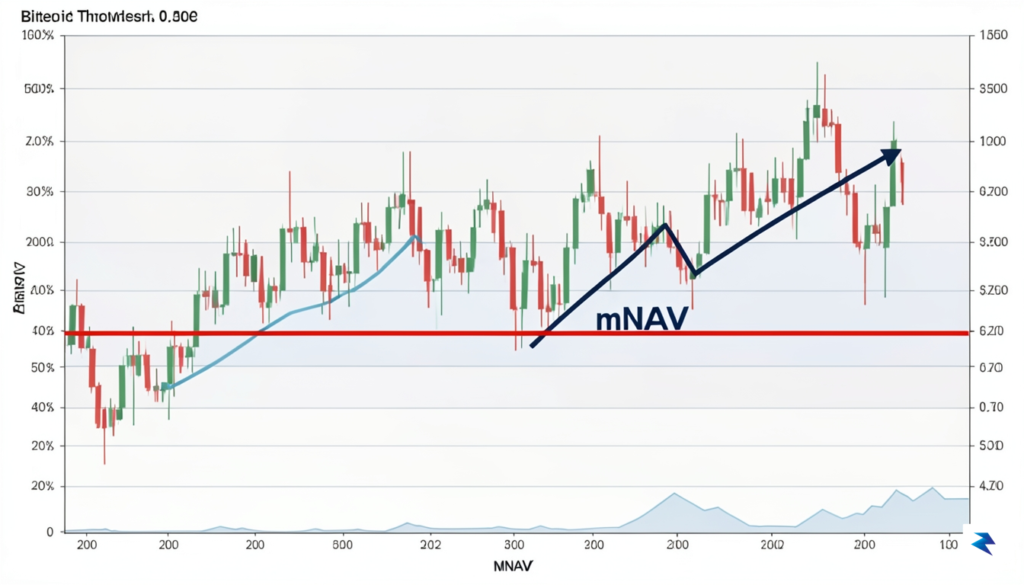
Understanding this metric is essential for any investor looking to navigate the current cycle, as it highlights the disparity between emotional market pricing and the intrinsic value of held assets. If the mNAV continues to hover at these depressed levels, it provides strong empirical evidence that the market is bracing for a sustained correction. By monitoring these shifts, observers can better anticipate whether the sector is preparing for a bottoming process or if additional downside is required to rebalance the valuation disconnect between mining operations and the assets they hold.
Historical Cycles and the Six-Month Lag
Market history in the cryptocurrency space often rhymes, even if it rarely repeats with exact precision. When examining the anatomy of previous bear markets, a recurring theme emerges: the relationship between valuation distress signals and the eventual formation of a durable price floor. Historically, there has been a persistent six-month lag between the initial emergence of bearish exhaustion indicators and the actual bottoming out of the asset’s price. This temporal delay is not merely a coincidence; it reflects the complex psychological and structural transition required for institutional and retail capitulation to fully manifest in the order books.
During the 2018 and 2022 cycles, this six-month window served as a period of prolonged uncertainty, where sentiment indicators signaled a bottom long before the spot price actually stabilized. By analyzing the current timeline relative to recent valuation metrics, it becomes clear that we may still be traversing this intermediate period of volatility. If the pattern holds, the market is currently navigating the final phase of the “lag period,” where liquidity is slowly drained from weaker hands before the asset reaches a level of undervaluation that finally attracts long-term institutional accumulation.
The six-month lag is more than just a historical curiosity; it is a manifestation of market inertia, where the decoupling of technical signals from price action highlights the time required for macro-economic pressures to fully permeate global liquidity conditions.
The statistical significance of this timeframe is bolstered by the maturation of Bitcoin as an asset class. In the early years of the network, market cycles were compressed due to low liquidity and a lack of sophisticated hedging instruments. Today, however, the presence of institutional derivatives, ETFs, and global macroeconomic sensitivity has lengthened these cycles. This maturation means that price corrections are no longer instantaneous “flash crashes” but rather grinding, multi-month processes. Consequently, the six-month lag acts as a buffer, allowing the market to digest fundamental shifts in interest rates and regulatory environments before a true floor can be established.
Ultimately, understanding this temporal dimension is crucial for those attempting to forecast the year-end outlook. If we accept that the current cycle is adhering to the established historical rhythm, then a drop toward the $44,000 range would not be an anomaly, but rather the logical conclusion of this structural delay. Investors should view this potential decline not as a signal of systemic failure, but as a continuation of the cyclical flushing of leverage that has preceded every major bull run in Bitcoin’s history. As we move closer to the projected timeframe, the market’s ability to find support at these lower levels will define the trajectory for the next phase of growth.
Navigating Volatility for Long-Term Investors

For the long-term investor, Bitcoin’s inherent volatility is not a bug, but a fundamental feature of its market architecture. When analysts forecast significant pullbacks, the instinct to react impulsively can be overwhelming, yet the most successful participants often rely on structured strategies rather than emotional triggers. One of the most effective ways to mitigate the stress of a bearish trend is to embrace dollar-cost averaging (DCA). By committing to fixed, periodic investments regardless of the current price, you effectively smooth out your entry cost over time, removing the need to time the bottom perfectly. This disciplined approach transforms market drops from a source of anxiety into an opportunity to accumulate assets at a lower relative basis.
Beyond simple accumulation strategies, effective risk management requires a clear distinction between short-term price noise and long-term fundamental value. Market corrections are often driven by macroeconomic shifts, regulatory hearsay, or mining-specific supply dynamics that may have no bearing on the underlying utility of the Bitcoin network. To maintain composure, investors should perform a regular audit of their personal risk tolerance. Ask yourself: if your portfolio dropped by an additional 30% tomorrow, would your core life plans be disrupted? If the answer is yes, your current allocation may be too aggressive. True conviction is built on the foundation of a portfolio size that allows you to sleep soundly even during periods of significant downward pressure.

The goal of a long-term strategy is not to avoid volatility, but to position yourself so that you are not forced to exit the market when prices are at their most disadvantageous.
Establishing a Defensive Framework
To navigate these turbulent waters, consider implementing a “defensive framework” that helps you detach from daily ticker updates. First, define your time horizon clearly; if your investment thesis spans several years, the potential for a temporary dip toward $44,000 becomes a mere blip on a much larger timeline. Second, diversify your technical knowledge by tracking on-chain metrics—such as exchange outflows or long-term holder supply—which often provide a more grounded view of market health than sensationalist headlines. By focusing on these objective data points, you can shift from a reactive mindset to a proactive one.
- Stick to the plan: Use automated DCA tools to remove emotion from your buy orders.
- Stress test your exposure: Periodically rebalance your portfolio to ensure it aligns with your liquidity needs.
- Filter the signal: Prioritize long-term network growth and adoption metrics over short-term price movements.
Ultimately, surviving a bear market is as much about psychological fortitude as it is about financial planning. When market sentiment turns sour, remember that price is what you pay, but value is what you receive. By keeping your position size manageable and maintaining a focus on the structural developments of the asset, you can transform periods of volatility into a period of quiet, strategic preparation for the next cycle.
Strategic Considerations for Bitcoin Miners

Bitcoin miners occupy a unique vantage point in the digital asset ecosystem, acting as both the physical infrastructure of the network and the first line of institutional investors. When market analysts suggest a potential slide toward the $44,000 level, miners are not merely observers; they are forced to re-evaluate their entire operational framework. For these entities, a lower Bitcoin price is not just a headline, but a direct squeeze on profit margins that necessitates a transition from growth-at-all-costs to extreme operational efficiency. Firms currently focusing on upgrading their hardware fleets are likely doing so to lower their power cost per terahash, ensuring they remain profitable even if the network difficulty remains high while the asset price retreats.
The operational pivot toward efficiency involves a rigorous audit of energy contracts and hardware utility. In a $44,000 environment, older generation mining rigs—which may have been profitable during the peak of a bull market—become liabilities that consume more electricity than the value of the Bitcoin they produce. Consequently, industry leaders are aggressively moving toward immersion cooling technologies and high-efficiency ASIC chips to stretch every dollar of capital expenditure. This transition is essential for survival, as the cost of electricity often determines whether a firm can maintain its hash rate during periods of intense market volatility.

“Survival in the mining sector is rarely determined by the peak of the market, but rather by the ability to endure the inevitable troughs through disciplined treasury management and constant technological optimization.”
Beyond hardware upgrades, sophisticated treasury management becomes the lifeblood of institutional mining entities during a downturn. Many firms have shifted their strategies to hold significant portions of their Bitcoin reserves to mitigate the impact of price drops, while simultaneously utilizing hedging instruments to lock in prices for future production. This balancing act allows miners to sustain operations without being forced to liquidate their holdings at unfavorable price points. By maintaining a diversified capital reserve, these companies can weather the storm and potentially even acquire distressed assets or cheaper energy contracts from smaller, less prepared competitors who are forced to exit the space.
Ultimately, the outlook for institutional mining entities remains one of cautious resilience. As the market digests the possibility of a price correction, the miners who have prioritized energy efficiency and fiscal solvency are positioned to emerge as the dominant players in the next cycle. Rather than viewing a shift to $44,000 as a catastrophe, industry veterans often perceive it as a necessary clearing event that filters out inefficiencies. By maintaining a long-term focus on network security and infrastructure, these firms ensure that regardless of short-term price fluctuations, the structural integrity of the Bitcoin network remains uncompromised.