
Corgi and the Vibe Coding Controversy: Did AI Just Steal Software?
The Allegations: Papermark vs. Corgi The tech world is currently grappling with a significant intellectual property dispute that has cast a…


The fervent “AI Summer” that captivated investors and innovators alike, propelling valuations to dizzying heights and fueling an almost insatiable appetite for anything stamped with “artificial intelligence,” now appears to be transitioning into a more sober autumn. For months, a speculative gold rush mentality dominated the landscape, with capital flowing freely into nascent projects and established tech giants pivoting hard to stake their claim in the burgeoning AI frontier. This period, characterized by an infectious optimism and a focus on transformative potential, often overlooked the nitty-gritty details of profitability or long-term sustainability. However, recent market turbulence and a noticeable shift in investor discourse suggest that the initial honeymoon phase, where growth-at-all-costs was the prevailing mantra, is drawing to a close, giving way to a more discerning and pragmatic era.
This emerging resistance to unchecked enthusiasm isn’t a sign of AI’s failure, but rather a natural evolution as the technology moves from nascent promise to tangible application. Early excitement was often predicated on groundbreaking research and future possibilities, creating a narrative that sometimes outpaced commercial realities. Now, investors, boards, and even consumers are asking tougher questions: How exactly does this AI translate into revenue? What are the unit economics? And can these innovations truly scale profitably without exorbitant computational costs or talent acquisition battles? The market is, in essence, demanding a clearer path from impressive demonstration to sustainable business model, challenging the notion that potential alone is sufficient for long-term valuation.
Consequently, investor sentiment has undergone a significant recalibration. Where once the allure of exponential growth and market disruption overshadowed concerns about immediate earnings, the focus has unmistakably shifted towards profitability, return on investment (ROI), and robust financial fundamentals. Capital is no longer being deployed with the same unbridled abandon; instead, it’s being channeled more strategically towards companies demonstrating clear product-market fit, efficient operational structures, and a credible strategy for monetizing their AI innovations. This pivot reflects a broader market maturation, where the emphasis is less on merely having “AI capabilities” and more on demonstrating how those capabilities generate real, measurable economic value.
This transition, while perhaps feeling like a cooling-off period, is ultimately a healthy development for the AI ecosystem. It forces companies to refine their strategies, prioritize viable applications, and build more resilient business models rather than relying solely on speculative fervor. We are likely to see increased scrutiny on AI projects, a potential consolidation of smaller players, and a greater emphasis on solutions that solve concrete problems with demonstrable efficiency gains or revenue generation. Far from signaling the end of AI’s ascendancy, this shift merely marks the beginning of its more grounded, sustainable, and ultimately more impactful journey into mainstream economic integration.

The relentless acceleration of artificial intelligence isn’t just a software marvel; it’s profoundly reliant on a robust, cutting-edge hardware backbone. As AI models grow exponentially, so does their insatiable demand for computational power, and critically, the memory that feeds these powerful processors. This escalating need is now exposing significant vulnerabilities in the physical supply chain, turning what might seem like a niche component into a major bottleneck for the entire AI industry. The sheer volume of data processed by AI accelerators requires memory that is not only vast but also incredibly fast, leading to a scramble for specialized memory technologies.
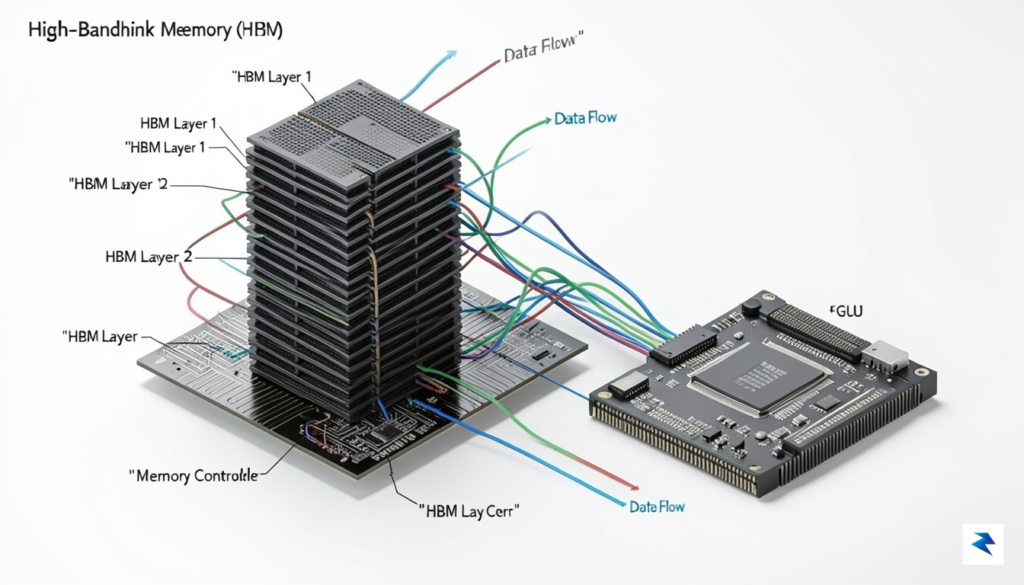
At the heart of this challenge are memory manufacturers like Micron, Samsung, and SK Hynix, global giants whose innovations are indispensable to the AI revolution. Their most sought-after product in this domain is High-Bandwidth Memory (HBM), a sophisticated form of RAM that is absolutely crucial for high-performance computing tasks, especially those involved in training and deploying complex AI models. Unlike traditional DRAM, HBM is designed to be stacked vertically, creating extremely short data pathways and allowing for unparalleled bandwidth directly to the GPU or AI accelerator. This architectural advantage enables processors to access and manipulate massive datasets with far greater efficiency, which is non-negotiable for the lightning-fast operations demanded by modern AI.
However, the very sophistication that makes HBM so powerful also renders it incredibly challenging and costly to produce. Manufacturing HBM involves intricate processes, including stacking multiple memory dies on top of an interposer, which then connects to the main processor package. This advanced 3D packaging requires specialized fabrication techniques, precision bonding, and extensive quality control, all of which contribute to a limited global production capacity. Furthermore, the yields for such complex manufacturing can be lower than for standard memory, adding to the scarcity. Consequently, the bottleneck in HBM supply is not merely a matter of quantity but also of the highly specialized equipment, expertise, and time required to scale up production, leaving AI hardware manufacturers clamoring for limited stock.
This scarcity and the elevated cost of cutting-edge memory components like HBM inevitably cascade through the entire technology ecosystem, impacting everything from enterprise-grade AI servers to the pricing of high-end consumer devices. When foundational components become more expensive or harder to acquire, the final products incorporating them reflect these pressures. For instance, while a premium iPad doesn’t directly use HBM in the same way an AI server does, the overall competition for advanced semiconductor manufacturing capacity, research and development investment in next-generation chip technologies, and the rising cost of raw materials and fabrication facilities ultimately contribute to broader pricing trends. The AI boom is soaking up a significant portion of the world’s advanced chip-making capabilities, which in turn influences the cost structure and availability for other sophisticated electronics, underscoring how interconnected the tech supply chain truly is.

The once-frenetic anticipation surrounding high-profile initial public offerings (IPOs) in the artificial intelligence sector has hit a significant wall, signaling a profound shift in how institutional investors evaluate potential market entrants. For months, the narrative was dominated by the sheer promise of generative AI, with speculative valuations reaching heights that often ignored traditional fiscal metrics. However, as the summer months progressed, a more sobering reality began to take hold. Companies that were once expected to sprint toward public listings—most notably OpenAI and other foundation model powerhouses—have opted for a more measured approach, keeping their capital private while they focus on stabilizing their operational foundations. This hesitation is not merely a reaction to market volatility; it is a direct response to a fundamental change in the investor appetite, which has transitioned from being captivated by technical milestones to demanding concrete, scalable revenue models.

At the heart of this cooling pipeline is the lingering pressure of high interest rates, which have fundamentally altered the economics of pre-profit technology ventures. In a low-interest-rate environment, investors were more than willing to subsidize massive research and development expenditures in exchange for explosive user growth. Today, the cost of capital is significantly higher, and public market participants are far less forgiving of companies that burn through cash without a clear, near-term path to profitability. This shift effectively penalizes the “growth-at-all-costs” mentality that characterized the early wave of the AI gold rush. Consequently, private firms are choosing to stay out of the public spotlight until they can demonstrate that their AI capabilities are not just impressive technical feats, but reliable engines for sustainable corporate income.
The transition from “potential” to “profit” is the new litmus test for AI, and the market is no longer willing to grade on a curve for speculative innovation.
Delaying an IPO is inherently risky, yet it is a calculated gamble in an increasingly skeptical climate. While staying private provides a buffer against the immediate scrutiny of quarterly earnings reports and stock price fluctuations, it also limits access to the massive liquidity pools found in the public markets. By waiting, these companies risk missing windows of peak investor enthusiasm, but the alternative—entering a public market that has grown weary of “AI hype” without a bulletproof balance sheet—could result in a disastrous valuation haircut. Ultimately, this cooling period acts as a necessary filter. It separates the companies that are built on genuine, value-generating utility from those that are merely riding the wave of speculative fervor. For the broader market, this pause is a healthy correction, suggesting that we are moving toward a more mature phase where AI must prove its worth on the same terms as any other established industry sector.

For the past eighteen months, the corporate landscape has been defined by an aggressive “AI-first” gold rush, characterized by speculative moonshot projects and massive capital expenditure on GPU infrastructure. However, the initial euphoria surrounding large language models is rapidly giving way to a more pragmatic, bottom-line-focused reality. Companies are no longer satisfied with simply experimenting with generative tools; they are now facing intense pressure from stakeholders to demonstrate tangible Return on Investment (ROI). This shift represents a transition from the era of “AI as a novelty” to “AI as an operational utility,” where the success of a deployment is measured not by its sophistication, but by its ability to demonstrably lower overhead costs or unlock new, defensible revenue streams.
The transition is particularly evident in how enterprise leaders are re-evaluating their portfolios. Where early-phase investments were often opaque and experimental, current demands prioritize integration into existing workflows. Organizations are discovering that the true value of artificial intelligence lies in its capacity for automating high-volume, mundane tasks—such as customer support scaling, internal knowledge management, and code generation—rather than pursuing complex, high-risk creative automation. This pragmatic pivot effectively weeds out superficial implementations, forcing firms to justify their compute costs against realized productivity gains or direct impact on the P&L statement.

The market has moved past the stage where simply announcing an AI integration is enough to move a stock price; today, the focus is entirely on the endurance and efficiency of those integrations in the real world.
Industry giants like Apple exemplify this measured approach, contrasting sharply with the “move fast and break things” philosophy adopted by some early adopters. Instead of rushing to saturate every software corner with generative features, Apple has focused on “Apple Intelligence”—a strategy that emphasizes user-facing utility, privacy, and seamless hardware-software integration. By embedding AI into the OS level to solve specific user pain points, such as intelligent notification summaries or cross-app data retrieval, Apple ensures that its technological investments directly bolster the value proposition of its ecosystem. This strategy effectively insulates the company from the volatility of the broader AI market, as their innovation is anchored to the immediate, tangible needs of their existing user base rather than speculative industry trends.
Ultimately, the cooling of the AI hype cycle is a healthy maturation for the industry. As companies like Micron recalibrate their hardware production to meet the specific, high-demand needs of infrastructure builders, the entire ecosystem is being forced to prioritize sustainable growth over unsustainable expansion. This period of tightening will likely discard the vanity projects that characterized the early rush, leaving behind a robust framework where artificial intelligence serves as a reliable engine for long-term operational efficiency.

As the initial fervor surrounding artificial intelligence begins to settle into a more sustainable trajectory, both individual investors and the tech-buying public must recalibrate their expectations. The breakneck pace of innovation and market speculation witnessed over the past year, fueled by groundbreaking AI advancements, is giving way to a period of consolidation and more discerning valuation. For investors, this signals a critical juncture to move beyond speculative plays and instead focus on companies demonstrating robust fundamentals, clear paths to profitability, and genuine, integrated AI strategies rather than superficial “AI-washing.” Diligence in researching long-term value propositions, diversifying portfolios beyond a handful of high-flying tech stocks, and understanding the tangible impact of AI on a company’s core business will be paramount for navigating this evolving landscape successfully.
On the consumer front, the implications of this market adjustment are already becoming apparent, particularly in hardware pricing. The intense demand for specialized components, such as high-bandwidth memory (HBM) crucial for AI data centers and advanced graphics processing units (GPUs), has created supply chain pressures and driven up costs across the board. Consequently, consumers can anticipate higher price tags for next-generation devices, from powerful laptops and smartphones touting advanced on-device AI capabilities to gaming PCs featuring cutting-edge GPUs. This shift necessitates a more considered approach to purchasing decisions; the era of automatic yearly upgrades may be waning, replaced by a focus on value, longevity, and whether the premium for “AI features” genuinely enhances their daily usage patterns. Consumers will increasingly need to weigh the tangible benefits against the escalating costs, making informed choices about when and what to upgrade.
Looking ahead, the AI industry’s path to stability will likely involve a more measured, yet profoundly impactful, evolution. While the initial gold rush mentality may cool, foundational research and development will undoubtedly continue to push the boundaries of what AI can achieve. However, commercial applications will face heightened scrutiny, demanding clear return on investment and demonstrable utility to gain traction. We are moving towards an equilibrium where sustainable growth, ethical considerations, and practical implementation take precedence over sheer hype
You must be logged in to post a comment.