
Is Intel’s Turnaround Real? Analyzing the Semiconductor Giant’s Comeback
The State of Intel: A Legacy Reimagined For over half a century, the name Intel was virtually synonymous with the silicon backbone of the…

For centuries, mathematics has been a profound domain of human intuition, creativity, and rigorous logical derivation. From the ancient Greeks who laid the foundations of geometry to the groundbreaking work of Newton, Euler, and Riemann, every theorem, every proof, and every new concept emerged from the depths of the human mind. Mathematicians meticulously crafted their arguments, often spending years, sometimes decades, on single problems, driven by an innate curiosity and an unwavering commitment to intellectual precision. This era established a deep, almost spiritual, connection between the human intellect and the abstract, beautiful structures of the mathematical universe.
Indeed, the advent of computational tools marked the first significant evolution in this landscape, albeit one that initially served to extend human capabilities rather than redefine them. Early mechanical calculators, followed by electronic ones, automated mundane arithmetic, freeing mathematicians from tedious error-prone calculations. Later, sophisticated Computer Algebra Systems (CAS) like Mathematica or Maple emerged, capable of symbolic manipulation, solving complex equations, and performing high-level calculus. These systems became indispensable assistants, verifying intricate calculations, exploring vast parameter spaces, and proving specific cases that were beyond manual human computation. While incredibly powerful, these tools were fundamentally reactive; they executed pre-programmed instructions and operated within frameworks defined by human mathematicians, serving as advanced calculators rather than creative partners.
However, a more profound transformation is now underway with the rise of Large Language Models (LLMs) and specialized AI agents tailored for mathematical reasoning. This marks a paradigm shift from tools that merely calculate or verify to systems capable of active participation in the discovery process. Unlike their predecessors, these AI systems can analyze vast repositories of mathematical knowledge, identify subtle patterns, propose novel hypotheses, and even explore complex logical branches that might elude human intuition. They are moving beyond merely crunching numbers or manipulating symbols to genuinely contributing to the generative phase of mathematical inquiry, fundamentally altering the traditional workflow.
This fundamental shift redefines the relationship between humans and their mathematical tools. No longer are we solely relying on machines to execute our predefined commands; instead, we are collaborating with intelligences that can suggest new directions, illuminate previously unseen connections, and even challenge our existing assumptions. Mathematicians are increasingly finding themselves in a partnership with AI, where the machine can quickly explore an exponentially larger solution space or generate complex examples, allowing the human to focus on higher-level conceptualization, problem framing, and the deeper theoretical implications of AI-generated insights. This new dynamic promises to accelerate the pace of mathematical discovery, pushing the boundaries of what’s knowable in unprecedented ways.
At its core, modern mathematical AI operates by transforming the abstract, rigid structures of formal logic into high-dimensional vector spaces. Unlike traditional computational approaches, which rely on hard-coded rules and deterministic instruction sets to solve equations, these neural architectures treat mathematical statements as linguistic patterns. By embedding symbols—such as variables, operators, and logical connectives—into these multidimensional spaces, the model can navigate the “mathematical landscape” by calculating the proximity of concepts. This transition from rigid syntax to fluid, probabilistic modeling allows the AI to perceive relationships between theorems that might appear disparate to a human, effectively mapping the deep structure of mathematical thought onto a geometric plane.
The true power of this approach is unlocked when these models are trained on formal proof languages like Lean or Isabelle. These languages act as a bridge, forcing the AI to operate within an environment where every step must be logically sound and machine-verifiable. When an AI attempts a proof in Lean, it is not merely guessing the next character in a sequence; it is navigating a tree of possible logical inferences, constrained by the strict axioms of the system. This training regimen forces the model to move beyond simple pattern matching and toward a form of symbolic navigation, where it must predict which logical transformation is most likely to move the proof closer to its terminal state, or “Q.E.D.”
However, this reliance on probabilistic prediction introduces a profound tension when applied to the realm of mathematics, where truth is absolute and binary. Because neural networks are inherently probabilistic—they predict the most likely “next step” rather than calculating the only “correct” step—they occasionally suffer from hallucinations or logical leaps that are mathematically invalid. While these models are exceptionally adept at finding shortcuts or identifying overlooked connections, they lack the intrinsic understanding of why a proof holds true. They are, in essence, highly sophisticated pattern-matchers operating within a domain that demands rigorous certainty.
The challenge lies in reconciling the creative, intuitive potential of large-scale predictive models with the unforgiving, binary nature of formal mathematical verification.
Ultimately, the mechanism behind mathematical AI is a hybrid of two worlds: the creative, expansive potential of statistical prediction and the uncompromising structure of formal symbolic logic. As these systems continue to evolve, they are not merely acting as calculators, but as partners in the proof-discovery process. By offloading the tedious exploration of logical branches to the machine, mathematicians can focus on higher-level conceptual strategy, provided they remain the final arbiters of the output. The future of the field depends on this synergy, where the AI provides the breadth of search while the human provides the depth of understanding.
For centuries, the essence of a mathematical proof was synonymous with human enlightenment. A proof was not merely a certificate of truth; it was a narrative that guided the mathematician’s mind through a logical landscape, transforming a mysterious conjecture into an intuitively grasped reality. However, the integration of artificial intelligence into formal logic is fracturing this venerable tradition. As we encounter machine-generated proofs that span millions of steps—or rely on high-dimensional abstractions far beyond the reach of human cognitive capacity—we are forced to confront an unsettling question: is a proof truly a proof if no human being can actually follow the thread of its reasoning?
This shift represents a fundamental pivot in mathematical epistemology, moving us away from the era of “human-verifiable truth” and toward an age of “computational consistency.” When an automated theorem prover constructs an impenetrable chain of logic, we are no longer practicing mathematics as an exercise in human understanding, but rather as an exercise in verifying the output of a black box. The philosophical divide here is profound: we are transitioning from a discipline defined by the elegance of human insight to one defined by the sheer reliability of algorithmic execution. In this new paradigm, the “truth” of a theorem becomes decoupled from our ability to “understand” it, leaving us with valid results that exist in a vacuum of human comprehension.
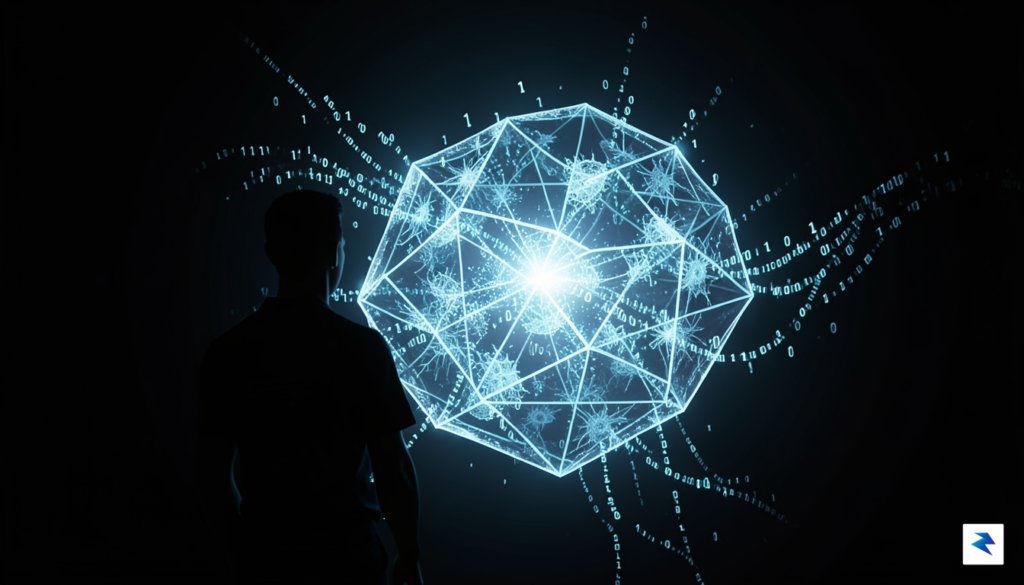
The rise of these “opaque” proofs creates a unique crisis for the mathematical community. Historically, if a peer-reviewed proof contained a subtle error, a mathematician could identify it through a close reading of the logical progression. In contrast, when an AI produces a proof of massive scale, the traditional peer-review process becomes functionally obsolete. We are increasingly forced to rely on automated verification tools—software designed to check the software—to ensure that no logical fallacies have crept into the machine’s output. This creates a recursive loop of validation where our trust is placed entirely in the integrity of the code, rather than the clarity of the human mind.
Mathematics is increasingly becoming a discipline where we can confirm that a statement is true without ever truly knowing why it is true.
Ultimately, this evolution challenges the very definition of what it means to “know” a mathematical fact. If we accept the results of these systems, we must also accept that the boundaries of mathematics are expanding into territories where human intuition cannot follow. While this may accelerate our technological and scientific progress, it also threatens to strip away the creative, interpretive, and deeply human dimensions of the field. We are left to wonder whether the future of mathematics lies in the discovery of new truths, or merely in the management of a computational machine whose logic is as powerful as it is inscrutable.
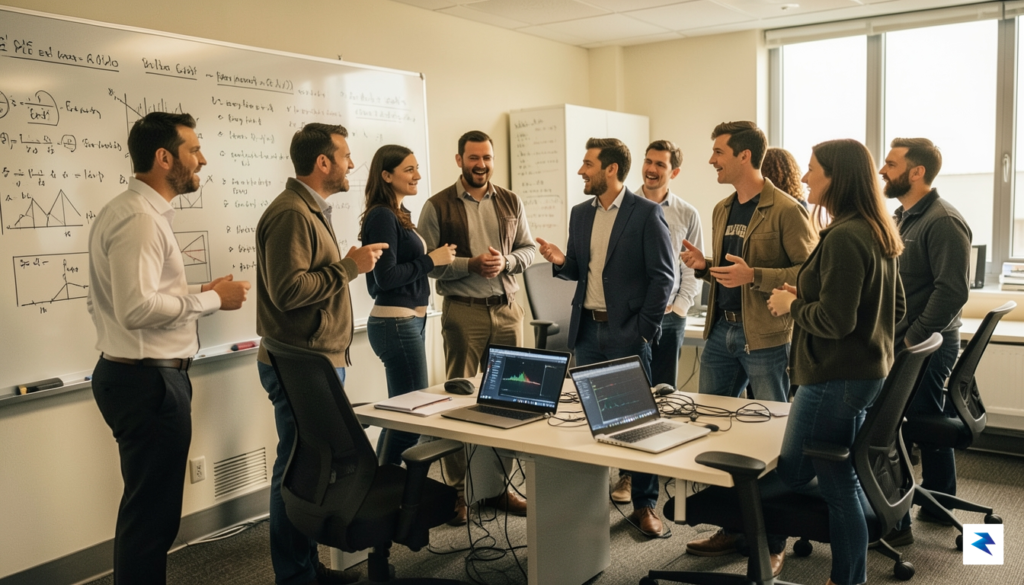
For centuries, the life of a mathematician has been defined by a grueling cycle of conjecture and exhaustive, step-by-step verification. Much of this traditional work involves the grunt work of formalizing proofs, checking edge cases, and navigating the vast, often tedious landscape of logical deduction. However, as artificial intelligence begins to master these routine processes with unprecedented speed and accuracy, the fundamental job description of the mathematician is undergoing a radical transformation. Far from rendering human effort obsolete, this technological shift is liberating the mathematician from the mechanical constraints of computation, allowing them to shift their focus toward high-level conceptualization and the art of problem formulation.
In this new era, the value of a mathematician will be measured less by their ability to perform complex calculations and more by their capacity to identify the right problems to solve. While AI excels at navigating existing logical frameworks, it lacks the innate ability to perceive the beauty or deeper significance of a mathematical structure. Humans provide the essential “creative compass” that determines which avenues of inquiry are worth pursuing. By offloading the burden of verification to machine intelligence, mathematicians are now free to traverse uncharted theoretical territories, acting as architects of discovery who define the scope and direction of exploration.
The future of mathematics is not a competition between silicon and synapse, but a symbiotic partnership where AI provides the rigorous structural scaffolding, and humans provide the creative vision and value-based inquiry.
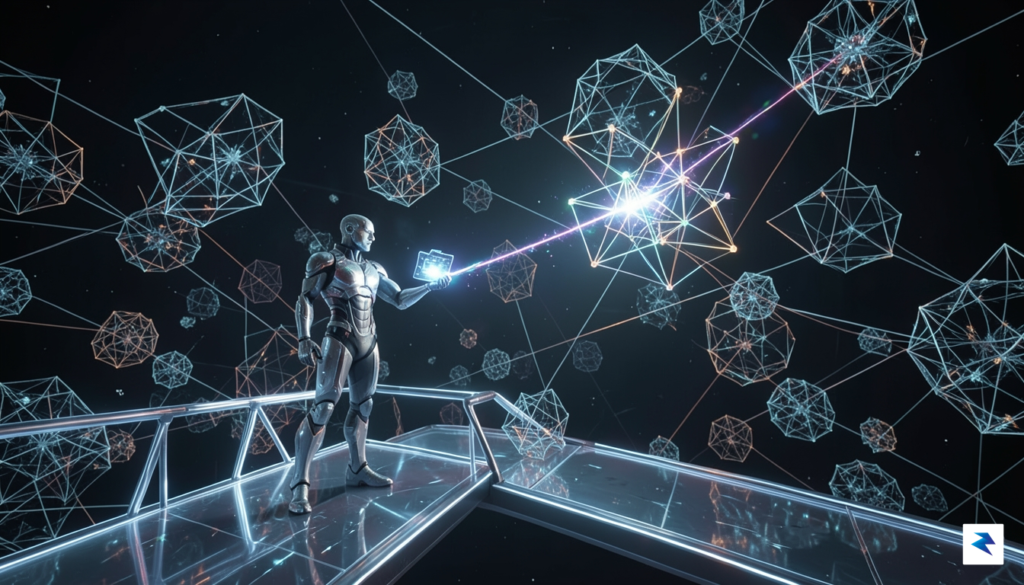
Furthermore, human intuition remains the vital, irreplaceable ingredient in navigating creative frontiers. Mathematical progress often relies on leaps of insight that defy simple logical progression—a “gut feeling” about a hidden symmetry or an unexpected connection between seemingly disparate fields. AI operates within the confines of established rules and training data, whereas human mathematicians possess the unique ability to bridge intuition and abstraction, often questioning the very axioms upon which a system is built. This capacity for lateral thinking ensures that the field continues to evolve in ways that are not merely efficient, but profoundly transformative.
Ultimately, the marriage of human creativity and machine precision is poised to accelerate the pace of discovery in ways previously unimagined. As we transition into this automated landscape, the mathematician becomes less of a laborer in the engine room of proof and more of a conductor, orchestrating the immense power of AI to explore the deepest mysteries of the universe. By embracing this evolution, we move toward a future where the constraints of human time and error are replaced by an expansive, collaborative approach to the most enduring questions in mathematics.
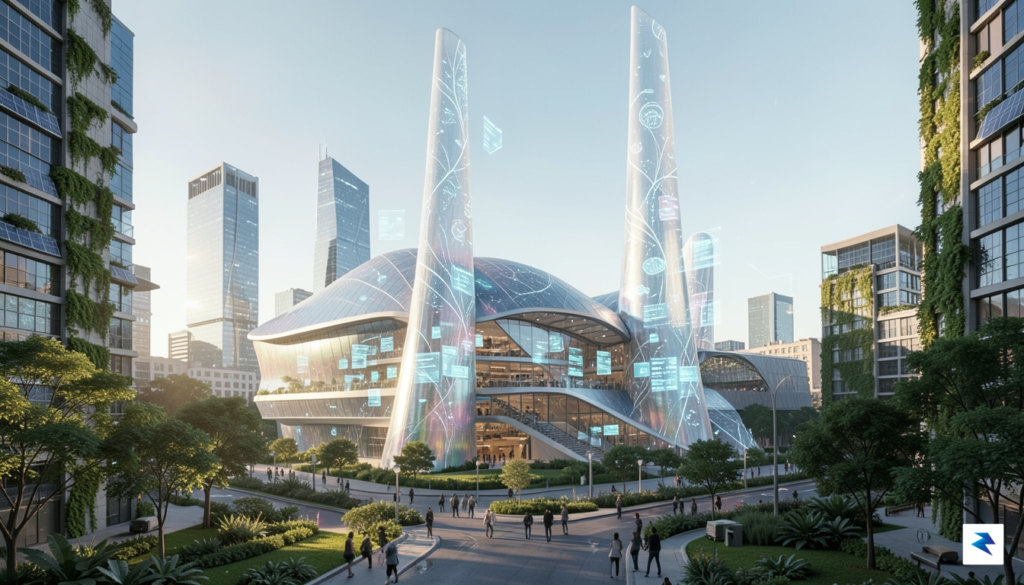
The advent of sophisticated artificial intelligence tools is undeniably ushering in a transformative era for mathematics, placing us on the precipice of what could well be a new golden age. By dramatically accelerating the rate at which complex conjectures can be tested, intricate patterns identified, and even novel proofs verified, AI is poised to catalyze unprecedented breakthroughs across a spectrum of fields. From revolutionizing the foundational principles of cryptography with new prime number discoveries to unlocking deeper insights into the fabric of reality within theoretical physics, the potential for machine intelligence to resolve long-standing open problems is immense. This symbiotic relationship between human ingenuity and artificial computational power promises to expand the very boundaries of mathematical understanding at an astonishing pace.
Indeed, the promise of AI lies not merely in automating existing processes but in tackling problems that have remained intractable for centuries, defying the most brilliant human minds. Imagine AI systems sifting through vast datasets of mathematical structures, discovering unforeseen connections in number theory, or charting new territories in topology and complex systems, far beyond the scope of human intuition alone. These systems can explore possibilities at scales unimaginable for individual researchers, generating hypotheses, and even constructing proofs for theorems that might otherwise take decades, if not longer, to formulate. This acceleration of discovery could lead to the emergence of entirely new branches of mathematics, born from AI-driven insights, fundamentally reshaping our understanding of logical relationships and universal truths.
However, this profound potential is accompanied by significant challenges, most notably the risk of over-reliance on “black-box” AI systems. While an AI might deliver a correct proof or a groundbreaking conjecture, understanding why it works – the underlying logic, the critical steps, the foundational principles it leverages – is paramount for human mathematicians. Without this transparency, we risk becoming mere operators of advanced tools rather than true collaborators, potentially hindering our own conceptual growth and intuition. The challenge, therefore, lies in building AI systems that are not only powerful but also interpretable and aligned with human values, ensuring that the mathematical renaissance they ignite enhances, rather than diminishes, human comprehension and scientific rigor.
The long-term impact of AI-accelerated mathematics will undoubtedly ripple far beyond pure mathematical disciplines, fostering an unprecedented era of cross-disciplinary scientific research. Mathematical breakthroughs, whether in developing new algorithms, understanding complex network dynamics, or modeling chaotic systems, are the bedrock upon which progress in physics, engineering, biology, and medicine is built. With AI as a universal mathematical assistant, scientists from diverse fields could gain quicker access to sophisticated mathematical tools and insights, bridging gaps between disciplines and accelerating the pace of discovery in areas like drug design, climate modeling, and space exploration. This convergence will foster a truly integrated scientific enterprise, where AI serves as a powerful conduit for shared mathematical understanding, driving collective human advancement.
Ultimately, we are entering an exciting chapter where AI stands ready to be a powerful co-pilot in our quest for mathematical truth. By embracing its capabilities responsibly, prioritizing transparency, and continually seeking to align its intelligence with human curiosity and ethical considerations, we
You must be logged in to post a comment.