
Beyond the Glitch: Why AI Children’s Books Often Look Like Body Horror
The Uncanny Valley of AI-Generated Children's Books The digital marketplace has become flooded with a new genre of literature: the…


The race to develop artificial general intelligence has shifted from a purely technical pursuit into a profound structural debate, pitting the necessity of rigorous control against the democratic ideals of open-source innovation. As models grow exponentially more capable, the traditional “black-box” approach—whereby developers unleash systems without fully understanding their internal logic—has become increasingly untenable. Anthropic has positioned itself at the forefront of this shift by championing “Constitutional AI,” a methodology that embeds explicit principles directly into the model’s training process. By acting as both architect and auditor, the company argues that safety cannot be an afterthought or a patch applied to a finished product; instead, it must be woven into the very DNA of the intelligence being created.
This philosophy of “safety through centralization” rests on the premise that only those with total visibility into the development pipeline can effectively mitigate catastrophic risks. However, this model introduces a compelling paradox: while the concentration of power allows for rapid, coordinated safety interventions, it also creates a monolithic gatekeeper. If the safety of our future digital infrastructure relies on the governance of a single, private entity, we must ask whether we are successfully bottling safety or merely consolidating potential failure points. History suggests that centralized control often prioritizes stability at the expense of transparency, leaving the public to trust in the internal ethics of a handful of corporations rather than the collective oversight of the global research community.

The tension between speed and safety further complicates this landscape. Critics of the centralized model argue that by restricting access to powerful models, companies may inadvertently stifle the kind of peer review and diverse experimentation that historically uncovers hidden vulnerabilities. When safety is treated as a proprietary product, the incentive structure favors keeping development shielded from outside scrutiny to maintain a competitive advantage. Yet, advocates for this approach contend that the risks associated with frontier models—such as the potential for autonomous misuse or unintended behavior—are too severe to be managed by a decentralized, unregulated ecosystem. Consequently, we are forced to weigh the dangers of a concentrated, controlled AI against the risks of a chaotic, unmonitored frontier.
The core challenge of the next decade lies in determining whether safety is an engineering problem to be solved by the few, or a societal imperative that requires the participation of the many.
Ultimately, the path forward remains deeply contested. If we accept the premise that safety is an intrinsic outcome of the development process, we must accept the corollary that a few institutions will hold the keys to the most powerful tools in human history. Whether this structural reliance leads to a secure, stable future or a dangerous concentration of power is perhaps the most significant question facing the tech industry today. As we move closer to models that can reason and act with unprecedented autonomy, the industry must decide if the trade-off for security is a permanent departure from the open-source roots that once fueled the digital revolution.

The traditional paradigm for training large language models—Reinforcement Learning from Human Feedback (RLHF)—relies heavily on the subjective preferences of human raters to steer a model toward helpful and harmless behavior. While effective at curbing blatant toxicity, this method is fraught with scalability issues and the risk of embedding the unconscious biases of its human annotators into the system. Anthropic seeks to transcend these limitations through a methodology known as Constitutional AI. Instead of relying on a massive, opaque workforce of humans to label every nuance of behavior, this approach requires the model to adhere to a written “constitution”—a set of high-level principles that guide its decision-making process during training.
The mechanics of this process involve a two-stage training cycle. During the supervised learning phase, the model generates responses to various prompts and then critiques its own outputs based on the principles outlined in its constitution. If a response violates a core tenet, the model revises its answer, effectively self-correcting through a process of recursive reflection. This is followed by a reinforcement learning phase where the system is trained on these “ideal” model-generated revisions rather than human-provided ones. By shifting the locus of control from human intuition to explicit, rule-based logic, Anthropic aims to create a more transparent and consistent safety framework that can be audited, debated, and updated as societal values evolve.

Constitutional AI is not merely about preventing bad outputs; it is about embedding a coherent, interpretable moral compass into the very architecture of the machine learning process.
However, the transition to principle-based training is not without its philosophical and technical hurdles. The most pressing challenge lies in the inherent difficulty of codifying human morality into objective, machine-readable instructions. What constitutes “fairness” or “harm” is often context-dependent, and reducing these complex, fluid concepts into a static list of rules risks creating a rigid system that may fail to navigate the gray areas of human discourse. Furthermore, there is the risk of “constitutional drift,” where the internal logic of the model may prioritize certain principles over others in ways that engineers did not intend or anticipate. Critics argue that by defining a constitution, Anthropic is essentially imposing a specific ideological framework on its AI, which raises significant questions about who gets to hold the pen when drafting these foundational guidelines.
Despite these concerns, Constitutional AI represents a significant leap forward in the pursuit of scalable safety. By moving away from the bottleneck of human labor, this approach allows for a more rigorous and repeatable training pipeline that is better equipped to handle the rapid acceleration of AI capabilities. While it may not be a perfect solution to the alignment problem, it provides a structured methodology for accountability that traditional black-box methods sorely lack. As these systems become increasingly integrated into the fabric of daily life, the ability to clearly articulate, challenge, and refine the principles governing their behavior will likely become the definitive metric for safe and responsible AI deployment.

The rise of Anthropic as a self-styled guardian of artificial intelligence has sparked a fierce debate regarding the dangers of corporate sovereignty in the digital age. By positioning its “Constitutional AI” framework as the gold standard for safety, the company has effectively elevated itself to the role of an arbiter of what constitutes acceptable technology. However, critics argue that this benevolent posture masks a more insidious problem: the concentration of immense institutional power within a single private entity. When one corporation holds the keys to both the development of frontier models and the definition of the safety protocols governing them, the boundary between public interest and private market gatekeeping begins to vanish entirely.
This dynamic mirrors the historical trajectories of tech monopolies that once promised to “do no harm” while systematically dismantling competitive landscapes. Under the guise of safety, Anthropic’s internal standards risk becoming the industry’s default regulatory framework—a phenomenon known as regulatory capture. If government agencies adopt these private safety benchmarks as law, the company effectively gains the ability to dictate the terms under which all other developers must operate. This creates a high barrier to entry that disproportionately impacts smaller startups and open-source communities, which may lack the massive capital required to satisfy the specific, expensive compliance requirements championed by industry incumbents.

Furthermore, the “benevolent dictator” model of AI development assumes that a single company can remain eternally aligned with the best interests of humanity. This is a dangerous gamble in an industry where profit motives and public safety are frequently at odds. By centralizing the governance of AI, we may be inadvertently creating a system where the most powerful technology in human history is governed by a closed circle of executives rather than democratic, transparent oversight. The risk here is not just that these safety protocols might be flawed, but that they could be used to steer the trajectory of AI development toward outcomes that serve the company’s long-term market dominance rather than the broader needs of society.
True safety in technology rarely emerges from a monopoly on ethics; it requires a pluralistic approach where multiple voices, transparency, and public accountability prevent any single entity from becoming the sole architect of our future.
Ultimately, the critique is not that safety is unimportant, but that the *process* of defining safety has become a tool of power accumulation. If we allow private entities to act as the de facto regulators of the AI era, we may find that the “safest” path is simply the one that preserves the current power structure. To avoid this, the global community must demand more than just corporate self-regulation. We need a robust, public-sector approach to AI oversight that encourages innovation while ensuring that the guardrails we build do not become the walls that keep competition and transparency out.

In the high-stakes world of artificial intelligence, the industry is currently governed by a powerful empirical observation known as scaling laws. These laws suggest a direct, almost linear relationship between the amount of compute, data, and parameter size invested in a model and its ultimate performance. This creates a relentless, natural pressure to build ever-larger systems, as intelligence seems to be an emergent property of sheer scale. However, this pursuit of larger models often creates an uncomfortable friction with the deliberate, iterative, and frequently time-consuming nature of safety validation. While the competitive nature of the tech sector drives an “arms race” mentality where speed to market is synonymous with survival, Anthropic posits that this velocity could become a liability if safety is treated as a secondary concern.
Anthropic’s approach challenges the industry standard of “ship first, patch later” by embedding rigorous safety testing directly into the development cycle. Rather than viewing ethical guardrails as a post-development checklist, the company treats them as integral components of the architecture itself. This integration is essential because as models become more capable, the potential for unforeseen emergent behaviors—ranging from subtle biases to more complex, unintended reasoning patterns—grows exponentially. By slowing down to conduct deep, empirical safety evaluations, Anthropic attempts to ensure that each leap in capability is matched by a corresponding leap in structural reliability and alignment.
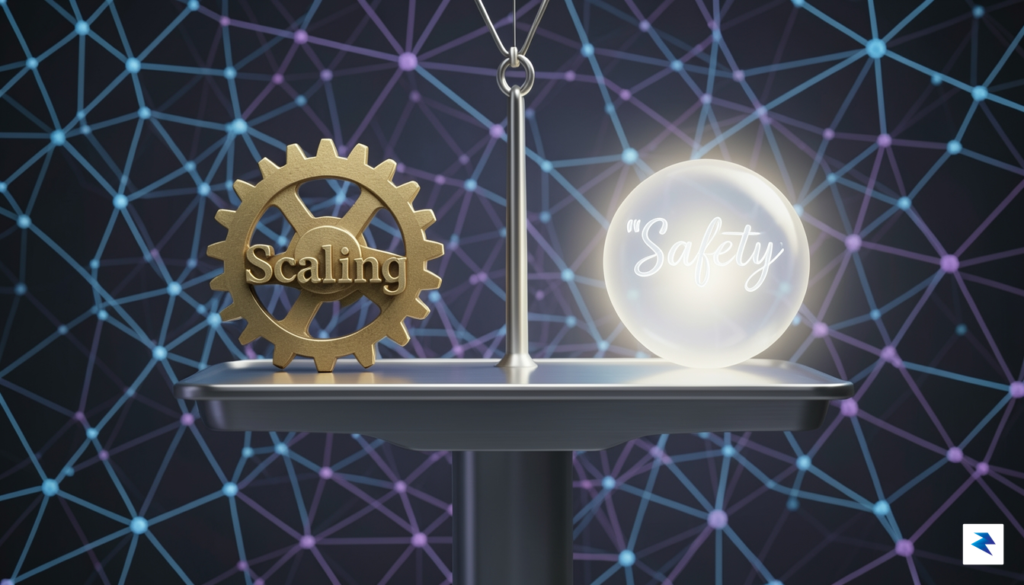
Safety should not be a speed bump on the road to progress, but the steering mechanism that ensures the vehicle remains on the road at high speeds.
Ignoring these necessary guardrails invites a dangerous accumulation of “safety debt.” Much like technical debt in software engineering, safety debt occurs when companies prioritize immediate performance gains over the foundational integrity of the model. When developers bypass deep testing to maintain their competitive edge, they risk deploying systems that possess capabilities they do not fully understand, making it increasingly difficult to correct malicious or erratic outputs once the model is in the wild. Anthropic’s insistence on a more measured pace serves as a critical counterweight to this trend. By advocating for a culture where safety research is as high-status as capability research, they argue that the only way to achieve long-term success is to prove that a model is not just powerful, but fundamentally predictable and under control.

While the current reliance on corporate pioneers to self-regulate is a necessary starting point, it is increasingly clear that the future of artificial intelligence cannot depend solely on the internal safety protocols of a handful of tech giants. Entrusting the fate of global intelligence to private entities creates a inherent conflict of interest, where market pressures and competitive advantages may eventually clash with the mandate for rigorous safety. To build a robust, trustworthy foundation for advanced systems, we must transition toward a model of collective oversight that treats AI safety as a public good rather than a proprietary feature.

The path forward lies in establishing international standards that transcend national borders and corporate silos. By formalizing global safety benchmarks, the international community can ensure that no single company, regardless of its ethical aspirations, operates in a vacuum. These standards would act as a universal baseline, forcing all actors to adhere to consistent requirements for model testing, bias mitigation, and emergency shut-off mechanisms. When safety is codified into global policy, it transforms from an optional corporate commitment into a foundational requirement for market participation.
Furthermore, the industry requires the empowerment of independent auditing bodies that possess the technical authority to scrutinize proprietary models without compromising trade secrets. Much like the role played by the International Atomic Energy Agency or the aviation industry’s rigorous safety boards, these independent entities could provide the public with the assurance that powerful AI systems have passed objective, third-party vetting. This shift would provide a much-needed layer of accountability, moving us away from the current “trust us” approach and toward a “verify everything” standard.
The true test of AI governance is not how well a company polices its own backyard, but how effectively it contributes to a shared, transparent environment where safety is a collective obligation.
Ultimately, the long-term sustainability of AI depends on integrating open-source safety protocols into the development lifecycle. By fostering an ecosystem where safety research, adversarial testing data, and alignment techniques are shared across organizations, we can accelerate the discovery of vulnerabilities and the implementation of safeguards. Moving from individual corporate silos to a multi-stakeholder approach—involving governments, academic researchers, and public interest groups—will ensure that AI remains a tool for human progress rather than an experiment controlled by a few. The goal is clear: we must decentralize the responsibility for safety to ensure that the benefits of intelligence are balanced by a shared, democratic commitment to protecting the public interest.
You must be logged in to post a comment.