
Why Your Brain Is Not Built for 24/7 Bad News
The Evolutionary Mismatch of Modern News Consumption Our brains, marvels of evolutionary engineering, are fundamentally wired for survival.…

The landscape of game engine development has long been dominated by established titans like C++ and C#, languages revered for their performance, extensive libraries, and fine-grained control over hardware. Developers instinctively reach for these tools when tackling the intricate demands of real-time rendering, complex physics simulations, and expansive world generation. However, a fascinating new project is challenging these deeply ingrained assumptions: the development of a 3D voxel game engine written entirely in APL. This unconventional pairing forces us to reconsider the very foundations of software architecture, pushing the boundaries of what’s possible with high-level array languages and inviting a fresh perspective on solving some of the most complex spatial problems in computing.
APL, or A Programming Language, boasts a rich history dating back to the 1960s, initially conceived by Kenneth E. Iverson as a powerful and concise notation for mathematical expression. Its unique character set and array-oriented paradigm allow developers to perform complex operations on entire data structures with remarkable brevity, often reducing dozens of lines of conventional code into a single, elegant APL expression. This inherent ability to manipulate arrays as fundamental entities, rather than iterating through individual elements, has historically made APL a powerful tool for scientific computing, financial modeling, and data analysis where large datasets and complex transformations are commonplace. The very nature of its design promotes thinking in terms of data structures and their transformations, a characteristic that unexpectedly aligns well with certain aspects of game development.
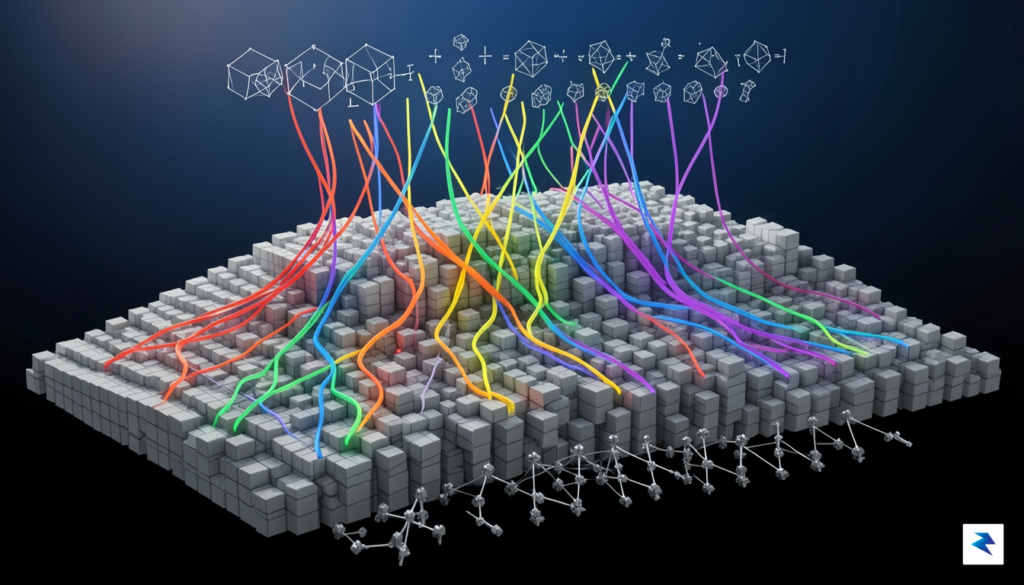
This is particularly true when considering the architecture of a voxel-based game engine. Voxels, essentially three-dimensional pixels, represent discrete units of space, collectively forming a volumetric grid that defines a game world. Think of them as individual blocks of data arranged in a massive 3D array, each containing information about its material, color, and other properties. Such a data structure is a natural and intuitive fit for an array-oriented language like APL. Operations that might require nested loops and extensive boilerplate code in other languages—like querying a region, applying transformations across a volume, or performing constructive solid geometry—can often be expressed with astonishing conciseness and clarity in APL, directly leveraging its powerful array primitives. This synergy between APL’s design philosophy and the inherent structure of voxel data is a core reason developers are exploring this path.
Ultimately, this ambitious project aims to do more than just build a game engine; it seeks to prove that brevity and performance are not mutually exclusive, even in environments as demanding as 3D gaming. While APL might not traditionally be associated with the raw speed of compiled languages, its highly optimized array operations, coupled with the potential for clearer, more maintainable code, present a compelling argument for its use. The core objective is to demonstrate that by leveraging APL’s unique strengths in handling spatial data and complex transformations, it’s possible to craft a performant and robust engine that challenges our preconceived notions about the tools best suited for high-stakes software development. This endeavor is about pushing the boundaries, exploring new paradigms, and showing that innovation can emerge from the most unexpected intersections of technology.

At the very heart of this innovative 3D voxel engine lies APL’s unparalleled strength in manipulating multi-dimensional arrays. Unlike traditional game engines that often rely on complex object hierarchies, scene graphs, and boilerplate-heavy structures, this engine fundamentally treats all spatial data as a series of interconnected arrays. This approach means that the entire world, from individual voxels to entire chunks, is represented and processed directly within APL’s native array paradigm. This design choice dramatically simplifies data management and processing, allowing for an incredibly concise and powerful codebase where the data itself dictates the architecture, rather than abstract class structures.
Memory management within the APL runtime is a testament to the language’s efficiency for array-oriented tasks. The voxel grid itself is stored as a colossal multi-dimensional array, where each element might represent a specific voxel type, color, or other property. APL’s interpreter is highly optimized for allocating, accessing, and transforming these arrays directly in memory, often in highly efficient C-level operations. This means that operations like querying a specific voxel’s state, updating a region of voxels, or even iterating through an entire chunk are performed with remarkable speed and minimal overhead. Developers working with this engine benefit from not needing to manually manage pointers or allocate memory; APL handles these intricacies, freeing them to focus on the high-level logic of world construction and interaction.
The rendering pipeline, in stark contrast to conventional methodologies, largely bypasses the typical graphics API calls for drawing individual polygons or managing complex shaders directly. Instead, it leverages APL’s array transformations to prepare data for a relatively simple rendering frontend. For instance, generating a mesh from the raw voxel data involves applying array operations to identify voxel faces that are exposed to the ‘air’ (i.e., not surrounded by other voxels). These operations transform the multi-dimensional voxel array into a list of vertices and indices, which can then be passed to a graphics library (like OpenGL or DirectX) for rendering. Lighting calculations, culling algorithms, and even basic physics simulations are all expressed as array manipulations, converting one array state into another, culminating in the final visual representation on screen.
When it comes to procedural generation, the APL voxel engine truly shines. The native array manipulation capabilities of APL are perfectly suited for generating vast and intricate worlds from algorithms. Instead of laboriously placing objects or scripting complex generation routines in a traditional engine, developers can define entire biomes, terrain features, or even dynamic events as functions that operate directly on the voxel grid array. Noise functions, erosion simulations, and even intricate structural generation can be expressed with remarkable conciseness using APL’s powerful primitives. This allows for an unprecedented level of control and experimentation in world creation, where a few lines of APL code can generate worlds of immense complexity and variety.
Comparing this approach to monolithic engines like Unity or Godot reveals a fundamental philosophical divergence. Traditional engines offer comprehensive toolsets, visual editors, and pre-built components designed for a wide array of game genres, often relying on object-oriented programming paradigms in C# or C++. The APL voxel engine, however, offers a lean, data-oriented core specifically tailored for voxel-based worlds. While it might lack the expansive visual editors or pre-packaged physics engines of its monolithic counterparts, it provides unparalleled efficiency and expressiveness for tasks centered around array manipulation. For developers passionate about pushing the boundaries of procedural content and highly dynamic, array-driven game mechanics, this APL engine offers a unique and powerful alternative, prioritizing raw computational elegance and direct data control over layers of abstraction and pre-built tooling.

Diving into game development with APL isn’t just about learning a new programming language; it’s about embracing a fundamentally different way of thinking about computation. Traditional programming paradigms, prevalent in languages like Python, C++, or Java, typically guide developers to solve problems through sequential, iterative steps. When faced with a complex task, such as calculating the interaction of hundreds of thousands of voxels in a 3D environment, the conventional approach often involves writing explicit loops that process each element one by one, or perhaps in small batches. This method, while intuitive for many, can quickly lead to verbose code and the mental overhead of managing loop indices, mutable states, and intricate conditional branches.
APL, however, challenges this convention by advocating for an array-oriented philosophy. Instead of telling the computer precisely how to iterate through data, you describe what operation needs to be performed on entire collections of data simultaneously. Imagine, for instance, needing to check for collisions across every voxel in a player’s immediate vicinity, or calculating light propagation through a complex scene. In APL, these tasks are often reduced to concise expressions that operate on entire arrays representing the game world or specific geometric structures. This means you’re not thinking about iterating through x, y, and z coordinates one by one; instead, you’re thinking about applying a transformation or a predicate function across all relevant coordinate arrays at once, mapping operations across data rather than looping.
Consequently, this philosophical shift profoundly simplifies the implementation of complex 3D logic. Consider the intricacies of collision detection, where multiple objects might occupy the same space, or sophisticated lighting models that involve ray tracing or global illumination. In conventional languages, these features often demand hundreds, if not thousands, of lines of meticulously crafted loop structures and conditional statements. APL’s array-oriented nature, by contrast, allows developers to express these algorithms with remarkable brevity. Operations that transform entire matrices of voxel data, filter specific regions, or calculate distances between sets of points can be encapsulated in single, powerful expressions, dramatically reducing the lines of code required and, crucially, the surface area for bugs.
Naturally, this unique approach comes with its own cognitive demands. The symbolic nature of APL, a key characteristic of its expressiveness, can initially present a steep learning curve for those accustomed to more verbose, keyword-based languages. The challenge lies in shifting one’s mental model from scalar-by-scalar processing to thinking in terms of whole arrays and the functions that transform them. However, once this paradigm is embraced, the efficiency gain is profound. The ability to articulate complex algorithms in a highly compact form not only accelerates development but also makes the code inherently more mathematical and, arguably, more verifiable. The cognitive load shifts from managing low-level iteration details to a higher-level abstraction of data flow and transformation.
Ultimately, building a 3D voxel engine in APL is a testament to the power of array-oriented programming. It’s about leveraging a language designed to excel at manipulating large, multi-dimensional datasets – precisely the kind of data that defines a voxel-based game world. From efficiently determining which voxels intersect with a player’s bounding box to calculating the precise angle of light rays hitting a textured surface, APL encourages a direct, powerful method of expression that bypasses the need for boilerplate looping. This paradigm shift, while initially challenging, unlocks a level of clarity and conciseness that can revolutionize how developers approach the intricate demands of modern game development.


When developers consider the architecture of a high-frame-rate 3D engine, APL is rarely the first language that comes to mind. The traditional assumption is that high-level, interpreted languages introduce too much overhead to handle the massive data throughput required for voxel rendering. However, this engine leverages the fundamental strength of APL: the ability to treat entire grids of data as single, first-class entities. Rather than relying on the iterative loops that typically bog down high-level languages, APL performs operations on entire arrays at once. This shifts the computational burden from the interpreter’s loop-handling logic to the engine’s highly optimized, C-based primitive functions, which execute at near-native speeds.
The secret to achieving fluid frame rates lies in how the interpreter handles these bulk operations. By utilizing vectorized math, the engine avoids the “tax” of type-checking and bounds-checking that occurs during every iteration of a standard for loop in languages like Python or JavaScript. Instead, the APL interpreter prepares a block of memory and executes a single, tight instruction set across the entire voxel array. This approach inherently minimizes the overhead associated with interpretation, allowing the engine to manipulate massive chunk data—such as performing frustum culling or generating light maps—with surprising efficiency.
Performance in this context is not about how fast the language executes an individual line of code, but rather how effectively it can orchestrate hardware-level parallelization across massive data structures.
Despite these advantages, we must acknowledge the inherent limitations of working outside the traditional C++ environment. There are moments where the interpreter’s management of memory allocation can introduce stutter, particularly when dynamic voxel chunks are rapidly loaded or unloaded during movement. Furthermore, while the math is incredibly fast, the interface between the high-level APL logic and the low-level graphics API (such as OpenGL or Vulkan) requires careful orchestration to prevent bottlenecks at the driver level. To combat this, the engine employs a tiered approach: high-level logic remains in APL for rapid prototyping and flexibility, while the heavy lifting of vertex buffer generation is offloaded to pre-compiled, efficient kernels.
Ultimately, the viability of a voxel engine in a non-traditional language hinges on how well the developer leans into the strengths of the array-oriented paradigm. By structuring the game loop to mirror the way hardware expects data—contiguously and in bulk—we effectively bypass the typical pitfalls of interpreted performance. It is a paradigm shift that requires re-learning how to think about game state, but the resulting codebase is often orders of magnitude smaller and easier to maintain than its C++ counterparts, proving that high performance and high-level abstraction are not mutually exclusive.

While the prospect of harnessing the brevity of APL for real-time 3D rendering is undeniably seductive, the journey from a technical proof-of-concept to a production-ready engine remains fraught with significant hurdles. Currently, the primary obstacle is the glaring lack of a mature ecosystem; developers in the APL space find themselves operating in a frontier where standard libraries for physics, asset management, and cross-platform windowing are either non-existent or require tedious manual bindings to C-based APIs. Without the robust backing of a community-driven repository like NuGet, NPM, or crates.io, the burden of implementing low-level utility functions falls entirely on the engine author. Furthermore, the steep learning curve associated with APL’s unique symbolic syntax means that onboarding new contributors is a non-trivial challenge, effectively limiting the engine’s growth to a small circle of specialized practitioners.
Despite these barriers, the engine holds immense potential in domains where concise, mathematically dense code is a priority. In the realm of academic research and computer science education, for instance, this engine serves as a perfect vehicle for demonstrating how complex voxel traversal algorithms—often bloated in traditional object-oriented languages—can be distilled into elegant, highly parallelizable array operations. It offers a sandbox for procedural generation researchers to prototype infinite terrains where the logic is defined by matrix transformations rather than sprawling class hierarchies. By treating the game world as a high-dimensional array, developers can leverage the inherent mathematical properties of APL to generate textures, terrain, and entity behaviors that would require thousands of lines of boilerplate code in C++ or C#.

The true power of this project lies not in its ability to compete with industry giants, but in its capacity to redefine the limits of code brevity in high-performance computing.
Ultimately, this project stands as a provocative critique of the “more is more” philosophy that has come to define modern software engineering. In an era where game engines often require gigabytes of installation space and hundreds of dependencies, the APL-based approach reminds us that high-level abstractions can yield performance-oriented outcomes without sacrificing readability for those fluent in the language. It encourages a “less is more” mindset, pushing developers to reconsider the necessity of heavy frameworks when a well-structured array-oriented architecture can achieve similar, if not more performant, results. Whether or not this specific engine evolves into a mainstream tool, it succeeds as an essential exercise in computational minimalism, proving that the most powerful solutions are often those that say the most with the fewest symbols.
You must be logged in to post a comment.