
Wildfire Smoke Safety: How to Properly Protect Your Lungs
Understanding the Risks: Why Wildfire Smoke is Dangerous When wildfire smoke blankets a region, the hazy air is far more than a mere visual…

The recent dip of Bitcoin below the $63,000 threshold serves as a stark reminder that even the most innovative digital assets are not immune to the gravitational pull of global geopolitical instability. While proponents have long marketed Bitcoin as a form of “digital gold”—a hedge against inflationary fiat policies—the reality of modern market mechanics tells a more nuanced story. When military escalations occur, such as the recent tensions involving Iran, investors typically pivot toward a “risk-off” sentiment. This reaction is not necessarily a reflection of Bitcoin’s long-term utility, but rather a direct response to the immediate, visceral need for liquidity in an uncertain environment.
In times of war or sudden military confrontation, institutional capital—which now dominates a significant portion of crypto trading volume—tends to retreat from speculative positions. During these high-stress scenarios, portfolio managers prioritize cash and highly liquid, government-backed instruments over volatile assets. Because Bitcoin operates on a 24/7 global market, it often becomes the first “exit door” for traders looking to de-risk their portfolios before traditional stock exchanges open or during times when equity markets are closed. This automatic sell-off mechanism creates a reflexive correlation between Bitcoin and traditional equity indices, such as the S&P 500 or the Nasdaq, as both are jettisoned in favor of capital preservation.
The flight to safety is a fundamental human response to conflict; in the digital age, this means that even assets designed to be decentralized are subjected to the same psychological pressures that drive traditional investors to flee to the U.S. dollar or sovereign bonds during times of crisis.

Furthermore, the integration of Bitcoin into the broader financial ecosystem has tightened its coupling with global macroeconomic factors. As geopolitical shocks—such as trade rhetoric from political figures regarding China or direct military strikes—introduce sudden volatility, the “risk-on” classification of Bitcoin becomes its primary driver. When uncertainty spikes, the price of crypto assets often mirrors the decline in technology stocks, confirming that for many institutional players, Bitcoin is currently viewed as a high-beta growth asset rather than a safe-haven store of value. Until Bitcoin achieves greater independence from the liquidity cycles of the traditional banking system, it will likely continue to experience sharp, reaction-based sell-offs whenever global conflict threatens the stability of the broader financial markets.

The recent slide of Bitcoin below the $63,000 threshold serves as a stark reminder of how quickly digital assets respond to the tremors of geopolitical instability. Following the news of the U.S. strike on Iran, the immediate influx of sell-off volume suggested a rapid, reactionary pivot by market participants. Investors who previously viewed cryptocurrency as a hedge are increasingly finding themselves in a position where the liquidity provided by Bitcoin is being harvested to cover margin calls or to fortify positions in traditional safe havens like gold or treasury bonds. This behavior underscores a broader psychological shift: in moments of acute uncertainty, the allure of “digital gold” often takes a backseat to the preservation of capital in time-tested, lower-risk assets.
Leveraged traders, who thrive during periods of low volatility, are arguably the most vulnerable during these sudden market corrections. When the price of Bitcoin experiences a sharp, news-driven decline, these participants are frequently forced to liquidate their positions to avoid total account depletion. This creates a cascading effect often referred to as a “long squeeze,” where the forced selling of one trader triggers further downward pressure, leading to more liquidations. Consequently, the market experiences a period of heightened volatility that can temporarily decouple price action from fundamental valuation metrics. For the average investor, this environment makes short-term price discovery exceptionally difficult, as the market is currently being driven more by fear and risk management protocols than by long-term adoption trends.
When global tensions spike, the immediate reaction of the market is rarely rational; it is a primal dash for liquidity, often leaving risk-on assets like Bitcoin temporarily battered as capital flows toward the perceived safety of established sovereign institutions.
Historically, these corrections mirror patterns observed during previous instances of international conflict or sudden macroeconomic shifts. While Bitcoin has matured significantly as an asset class, it remains tethered to the global risk appetite. Much like the market reactions witnessed during the onset of the pandemic or various regional escalations over the last few years, the current dip reflects a standard “risk-off” transition. The uncertainty injected by recent rhetoric concerning China further complicates this recovery, as investors are now balancing concerns over regional war with the potential for disrupted global supply chains. Until the geopolitical dust settles, market sentiment is likely to remain fragile, with price discovery continuing to be dictated by the ebb and flow of news headlines rather than the underlying strength of the network.
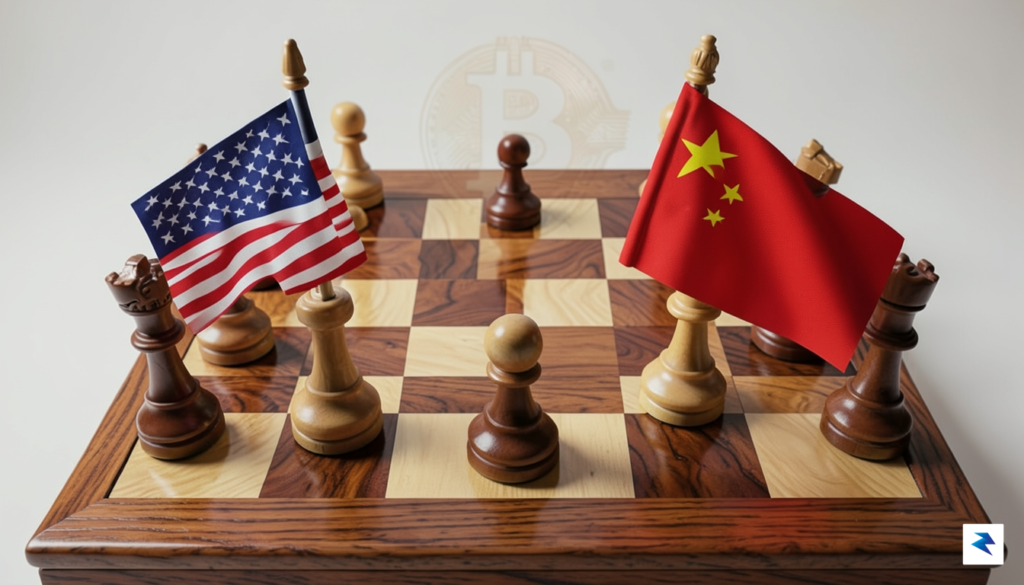
Beyond the immediate shockwaves of military escalation in the Middle East, the broader financial landscape is being buffeted by a secondary, equally potent force: the return of aggressive trade rhetoric. Former President Donald Trump’s recent remarks regarding potential escalations in U.S.-China economic relations have injected a fresh layer of volatility into an already jittery market. When high-profile political figures float the possibility of heightened tariffs or a decoupling of trade dependencies, the immediate reaction in digital asset markets is often one of reflexive risk-off behavior. Investors, who are already balancing the risks of geopolitical instability, view these comments as a harbinger of potential supply chain disruptions and a cooling of global economic growth, both of which historically dampen the appetite for speculative, high-beta assets like Bitcoin.
The correlation between U.S.-China trade friction and crypto market cooling periods is not a new phenomenon; it is a well-documented pattern that dates back to the height of the trade wars in 2018 and 2019. During those periods, whenever tensions flared, Bitcoin and other major cryptocurrencies frequently experienced sudden sell-offs as institutional capital retreated toward the relative safety of the U.S. dollar or gold. The current environment is particularly sensitive because trade protectionism doesn’t just threaten specific industries; it creates a systemic uncertainty that permeates the entire global economy. When major powers signal a departure from cooperative trade policies, it undermines the confidence necessary for investors to commit capital to riskier, long-term speculative positions, leading to the kind of liquidity contraction currently pushing Bitcoin toward the $63,000 threshold.
Trade protectionism acts as a macro-economic anchor, dragging down market sentiment by replacing predictable policy frameworks with the constant threat of sudden, punitive economic mandates.
Furthermore, the unpredictability of campaign-trail rhetoric adds a distinct psychological layer to market sentiment. Unlike established legislative changes, campaign commentary can change daily, forcing traders to price in the “worst-case scenario” just to remain hedged against sudden shocks. This defensive posture is inherently detrimental to the bullish momentum that Bitcoin requires to break through resistance levels. As investors digest the potential for a renewed cycle of tariffs and trade barriers, the focus shifts away from Bitcoin’s intrinsic value as a decentralized asset and toward its vulnerability to global macroeconomic policy shifts. Until there is greater clarity regarding the trajectory of international trade relations, the market is likely to remain trapped in this cycle of reactive trading, where every headline regarding U.S.-China tension acts as a catalyst for downward price pressure.
While the immediate market reaction to geopolitical friction often manifests as a sharp retreat in price, it is essential to distinguish between reflexive volatility and the structural integrity of the Bitcoin network. Market participants frequently panic during times of uncertainty, triggered by headlines regarding international conflicts or shifts in major trade policies. However, these transient shocks do not alter the protocol’s underlying mechanics, such as its fixed supply cap, censorship resistance, or the immutable nature of its distributed ledger. For long-term investors, the difference between short-term price fluctuations and the realization of value is a critical distinction that separates speculative trading from a conviction-based investment strategy.
Historically, significant price corrections have often coincided with periods of institutional accumulation rather than wholesale abandonment. When retail sentiment turns fearful due to geopolitical instability, sophisticated investors—including exchange-traded fund (ETF) issuers and corporate treasury departments—frequently view these dips as strategic entry points. By leveraging periods of downward pressure, these entities bolster their long-term holdings, effectively absorbing the supply dumped by reactive sellers. This pattern suggests that while the price may fluctuate in response to news cycles, the broader trend of institutional integration remains firmly intact, providing a structural floor that did not exist during previous market cycles.
The true value proposition of a decentralized asset often reveals itself most clearly when traditional financial systems face stress, rather than when the world is calm.
Furthermore, there is a compelling argument that geopolitical instability may eventually act as a catalyst for increased adoption rather than a deterrent. As national currencies face inflationary pressures and international trade becomes more complicated by diplomatic sanctions, the appeal of a neutral, borderless store of value becomes increasingly evident. Bitcoin is unique in its ability to function outside the purview of any single government, positioning it as a potential “digital gold” during times of extreme systemic risk. While current market behavior is governed by fear, the long-term thesis rests on the idea that as global instability persists, individuals and nations alike will seek alternatives to assets that are susceptible to political weaponization or localized monetary policy failures.
Ultimately, the resilience of the ecosystem is measured not by its daily performance against the dollar, but by the ongoing expansion of its infrastructure and the deepening of its liquidity pools. While the current price action below $63,000 serves as a reminder of Bitcoin’s sensitivity to macroeconomic news, it also highlights the disconnect between temporary sentiment and the enduring maturation of the asset class. Investors who look beyond the immediate noise are likely to find that the fundamental drivers of adoption—security, scarcity, and decentralization—continue to gain momentum regardless of the latest diplomatic headlines.

When the digital asset market reacts sharply to geopolitical flashpoints, the immediate instinct for many retail investors is to panic-sell or attempt to time the bottom. However, seasoned market participants understand that volatility is not a bug in the cryptocurrency ecosystem; it is a fundamental feature. Instead of succumbing to the pressure of short-term price swings, investors should view these turbulent periods as a stress test for their long-term thesis. Maintaining a disciplined approach requires shifting focus away from hourly charts and toward the underlying fundamentals that prompted your initial investment in the first place.

One of the most effective strategies for navigating such uncertainty is the consistent application of Dollar Cost Averaging (DCA). By automating your purchases at regular intervals—regardless of whether Bitcoin is trading at $63,000 or experiencing a sharp correction—you effectively smooth out your entry price over time. This systematic approach removes the emotional toll of trying to predict the “perfect” dip, which is notoriously difficult even for professional traders. When geopolitical events cause sudden liquidity crunches, those who utilize DCA are often able to accumulate more assets during periods of fear, positioning themselves for recovery without the stress of market timing.
The core of a resilient portfolio is not the absence of risk, but the intelligent management of it through diversification and patience.
Furthermore, investors must learn to distinguish between genuine market “signals” and mere geopolitical “noise.” In an era of 24-hour news cycles, headlines regarding strikes, trade rhetoric, and international policy shifts can create a deafening roar of sentiment that often leads to irrational market moves. To filter this effectively, consider the following checklist:
Finally, do not underestimate the power of a diversified portfolio in mitigating the impact of localized geopolitical shocks. While Bitcoin often acts as a digital hedge, it remains a high-beta asset that correlates strongly with global liquidity. By balancing your portfolio with assets that have different risk profiles or non-correlated drivers, you create a buffer against the specific volatility associated with any single region or political dispute. Remember that wealth preservation is a marathon, not a sprint; during times of high tension, the most profitable move is frequently the one that requires the most patience.
You must be logged in to post a comment.