
Top 10 Fun Discord Bots
Are you looking to spice up your Discord server with some fun and engaging bots? Do you want to create an environment that keeps your members…

For decades, the humble browser cookie reigned supreme as the primary tool for websites to remember users, track their activities, and deliver personalized experiences. These small data files, stored directly on your computer, allowed sites to keep you logged in, remember your shopping cart, and tailor advertisements. However, as privacy awareness grew and regulations like GDPR and CCPA emerged, users gained more control over cookies, often deleting them or configuring their browsers to block third-party trackers. This shift, coupled with the rise of ad blockers, presented a significant challenge to the advertising industry, prompting a relentless search for more resilient, and often more invasive, methods of user identification.
This quest led to the rise of browser fingerprinting, a sophisticated technique that moves beyond simple stored data. Instead of relying on a file saved on your device, fingerprinting constructs a unique profile of you by analyzing a multitude of data points your browser inherently shares with every website it visits. Think of it like a digital composite sketch, piecing together seemingly innocuous details such as your screen resolution, installed fonts, browser plugins, operating system, timezone, language settings, and even the specific characteristics of your graphics card or audio stack. When combined, these individual pieces of information form a highly distinctive “fingerprint” that can be remarkably unique across millions of users, even without a single cookie being placed on your machine.
The insidious nature of fingerprinting lies in its ‘stateless’ operation. Unlike cookies, which are persistent storage mechanisms, fingerprints don’t require the website to store anything on your device. Instead, the tracking occurs server-side, where the collected data points from your browser are processed and analyzed to identify you. This makes it incredibly difficult to block using traditional privacy tools. You can clear your cookies, browse in incognito mode, or even use VPNs, but your browser continues to report these intrinsic hardware and software characteristics. This constant leakage of information means that even if you take steps to erase your digital breadcrumbs, your unique browser setup can still betray your identity across different sites and sessions, creating a persistent tracking vector that is challenging to circumvent without breaking core web functionality.
Browser developers are acutely aware of this escalating threat and are engaged in an ongoing arms race to mitigate fingerprinting risks. Modern browsers like Firefox, Safari, and increasingly Chromium-based browsers, implement various defenses. These include privacy budgets that limit how much identifying data websites can collect, randomization techniques that subtly alter certain API outputs to make them less unique, and stricter controls over access to sensitive hardware information. Some browsers also employ advanced machine learning to detect and block known fingerprinting scripts. However, the challenge is immense, as many of the APIs used for fingerprinting also serve legitimate purposes, from optimizing web rendering to enabling complex web applications.
This continuous cat-and-mouse game between privacy advocates and tracking entities illustrates why new, increasingly subtle techniques are constantly emerging. Trackers are always seeking novel ways to leverage the minute differences in how various systems execute code or render information. The recent discovery that even the precise calculation of mathematical functions like Math.tanh can reveal underlying operating system characteristics in Chromium 148 is a stark reminder of this sophistication. It underscores that the battle for online privacy is not just about blocking obvious trackers; it’s about understanding and defending against the most minute, seemingly benign, differences in our digital footprints.
With the release of Chromium 148, a subtle yet significant discovery emerged that fundamentally alters the landscape of browser fingerprinting. Researchers found that the seemingly innocuous `Math.tanh()` JavaScript function, which calculates the hyperbolic tangent of a number, now behaves slightly differently depending on the operating system a user’s browser is running on. This minute discrepancy isn’t a bug in Chromium itself, but rather a newfound exposure of underlying system characteristics, turning a standard mathematical operation into a silent, persistent identifier for your device’s OS.
The core of this revelation lies in the intricate world of floating-point arithmetic and how computers handle complex mathematical operations. While computers adhere to the IEEE 754 standard for representing floating-point numbers, the actual *implementation* of transcendental functions like `tanh` can vary. These functions are often highly optimized routines provided by the operating system’s standard math libraries, such as `libm` on Unix-like systems (Linux, macOS) or specific libraries on Windows. Different operating systems, with their distinct compilers, processor architectures, and library versions, might calculate the hyperbolic tangent with infinitesimally different levels of precision or internal rounding, especially in the least significant bits of the result, even for the same input value.
Before Chromium 148, the browser might have used its own consistent internal implementation for `Math.tanh()`, effectively masking these underlying OS differences. However, with this update, Chromium appears to be leveraging the host operating system’s native math library more directly or in a way that exposes these pre-existing system-level variations. Consequently, when a JavaScript engine within Chromium 148 invokes `Math.tanh(x)` for a specific input `x`, the exact floating-point output it receives can now subtly signal whether the calculation was performed by Windows’ math library, macOS’s, or Linux’s.
To exploit this, a website can execute `Math.tanh()` with a carefully chosen set of input values. For each input, it records the precise floating-point output returned by the user’s browser. By comparing these collected results against a pre-compiled database of `Math.tanh()` outputs known to be associated with Windows, macOS, and various Linux distributions, the website can accurately deduce the user’s operating system. This technique bypasses traditional OS detection methods that might rely on user-agent strings, which can be easily spoofed, offering a more robust and covert way to identify a user’s underlying platform. This seemingly minor mathematical deviation thus becomes a powerful, hard-to-evade fingerprinting vector, raising significant concerns for user privacy and anonymity online.


At the very core of how modern computers perform calculations lies the concept of floating-point arithmetic, a system designed to represent real numbers with a fractional component. While seemingly straightforward, this system is inherently a balancing act between precision and the finite memory available to a computer. Unlike integers, which can be represented exactly, most real numbers (like pi or 1/3) cannot be stored perfectly in binary, leading to tiny, almost imperceptible rounding errors. These minute differences, normally inconsequential for everyday computing tasks, become critically important when they act as unique identifiers for the underlying software and hardware.
The bedrock for how these numbers are handled is the IEEE 754 standard, a widely adopted technical standard for floating-point computation established by the Institute of Electrical and Electronics Engineers. This standard dictates how floating-point numbers are represented in binary (e.g., single-precision 32-bit or double-precision 64-bit formats) and specifies rules for arithmetic operations, conversions, and error handling. Its primary goal is to ensure consistency and interoperability across different computing platforms, allowing software to produce the same results regardless of the specific CPU or operating system. However, while the standard defines the *framework*, it leaves room for interpretation in the exact implementation details of complex mathematical functions.
This flexibility in implementation is precisely where the “variance” originates. Although all systems adhere to the IEEE 754 standard for basic operations like addition and multiplication, the algorithms used for more complex transcendental functions—such as logarithms, exponentials, or trigonometric functions like Math.tanh()—can vary subtly. These differences often stem from hardware-specific optimizations, compiler choices, or the particular mathematical libraries employed, each potentially prioritizing speed, code size, or a slightly different approach to achieving the required precision. Consequently, two different systems, both adhering to IEEE 754, might calculate the hyperbolic tangent of the exact same input number and produce results that differ by only the smallest possible unit in their least significant bits.
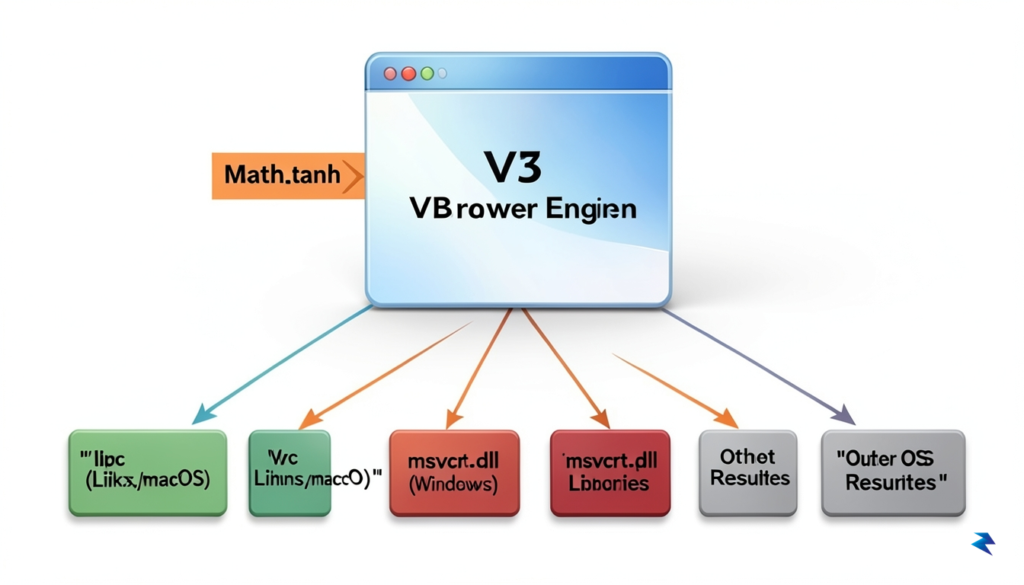
Browser engines, such as Chromium’s V8 JavaScript engine, don’t typically re-implement every complex mathematical function from scratch within their own codebase. Instead, for performance and reliability, they often defer these calculations to the highly optimized, native math libraries provided by the operating system itself. For instance, on Linux and macOS, these functions are usually handled by parts of the C standard library, commonly known as libc. On Windows, the corresponding functionality is often found within msvcrt.dll, the Microsoft C runtime library. Because each operating system’s math library is developed independently and optimized for its specific environment, processor architectures, and historical decisions, their internal algorithms for functions like Math.tanh() can lead to these tiny, yet distinct, computational fingerprints.
Consider the Math.tanh() function, which calculates the hyperbolic tangent of a number. This function is critical in various scientific and engineering applications, including neural networks. When a JavaScript application calls Math.tanh(0.5), the V8 engine passes this request down to the underlying operating system’s math library. While both libc on a Linux machine and msvcrt.dll on a Windows machine will aim to return the most accurate IEEE 754 double-precision floating-point number for tanh(0.5), their internal approximation methods, series expansions, or rounding strategies might diverge at the very last decimal place. This infinitesimal deviation, often a difference in just one or two bits at the very end of the 64-bit representation, is usually imperceptible to human users and harmless to most applications.
The key to uncovering these variances lies in a technique known as differential testing. Researchers or fingerprinting scripts perform the exact same series of mathematical calculations—for example, calling Math.tanh() with hundreds or thousands of different input values—across a wide range of target systems. They then meticulously collect and compare the output results from each system. If a specific input consistently yields a slightly different floating-point value on one OS compared to another, even by a single bit, that difference becomes a unique characteristic. Aggregating these subtle deviations across multiple inputs creates a distinct “signature” that can reliably identify the specific operating system, and sometimes even the particular version of the OS or CPU architecture, due to the unique way its math library processes these computations.
This seemingly esoteric mathematical detail transforms into a significant privacy concern. What appears to be an insignificant rounding error becomes a powerful data point for

The revelation that a fundamental mathematical function like Math.tanh can betray underlying operating system information within Chromium-based browsers marks a significant and concerning shift in the landscape of digital privacy. For individuals who meticulously configure their online environment, employing tools like Virtual Private Networks (VPNs) for IP obfuscation or privacy-hardened browsers such as Tor Browser and Brave, this development is particularly unsettling. It fundamentally challenges the assumption that merely masking an IP address or clearing cookies is sufficient to maintain anonymity; instead, it demonstrates that the very software environment running on a user’s device can inadvertently become a unique fingerprint.
Consider the meticulously crafted security architecture of tools like Tor Browser. Designed from the ground up to provide robust anonymity, Tor aims to make every user appear indistinguishable from every other Tor user. This is achieved through a combination of traffic routing, strict default settings, and efforts to normalize browser characteristics. However, if a website can execute a JavaScript function and discern, with a high degree of probability, whether the user is running Windows, macOS, or Linux based on the minute computational differences of Math.tanh, then a critical layer of this anonymity is compromised. This isn’t about IP addresses or geo-location; it’s about the deep-seated characteristics of the operating system itself, leaking through a seemingly benign mathematical operation.
At the heart of anonymity lies the concept of ‘unlinkability’. In simple terms, unlinkability means that an observer should not be able to determine whether two observed actions or pieces of data belong to the same entity. For a privacy-conscious user, this translates to the ability to browse the web across different sessions and websites without those sessions being linked back to a persistent, identifiable profile. The new Math.tanh fingerprinting vector directly attacks this principle. If a website can detect your OS via this method, it gains a persistent piece of information about your environment, even if your IP address changes, or you clear your browser history.

This persistent OS signature becomes a sticky attribute that follows you. Imagine a scenario where you use Tor Browser to access a sensitive site, then later browse another site using a different browser or even a clean Tor session. If both sites employ this fingerprinting technique, and your OS signature remains consistent, those sessions could be linked, potentially eroding your carefully constructed anonymity. It creates a subtle yet powerful identifier that is remarkably difficult for users to change or hide, as it’s inherent to the software stack they are running.
The implications extend beyond just identifying the OS. Knowing the OS reduces the potential pool of users a specific fingerprint could belong to, making it easier for advanced tracking mechanisms to narrow down candidates. This effectively makes it harder to blend in with the crowd, which is the foundational principle of all effective anonymity systems. Privacy-hardened browsers and VPNs are constantly engaged in an arms race against evolving fingerprinting techniques, and this discovery underscores the ongoing challenge. It serves as a stark reminder that anonymity is a fragile state, constantly threatened by new, often unexpected, vectors of information leakage, pushing developers to find even more robust ways to normalize and obscure every conceivable system characteristic.

The recent discovery regarding `Math.tanh()` in Chromium 148, which subtly leaks information about the underlying operating system, is far more than an isolated bug; it’s a striking example of a deeper, systemic challenge facing browser developers. The very fabric of the web relies on consistent behavior, yet subtle differences in how mathematical operations are handled across diverse hardware and software environments can inadvertently become unique identifiers. This incident underscores that even highly standardized web APIs can harbor silent vulnerabilities, and until comprehensive, deep-level fixes are universally implemented, users must remain acutely aware of the persistent limitations inherent in many of today’s privacy tools.
The path forward for browser developers lies in achieving true determinism for sensitive web APIs. This means ensuring that functions like `Math.tanh()` and similar mathematical operations produce absolutely identical, bit-for-bit reproducible results across every conceivable operating system, CPU architecture, and hardware configuration. Such a monumental task requires a concerted effort to establish and adhere to ultra-precise reference implementations, meticulously tested against a vast array of environments. Furthermore, browser engines need to bolster their sandboxing capabilities, creating a more impermeable barrier between the JavaScript execution environment and the underlying system. This enhanced isolation would prevent web content from probing minute, OS-dependent variations that can be exploited for fingerprinting, effectively cutting off these silent data leaks at their source rather than merely patching individual instances.
Beyond mathematical functions, a broader philosophical shift is needed towards proactive standardization that anticipates and neutralizes potential fingerprinting vectors. Browser vendors, alongside standards bodies, should rigorously audit all web APIs for any exposure to system-level nuances. This might involve defining strict algorithmic implementations for floating-point arithmetic in JavaScript, independent of the host system’s native math libraries, or providing mock values for system properties that are prone to variation. Such a comprehensive approach ensures that the web platform presents a uniform face to every user, regardless of their device, thereby making it significantly harder for malicious actors to differentiate and track individuals based on their system’s unique characteristics.
While browser developers work on these foundational improvements, users are not entirely powerless. Employing browsers specifically designed with anti-fingerprinting in mind, such as the Tor Browser or Brave, can provide a significant layer of protection by actively randomizing or suppressing common fingerprinting vectors. For users of mainstream browsers like Firefox, enabling its Enhanced Tracking Protection (ETP) in “Strict” mode or delving into `about:config` to activate advanced privacy settings like `privacy.resistFingerprinting` can help. This particular Firefox setting attempts to present a more generic browser profile to websites, making it harder to distinguish your browser from others. It’s also crucial to keep your browser and operating system updated to benefit from the latest security patches and privacy enhancements, as these updates often address newly discovered vulnerabilities.
However, even with these precautions, it’s vital to understand their limitations. Techniques like `Math.tanh()` fingerprinting operate at a very deep, almost imperceptible level, often bypassing standard ad blockers or anti-tracking extensions that focus on more superficial tracking scripts. While privacy-focused extensions like uBlock Origin, Privacy Badger, or Canvas Blocker are invaluable for mitigating many forms of tracking, they may not entirely nullify every deep-seated OS-level leak. The most extreme measure, disabling JavaScript entirely, effectively stops almost all fingerprinting, but it renders most modern websites unusable. Therefore, a pragmatic approach involves layering multiple privacy tools and maintaining a healthy skepticism about the extent of your anonymity online.
The discovery of the `Math.tanh()` fingerprinting vector was not an internal browser revelation but the result of diligent, independent research. This highlights the absolutely critical role that the wider privacy community, security researchers, and open-source contributors play in identifying these “silent leaks” before they can be widely exploited. These dedicated individuals and groups often possess the unique expertise and perspective to uncover subtle, non-obvious methods of user tracking that might otherwise go unnoticed for extended periods. Their work acts as an early warning system, pushing browser vendors to address vulnerabilities that could severely compromise user privacy.
“The ongoing cat-and-mouse game between privacy advocates and fingerprinting exploiters underscores the need for constant vigilance and collaborative effort. Every new discovery, no matter how small, pushes the boundaries of browser security forward.”
Fostering and supporting this ecosystem of independent research is paramount. Browser vendors should maintain clear channels for reporting such findings, provide bug bounties, and actively engage with the research community. This collaborative vigilance is essential to staying ahead in the ever-evolving landscape of online privacy. Ultimately, the battle against sophisticated fingerprinting techniques is an ongoing one, requiring a multi-pronged approach that combines robust engineering from browser developers, informed vigilance from users, and persistent, expert scrutiny from the global research community.

You must be logged in to post a comment.