
Why Saronic’s New Texas Shipyard Signals the Future of Maritime Drones
The Rise of Autonomous Maritime Technology The maritime domain is currently undergoing a structural transformation that mirrors the rapid…


The digital landscape is currently witnessing an unprecedented surge in synthetic content, as Large Language Models (LLMs) like GPT-4 and its successors become deeply embedded in the fabric of daily communication. From automated blog posts and marketing copy to sophisticated academic drafting, the line between human-authored and machine-generated text is becoming increasingly blurred. This proliferation has ignited a frantic arms race in detection technology, where the prevailing industry response has been to fight fire with fire: deploying ever-larger, more complex transformer-based models to recognize the subtle statistical fingerprints left behind by their AI counterparts. However, this “bigger is better” approach is beginning to show its limitations, forcing developers and researchers to reconsider the efficacy of their detection strategies.

While deep learning models excel at capturing high-dimensional linguistic nuances, they often come with significant drawbacks that hinder their practical application. Most notably, the computational overhead required to run massive transformer models—both during the training phase and at inference—is staggering. Furthermore, these detectors often function as “black boxes,” providing a probability score without offering a clear explanation of why a specific text was flagged as synthetic. This opacity is a liability in contexts requiring high accountability, such as academic integrity or content moderation, where users demand transparency regarding the decision-making process. By relying exclusively on these resource-heavy architectures, we risk creating a bottleneck where detection remains slower, more expensive, and less interpretable than the content generation it intends to monitor.
In response to these challenges, there is a renewed interest in what might be termed “classical” machine learning—a collection of robust, battle-tested algorithms including Support Vector Machines (SVM), Logistic Regression, and Random Forests. Unlike their deep learning cousins, these models do not attempt to “understand” language in the same way; instead, they focus on identifying specific, measurable features of text, such as lexical density, punctuation patterns, and sentence length distribution. These algorithms are remarkably lightweight, allowing them to process vast amounts of data with minimal latency and minimal hardware requirements.
Classical machine learning offers a level of algorithmic transparency that deep learning models simply cannot replicate, making them an essential tool for auditability in the age of AI.
By shifting the focus back to these foundational techniques, we gain a dual advantage: accessibility and clarity. Because classical models rely on explicitly defined features rather than hidden weight layers, it is much easier for a data scientist to analyze which specific characteristics are driving a classification decision. As the internet continues to be flooded with synthetic text, the industry is discovering that we do not always need a sledgehammer to crack a nut. By combining the speed of classical models with clever linguistic feature engineering, we can create detection systems that are not only more efficient but also more reliable in their diagnostic capabilities.
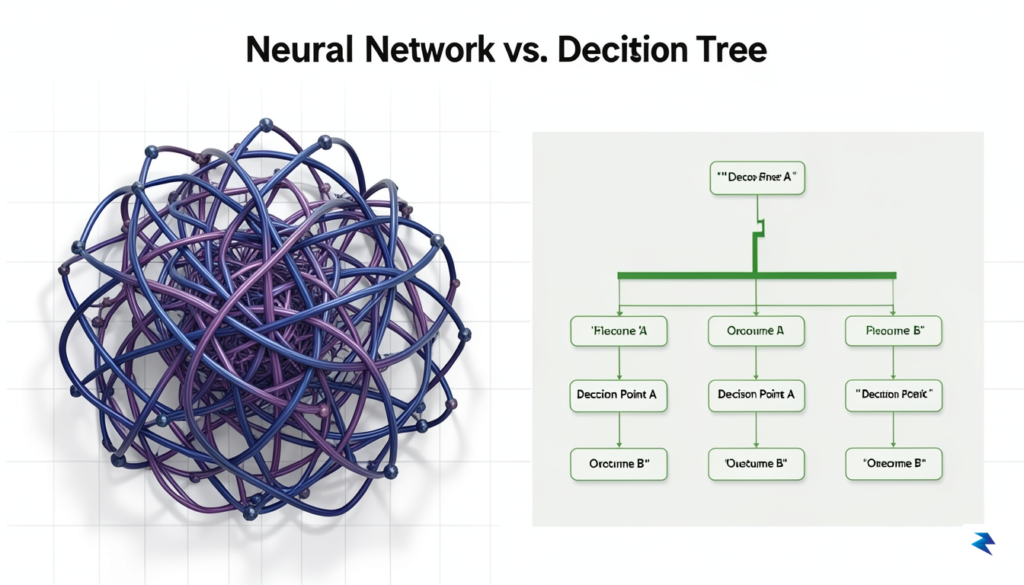
In an era dominated by massive neural networks and billion-parameter models, it is easy to assume that the most complex solution is always the best one. However, classical machine learning—approaches like Logistic Regression, Support Vector Machines, and Random Forests—remains a potent, often superior, tool for identifying machine-generated content. While deep learning models often function as “black boxes” that ingest raw data to produce a probability score, classical techniques rely on feature engineering. By explicitly instructing a model to look for specific linguistic “fingerprints”—such as n-gram frequencies, burstiness, or perplexity scores—we can build detectors that are not only faster but significantly more reliable in constrained environments.
The primary advantage of these traditional methods lies in their remarkable efficiency and low overhead. Training a deep learning transformer from scratch to identify AI prose requires massive datasets, expensive GPU clusters, and weeks of computational time. Conversely, a classical model can be trained on a standard laptop in minutes, using a fraction of the electricity and hardware resources. This drastic reduction in latency makes classical machine learning an ideal candidate for real-time applications, such as browser extensions or integrated writing tools that need to analyze text instantaneously without relying on expensive cloud-based API calls.

Furthermore, the interpretability of classical machine learning provides a level of accountability that is missing from modern deep learning architectures. In academic or professional settings, simply flagging a document as “AI-generated” is rarely sufficient; stakeholders often demand to know why a text was flagged. Because classical models operate on human-readable features—such as an over-reliance on specific transitional phrases or a lack of semantic variation—we can pinpoint the exact stylistic markers that triggered the detection. This transparency allows for a more nuanced vetting process, reducing the risk of false positives that can occur when an opaque neural network misinterprets a user’s unique, highly structured writing style as machine-generated.
The true power of classical machine learning in AI detection isn’t in its complexity, but in its precision. By focusing on the structural anatomy of language rather than just predicting the next token, these models offer a surgical approach to authenticity that deep learning often ignores.
Ultimately, the decision to use classical machine learning is a strategic choice to value performance, transparency, and accessibility over raw scale. By moving away from the “bigger is better” mentality, developers can create tools that are not only more sustainable but also more trustworthy. When we treat detection as a process of forensic analysis rather than a guessing game, we find that the most effective solutions are often the ones that have been hiding in plain sight, leveraging decades of proven statistical research to solve the challenges of the modern AI age.

At the heart of distinguishing machine-generated prose from human writing lies a structured data pipeline that transforms raw strings into quantifiable statistical signatures. Before an algorithm can make a determination, the text must undergo rigorous preprocessing, including tokenization—the process of breaking down sentences into manageable units—and normalization, such as converting text to lowercase or stripping away non-essential punctuation. This foundational step is critical because it standardizes the input, ensuring that the model focuses on the structural and rhythmic qualities of the language rather than superficial formatting variations.
Once the text is prepared, the extraction phase begins, where researchers look for specific linguistic markers that distinguish silicon-based logic from human intuition. One of the most effective methods involves n-gram analysis, which examines sequences of characters or words to identify patterns of repetition or predictability. While human writers naturally vary their sentence structure and vocabulary, LLMs often exhibit a “robotic uniformity,” characterized by specific probability distributions in their word choices. By employing techniques like TF-IDF (Term Frequency-Inverse Document Frequency), we can weigh the importance of specific terms against their rarity, effectively highlighting the repetitive or overly common phrasing that often signals an AI-generated origin.

Beyond simple word counting, sophisticated classifiers often integrate syntactic complexity metrics, such as Part-of-Speech (POS) tagging. By mapping the frequency of nouns, verbs, adjectives, and conjunctions, these models can discern the underlying “grammar” of a text. Human authors frequently break syntactic rules for stylistic effect or emotional resonance, whereas AI models tend to adhere to the most statistically probable grammatical pathways. When these features are fed into robust algorithms like Support Vector Machines (SVM) or Logistic Regression, the machine learns to draw a boundary between these two distinct linguistic worlds.
Success in detection is rarely about finding a single “smoking gun” word; rather, it is about the aggregate weight of hundreds of subtle statistical deviations that occur simultaneously.
To ensure these models remain accurate across different domains, the training phase must utilize diverse, high-quality datasets that include both human-authored essays and synthetic outputs across various genres. Without this breadth, a model might suffer from overfitting, where it learns the specific quirks of a single dataset—such as a specific style of news article—and fails to recognize AI text in a creative or academic context. By constantly refining these feature sets and testing against adversarial examples, developers can create a detection framework that is both resilient and adaptable, proving that simpler, classical approaches often provide a clarity that deep learning models—which can sometimes be “black boxes”—cannot match.

While classical machine learning models—such as Support Vector Machines (SVMs) or Random Forests—offer an accessible and computationally efficient alternative to massive neural networks, they are by no means foolproof. The fundamental challenge lies in the inherent “arms race” between generative models and detection algorithms. As LLMs evolve to produce text that increasingly mimics human stylistic nuances, the statistical signatures that these classical models rely on become progressively thinner. Because traditional classifiers often depend on surface-level metrics like word frequency distributions, sentence length variance, or punctuation density, they are particularly susceptible to being outmaneuvered by modern AI that can be prompted to adopt specific personas or mimic erratic, human-like writing patterns.
One of the most persistent hurdles in this field is the high rate of false positives, which can have significant real-world consequences. Classical models often struggle to distinguish between the structured, predictable patterns of an LLM and the writing style of non-native speakers. Because individuals writing in a second language often rely on common grammatical templates and a restricted vocabulary, their work can inadvertently trigger the same statistical flags that signify machine-generated content. Similarly, technical writing, which requires a high degree of precision and adherence to standardized terminology, often appears “robotic” to a classifier. Consequently, relying solely on these metrics in academic or professional settings risks unfairly penalizing legitimate human authors who simply happen to write in a formal or non-native style.

Beyond the issue of false positives, these models are remarkably vulnerable to adversarial attacks and simple human-led edits. Because classical classifiers are tuned to detect static statistical patterns, even minor interventions—such as paraphrasing a few sentences, inserting deliberate stylistic inconsistencies, or rearranging word order—can effectively “poison” the detection process. By introducing human-authored noise into an AI-generated draft, an actor can shift the text’s profile enough to bypass the model’s thresholds entirely.
The effectiveness of a classical classifier is only as strong as the statistical stability of the text it analyzes; once that stability is disrupted by human-led edits, the model’s predictive power often collapses.
Ultimately, understanding these limitations is essential for anyone implementing detection software. We must treat these tools as heuristics rather than absolute arbiters of truth. As AI continues to become more sophisticated, the gap between “detectable” and “human-like” text will only narrow, requiring a more nuanced approach that combines classical statistical analysis with critical human oversight to verify results.

As we navigate the rapidly evolving landscape of generative artificial intelligence, it has become increasingly clear that no single tool can serve as a universal arbiter of truth. The quest to differentiate between human-authored prose and machine-generated output is not a problem that can be solved with a binary switch; rather, it requires a sophisticated, layered defense strategy. By integrating the lightweight speed and high interpretability of classical machine learning—such as logistic regression or support vector machines—with the nuanced contextual awareness of modern neural networks, we can construct a verification ecosystem that is far more resilient than any individual model could be on its own.
A robust defense architecture must move beyond surface-level text analysis to incorporate a wider array of diagnostic signals. This means pairing statistical detection methods with rigorous metadata analysis, such as examining revision history, timestamp anomalies, and unique linguistic fingerprints that are often lost in the “average” probability distributions favored by LLMs. Furthermore, this technical stack must be supported by human oversight, where domain experts provide the qualitative context that algorithms frequently miss. By treating classical machine learning as a rapid-response filter and deep learning as a forensic tool, organizations can catch the vast majority of automated content while reserving intensive manual review for the most complex or high-stakes cases.

Maintaining classical methods within our analytical toolbox is not a step backward; it is a strategic necessity for transparency. Unlike modern “black box” models, where the reasoning behind a classification can be notoriously opaque, classical algorithms offer a clear view of which specific features—such as word frequency, sentence structure, or punctuation density—triggered a detection flag. This inherent explainability is vital for maintaining trust in digital environments, as it allows users to understand the “why” behind a decision rather than relying on an automated verdict. This clarity ensures that when we flag content, we do so with evidence that can be audited, debated, and refined.
The goal of AI detection should not be to build an impenetrable wall, but to cultivate a climate of digital integrity where accountability remains at the forefront of human communication.
Ultimately, the ethical implications of AI detection reach far beyond technical accuracy. As we integrate these layered defense systems into our professional and academic lives, we must ensure that they are used to promote authenticity rather than to police creativity. By embracing a multi-faceted approach, we shift the focus from merely “catching” machines to fostering an environment where human expertise and artificial assistance coexist transparently. In the future, the most credible content will likely be that which is accompanied by verifiable, multi-layered provenance, ensuring that we remain the masters of our own digital discourse in an age of infinite generation.
You must be logged in to post a comment.