
Why Private Key Leaks Are Costing Crypto Billions More Than Smart Contract Hacks
The Hidden Reality of Crypto Security: Rethinking the Private Key Problem For years, the narrative surrounding cryptocurrency security has…


For the better part of three decades, the Applicant Tracking System (ATS) has functioned as the digital gatekeeper of the modern workforce, often acting as an impenetrable black box that leaves millions of qualified candidates wondering why their applications vanished into the void. At its core, an ATS was designed to solve a logistical problem for recruiters: how to manage an overwhelming volume of resumes by parsing text, filtering keywords, and ranking applicants based on predefined criteria. However, because these proprietary algorithms have historically remained shielded from public view, job seekers have been forced to play a guessing game, blindly optimizing their resumes for machines rather than humans. This opacity has fostered a deep sense of cynicism, as applicants frequently struggle to understand why their scores fluctuate wildly or why they receive automated rejections despite possessing the requisite skills for the roles they pursue.
The frustration felt by candidates is not merely anecdotal; it is a symptom of a systemic lack of accountability in recruitment technology. When an algorithm determines a candidate’s future, the absence of transparency creates a barrier to trust that undermines the entire hiring ecosystem. By keeping these scoring models proprietary, software vendors have protected their intellectual property at the expense of fair and equitable hiring practices. This environment has encouraged “resume hacking”—a desperate practice where candidates stuff their documents with hidden keywords or formatting tricks just to bypass automated filters. Such tactics do nothing to improve the quality of a hire; instead, they degrade the integrity of the process and force candidates to prioritize machine readability over authentic professional storytelling.

HackerRank’s recent decision to open-source its ATS represents a profound paradigm shift that challenges the status quo of the HR tech industry. By inviting the global developer community to inspect, audit, and contribute to the code that powers resume scoring, the company is effectively pulling back the curtain on the “black box.” This move toward radical transparency is significant because it shifts the power dynamic from opaque software vendors to the stakeholders who are actually impacted by the technology. When the source code is public, the logic behind scoring becomes a matter of public record, allowing for rigorous testing to identify and eliminate inherent biases that often plague automated systems.
True innovation in hiring technology should be measured not by how well it hides its logic, but by how effectively it fosters trust through accessibility and open collaboration.
This transition to open-source tooling is more than just a technical update; it is a necessary evolution for the future of work. When recruitment tools are built in the open, they become subject to peer review, which is the most effective mechanism for ensuring fairness and accuracy in algorithmic decision-making. By embracing this philosophy, we are moving toward a future where candidates can understand exactly what is being measured and why. This shift doesn’t just improve the technical efficacy of resume parsing; it restores the human element to recruitment by replacing secret algorithms with open, understandable standards that treat every applicant with the respect they deserve.
For years, job seekers have treated resume screening algorithms like inscrutable oracles, blindly optimizing for keywords in hopes of triggering a positive response. By diving into the mechanics of the open-source implementation, we can finally move past the guesswork and understand the architecture that governs these scores. At its core, the system does not simply run a “find” command for specific strings; instead, it utilizes a sophisticated pipeline designed for data normalization. The initial stage involves converting unstructured PDF or document data into a clean, machine-readable format, which strips away the stylistic formatting that often confuses less advanced parsers. By prioritizing this structural integrity, the engine ensures that the subsequent analytical stages are processing raw, meaningful data rather than layout-specific artifacts.
Once the document is normalized, the parser pivots to a dual-layered evaluation strategy: keyword extraction and named entity recognition (NER). Simple keyword matching acts as a preliminary filter, identifying the presence of hard skills and technologies within the text, but the true analytical power lies in the entity recognition layer. This component is designed to understand the context surrounding a specific term. For example, rather than just identifying the word “Python,” the system attempts to determine if it appears in the context of professional experience, academic projects, or merely a list of interests. By mapping these terms to a predefined schema of professional competencies, the parser distinguishes between a candidate who has simply listed a language and one who has demonstrated active, meaningful proficiency.
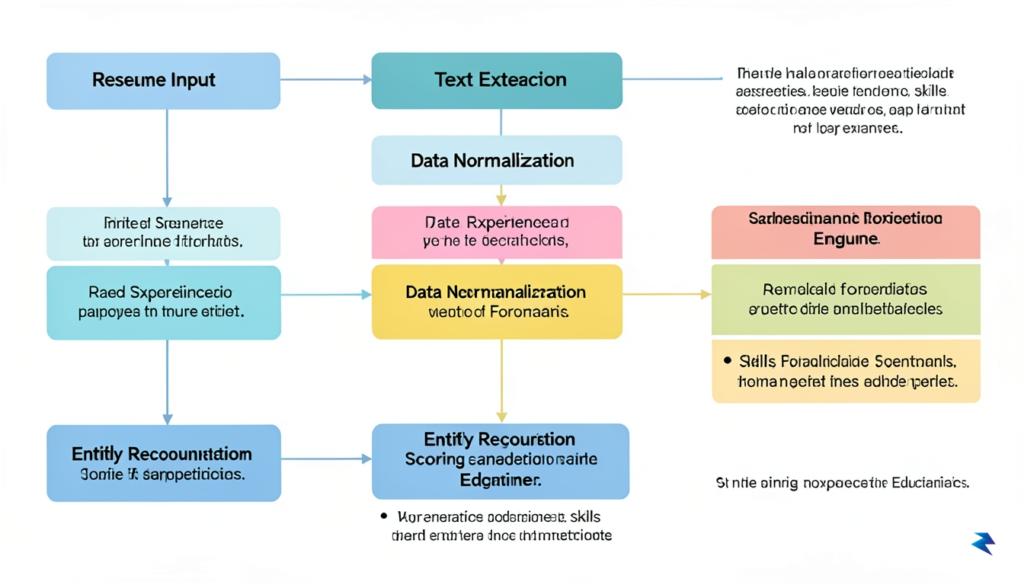
The scoring distribution is intentionally weighted to prioritize recent, relevant experience over superficial keyword stuffing. A resume that demonstrates a logical progression of skills is consistently scored higher than one that simply repeats high-value terms in a vacuum.
The final scoring weight distribution is where the “black box” logic becomes most apparent. The algorithm assigns distinct values to different sections of the resume, with a heavy emphasis on chronological work history and verified educational credentials. It functions by calculating a weighted sum where technical proficiency, tenure at previous organizations, and the breadth of skill sets are aggregated into a final numeric score. Unlike primitive filters that might penalize a resume for missing a single specific keyword, this system rewards coherence and depth. Consequently, the fluctuations in score—jumping from 74 to 88, for instance—often reflect subtle changes in how effectively the document structure communicates the candidate’s actual narrative to the parser’s entity extraction models, rather than just the addition of a few extra buzzwords.

If you have ever felt a sense of whiplash after uploading the exact same document to an applicant tracking system only to receive a different score, you are not alone. This volatility is not a glitch in the software, but a fundamental characteristic of how data normalization works. When a resume is submitted, the system must first perform a complex parsing process, converting raw file data—whether PDF, Word, or plain text—into a structured machine-readable format. Even minor variations in how these files are generated can introduce discrepancies in how the algorithm perceives your professional history. A stray line break, a slightly different font encoding, or the way a bullet point is interpreted can shift the weight of your keywords, leading to those frustrating score fluctuations.
At the heart of this issue is the tension between rigid keyword matching and more flexible semantic analysis. Modern systems strive to go beyond simple “if-then” logic by utilizing natural language processing to understand the context of your experience. However, the math behind these models is inherently probabilistic. When a system attempts to balance an exact match—looking for specific technical stacks like “React” or “Python”—against semantic similarity—interpreting whether “managed a team” is equivalent to “led a project”—it introduces a level of subjectivity. If the algorithm slightly recalibrates its confidence interval or if the underlying vector embedding model encounters a subtle ambiguity, your score will inevitably sway, even if your qualifications have remained identical.

Furthermore, the pursuit of the “perfect score” is largely a psychological trap. Because these systems are designed to rank candidates relative to a specific job description, the score is a dynamic output, not a static reflection of your worth. Factors such as whitespace, the presence of headers and footers, or even how the system handles special characters can cause the parser to misidentify or ignore entire sections of your resume. This means that two identical files might be processed with slightly different extraction success rates depending on the server load, the internal library versions being used to process the file, or the specific way the document was exported.
The resume score is not a grade on your professional competence; it is a snapshot of how well your document’s structure aligns with the current parsing logic of a specific, transient configuration.
Ultimately, these variances serve as a stark reminder that you are writing for two different audiences: the human hiring manager who needs to see your impact, and the parsing algorithm that needs to categorize your skills. Instead of obsessing over a 10-point swing in a proprietary score, focus on the structural integrity of your document. By using clean, standard formatting—such as avoiding complex tables, unusual symbols, and overly decorative layouts—you reduce the likelihood of parsing errors. By prioritizing clarity and standard terminology, you ensure that even if the algorithm fluctuates, the core pillars of your experience remain visible, consistently, and accurately.

While the prospect of an open-source Applicant Tracking System (ATS) brings a sense of transparency to the job hunt, it is vital to remember that these algorithms are designed for efficiency, not empathy. When I saw my own score fluctuate from 90 to 74 and finally settle at 88, it became clear that these numbers are highly sensitive to formatting, keyword density, and minor structural variations. Relying on an algorithm to determine your professional worth is a dangerous game, as machine learning models lack the nuance required to evaluate a human career path. An ATS is fundamentally a tool for administrative sorting; it is designed to manage high volumes of data, not to identify the spark of potential that might define a truly transformative hire.
Recruiters understand this limitation better than anyone. When a human hiring manager reviews a resume, they look for the story behind the data points. They are not merely scanning for a specific set of keywords; they are searching for evidence of adaptability, soft skills, and the capacity for growth—qualities that an ATS is notoriously bad at quantifying. A candidate might score an 88 because their resume is perfectly optimized for a scraper, yet they might lack the collaborative spirit necessary for a team-based environment. Conversely, a candidate with a lower technical score might possess the exact niche experience or unconventional background that provides the precise perspective a company needs to solve its most complex problems.
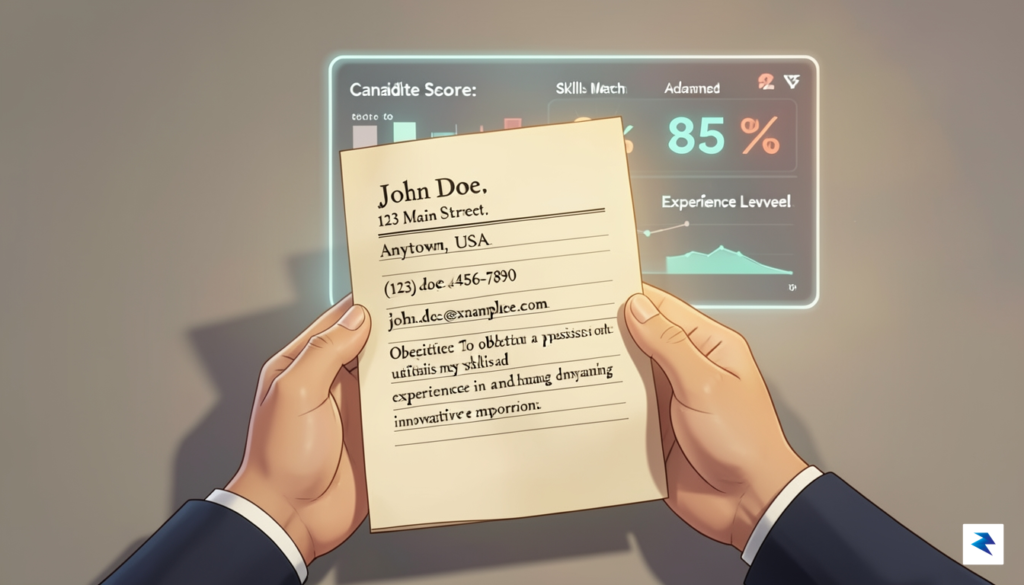
At the end of the day, an ATS score is a data point, not a verdict. It is a signal, not a final decision.
Furthermore, we must address the “black box” nature of these systems. Even with open-source code, the weight assigned to specific professional achievements often remains arbitrary. If you treat your resume as a document meant for a machine, you risk optimizing for an algorithm while losing the human voice that makes your experience compelling. The most effective job seekers use these tools to ensure their credentials are readable, but they prioritize clear, narrative-driven communication for the human audience that will eventually make the hiring choice. By viewing the ATS as a gatekeeper rather than a judge, candidates can navigate the application process with a healthier perspective, knowing that the real interview begins only when a human finally takes the time to look past the score.
Ultimately, the goal of modern recruitment should be to leverage technology to remove administrative friction, not to automate human intuition out of the equation. Companies that lean too heavily on these scoring metrics risk missing out on diverse talent who may not follow the traditional “optimized” resume template. As we embrace these new, transparent tools, it is crucial that the industry reinforces the role of the recruiter as an interpreter. We should use these systems to get our foot in the door, but we must rely on our unique, human contributions to actually secure the role.

The transition toward automated resume parsing has fundamentally changed the landscape of job hunting, turning document preparation into a delicate balancing act between aesthetic appeal and machine readability. When an Applicant Tracking System (ATS) ingest your resume, it essentially strips away the visual presentation to parse your background into structured data fields. To ensure your credentials don’t get lost in translation, you must prioritize structural simplicity. This means avoiding complex graphics, tables, and multi-column layouts that can cause parsing engines to misinterpret the chronological order of your experience or fail to extract your contact information entirely.

Adopting a “machine-first” mindset doesn’t require you to sacrifice the professional look of your document. By adhering to industry-standard formatting, you provide the parser with the predictability it needs to correctly categorize your skills. Consider the following best practices for optimizing your resume:
Pro Tip: Never embed critical information inside images, icons, or text boxes. If the parser cannot highlight the text with your cursor, it likely cannot read the content at all, rendering any text inside those elements invisible to the automated review process.
Finally, always aim for a balance between descriptive detail and concise delivery. While it is tempting to use dense, paragraph-heavy descriptions, utilizing bullet points for your achievements allows the parser to cleanly segment your contributions. By providing a clean, linear, and predictable document, you minimize the risk of a low “match score” caused by technical errors rather than a lack of actual qualification. When you remove the friction between your document structure and the parser’s logic, you ensure that your actual experience remains the primary focus of the automated evaluation.

The decision to open-source recruitment technology is more than just a gesture of goodwill; it represents a fundamental shift in how the tech industry views the “black box” of hiring. By exposing the underlying logic of resume parsers and scoring algorithms to public scrutiny, companies like HackerRank are effectively inviting the developer community to act as a collective auditor. This move toward radical transparency forces vendors to move away from proprietary, obfuscated metrics that often leave candidates—and even recruiters—confused about why a specific score was assigned. When the rules of the game are laid bare, the industry is forced to move toward higher standards of fairness, accuracy, and accountability, ultimately benefiting the quality of talent acquisition as a whole.

As these algorithms become auditable, the competitive landscape of the job market is poised for a significant transformation. Candidates will no longer be left guessing why their profile fluctuated between a 74 and an 88; instead, they will be able to optimize their applications based on verified, logical criteria rather than trial-and-error “resume hacking.” For companies, this creates a compelling employer brand advantage: organizations that utilize transparent, open-source evaluation tools signal that they value meritocracy over inscrutable gatekeeping. Consequently, top-tier talent will naturally gravitate toward firms that demonstrate a commitment to objective, data-driven hiring practices, leaving opaque legacy systems behind.
True transparency in recruitment isn’t just about showing the score; it is about building a system where every candidate understands the path to success, and every recruiter can defend the integrity of their choices.
Looking ahead, the broader impact of this shift will likely be the standardization of ethical hiring practices across the tech sector. Developers and recruiters alike must now take an active role in refining these open-source tools to eliminate inherent biases and improve the precision of skill assessment. By contributing to the development of these shared resources, the industry can create a more equitable hiring ecosystem where human potential is measured by capability rather than the ability to game a secret algorithm. We are entering an era where the most successful companies will be those that prioritize clarity and trust, effectively proving that the most effective recruitment strategy is one that everyone can see and understand.
You must be logged in to post a comment.