The Hydraulic Mystery: Why Giant Trees Don’t Run Out of Water
The Hydraulic Paradox of Tall Trees For centuries, the sheer majesty of the world’s tallest trees has captivated human imagination. From the…
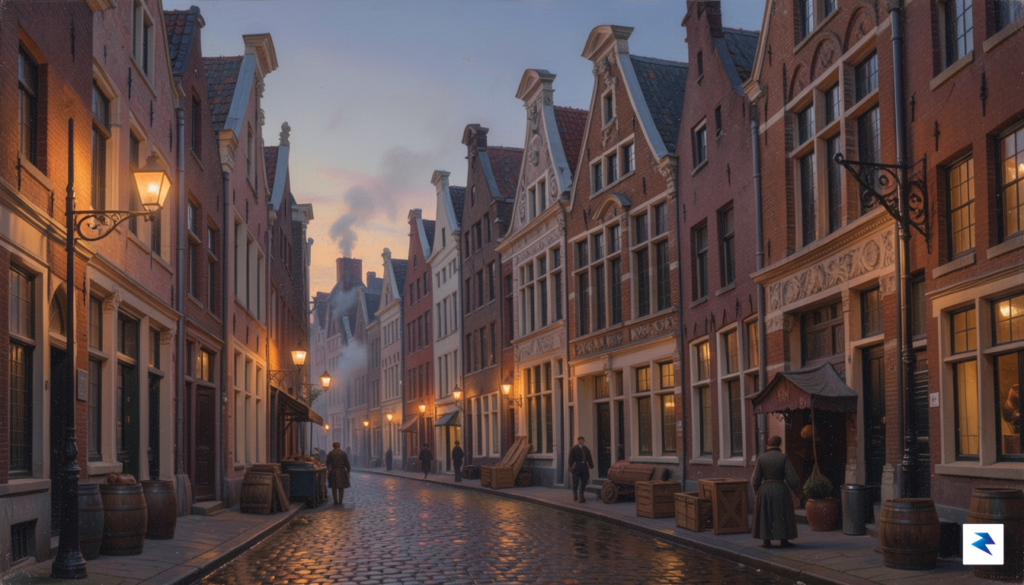
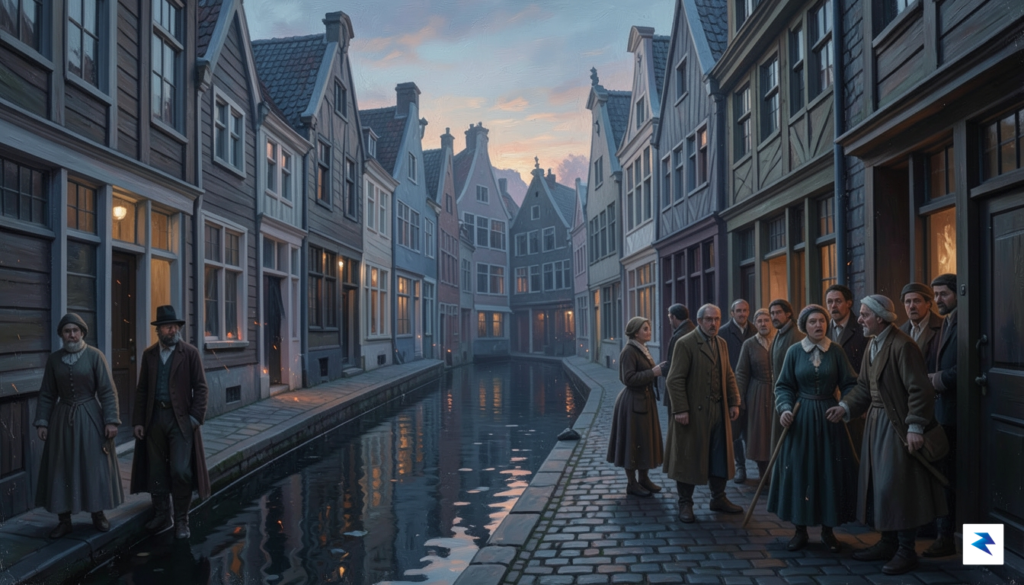
In the heart of the Dutch Golden Age, Amsterdam was a marvel of global commerce and architectural ambition, yet beneath its veneer of prosperity lay a terrifying vulnerability. The city was a labyrinth of narrow, timber-framed houses, pressed shoulder-to-shoulder along winding canals. Because wood was the primary construction material—often coated in flammable tar for waterproofing—every residential block functioned essentially as a giant, interconnected tinderbox. In this dense urban environment, the fundamental “fire triangle” of oxygen, fuel, and heat was always perfectly balanced, waiting for a single human error to trigger a catastrophe. A dropped candle, a hearth left unattended, or a stray ember from a pipe could transform a quiet neighborhood into a raging inferno within minutes.
The psychological toll of living in such a volatile environment was profound. For the average Amsterdamer, the threat of fire was not merely a periodic concern; it was an existential shadow that followed them into every night’s sleep. The city’s firefighting capabilities were, for much of the early 17th century, tragically rudimentary. Citizens relied on leather buckets, hand-held squirts, and the chaotic efforts of neighbors to douse flames, yet these tools were utterly insufficient against the ferocity of a structure fire. When a blaze took hold, the sound of the alarm bell did not bring hope, but rather a sense of shared dread, as people watched their livelihoods and their history vanish into columns of black smoke that could be seen for miles.
“The city was a vast, combustible machine; once ignited, it possessed a momentum that no bucket brigade could hope to break.”
This chronic state of peril created a desperate, city-wide hunger for technological intervention. As the wealth of the Dutch Republic grew, so too did the realization that the city’s physical survival depended on moving beyond the era of frantic, disorganized bucket lines. The public consciousness was ripe for a transformation in safety, waiting for someone to conceptualize firefighting not as a desperate scramble for survival, but as a systematic, engineering challenge. It was against this backdrop of constant, flickering danger that Jan van der Heyden and his brother Nicolaes emerged. They were not career firefighters, but rather observant, brilliant inventors who looked at the city’s architectural landscape and saw a complex problem that demanded a radical, mechanical solution. Their arrival on the scene would soon shift the balance of power between the relentless force of fire and the ingenuity of the urban environment.

In the bustling, timber-framed landscape of 17th-century Amsterdam, fire was a constant, terrifying specter. While the city thrived on trade and artistic brilliance, its defenses against the infernos that frequently razed its neighborhoods were remarkably primitive. It was into this precarious environment that Jan and Nicolaes van der Heyden emerged—not as trained mechanical engineers, but as masters of perspective and light. Jan, already a celebrated painter known for his meticulous, almost photographic depictions of urban life, possessed an innate ability to observe the structural flaws in the city’s architecture. Alongside his brother Nicolaes, he applied this unique artistic sensibility to the mechanical realm, effectively bridging the gap between aesthetic observation and functional engineering.
The brothers recognized that the traditional reliance on leather buckets and rudimentary hooks was failing the city entirely. These archaic methods required vast numbers of people to form chaotic “bucket brigades,” a system that proved both inefficient and dangerous when flames leapt across narrow canals. Because the existing tools lacked the reach or the pressure required to suppress fire at its source, Amsterdam’s fire response was essentially reactive rather than preventative. The Van der Heydens perceived that the issue was not merely one of manpower, but one of fluid dynamics and precision engineering—the same kind of precision required to capture the texture of brickwork or the reflection of light on a canal.
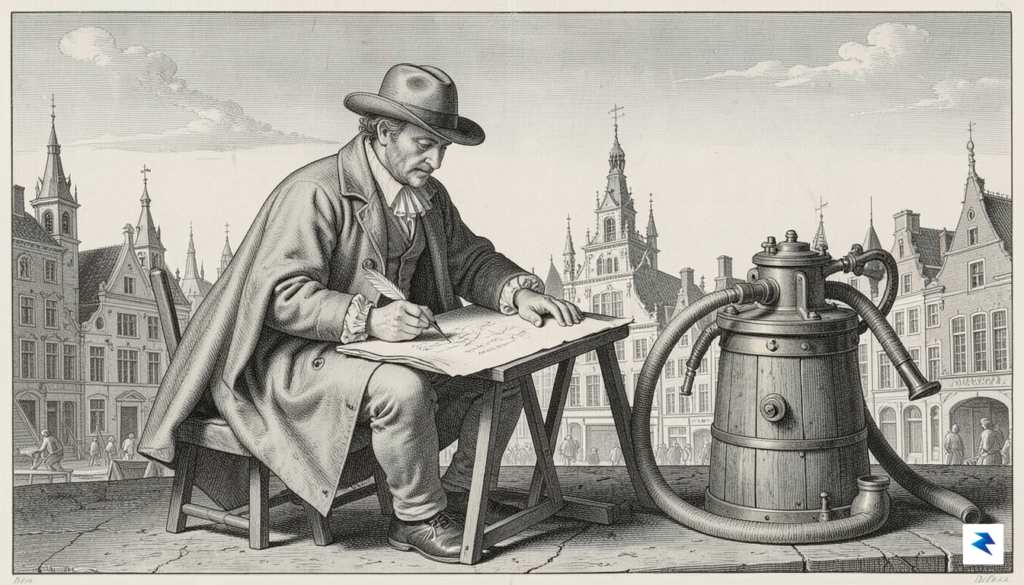
“The eye of the artist sees the world not as it is, but as it might function; where others saw only the tragedy of a burning building, the Van der Heyden brothers saw a mechanical failure waiting to be corrected.”
Driven by their desire to protect the city they so often captured on canvas, the brothers embarked on a radical shift in focus. They began to experiment with the concept of pressurized water delivery, visualizing a system that could project a continuous, directed stream of water directly into the heart of a blaze. By abandoning the disorganized bucket line, they proposed a revolutionary mechanical pump system that utilized reinforced hoses and dual-action cylinders. This transition from capturing the beauty of Amsterdam to engineering its survival marked a pivotal moment in the history of civil safety. Their work did not just introduce a new tool; it introduced the concept of professionalized fire suppression, replacing disorganized panic with the calculated, rhythmic efficiency of a machine.
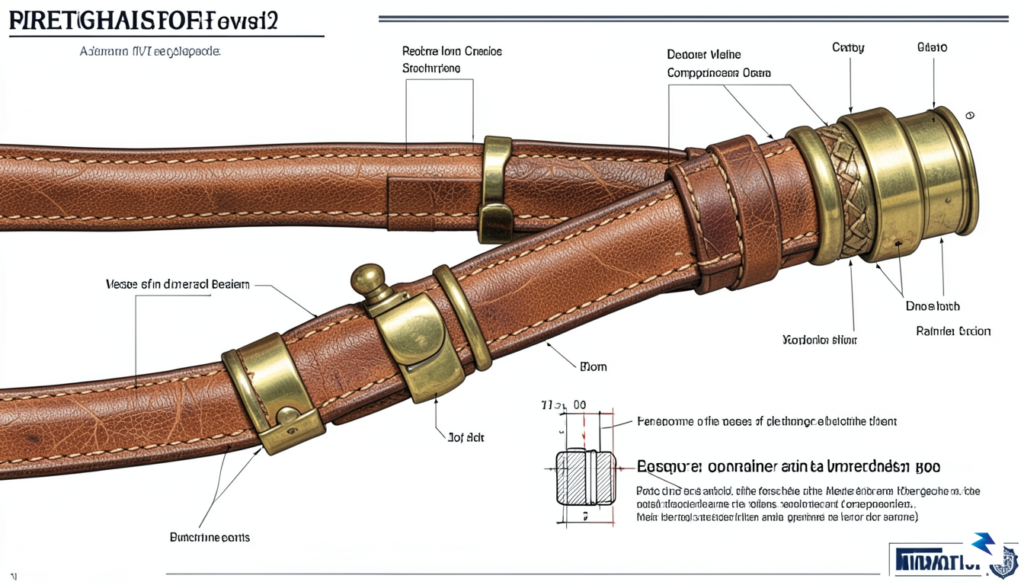
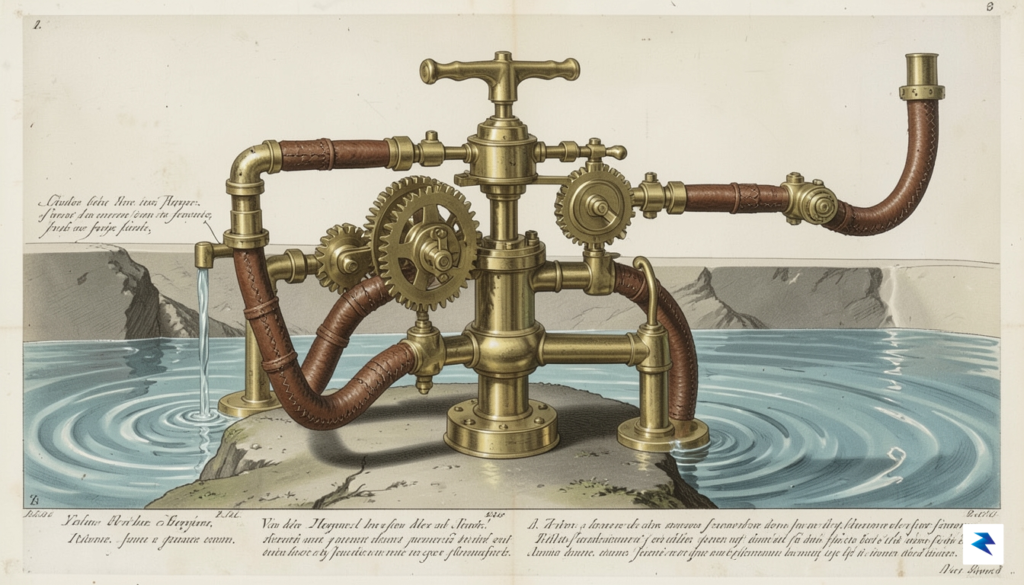
Before the advent of the Van der Heyden system, firefighting was a desperate, high-risk endeavor defined by the limits of human endurance. Residents relied almost exclusively on the bucket brigade—a chaotic, inefficient line of citizens passing leather pails from a nearby canal to the heart of the blaze. This method was not only prone to spilling but also forced firefighters to stand dangerously close to the intense heat of the flames. The brothers Jan and Nicolaas van der Heyden fundamentally altered these physics by introducing a sophisticated dual-action pump system combined with the revolutionary application of the flexible leather hose.
The technical brilliance of their design rested on the precision of their suction and force pumps. Unlike previous cumbersome wooden engines that required constant, rhythmic refilling, the Van der Heyden pump used a stable, metal-cased mechanism that could maintain a consistent, pressurized stream of water. By integrating a flexible hose made of stitched leather, they allowed the nozzle to be directed with surgical precision. This shift moved the primary firefighting equipment away from the immediate danger zone, permitting the operators to douse the fire from a safe distance while maintaining a constant pressure that a human chain could never hope to replicate.
“The introduction of the flexible hose was the single greatest advancement in fire suppression history, transforming the firefighter from a mere water-carrier into a tactical operator.”
This innovation effectively turned the tide against the frequent, catastrophic conflagrations that had historically decimated Amsterdam’s timber-framed buildings. With the hose, water could be pushed up to the higher stories of narrow houses, reaching crevices and embers that were previously inaccessible to bucket-wielding volunteers. The logistical impact was profound; where a bucket brigade might lose sixty percent of its water to evaporation and spillage, the Van der Heyden system delivered a concentrated, high-velocity jet directly onto the ignition point.
Furthermore, the integration of these systems into a standardized municipal network meant that response times dropped and effectiveness soared. By replacing the erratic human element with a reliable, engineered flow of water, the brothers created the prototype for the modern fire engine. Their invention did not just improve the efficiency of quenching flames; it established a new philosophy of firefighting based on reach, pressure, and the protective distance of the operator, principles that remain the foundation of fire science to this very day.
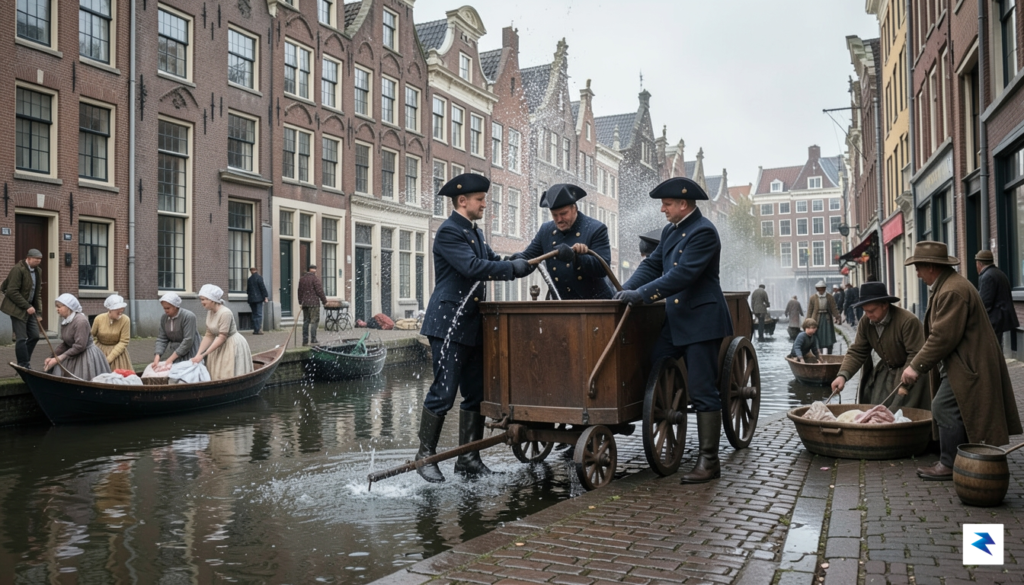
While the invention of the flexible suction hose and the double-acting piston pump—collectively known as the brandspuit—represented a monumental leap in engineering, Jan and Nicolaes van der Heyden understood that hardware alone could not save a city built of timber. They recognized that the most sophisticated firefighting equipment in the world remains inert and ineffective without the human element to wield it. Consequently, the brothers pioneered a radical shift in how Amsterdam approached public safety, moving away from spontaneous, chaotic volunteerism toward a disciplined, centralized framework. By establishing dedicated brigades, they effectively invented the concept of the municipal fire department as a coherent organization rather than a loose collection of neighbors with buckets.
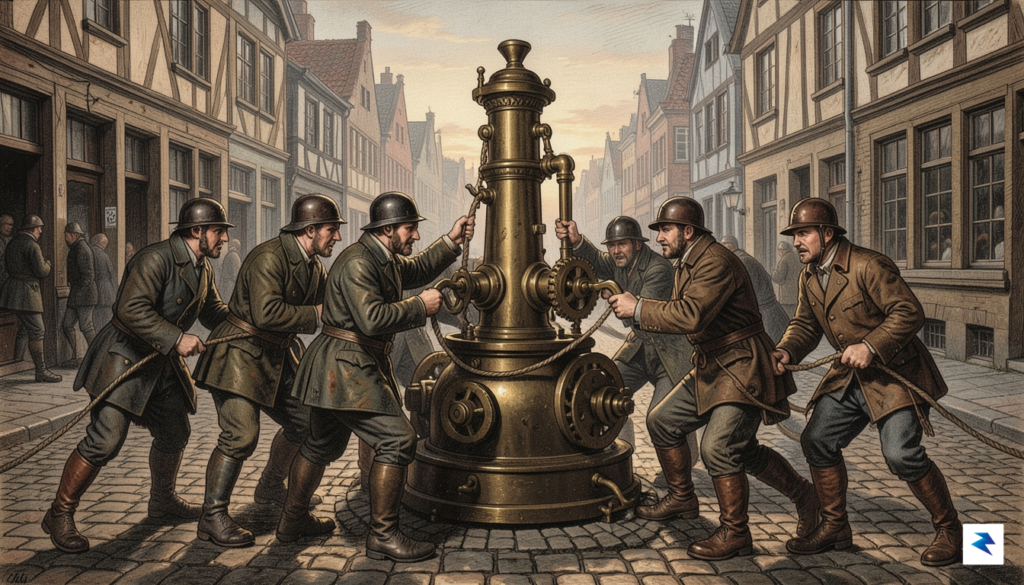
The brothers insisted that technical proficiency was as vital as the machine itself. They implemented rigorous, systematic training regimes that required brigade members to practice the assembly, deployment, and operation of their pumps under simulated emergency conditions. This was a departure from the previous norm where fire response was often haphazard and lacked coordination. By standardizing the movements and responsibilities of each crew member, the Van der Heydens ensured that when a fire broke out, the brigade functioned as a single, well-oiled machine. This focus on drill and repetition served to mitigate the panic that historically plagued firefighting efforts, allowing crews to maintain composure while operating in the heat of a crisis.
The true genius of the Van der Heyden system lay in the realization that fire suppression is as much a matter of administration and discipline as it is of hydraulics.
To sustain these units, the brothers successfully lobbied for city ordinances that integrated firefighting into the formal municipal budget and administration. These legal mandates ensured that equipment was regularly inspected, maintained, and stationed in strategic locations throughout Amsterdam, rather than left to rot in private sheds. This institutionalization of the fire service provided a reliable foundation for funding, ensuring that the necessary resources were always available regardless of the individual wealth of the citizens being protected. By embedding the fire brigade into the city’s governmental structure, they created a blueprint for modern public services: a professionalized, state-sanctioned entity tasked with the consistent protection of the urban environment. This model of command, control, and constant preparation remains the bedrock upon which every professional municipal fire department in the world is built today.
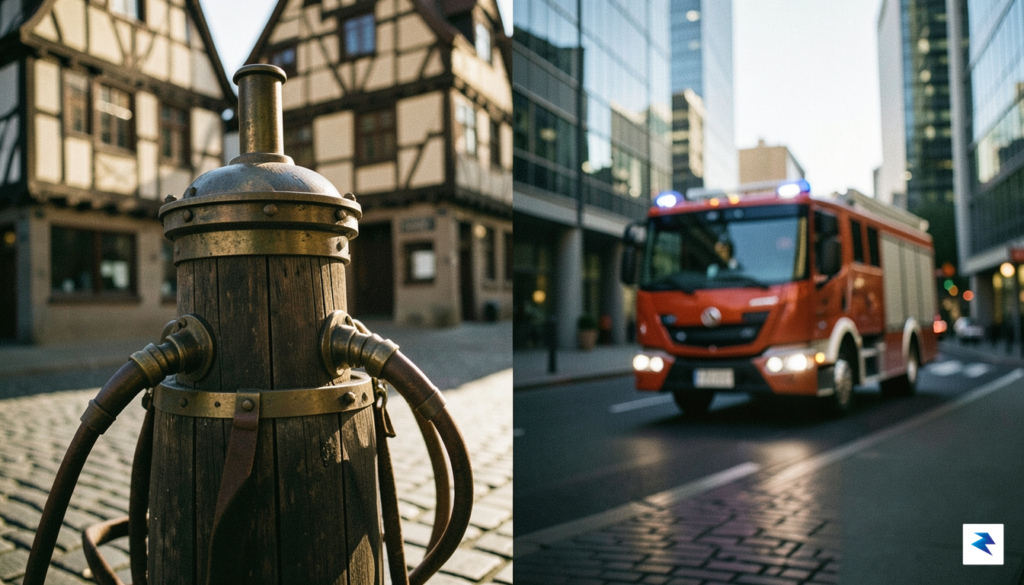
The ingenious solutions pioneered in 17th-century Amsterdam by Jan and Adriaan van der Heyden were far from mere historical curiosities; they laid fundamental groundwork for the structural safety embedded in every modern city today. Before their interventions, Amsterdam, like many bustling urban centers of its time, was a precarious tinderbox, constantly threatened by devastating fires that could wipe out entire districts in a single night. The brothers’ revolutionary fire hose and pump system, coupled with their meticulous organization of fire brigades and public education campaigns, transformed the city from a vulnerable collection of wooden structures into a formidable example of urban resilience. This systematic approach to risk mitigation not only saved countless lives and properties but also fostered an unprecedented sense of security among its burgeoning population, proving that proactive municipal planning could effectively tame the destructive power of uncontrolled flames.
The remarkable success witnessed in Amsterdam quickly garnered international attention, prompting other European cities to dispatch envoys to study and replicate the Van der Heyden model. From London, still reeling from the Great Fire, to growing metropolises across Germany and France, the influence of Amsterdam’s advanced firefighting techniques began to spread like wildfire itself, but in a constructive sense. The adoption of flexible, high-pressure hoses and the establishment of professionally trained, municipally funded fire departments marked a pivotal shift from haphazard, bucket-brigade responses to organized, efficient emergency services. This cross-pollination of innovation cemented the Van der Heyden brothers’ status not just as local heroes, but as architects of a continent-wide paradigm shift in urban safety infrastructure.
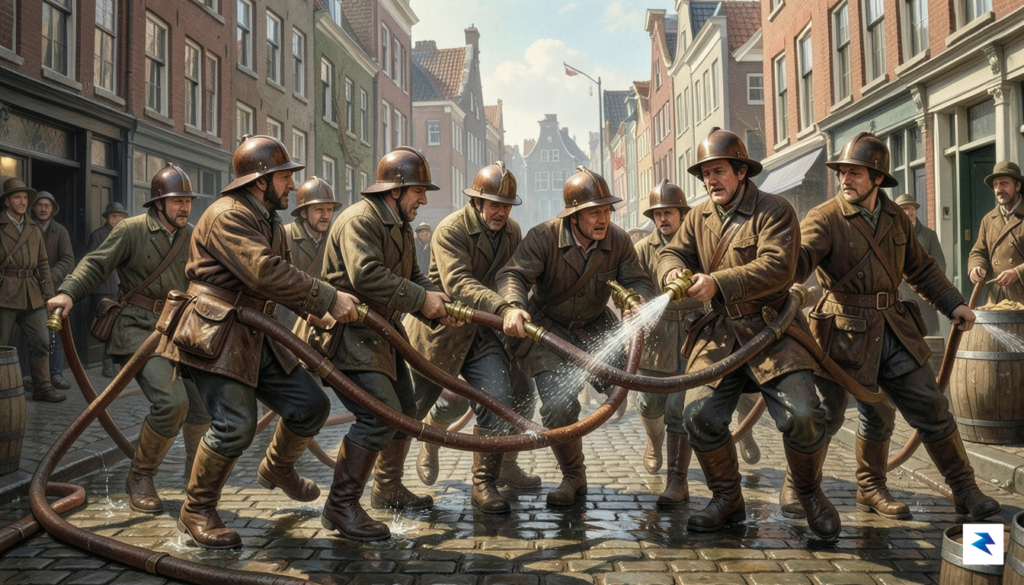
What truly distinguished the Van der Heydens’ contributions was their implicit understanding of human-centric design principles, long before the term even existed. Their innovations weren’t just about better technology; they were about creating systems that prioritized the immediate safety and long-term well-being of the city’s inhabitants. By designing equipment that was easier to deploy and more effective in containing fires, and by organizing human resources into disciplined, responsive units, they fundamentally shifted the focus of civil engineering towards public safety as a core responsibility. This profound insight underscores the idea that infrastructure, whether it be a building code or a fire suppression system, must be conceived with the human element—vulnerability, rescue, and community resilience—at its absolute core.
Consequently, the enduring impact of the Van der Heyden brothers’ work resonates deeply in the global safety protocols and urban planning standards we uphold today. Every time a modern fire engine races to an emergency, every municipal building code designed to prevent the rapid spread of fire, and every public awareness campaign about fire safety, carries a direct lineage back to their pioneering efforts. They didn’t just invent a better pump; they forged a new understanding of municipal responsibility, risk management, and the collective imperative to protect urban populations from calamity. Their legacy is evident in the structured, proactive, and technologically informed approach to public safety that is now a non-negotiable expectation in cities worldwide, ensuring that the lessons learned in 17th-century Amsterdam continue to safeguard us all.
You must be logged in to post a comment.