
Cboe Revives S&P 500 Binary Options: A New Era for Event-Based Trading
The Return of Binary Options to Cboe After a decade-long hiatus that saw binary options largely relegated to the fringes of the financial…


The staggering $4 billion price tag attached to the acquisition of Modular serves as a clear signal that the semiconductor industry has reached a critical inflection point where raw hardware performance is no longer the sole determinant of success. For years, the chip market was defined by a relentless race for faster clock speeds and smaller transistors, but the modern era of artificial intelligence demands a more nuanced approach. By investing heavily in a software-centric startup, Qualcomm is signaling that the future of computing is not merely about how many operations a chip can execute per second, but how efficiently developers can translate complex models into actionable, real-world intelligence on a device.

For Qualcomm, this move is a deliberate attempt to break free from its historical reliance on mobile handset chipsets and establish a dominant foothold in the broader AI infrastructure market. While the company has long been a leader in mobile processing, the rise of edge AI—where processing occurs locally on devices rather than in the cloud—requires a sophisticated software stack that can optimize power consumption and latency. Modular’s unique expertise in compiler technology and AI optimization provides the missing link that Qualcomm needs to ensure their Neural Processing Units (NPUs) are not just powerful, but also accessible and highly efficient for the developers building the next wave of generative AI applications.
The true value of this acquisition lies in the bridge it builds between high-performance hardware and the fragmented software ecosystem that currently holds back AI deployment at scale.
The integration strategy is fundamentally about reducing the friction between the silicon and the software engineer. Historically, even the most capable NPUs remained underutilized because the software tools required to program them were complex, proprietary, or poorly documented. Modular brings a suite of tools designed to streamline the compilation and deployment of AI models across heterogeneous hardware environments. By absorbing this expertise, Qualcomm aims to create a unified, developer-friendly ecosystem where AI models can be ported, tuned, and deployed across their product line with unprecedented ease. This shift from a hardware-first to a software-defined product philosophy is essential for any company hoping to define the standards of the next decade of edge computing.
Ultimately, this investment reflects a broader industry realization: software is the new frontier for hardware differentiation. As AI models grow increasingly sophisticated, the bottleneck is shifting away from the hardware’s physical limitations and toward the efficiency of the software stack managing those resources. Through this acquisition, Qualcomm is effectively insulating itself against the commoditization of its chips by creating a moat built out of software optimization. By ensuring that their hardware is the most seamless environment for AI development, they are positioning themselves to be the indispensable foundation upon which the future of mobile and edge intelligence is built.

For years, the artificial intelligence community has grappled with a persistent technical dichotomy: the necessity of using Python for its accessibility and expansive ecosystem versus the requirement for low-level languages like C++ or CUDA to achieve production-grade performance. While Python acts as the lingua franca of machine learning, its interpreted nature and global interpreter lock (GIL) create significant overhead that stalls the execution of high-performance models. Developers are often forced to write performance-critical kernels in C++, creating a fragmented workflow that complicates deployment and debugging. Modular aimed to bridge this chasm with the introduction of Mojo, a programming language specifically engineered to marry the syntax and ease of Python with the raw, bare-metal speed of C.

Mojo achieves this performance leap by utilizing a unique compiler architecture that allows developers to maintain Python-style code while opting into advanced system-level features. By enabling fine-grained control over memory management, hardware threading, and vectorization, Mojo empowers engineers to extract every ounce of utility from modern silicon. Unlike traditional languages that require a complete rewrite of logic to optimize for specific architectures, Mojo provides a superset of Python, meaning it can technically run existing Python scripts while offering the capability to “harden” performance-critical sections with type-hinting and explicit memory layouts. This allows for a seamless transition from experimental research to high-throughput production environments.
Mojo represents a fundamental shift in AI engineering, treating hardware acceleration not as an afterthought, but as a first-class citizen of the programming language itself.
Beyond the language itself, Modular’s broader AI Engine serves as a sophisticated orchestration layer that maximizes hardware utilization across fragmented computing landscapes. The current state of AI infrastructure is often inefficient, as models frequently struggle to communicate effectively with the underlying heterogeneous hardware, such as NPUs, GPUs, and CPUs. Modular’s technology acts as a universal translator, intelligently scheduling workloads to ensure that data spends less time in transit and more time being processed by the optimal compute unit. For Qualcomm, which dominates the mobile and edge computing space, integrating this engine into their Snapdragon roadmap is a strategic masterstroke. By combining Modular’s software-defined acceleration with their own industry-leading chipsets, Qualcomm is positioning itself to deliver near-instantaneous AI performance on everything from smartphones to autonomous vehicles, effectively commoditizing the complex engineering required to run the world’s most demanding neural networks.
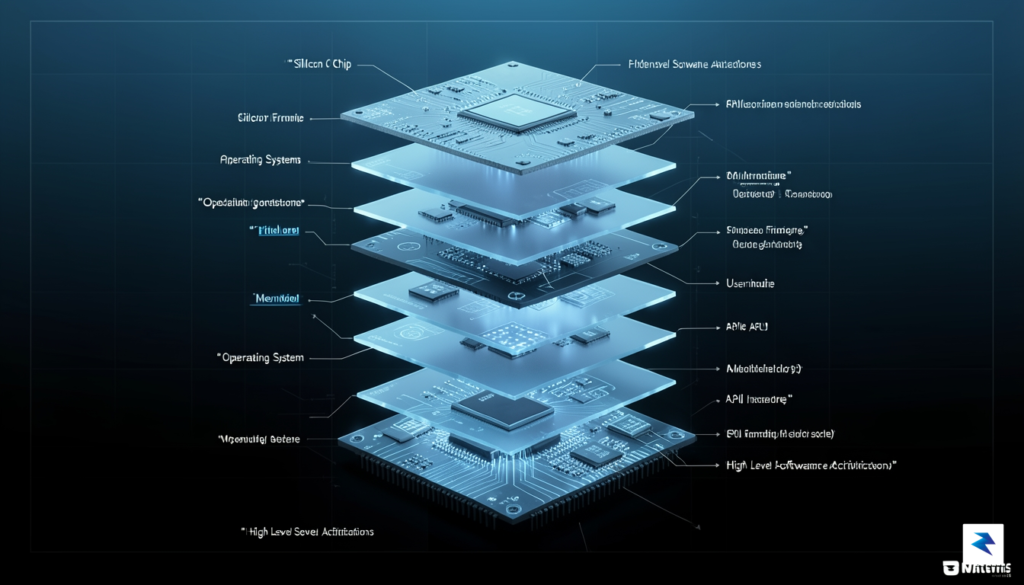
The race for artificial intelligence supremacy has fundamentally shifted away from the traditional metrics of clock speed and transistor density. For decades, the semiconductor industry operated on a general-purpose model, where hardware was designed to be flexible enough to handle any workload. However, the meteoric rise of generative AI has ushered in an era of domain-specific architecture, where the hardware must be purpose-built to accelerate the unique mathematical operations required by deep learning models. In this high-stakes landscape, manufacturing prowess is merely the entry ticket; the true battleground has migrated to the software stack, which acts as the crucial translator between raw silicon power and real-world application performance.
This transition toward hardware-software co-design is rooted in the realization that a chip is only as valuable as the ecosystem that supports it. If developers cannot easily map their complex neural networks onto a new processor, that hardware will inevitably remain dormant, regardless of its theoretical performance benchmarks. Consequently, the industry is seeing a concerted effort by hardware giants to create a “software moat”—a proprietary layer of compilers, libraries, and development tools that ensures their silicon remains the path of least resistance for engineers. By owning the full stack, a company can optimize every layer of the execution pipeline, effectively locking developers into a hardware platform that becomes increasingly difficult to abandon.

The industry benchmark for this strategy remains NVIDIA, whose CUDA platform has effectively monopolized AI research and deployment for over a decade. While competitors have frequently produced chips that rival NVIDIA’s in raw FLOPs (floating-point operations per second), they have consistently failed to dislodge the incumbent because they lack a comparable software ecosystem. Developers are deeply entrenched in the CUDA environment, and the cost of migrating to a new architecture—in terms of both engineering time and performance instability—has been prohibitively high. Qualcomm’s move to acquire Modular is a calculated attempt to break this cycle of dependency by securing a sophisticated, modern software foundation that can bridge the gap between their mobile-first silicon and the rigorous demands of enterprise-grade AI.
The true “moat” in modern computing is no longer the silicon itself, but the developer ecosystem that breathes life into it. If a company does not control the software stack, it is merely a commodity provider at the mercy of platform gatekeepers.
By integrating Modular’s capabilities, Qualcomm is signaling that it understands the future of edge AI requires more than just efficient power consumption; it requires a developer-first approach to hardware orchestration. This acquisition is a direct response to the fragmented nature of current AI deployment, where developers are often forced to write custom, low-level code to get peak performance out of heterogeneous hardware. By simplifying this process, Qualcomm aims to become the default choice for developers building the next generation of intelligent devices, ensuring that their silicon isn’t just an option, but the standard for the AI-powered future.

For years, the barrier to entry for deploying sophisticated AI models has been defined by a fragmented and cumbersome software stack. Developers often find themselves struggling to bridge the gap between high-level model research and the low-level reality of hardware execution, where traditional programming architectures simply cannot keep pace with the massive parallel processing requirements of modern neural networks. This disconnect has historically forced engineers to spend an inordinate amount of time optimizing code for specific silicon rather than focusing on the creative aspects of model architecture. By bringing Modular into the fold, Qualcomm is signaling a departure from this inefficient paradigm, moving toward a unified infrastructure that treats hardware acceleration as a first-class citizen rather than an afterthought.

The acquisition promises to fundamentally transform the daily workflow for AI engineers by abstracting away the underlying complexity of heterogenous computing. Modular’s Mojo programming language and their AI engine represent a significant leap forward, as they allow developers to write high-performance code that is natively optimized for a wide array of hardware environments without the typical overhead of legacy systems. Instead of wrestling with fragmented compilers and manual tuning, developers will soon have access to a streamlined, cohesive pipeline that bridges the gap between training and deployment. This shift effectively democratizes access to edge computing, enabling researchers to push their most demanding models onto mobile devices without sacrificing speed, responsiveness, or power efficiency.
The integration of Modular’s technology into the Qualcomm ecosystem means that the next generation of AI applications will no longer be confined to the cloud, but will instead run natively and fluidly on the devices we carry every day.
Looking further ahead, the long-term impact on the Snapdragon platform is poised to be transformative. Qualcomm has long dominated the mobile silicon market, but as AI workloads become more complex, the demand for dedicated, power-efficient processing has reached a fever pitch. By embedding Modular’s technology directly into their stack, Qualcomm is positioning its hardware to act as a seamless execution layer for the next era of generative AI. This will likely result in smartphones and laptops that can handle local, real-time AI tasks—such as advanced language modeling and computer vision—with a fraction of the energy consumption we see today. Ultimately, this move ensures that developers remain focused on building the intelligent features of tomorrow, rather than being tethered to the technical limitations of yesterday’s software architecture.

The acquisition of Modular represents a seismic shift in the semiconductor industry, signaling that the battle for dominance in artificial intelligence is no longer just about raw transistor counts or clock speeds. For years, companies like NVIDIA have enjoyed a formidable moat built on the CUDA software ecosystem, which effectively locked developers into their hardware. By bringing Modular’s expertise—specifically its work on the Mojo programming language and AI engine infrastructure—in-house, Qualcomm is aggressively attempting to dismantle these proprietary barriers. This move forces direct competitors like Intel and Apple to re-examine their own strategies, as the industry moves toward a reality where software-hardware co-design is the primary differentiator for edge AI performance.
For Intel, which has struggled to translate its hardware dominance into a cohesive AI software strategy, Qualcomm’s play serves as a wake-up call. Intel’s reliance on disparate software libraries has often left developers frustrated, whereas Qualcomm is now signaling a commitment to a unified, high-performance stack that could theoretically bridge the gap between diverse chip architectures. Meanwhile, Apple has long maintained a vertical integration strategy that optimizes its silicon for its own ecosystem, but Qualcomm’s move threatens to commoditize that advantage. If Qualcomm can provide a more flexible, developer-friendly software environment for the broader Android and PC markets, it could undermine the “walled garden” approach that has defined Apple’s silicon success for the last decade.

The true value of this acquisition lies not in the hardware itself, but in the ability to abstract away complexity, allowing AI models to run with unprecedented efficiency across Qualcomm’s vast portfolio of mobile, automotive, and IoT processors.
There are, however, significant risks associated with this level of vertical integration. By absorbing Modular, Qualcomm is betting heavily that it can maintain an open-source appeal while simultaneously proprietary-locking its software to its own silicon. If developers feel that the ecosystem is becoming too fragmented or restrictive, they may gravitate toward alternative open-source frameworks that aren’t tied to a single chip vendor. Despite these risks, the rewards are substantial; if successful, Qualcomm will have created a “compute-everywhere” platform that makes its chips the default choice for developers building the next generation of generative AI applications.
Ultimately, the competitive landscape is trending toward a future where the most successful chipmakers are essentially software companies in disguise. The industry is moving away from a world where silicon is a static foundation and toward one where AI infrastructure must be fluid, adaptive, and highly optimized through specialized compilers and languages. As NVIDIA, Intel, and Apple watch this development unfold, the pressure to innovate beyond the physical constraints of silicon will only intensify. The coming years will reveal whether Qualcomm’s $4 billion investment is the catalyst that democratizes AI development or if it marks the beginning of an era where software-defined hardware becomes the only way to compete at the highest level.
You must be logged in to post a comment.