
The End of the Monopoly? How New EU Rules Are Changing Android and Search
The New EU Mandate: Breaking Down the Regulatory Shift The landscape of European digital governance has undergone a seismic shift with the…


For nearly a decade, the blockchain industry has been locked in a seemingly inescapable compromise: the choice between robust, zero-knowledge privacy and the high-throughput performance required for global financial systems. While Zcash has long served as the gold standard for shielded, private transactions, its adoption has been hampered by technical bottlenecks that restricted its capacity to a fraction of the volume processed by legacy payment rails. Historically, the computationally expensive nature of generating and verifying zero-knowledge proofs created a significant overhead, forcing the network to prioritize security and cryptographic integrity over raw speed. Consequently, while Zcash successfully proved that private finance was possible, it remained a niche asset, unable to compete with the sheer velocity of traditional centralized networks.
The pursuit of “privacy-at-scale” represents the ultimate holy grail for decentralized finance, as it seeks to marry the necessity of individual financial sovereignty with the utilitarian demand for instant, high-frequency settlement. Without a breakthrough in scalability, privacy-centric assets are often relegated to a secondary status, viewed more as stores of value than as functional mediums of exchange for a global economy. The current state of the Zcash ecosystem demands a transition from a specialized protocol into a high-performance engine capable of handling the demands of millions of users without sacrificing the underlying shielded transaction model that defined its inception.

The introduction of the Zakura client marks a transformative departure from previous architectural constraints, effectively addressing the blockchain trilemma—the challenge of balancing decentralization, security, and scalability. By fundamentally re-engineering how nodes process shielded transactions, Zakura moves beyond the incremental performance gains of the past and introduces a new paradigm for throughput. Instead of viewing privacy as an impediment to velocity, this new client architecture leverages advanced cryptographic optimizations to parallelize proof verification, allowing the network to scale toward Visa-level capacities of 50,000 transactions per second.
The Zakura upgrade represents a fundamental shift in blockchain engineering, proving that privacy and massive throughput are not mutually exclusive, but rather complementary pillars of a mature financial network.
This technical evolution is crucial because it ensures that Zcash is no longer just a private alternative to Bitcoin, but a viable infrastructure layer for enterprise-grade financial applications. By lowering the computational barrier to entry, Zakura enables a more diverse range of participants to host nodes and participate in the network, thereby reinforcing decentralization even as the transaction volume surges. As we look toward the future of global finance, this leap in performance positions the Zcash ecosystem to serve as the foundational bedrock for a truly private, high-speed digital economy that does not require users to sacrifice their personal data for the sake of efficiency.

The Zakura client represents a radical departure from the monolithic architecture that has historically constrained the Zcash network. In traditional node designs, the validation of consensus rules and the computationally intensive verification of zero-knowledge proofs are inextricably linked, creating a sequential bottleneck that limits throughput. Zakura shatters this paradigm by introducing a modular, decoupled framework. By separating the consensus engine from the privacy-verification layer, the client allows the network to handle transaction propagation and cryptographic validation as independent, asynchronous processes. This structural shift is the fundamental catalyst that enables the network to scale toward the ambitious threshold of 50,000 transactions per second.
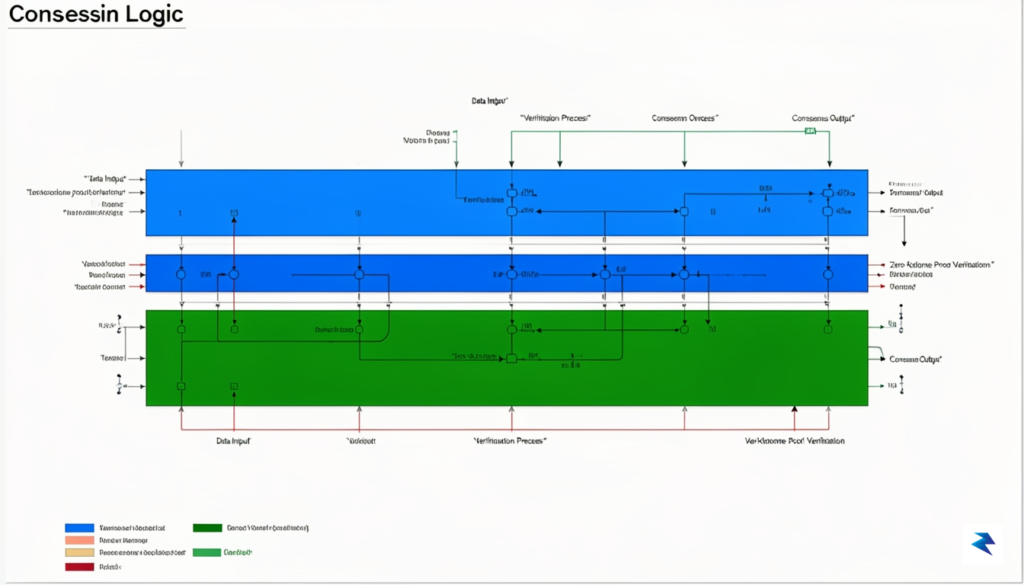
At the heart of this innovation is a sophisticated pipelining strategy. While a standard node might wait for a proof to be fully verified before propagating the transaction to other peers, Zakura employs a concurrent execution model. Validation tasks are distributed across multiple worker threads, ensuring that the node’s CPU is never idle while awaiting the outcome of a complex mathematical proof. This parallelization is not merely an optimization; it is a complete rethink of how Zcash manages its memory and computational resources. By offloading ZKP verification to specialized, high-efficiency sub-layers, the client significantly lowers the latency associated with shielded transactions, making the “privacy tax” on network performance virtually invisible to the end user.
By decoupling the consensus logic from the privacy-verification layer, Zakura transforms the node from a sequential gatekeeper into a high-throughput parallel processor.
Furthermore, the memory management improvements in Zakura address the bloat that has plagued earlier Zcash implementations. Traditional nodes often struggle with the overhead of maintaining a massive, synchronized state while simultaneously performing heavy cryptographic lifting. Zakura utilizes a highly optimized state-caching mechanism that isolates proof-verification data, preventing it from clogging the primary consensus memory pool. This modularity ensures that as the transaction volume surges toward Visa-like scales, the node remains stable and responsive. Consequently, the node is not just faster at processing existing blocks; it is fundamentally capable of sustaining a much higher ceiling of network activity without sacrificing the ironclad privacy guarantees that define the Zcash ecosystem.

To reach the monumental milestone of 50,000 transactions per second (TPS), the engineering team behind the new Zcash node architecture had to fundamentally rethink how zero-knowledge proofs are verified at scale. Traditionally, every individual transaction requires its own proof verification, which creates a massive computational bottleneck that prevents high-throughput processing. By implementing recursive zero-knowledge proofs (Recursive ZKPs), the system can now “wrap” multiple proofs into a single, compact proof. This process effectively allows a validator to confirm the validity of thousands of transactions simultaneously, rather than processing them in a linear, time-consuming sequence. This shift transforms the verification process from a heavy, arithmetic-intensive task into a streamlined, high-speed operation that mimics the performance of traditional, centralized payment processors.

Beyond the efficiency of proof aggregation, the network employs sophisticated state compression techniques to prevent the catastrophic blockchain bloat that typically plagues high-performance distributed ledgers. As transaction volume climbs toward Visa-scale levels, storing every piece of raw data would quickly become unsustainable for the average network participant. Instead, the new node architecture utilizes a shard-like approach to data management, where the global state is summarized into verifiable snapshots. By maintaining only the necessary cryptographic commitments rather than the entire history of every granular movement, the node maintains a lightweight footprint. This ensures that the network remains decentralized, as it lowers the hardware requirements for users who wish to operate their own nodes, even while the system handles the massive throughput of a global economy.
The move toward recursive proofs and state compression represents the “holy grail” of privacy-preserving finance: the ability to maintain ironclad anonymity while matching the velocity of the world’s most powerful centralized financial networks.
Ultimately, the goal is to decouple the privacy-preserving features of Zcash from the traditional performance trade-offs that have historically hampered blockchain adoption. By batching proofs and optimizing state storage, the developers have created a system that remains resilient under extreme load without sacrificing the underlying security model. This technological leap effectively proves that privacy is not a luxury that must be traded for speed; rather, with the right mathematical framework, they can coexist. As these protocols continue to evolve, the network positions itself as a robust, scalable infrastructure capable of supporting the next generation of global, private, and instantaneous digital payments.

The integration of the Zakura client represents more than just a software optimization; it signifies a fundamental shift in how Zcash manages its underlying consensus architecture. While the legacy Proof-of-Work (PoW) model provided a reliable foundation for security, the transition toward a stake-weighted mechanism is essential for supporting the massive transaction throughput of 50,000 per second. By moving away from energy-intensive mining toward a model that rewards node operators based on their staked commitment, the network can harmonize high-speed performance with decentralized integrity. This transition ensures that the speed gains facilitated by Zakura are not gated by hardware-heavy mining farms, but are instead accessible to a broader, more distributed set of participants.

The power of Zakura is fully realized when it functions within a modernized consensus framework that incentivizes efficient hardware usage rather than sheer computational brute force. In a Proof-of-Work environment, high-speed throughput often creates a bottleneck where only those with massive cooling and electricity resources can keep pace, leading to inevitable centralization. Zakura flips this dynamic by optimizing node performance, allowing participants to process more transactions with less overhead. This creates a natural incentive for operators to upgrade their infrastructure to meet the demands of the network, as the efficiency of their setup directly correlates to their ability to validate blocks and earn rewards within a stake-weighted model.
“The ultimate goal of the Zakura initiative is to decouple speed from systemic risk, ensuring that Zcash can compete with global payment processors without sacrificing its core values of privacy and permissionless participation.”
High-speed blockchains are notoriously susceptible to spam attacks and Sybil vulnerabilities, where malicious actors attempt to overwhelm the network with thousands of low-value transactions to stall confirmation times. By pairing the Zakura client with a sophisticated stake-weighted security model, Zcash effectively raises the cost of such attacks to prohibitive levels. Because transaction validation is tethered to the economic stake held by the node, an attacker would need to control a massive portion of the total supply to even temporarily disrupt the ledger. Consequently, the network becomes far more resilient to malicious traffic, as the very architecture that enables 50,000 transactions per second also creates a robust barrier against those who would seek to exploit that speed for disruptive purposes. This synergy between high-performance software and economic security is what will ultimately define the next generation of private, scalable digital finance.

The realization of a high-speed, private payment network capable of matching the throughput of traditional giants like Visa represents a fundamental shift in how we conceive of digital sovereignty. If Zcash can consistently process 50,000 transactions per second, it effectively removes the primary technical barrier that has historically hindered blockchain technology from entering the realm of high-frequency commerce. This transition moves the conversation beyond niche crypto-trading and into the daily habits of billions, offering a global, censorship-resistant rail that functions with the seamlessness of a modern banking app while maintaining the bedrock principle of financial confidentiality.

For the average consumer and merchant, this leap in performance unlocks transformative real-world use cases. In the e-commerce sector, the ability to confirm payments instantly without exposing sensitive purchasing data to third-party trackers or data brokers could redefine the relationship between buyer and seller. Furthermore, for the multi-billion dollar cross-border remittance market, where current systems are notoriously slow and expensive, a private, high-speed rail offers a lifeline. By bypassing legacy intermediary banks, individuals can send funds across borders with near-zero friction, ensuring that their personal financial history remains their own rather than a harvestable commodity for credit scoring agencies or surveillance networks.
True financial freedom is not just about the ability to transact, but the ability to transact without the requirement of public disclosure or third-party surveillance.
However, the path to mass adoption is not merely a technical challenge; it exists at the tense intersection of privacy-first innovation and global financial standards. Critics often argue that absolute privacy facilitates illicit activity, yet the Zcash model challenges the assumption that transparency is the only viable path to compliance. By leveraging advanced cryptographic proofs, it is theoretically possible to create systems that allow for selective disclosure, enabling users to prove their compliance with tax or regulatory requirements without forfeiting the privacy of their entire transaction history. This approach creates a “privacy-by-default” ecosystem that respects individual autonomy while satisfying the demands of global anti-money laundering (AML) and know-your-customer (KYC) frameworks. The success of this architecture will ultimately depend on whether regulators choose to embrace cryptographic verification as a modern alternative to the outdated practice of blanket financial surveillance.

The deployment of the Zakura client represents far more than a mere technical upgrade; it acts as the cornerstone for a new era of financial sovereignty. While achieving a throughput of 50,000 transactions per second is an impressive engineering feat that bridges the gap between boutique privacy coins and global payment networks like Visa, the true innovation lies in the platform’s long-term sustainability. As the network matures, the development focus will inevitably pivot from raw throughput capacity to the nuances of ecosystem integration and the refinement of user-facing interfaces. By creating a robust, high-performance foundation, Zcash is effectively future-proofing itself against the inevitable congestion of the digital economy, ensuring that privacy is no longer a luxury for the few, but a standard feature for global commerce.

However, the road ahead is not without its hurdles. Transitioning from a high-performance protocol to a widely adopted financial standard requires more than just code; it demands the cultivation of a vibrant, cross-disciplinary developer community and a significant increase in real-world liquidity. The project must navigate the complexities of global regulatory environments while simultaneously lowering the barrier to entry for non-technical users. If Zcash is to truly compete with legacy financial infrastructure, it must ensure that the user experience is as seamless and intuitive as traditional banking applications, effectively abstracting the underlying cryptographic complexity without compromising the core ethos of shielded transactions.
Privacy is rapidly evolving from a niche concern into a premium commodity within the digital economy. As data harvesting becomes the default business model for modern tech giants, the demand for decentralized, trustless financial infrastructure will only continue to accelerate.
Ultimately, Zcash is positioning itself as the primary architecture for a future where economic privacy is synonymous with security. By successfully implementing the Zakura client, the network is demonstrating that anonymity and scalability are not mutually exclusive properties, but rather two sides of the same coin. Whether through the integration of decentralized finance protocols or the development of more sophisticated wallet solutions, the trajectory is clear: Zcash is building the necessary plumbing for a private, permissionless internet. As this foundation settles, the project is moving closer to its ultimate goal of providing a truly global, privacy-preserving payment rail that can withstand the demands of the modern digital landscape.
You must be logged in to post a comment.