
Inside Zcash’s New Zakura Client: Scaling Privacy to Visa Levels
The Evolution of Privacy-Centric Scalability For nearly a decade, the blockchain industry has been locked in a seemingly inescapable…


For over a decade, Bitcoin’s security has rested on the mathematical elegance of elliptic curve cryptography, specifically the Elliptic Curve Digital Signature Algorithm (ECDSA). This protocol ensures that only the rightful owner of a private key can authorize a transaction, effectively acting as the bedrock of digital sovereignty. However, the emergence of quantum computing threatens to dismantle this foundation. Unlike classical computers, which must perform exhaustive brute-force calculations to crack such encryption—a process that would take trillions of years—quantum machines operate on the principles of superposition and entanglement. This fundamental shift in computation allows them to solve specific, highly complex mathematical problems at speeds previously considered impossible.
The primary concern lies in a breakthrough known as Shor’s algorithm, a mathematical procedure that could theoretically enable a sufficiently powerful quantum computer to derive a private key directly from a corresponding public key. In the context of Bitcoin, the public key is often exposed on the network when a user sends a transaction, while the private key remains hidden. If a quantum adversary were to gain access to the public key, they could use Shor’s algorithm to reconstruct the private key, thereby gaining full control over the associated funds. This is not a flaw in Bitcoin’s design, but rather an inevitable consequence of how current cryptographic standards interact with the burgeoning field of quantum mechanics.
Framing this challenge as a failure of Bitcoin would be a misunderstanding of the technology’s lifecycle; instead, it is a necessary evolution. As cryptographic standards inevitably degrade over time, every major financial and security network must adapt to remain viable. Developers are already exploring post-quantum cryptographic primitives, such as Lamport signatures or other hash-based signature schemes, which are resistant to the specific capabilities of quantum processors. These safety nets are essential for ensuring that Bitcoin remains as resilient in the 21st century as it was in its infancy.
The transition to quantum-resistant cryptography is not merely an optional upgrade; it is a critical requirement for maintaining the long-term integrity and immutability of decentralized financial systems.
The race to develop these tools is currently focused on enabling a graceful migration for active users who can move their funds to quantum-secure addresses. While the network’s underlying architecture is adaptable, the urgency is driven by the theoretical “Q-Day,” the point at which quantum hardware reaches a scale capable of breaking widely used encryption. By proactively implementing recovery tools and signature upgrades, the Bitcoin ecosystem is demonstrating its capability to self-correct, ensuring that the protocol continues to provide robust security even as the computational landscape undergoes a radical transformation.

At the heart of the emerging defense against quantum-based threats is Project Eleven, an innovative proof-of-concept that fundamentally shifts how we conceive of digital asset security. Rather than relying on the traditional, vulnerable signature schemes that currently protect Bitcoin addresses, this mechanism leverages the wallet’s internal structure—specifically, its key-derivation path—to establish a verifiable anchor of ownership. By utilizing the deterministic nature of Hierarchical Deterministic (HD) wallets, the system allows a user to generate a mathematical proof that they possess the master private key material, even if the public-facing signature layer were to be compromised by a quantum computer. This approach essentially creates a “recovery bridge” that bypasses the need for the specific cryptographic signatures that quantum algorithms like Shor’s are designed to break.

The practical utility of this approach is perhaps its most compelling feature, as it moves away from slow, theoretical academic models and into the realm of real-world efficiency. During recent stress tests, the Project Eleven mechanism demonstrated an impressive execution time of just 243 milliseconds on standard, off-the-shelf hardware. This speed is critical because it ensures that in a scenario where a user must migrate their assets to a quantum-secure address, the process does not become a bottleneck or a point of failure. By keeping the computational overhead remarkably low, the project proves that robust security does not necessarily require massive industrial-grade processing power, making it a viable solution for the average individual crypto holder.
By shifting the burden of proof from vulnerable public signatures to the internal derivation path, Project Eleven provides a tactical lifeline for users long before a quantum threat becomes an active reality.
Furthermore, the elegance of this mechanism lies in its inherent accessibility for existing wallet infrastructures. Because it taps into the derivation logic already embedded within the BIP-32 and BIP-44 standards—which govern how most modern wallets derive their keys—the implementation does not require a total overhaul of the current Bitcoin protocol. Instead, it offers a modular, secondary layer of protection that can be activated as a defensive measure. As we look toward a future where quantum computing could theoretically expose legacy addresses, having a tool that treats wallet ownership as a provable function of the master seed rather than a series of vulnerable signatures is a significant leap forward in decentralized security architecture.

The looming specter of quantum computing presents a profound challenge to the cryptographic foundations of Bitcoin. While the immediate threat remains hypothetical, the long-term implications for digital signatures, which underpin every Bitcoin transaction, are undeniable. However, the brilliance of a newly developed recovery tool lies not in attempting a radical overhaul of Bitcoin’s core cryptography, but rather in a clever, non-disruptive approach: it provides an alternative, quantum-resilient layer of verification that anchors identity and ownership, even if traditional signatures become compromised. This strategy respects the existing architecture while offering a robust path forward.
At the heart of this innovative solution are **key-derivation paths**, a concept fundamental to modern Bitcoin wallet management, notably implemented through standards like **BIP32** (Hierarchical Deterministic Wallets) and **BIP44** (Multi-Account Hierarchy for Deterministic Wallets). Unlike older methods where each private key was a standalone entity, HD wallets begin with a single, master “seed” – a long string of random numbers. From this seed, an entire tree of private and public keys can be deterministically generated, following a precise, predictable mathematical path. This means that an almost infinite number of unique addresses can be derived from one seed, all linked by an unalterable, verifiable lineage.
This hierarchical structure is more than just a convenience; it’s a powerful anchor for digital identity within the Bitcoin ecosystem. Each public key, and subsequently each Bitcoin address, can be traced back to its originating seed through its unique derivation path (e.g., `m/44’/0’/0’/0/0`). If you possess the seed and the derivation path, you can regenerate any specific public key and its corresponding address. This capability establishes a deep, verifiable link between the seed holder and the funds associated with those addresses, forming a robust proof of ownership that operates on a different plane than the signature itself. It’s a foundational relationship, not merely a transactional one.
The quantum threat, specifically Shor’s algorithm, targets the Elliptic Curve Digital Signature Algorithm (ECDSA) currently used by Bitcoin to sign transactions. In a post-quantum world, an adversary equipped with a sufficiently powerful quantum computer could theoretically compute the private key from a public key, thereby forging valid signatures for transactions from any existing Bitcoin address. This prospect is terrifying because it could allow attackers to drain funds from unsuspecting users. However, the key insight of the recovery tool is that while signatures might become forgeable, the **derivation path itself** and the underlying seed remain resilient. The mathematical process of deriving keys from a seed is a one-way function that isn’t broken by Shor’s algorithm, making the lineage of keys an enduring proof.
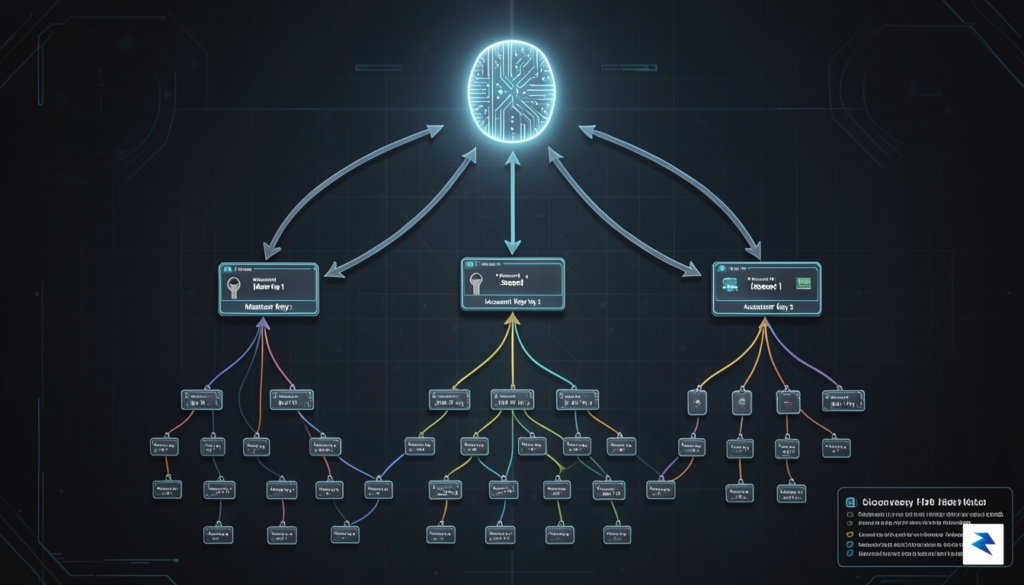
The recovery tool leverages this enduring strength by providing a method to assert ownership through this verifiable derivation path. Instead of relying solely on an ECDSA signature, which could be compromised, it allows users to demonstrate control over funds by reconstructing and proving the lineage from their master seed to the specific Bitcoin address holding the funds. This creates a quantum-resilient layer of verification that can be used to recover or move assets. For instance, a user could generate a new, quantum-resistant address (using different cryptography, perhaps) and then, using the recovery tool, prove to a third party or a new protocol that the original quantum-vulnerable address belongs to the same seed, thereby authorizing a transfer of funds.
Naturally, this approach comes with its own set of trade-offs. It’s important to understand that this tool doesn’t magically make existing ECDSA signatures quantum-proof; rather, it offers a *recovery mechanism* or an *alternative proof of ownership*. It’s a strategy for migrating funds from potentially vulnerable addresses to secure ones in a future quantum scenario, or for proving ownership in disputes. It doesn’t alter the fundamental cryptographic security of past transactions, nor does it instantly imbue all Bitcoin transactions with quantum resistance. Instead, it offers a pragmatic pathway for individual users to secure their assets using existing, robust features of Bitcoin’s design.
Crucially, this entire framework interacts seamlessly with the current Bitcoin blockchain without requiring a disruptive hard fork. The Bitcoin network continues to validate transactions according to its established ECDSA rules. The recovery tool operates as an external layer, providing a verifiable method for users to demonstrate ownership and initiate new, valid transactions (perhaps to quantum-resistant addresses) that are then processed by the legacy blockchain. This means no changes to the Bitcoin protocol are necessary, ensuring backward compatibility and avoiding the contentious debates and network fragmentation often associated with hard forks. It’s an elegant solution that builds upon Bitcoin’s existing strengths, offering a proactive defense against a future threat without disrupting the present.

While the emergence of quantum-resistant recovery tools represents a significant milestone in securing the future of the Bitcoin network, it is essential to dispel the persistent myth that these advancements provide a “magic key” for dormant stashes. Specifically, the legendary 1.1 million Bitcoin attributed to Satoshi Nakamoto remain firmly out of reach, regardless of any technological breakthrough in cryptography or key restoration. The primary reason for this is architectural: Bitcoin’s security model is built upon the fundamental principle of self-custody, which dictates that assets are only accessible to those who possess the original private keys. In the case of the early, pre-mined coins, there is no evidence of a “lost” technical barrier that a new tool could simply bypass; rather, these coins are effectively locked because the keys themselves are either lost, destroyed, or held by an entity that has chosen to remain entirely silent.
It is a common misconception that developers can somehow “patch” the blockchain to facilitate the recovery of funds from wallets that have been inactive since the network’s infancy. In reality, any recovery mechanism requires the active participation of the wallet owner, as it relies on specific, verifiable key-derivation paths that prove ownership of the underlying assets. Because the Satoshi-era wallets do not interact with the network—and because the original keys cannot be reconstructed from thin air—these funds are essentially frozen by design. This limitation serves as a poignant reminder of the ironclad ethos that governs the Bitcoin ecosystem: not your keys, not your coins. Without the cryptographic proof that only a private key can provide, the protocol remains indifferent to the identity of the owner, treating those coins as permanent, immutable entries on the ledger.

Furthermore, the development of these new recovery tools is intended to assist active users who are proactively migrating their assets to quantum-resistant addresses, rather than acting as a retrieval service for forgotten fortunes. By requiring the user to authorize the movement of funds from a vulnerable address to a secure one, the tool upholds the security standards that protect all participants in the network. This process reinforces the necessity of individual responsibility; Bitcoin was built to be a censorship-resistant, decentralized ledger where no central authority can override the lack of a private key. Consequently, while the technology is a massive leap forward for those looking to harden their security against the looming quantum threat, it offers no leverage against the “cold storage” of history. The Satoshi coins will likely remain a permanent fixture of the blockchain—a silent, immovable monument to the early days of a digital revolution that requires no intervention from the present.

The emergence of recovery mechanisms like Project Eleven represents a significant maturation in how the Bitcoin ecosystem approaches long-term cryptographic stability. Rather than viewing the quantum threat as a distant, abstract nightmare, developers are now actively building modular security layers that allow the network to evolve without compromising its core immutability. This shift marks a departure from purely theoretical discussions, signaling that the community is beginning to treat quantum resistance as a technical engineering challenge rather than an existential crisis. By creating tools that allow for secure fund migration, the ecosystem is establishing a blueprint for how Bitcoin might eventually upgrade its underlying signature schemes when the industry-standard Elliptic Curve Digital Signature Algorithm (ECDSA) faces genuine exposure.

The broader industry is already pivoting toward post-quantum cryptography (PQC), with global standards organizations like NIST finalizing algorithms designed to withstand the processing power of next-generation quantum computers. Bitcoin’s challenge, however, is unique; unlike centralized software that can be patched with a single update, the decentralized nature of the network requires overwhelming community consensus. Implementing these new cryptographic standards is not merely a matter of writing code, but a complex coordination effort that necessitates rigorous testing to ensure that no vulnerabilities are introduced during the transition. The goal is to integrate these protections in a way that respects the legacy of the network while ensuring that the most valuable digital asset in history remains impervious to future computational breakthroughs.
The true strength of Bitcoin’s transition to quantum-resistant standards lies not in the speed of its adoption, but in the deliberate, transparent, and battle-tested nature of its deployment.
Looking ahead, the road to a quantum-proof Bitcoin will likely involve a multi-layered approach, combining soft-fork upgrades with opt-in security protocols. This strategy allows users to migrate their assets to more secure, quantum-resistant address types at their own pace, effectively “future-proofing” their holdings against the eventual arrival of cryptographically relevant quantum computers. As these recovery tools continue to develop, they serve as a vital stress test for the network’s governance, proving that Bitcoin is capable of self-correction. By prioritizing academic rigor and community-led development over rushed implementation, the Bitcoin ecosystem is successfully positioning itself to remain the gold standard of secure, trustless finance for decades to come.
You must be logged in to post a comment.