
Social Media Addiction Lawsuits: Why Platforms Are Settling Under Pressure
The Growing Legal Landscape of Social Media Accountability The recent settlement reached by Snap represents far more than a routine legal…


The prevailing narrative surrounding Large Language Models suggests that we have finally reached the era of “no-code” development, where the barriers to entry are dismantled by simple natural language prompts. While it is undeniably true that AI can generate boilerplate functions and unit tests in milliseconds, this speed creates a dangerous illusion of progress. What many developers fail to realize is that the “productivity trap” masks a significant decline in structural integrity. Generating a working snippet is a far cry from architecting a scalable, secure, and maintainable software system. When we treat programming as a process of prompt-to-code generation, we risk treating the codebase like a collection of disjointed puzzle pieces that lack a unified internal logic.
In traditional development, the friction of typing out syntax forced developers to deliberate on the structural implications of their code. Today, the ease of generation allows for rapid prototyping, which often leads to “spaghetti AI” code—a patchwork of functions that work in isolation but fail to harmonize under stress. Because the code is produced so effortlessly, there is a temptation to skip the rigorous architectural planning that once defined professional software engineering. Consequently, we are finding that the difficulty of programming has not vanished; it has simply migrated from the keyboard to the cognitive load of validation, debugging, and system integration. You are no longer just a writer of code; you are now an editor of an infinite, erratic stream of machine-generated text.

Programming has never been about the act of typing; it has always been about the discipline of modeling complex systems. AI excels at the former, but it remains fundamentally blind to the latter.
The maintenance burden is perhaps the most overlooked aspect of this transition. When a developer writes code manually, they possess an intimate, intuitive understanding of every edge case and design decision embedded within the logic. When an AI generates that same logic, that tacit knowledge is absent, leaving the human maintainer to play a high-stakes game of “guess the intent” whenever a bug inevitably arises. Debugging AI-generated code is significantly harder than debugging your own, as you must first deconstruct the model’s logic before you can even begin to address the underlying issue. By bypassing the learning curve of writing, we have inadvertently created a secondary, more grueling learning curve of forensic analysis. Ultimately, the future of development isn’t about doing less; it is about managing the immense complexity of an automated output that is as fragile as it is fast.
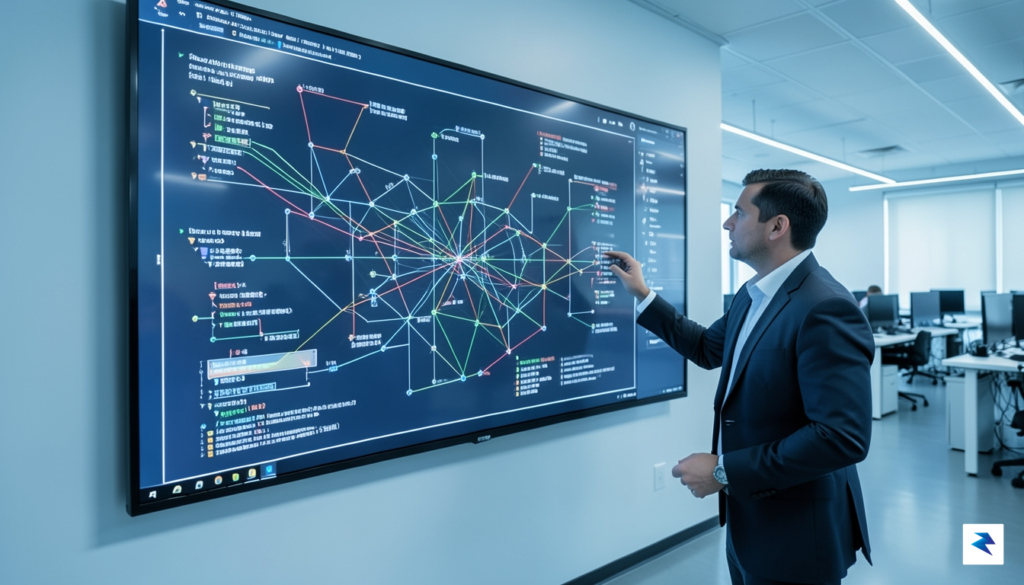
For decades, the craft of software development was defined by the granular process of syntax—the meticulous translation of abstract logic into specific, machine-readable instructions. Developers spent the majority of their time fighting compilers, managing memory, and ensuring that every semicolon was perfectly placed. Today, that foundational burden has shifted. As artificial intelligence becomes a standard tool in the IDE, the act of writing individual lines of code is increasingly relegated to the background, while the role of the developer is evolving into that of a high-level system architect and orchestrator.
This transition represents a move away from the “blank page” problem and toward a world of constant synthesis. Instead of constructing software from scratch, developers now spend their hours curating, integrating, and validating vast swaths of machine-generated output. The challenge is no longer about knowing exactly how to implement a specific sorting algorithm or a regex pattern from memory; it is about understanding how disparate, AI-generated components fit together within the broader architecture of an application. The developer acts less like a bricklayer and more like a general contractor, ensuring that the structural integrity of the entire project remains sound even when the individual pieces are drafted by an automated assistant.

The true complexity of modern development lies not in the creation of code, but in the verification of intent.
This shift introduces a profound change in cognitive load. When you write code manually, you are intimately familiar with every potential edge case because you built them into the logic yourself. When you audit AI-generated code, however, you must perform a form of forensic analysis to determine if the machine’s output aligns with your architectural intent. You aren’t just looking for syntax errors—those are largely a thing of the past—you are searching for subtle logical flaws, security vulnerabilities, and performance bottlenecks that might be hidden within seemingly perfect code. This requires a much deeper, more holistic understanding of system design, as you must be able to anticipate the downstream effects of a solution you didn’t personally author.
Ultimately, the developer of the future is defined by their ability to synthesize information rather than their raw typing speed. As we offload the “how” of implementation to intelligent models, our value is increasingly tied to the “why” of system design. We must cultivate a sharp, critical eye for review, becoming experts at identifying when a generated solution is elegant, when it is inefficient, and when it is fundamentally ill-suited for the long-term needs of the codebase. In this new landscape, the ability to manage, vet, and orchestrate complex systems becomes the most vital skill in the developer’s toolkit.

The most insidious threat lurking within the era of generative AI is not the absence of code, but the overwhelming presence of it. When a developer prompts an LLM to generate a complex function, the output often arrives with a sheen of professional polish that invites immediate, unquestioning acceptance. This phenomenon creates a dangerous “semantic gap”: the code produced is almost always syntactically perfect, satisfying the compiler’s rigid requirements while masking profound logical flaws. Because the syntax is valid, the program runs, creating a false sense of security that blinds developers to the underlying instability of the logic. Unlike a human-written bug, which often stems from a misunderstanding of the problem, AI-generated errors are often sophisticated, subtle, and fundamentally misaligned with the intended business requirements, making them exponentially harder to trace back to their source.
The cost of this “trusting too much” is rarely paid in the moment of creation; instead, it is deferred to the maintenance phase, where the true complexity of AI-assisted development emerges. When a developer writes code manually, they carry a mental model of the system’s state, edge cases, and architectural constraints. By contrast, accepting AI-generated snippets without rigorous verification turns the developer into a high-speed code reviewer for an entity that lacks actual understanding of the project’s context. This shift fundamentally alters the debugging process. Since the developer did not author the logic, they must first spend significant time deconstructing the AI’s “thought process” before they can even begin to isolate the bug, effectively doubling the cognitive load of a task that was meant to be automated.
The danger of AI is not that it makes mistakes, but that it makes mistakes with the same unshakeable confidence that it produces correct solutions. Relying on an oracle that cannot be interrogated leads to a “black box” architecture that is inherently fragile.
To combat this hidden burden, modern engineering teams must move away from the “generate and commit” workflow and toward a paradigm of mandatory, high-fidelity verification. This means that an AI-augmented workflow is only as strong as the testing framework that surrounds it. Developers must treat AI-generated code with the same skepticism reserved for an unvetted third-party library, subjecting it to exhaustive unit testing, integration testing, and property-based testing suites. By automating the verification process, we can catch the logical inconsistencies that the human eye—lulled into complacency by the AI’s smooth syntax—would otherwise overlook. In this new landscape, the value of a programmer is no longer defined by how many lines of code they can output, but by their ability to act as a cynical, hyper-vigilant gatekeeper against the seductive efficiency of machine-generated logic.

The speed at which modern AI tools can generate functional blocks of code is undeniably impressive, yet this velocity often masks a significant long-term risk. When a developer can produce hundreds of lines of code in seconds, the temptation to favor volume over quality becomes a systemic hazard. This “fast code” is frequently fragile code, written with an immediate focus on solving a singular, isolated prompt rather than integrating seamlessly into a sustainable, multi-year architecture. Because these snippets are generated without the inherent friction of human deliberation, they often lack the nuance required for edge-case handling or long-term system stability, turning what should be an asset into a sprawling, unmanageable liability.

To prevent a codebase from collapsing under the weight of AI-generated bloat, engineering teams must shift their mindset from writing code to curating it. The primary strategy for mitigating this debt is a rigorous commitment to modularity. By forcing AI-generated snippets to reside within strictly defined, loosely coupled modules, developers can isolate potential failures and ensure that a bug in an AI-suggested function does not cascade through the entire application. Furthermore, documentation becomes more critical than ever; since an AI cannot explain its reasoning or provide context for future maintainers, the human developer must wrap these snippets in comprehensive documentation that explains the why behind the how.
The true measure of a developer’s skill in the age of AI is no longer how fast they can type, but how effectively they can audit, refactor, and maintain the complex systems they assemble.
Another layer of the problem involves the subtle risk of vendor lock-in to specific AI patterns. Different models have distinct “fingerprints”—stylistic preferences and architectural biases that, over time, can make a codebase feel alien to the human engineers tasked with maintaining it. To counter this, teams should establish a clear set of internal coding standards that override the default suggestions of any single AI tool. By enforcing these human-centric guidelines, you ensure that the project remains legible and consistent, regardless of which tool generated the initial draft. Ultimately, AI should be viewed as a high-velocity intern rather than an autonomous architect; it can handle the heavy lifting, but the final responsibility for the integrity of the structure must always remain in human hands.
Maintaining a healthy codebase in this new era requires a proactive approach to technical oversight:

To remain relevant in an era defined by generative models, developers must pivot away from the role of a syntax-focused typist and toward that of a high-level system architect. While AI excels at churning out boilerplate code and solving isolated algorithmic challenges, it often lacks the structural intuition required to build long-term, maintainable software. You must cultivate a deep understanding of how disparate components interact within a larger ecosystem, focusing on trade-offs between latency, scalability, and technical debt. By mastering system-level thinking, you become the person who understands not just how to implement a feature, but why a specific architectural pattern is the right choice for the current problem space.
Beyond architecture, the most vital skill for the modern engineer is the ability to act as a diligent auditor rather than a mere creator. Because AI models are prone to subtle hallucinations and “plausible-looking” errors, your value now resides in your capacity for deep verification. This means you need to treat every snippet of generated code as a draft that requires rigorous testing, security analysis, and logical scrutiny. You aren’t just reading code for syntax anymore; you are auditing logic for edge cases and architectural integrity that an automated system might overlook. Developing a sharp, skeptical eye for AI output is not just a safety measure; it is your most important professional asset.

The developer of the future is defined less by their typing speed and more by their ability to discern, debug, and design.
Furthermore, true expertise is now shifting toward the domain level. As generic coding tasks become commoditized, your ability to solve complex, niche business problems becomes your primary competitive advantage. You should strive to understand the “why” behind the software: the industry regulations, the specific pain points of your users, and the unique constraints of your business model. When you possess deep domain knowledge, you can translate abstract business requirements into robust technical solutions that AI cannot replicate on its own. This domain-specific expertise allows you to guide the AI, providing it with the necessary context and guardrails to generate work that is actually useful.
To thrive in this landscape, consider sharpening the following core competencies:
Ultimately, the goal is to shift your perspective from being a producer of lines of code to being a curator of high-quality, resilient systems. If you can maintain this focus, you will find that AI is not a threat to your career, but a powerful lever that amplifies your ability to solve the hardest problems in your field.
You must be logged in to post a comment.