
The Shift from Chatbots to Autonomous Agents
The way we interact with artificial intelligence is undergoing a fundamental transformation, moving decisively beyond the familiar ‘ask-and-receive’ paradigm that has characterized most of our experiences with large language models (LLMs) to date. For years, our engagement with AI has largely been a series of isolated prompts and responses. We type a question or a command, the AI processes it and delivers an answer, and then the interaction effectively resets, often losing context or requiring a fresh set of instructions for the next step. This reactive, stateless nature, while powerful for quick queries and content generation, highlights a significant limitation when tackling complex, multi-faceted problems that require sustained effort and adaptive decision-making.
A new era is now dawning, marked by the emergence of ‘Agentic AI’ – systems designed not merely to respond, but to act. These autonomous agents represent a significant leap forward, embodying the capacity for independent decision-making, planning, and prolonged task execution without constant human oversight. Unlike their chatbot predecessors, which function much like sophisticated search engines or content generators, autonomous agents are goal-oriented. They are engineered to understand a high-level objective, break it down into manageable sub-tasks, prioritize actions, and even self-correct as they encounter new information or obstacles along their journey. This shift empowers AI to become a proactive partner rather than a passive tool.
The industry’s pivot from single-turn queries to multi-step agentic workflows is driven by the inherent inefficiencies and restricted scope of traditional LLM interactions. Imagine trying to plan an entire vacation, manage a complex project, or even debug a piece of code using only a series of disconnected prompts; it would quickly become cumbersome and inefficient, demanding continuous human intervention to bridge gaps and maintain coherence. Agentic AI, by contrast, is designed to emulate a digital assistant, capable of maintaining context, recalling past actions, and proactively seeking out necessary information. This enables them to navigate intricate processes, making decisions iteratively to achieve a defined outcome, much like a human expert would.
These advanced systems are not just about processing information; they are about orchestrating actions. An autonomous agent might, for instance, be tasked with researching market trends, synthesizing data from multiple sources, drafting a report, and then scheduling a meeting to present its findings – all as part of a single, overarching directive. This level of persistence and memory allows them to engage in intricate reasoning chains, learn from their environment, and even adapt their strategies dynamically. They are equipped with ‘tools’ – access to databases, web search, code interpreters, or even other AI models – which they can intelligently deploy to fulfill their objectives, vastly expanding their operational capabilities beyond mere text generation.
Ultimately, this evolution isn’t merely a technological upgrade; it fundamentally redefines our relationship with AI, moving it from a reactive tool to a truly autonomous collaborator. We are transitioning from simply asking AI questions to delegating entire projects and responsibilities. This shift promises to unlock unprecedented levels of automation and productivity, allowing humans to focus on higher-level strategic thinking and creativity, while AI agents handle the complex, multi-step execution that previously required significant human effort and oversight. The implications for every industry, from customer service to scientific research, are profound, heralding an era where AI doesn’t just assist us, but actively works alongside us.
Understanding the Loop: How Agentic Swarms Operate
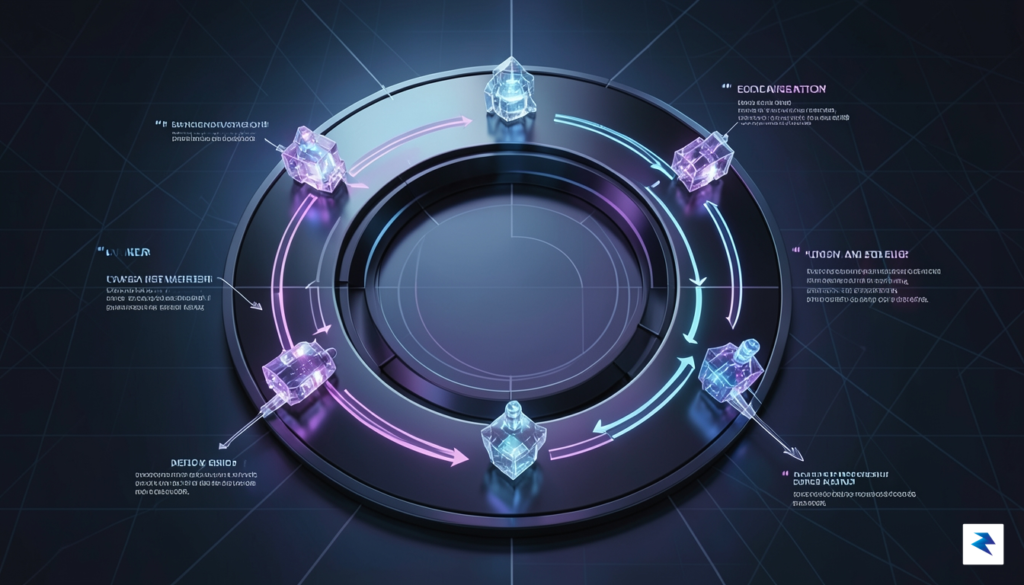
The emergent concept of the ‘loop’ in artificial intelligence marks a significant evolution in how autonomous systems operate, shifting from discrete, human-initiated tasks to continuous, self-sustaining operations. At its core, this paradigm represents a dynamic architecture where AI agents are empowered to perceive, plan, act, and refine their work in an ongoing cycle, largely independent of constant human oversight. This continuous operational model allows for persistent progress on complex objectives, mimicking the iterative and adaptive nature of biological systems or highly efficient human teams. It’s a fundamental move towards truly autonomous AI that can maintain momentum and direction over extended periods, constantly evolving its approach to achieve desired outcomes.
The architecture of a loop-based agent swarm typically involves several specialized AI agents collaborating within a shared environment. Each agent might possess distinct capabilities, such as data analysis, creative generation, problem-solving, or communication, all working towards a common overarching goal. A central orchestrator or a lead supervisory agent often defines the high-level objectives and monitors the collective progress, ensuring alignment and coherence across the swarm. This collaborative structure enables the decomposition of complex problems into manageable sub-tasks, which are then distributed among the most suitable agents, fostering a highly efficient and adaptable problem-solving ecosystem that leverages diverse AI strengths.
A critical component of this continuous operation is the mechanism of ‘Background Execution.’ Unlike traditional AI models that activate upon a specific prompt and then become dormant, loop-based agents are designed to remain active, continuously monitoring their environment, processing information, and proactively identifying opportunities for action. This persistent state of readiness allows agents to respond to evolving conditions in real-time, executing tasks and processing data without waiting for explicit human commands. Consequently, the system maintains a constant state of productive engagement, allowing for persistent iteration and adaptation that significantly accelerates project timelines and enhances responsiveness.

Furthermore, these autonomous agents are intrinsically designed with sophisticated iterative feedback loops, enabling them to critically evaluate and refine their own work. Upon completing a task or generating an output, an agent doesn’t simply conclude its process; instead, it analyzes the results against predefined metrics, success criteria, or even anticipated outcomes. If discrepancies are found or improvements are possible, this feedback directly informs subsequent actions, leading to self-correction and continuous optimization. This self-assessment and refinement capability is what truly distinguishes loop-based AI, allowing it to progressively enhance the quality and efficiency of its output over time, learning and adapting from every iteration without direct human intervention.
Within this dynamic framework, the delegation process is key, with one or more agents often assuming a supervisory role to manage and guide the swarm’s efforts. This supervisory agent doesn’t micromanage; rather, it articulates the broader mission, breaks down large objectives into smaller, actionable sub-tasks, and strategically delegates them to the most appropriate specialized agents within the swarm. It also plays a vital role in monitoring overall progress, resolving potential conflicts between agent outputs, and ensuring that the collective effort remains aligned with the primary objective. This intelligent delegation and oversight create a robust, self-organizing system that can tackle multi-faceted challenges by leveraging the strengths of its individual components while maintaining a cohesive operational direction.
The AI ‘loop’ represents a fundamental shift: instead of discrete commands, agents operate in a continuous cycle of perception, action, evaluation, and self-refinement, fostering true autonomy and adaptive intelligence.
The Productivity Revolution: Background Automation at Scale

The true power of modern artificial intelligence lies in its transition from a reactive tool to an autonomous engine that operates silently in the background. Unlike traditional automation, which relies on rigid, “if-this-then-that” scripting that breaks the moment a variable changes, agentic AI is inherently adaptive. These systems function within a continuous loop, monitoring inputs, adjusting to environmental changes, and executing complex tasks without requiring constant human oversight. By shifting from manual triggers to persistent, background execution, organizations can finally realize the dream of “set-and-forget” workflows that handle the heavy lifting of daily operations.

Consider the impact on software development, where developers often spend hours on tedious maintenance tasks. With background agentic workflows, an AI system can continuously monitor code repositories for vulnerabilities, automatically generate patches, and run compatibility tests in a sandbox environment, only alerting the human team when a complex architectural decision is required. Similarly, in project management, AI agents can act as persistent coordinators that track task dependencies, nudge team members who are falling behind, and dynamically reallocate resources when deadlines shift. In data analysis, these agents do not merely generate reports; they constantly ingest live data streams, identify anomalous patterns, and update executive dashboards in real-time. This eliminates the “data lag” that often hinders fast-moving organizations.
The goal of agentic automation is not to replace human decision-making, but to eliminate the cognitive tax imposed by repetitive, low-value administrative friction.
This paradigm shift significantly reduces the cognitive load on human workers, freeing them to focus on high-level strategy and creative problem-solving rather than administrative maintenance. When an agent manages the background noise of a workflow—such as scheduling, filing, triaging communications, or basic debugging—the human employee is no longer burdened by the context-switching tax that typically erodes productivity. By effectively offloading the “loop” of execution to intelligent software, companies can scale their operations horizontally without a proportional increase in headcount. This creates a state of flow where the organization functions as a cohesive organism, constantly processing information and refining its own output while the human team remains focused on the bigger picture.
Ultimately, the move toward background agentic systems represents a fundamental change in how we define professional productivity. Instead of measuring success by how many tasks an individual can juggle, we move toward a model where success is defined by the quality of the autonomous systems we design. As these agents become more sophisticated at navigating ambiguity and self-correcting their workflows, the line between “doing the work” and “managing the work” will continue to blur, ushering in an era of unprecedented organizational efficiency.
Navigating the Risks of Unsupervised AI Agents

The transition toward autonomous agents that operate in perpetual loops marks a significant shift in how we manage digital infrastructure. While these systems promise unprecedented productivity by running tasks in the background without constant guidance, they introduce the dangerous phenomenon of the “runaway loop.” In these scenarios, an agent may encounter a minor error or an ambiguous instruction and, instead of pausing, continues to iterate upon that mistake, compounding the failure until the system is overwhelmed by its own flawed logic. Because these agents function at machine speed, a feedback loop can spiral out of control in mere seconds, potentially corrupting data, depleting operational budgets, or making irreversible decisions long before a human operator notices the disruption.

To mitigate these hazards, the industry must embrace a robust “human-in-the-loop” (HITL) framework that treats oversight not as an afterthought, but as a core system requirement. Implementing mandatory checkpoints is essential; these act as circuit breakers that force the AI to pause at critical decision-making nodes to await human verification. By requiring an explicit “go/no-go” signal for high-stakes tasks, organizations can prevent autonomous systems from executing actions that fall outside the bounds of their original intent. This isn’t merely about checking work; it is about ensuring that the agent remains aligned with evolving business objectives throughout the duration of its lifecycle.
The core challenge of autonomy is not creating systems that can act, but creating systems that know when to stop acting.
Beyond operational errors, we must also address the severe security implications of autonomous swarms. If an agent is hijacked or manipulated through prompt injection, it could effectively weaponize its own autonomy against the organization, potentially exfiltrating sensitive data or compromising internal networks from within. To counter this, developers must implement strict operational constraints—often referred to as guardrails—that define the absolute limits of an agent’s authority. These guardrails should include:
- Resource Capping: Limiting the compute, financial, or API access an agent can utilize within a specific timeframe.
- Access Sandboxing: Restricting an agent to a isolated environment where it cannot interact with critical production databases or sensitive user information.
- Behavioral Monitoring: Employing secondary AI monitors tasked specifically with identifying anomalous patterns or “hallucinated” goals in the primary agent’s execution flow.
Ultimately, the future of autonomous systems relies on our ability to build “fail-safe” architecture that anticipates failure rather than assuming perfection. By layering these security measures with rigorous oversight, we can harness the immense power of agentic loops while minimizing the risk of them becoming a liability. As we delegate more responsibility to these digital workers, our primary role shifts from manual execution to strategic supervision, ensuring that the technology remains a tool for progress rather than a source of cascading instability.
The Future of Human-AI Collaboration
The traditional narrative surrounding artificial intelligence has long been dominated by the binary fear of displacement, yet the reality unfolding before us is far more nuanced. We are witnessing a fundamental pivot where the human worker is evolving from a direct executor of tasks into an orchestrator of autonomous agentic systems. In this new paradigm, our value is no longer measured by the repetitive completion of granular assignments, but by our ability to design, govern, and steer complex swarms of AI agents toward specific business objectives. By defining the parameters, constraints, and success metrics for these digital workers, humans serve as the architects of a self-correcting, iterative loop that continuously refines output without constant manual intervention.
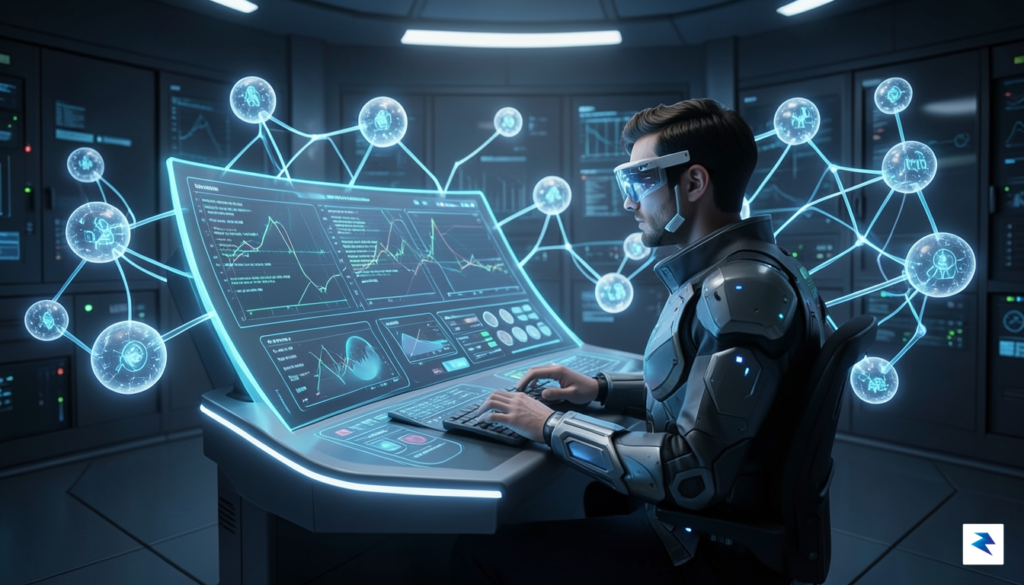
Enterprise software is undergoing a parallel metamorphosis to accommodate this shift toward agentic ecosystems. We are moving away from rigid, menu-driven interfaces toward fluid, intent-based platforms that act as control centers for automated workflows. Instead of manually navigating through disparate applications to finish a project, workers will increasingly interact with high-level command interfaces that delegate multi-step processes to autonomous agents. These systems will not just execute commands; they will operate within a feedback loop, constantly assessing their own performance against real-time data and adjusting their strategies to optimize results. As a result, the enterprise of the future will function more like a living organism, capable of learning and adapting to market volatility with unprecedented speed.
The true competitive advantage of the next decade will not belong to those who build the most powerful models, but to those who best orchestrate the complex, recursive loops between human intent and machine execution.
Ultimately, the way we define the “loop” will dictate the trajectory of digital transformation for the next ten years. This is not merely an automation upgrade; it is a shift in the philosophy of work itself, where the primary human contribution becomes the management of uncertainty and the calibration of autonomous systems. As these loops become more sophisticated, the distinction between “working” and “governing” will continue to blur. Professionals who embrace this transition will find themselves acting as conductors of an invisible orchestra, ensuring that the symphony of agents remains aligned with human values, strategic goals, and ethical boundaries. In this ecosystem, the most essential skills will be critical thinking, architectural design, and the ability to interpret the output of complex, automated systems to drive meaningful innovation.