Google NotebookLM Now Turns Your Research Into TikTok-Style Videos
The Evolution of NotebookLM: From Text to Visual Storytelling When Google first introduced NotebookLM, it was positioned as a sophisticated…
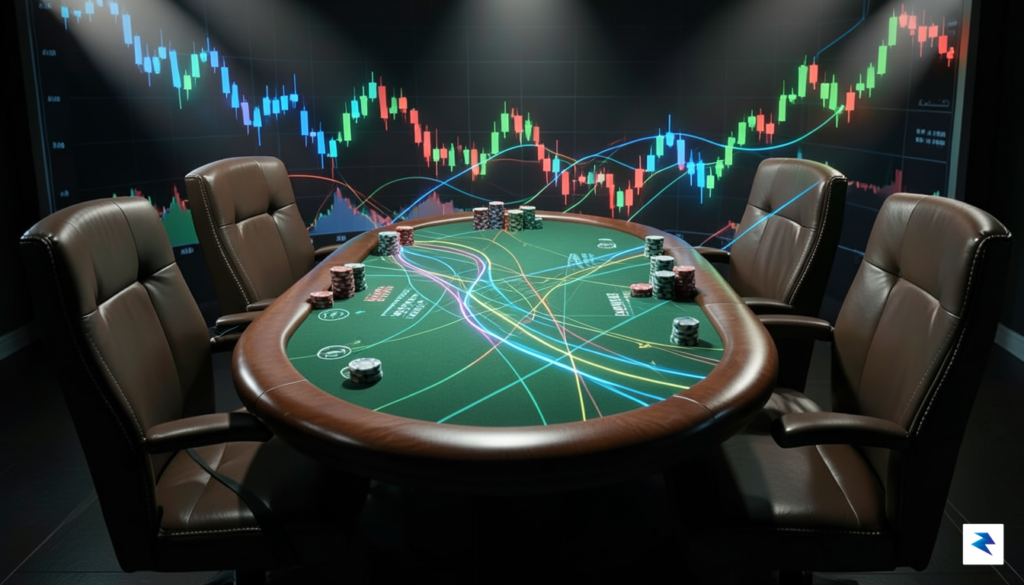
The journey of EquiLibre Technologies marks a significant inflection point in the evolution of artificial intelligence, representing a transition from the controlled, strategic mastery of games to the chaotic, high-stakes volatility of global financial markets. Founded by a trio of former DeepMind researchers, the firm began not by analyzing stock charts, but by cracking the code of imperfect-information games like heads-up no-limit Texas Hold’em. In these environments, an AI must navigate hidden information, bluffing, and the mathematical uncertainty of an opponent’s next move. By mastering these variables, the founders developed a sophisticated framework for decision-making under uncertainty that proved far more robust than the traditional statistical models previously employed by legacy investment houses.
When the team pivoted from the poker table to the trading floor, they brought with them a paradigm shift in how quantitative hedge funds approach risk assessment. In poker, the goal is to maximize expected value while minimizing the potential for catastrophic loss, a principle that maps almost perfectly onto the objectives of modern quantitative finance. Rather than relying on historical price trends or linear regression models, the EquiLibre approach treats market fluctuations as a series of moves in a complex, multi-player game. This ability to anticipate market “bluffs”—or anomalies—has allowed them to secure a valuation of $500 million, signaling a profound shift in the industry’s perception of what constitutes a winning strategy.
This transition of elite AI talent from big tech labs to proprietary trading firms is symptomatic of a broader trend: the realization that the most difficult challenges in machine learning no longer reside in games like Go or Chess, but in the real-world complexities of global capital. As these researchers translate their expertise, they are effectively turning hedge funds into high-performance laboratories for reinforcement learning. The success of this specific trio demonstrates that the same neural architectures once used to outsmart human poker players can be retrained to outmaneuver traditional algorithms in the financial sector. In an era where milliseconds define profit, the ability to synthesize incomplete data into a decisive action has become the ultimate competitive advantage, pushing the boundaries of what automated trading can achieve.
The leap from mastering virtual poker to managing half a billion dollars in assets highlights a critical truth: modern finance is no longer just about economics; it is an engineering problem of predictive modeling and risk management under extreme uncertainty.
Ultimately, the rise of firms like EquiLibre underscores a new chapter for quantitative finance, where the lines between algorithmic game theory and market strategy have become increasingly blurred. Investors and industry analysts are taking note as these “poker-trained” models demonstrate an uncanny ability to withstand market shocks that often derail conventional systems. As more AI researchers migrate toward the financial sector, we are likely to witness a continued acceleration in the sophistication of automated trading, permanently altering the landscape of institutional investing by replacing human intuition with the cold, calculated efficiency of game-theoretic AI.

Before they turned their sights toward the high-stakes world of quantitative finance, the founders of EquiLibre spent their formative years at the epicenter of the artificial intelligence revolution: Google DeepMind. It was here that they immersed themselves in the rigorous discipline of Deep Reinforcement Learning (DRL), a sophisticated branch of machine learning where agents learn to make complex sequences of decisions by interacting with an environment to maximize a reward. This wasn’t merely academic research; it was the crucible where they developed the intuition that modern, non-deterministic systems could be tamed through the right algorithmic architecture.
The core of their intellectual breakthrough lies in the subtle but profound distinction between games of perfect and imperfect information. In a game like Chess or Go, every player has access to the full state of the board, allowing for deep, exhaustive tree searches. However, the real world—and specifically the financial market—functions much more like high-stakes poker, where critical information is hidden from participants and opponents can actively deceive or bluff. By mastering the art of navigating imperfect information, the trio learned to build models that don’t just calculate probabilities, but account for the psychological and strategic layers of human interaction that define market volatility.

Their transition from the laboratory to the trading floor was driven by the realization that financial markets are essentially the ultimate game of imperfect information. Unlike a static simulation, the stock market is a dynamic, evolving system influenced by millions of actors, each operating with partial knowledge and disparate motives. By applying the same methodologies they used to train AI to outplay human poker professionals, these researchers were able to decode patterns in price movements that traditional, linear econometric models consistently missed. They brought a unique toolkit to the table, one that prioritizes adaptive learning over rigid historical assumptions.
The true power of reinforcement learning doesn’t lie in predicting the future with certainty, but in building a robust strategy that thrives amidst the inherent unpredictability of human behavior.
This pedigree in reinforcement learning allowed them to move beyond the constraints of standard statistical arbitrage. Instead of simply reacting to past price trends, their algorithms function as autonomous agents capable of anticipating how other market participants might react to shifting conditions. By treating the market as a massive, continuous game of incomplete information, they have effectively bridged the gap between cutting-edge computational research and the pragmatic, profit-driven demands of a hedge fund. This shift represents a fundamental change in how AI is applied to non-deterministic systems, moving from basic pattern recognition to a more nuanced, strategic form of decision-making that is currently reshaping the landscape of quantitative finance.
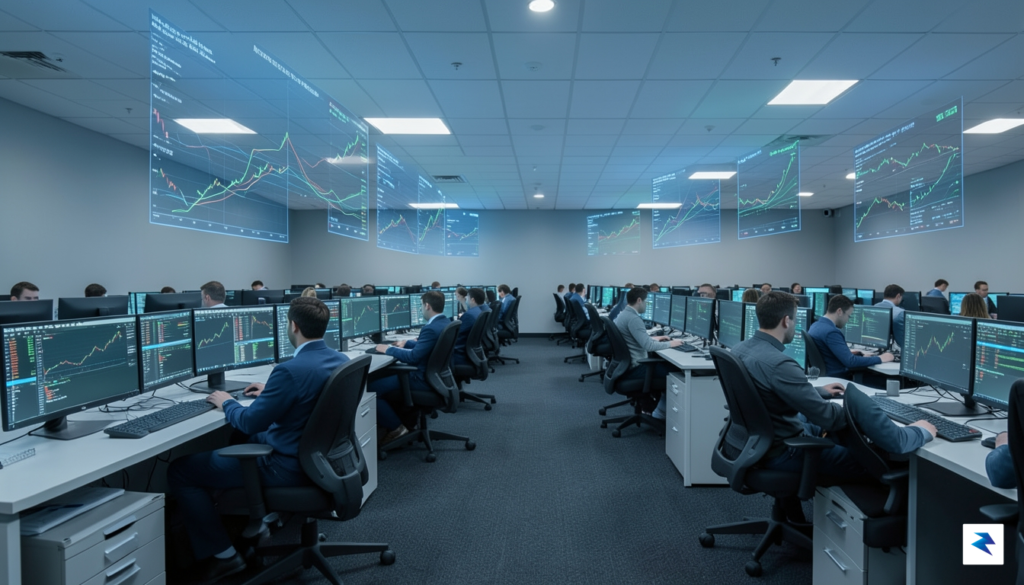
For decades, the financial sector relied upon linear models and static statistical methods to predict market movements. However, the complexity of global finance has outgrown these traditional tools, which often fail to capture the subtle, non-linear relationships inherent in modern, high-frequency trading environments. As markets become increasingly saturated with information, the ability to derive “alpha”—the excess return on an investment relative to a benchmark—has become a race against the clock. This is precisely why quantitative hedge funds are pivoting toward deep learning and reinforcement learning; they recognize that the old guard of financial modeling is no longer sufficient to navigate the chaotic, high-stakes volatility of the modern exchange.
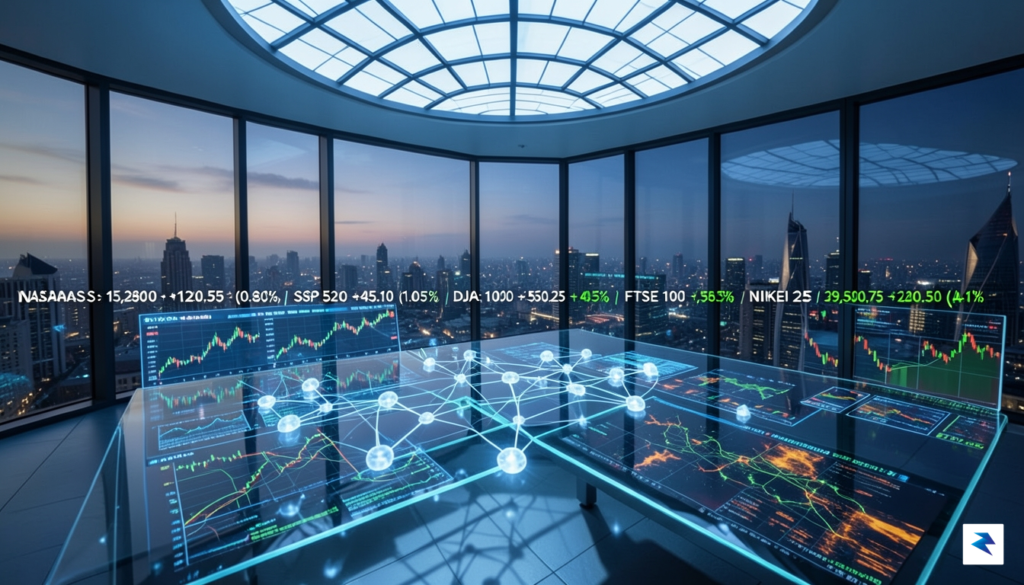
Financial markets serve as the ultimate, high-stakes sandbox for the world’s most brilliant AI researchers. Unlike the closed systems of Go or poker, where the rules remain static and the environment is contained, the market is a hyper-adversarial battlefield where the “opponents” are millions of other algorithms, institutional investors, and unpredictable geopolitical events. For developers who have already pushed the boundaries of gaming AI, the transition to finance is a natural progression. They are applying the same principles of predictive modeling and strategic optimization that once dominated board games to decode the noise of historical and real-time market data, seeking out the hidden patterns that traditional analysts simply cannot perceive.
The leap from mastering a game of incomplete information to mastering global capital markets is not as vast as it seems; both require the ability to calculate probabilities in real-time while anticipating the moves of an intelligent, adaptive adversary.
The core of this revolution lies in pattern recognition at an unprecedented scale. Modern AI models can ingest massive streams of alternative data—ranging from satellite imagery of retail parking lots to sentiment analysis of global news feeds—and distill them into actionable trading signals. By training these agents in simulated market environments, researchers can test millions of scenarios, allowing the AI to learn from its mistakes without risking actual capital. This iterative process of refinement creates a self-improving system that thrives on the very unpredictability that paralyzes human traders. Ultimately, the integration of gaming-inspired AI into hedge funds is not just an incremental improvement; it is a fundamental shift in how value is identified, risk is managed, and wealth is generated in the digital age.

At its core, EquiLibre distinguishes itself from conventional quantitative firms by rejecting the rigid, deterministic models that have long dominated Wall Street. While traditional technical analysis often relies on historical pattern recognition—essentially assuming that past price action serves as a reliable roadmap for the future—EquiLibre treats the market as an adversarial, multi-agent game. By leveraging deep probabilistic modeling, the system does not merely search for “buy” or “sell” signals; instead, it continuously maps an evolving landscape of outcomes. This methodology mirrors the strategic complexity of high-stakes poker, where the goal is not to predict the next card with certainty, but to calculate the precise mathematical edge of every potential move within a distribution of possibilities.
The technical architecture of this approach centers on the concept of counterfactual regret minimization—the same engine that powered their breakthrough poker AI. In a financial context, this means the algorithm is perpetually playing out “what-if” scenarios against the market. By simulating millions of potential market states, the model assigns a probability weight to every outcome, allowing for a level of risk management that static models simply cannot replicate. When volatility spikes or unexpected macroeconomic shifts occur, the model does not “break” or require manual recalibration; it simply shifts its probability density, treating the anomaly as a new variable in an ongoing, high-stakes hand.
The true edge in market volatility isn’t predicting the storm; it is knowing exactly how much you can afford to bet while the wind is blowing.
Furthermore, this probabilistic framework provides a unique buffer against “black swan” events, those rare and unpredictable occurrences that historically shatter conventional hedge fund portfolios. Because the EquiLibre model is built to operate under conditions of extreme uncertainty and incomplete information—the hallmarks of professional poker—it is inherently designed to favor survival and long-term compounding over short-term alpha chasing. By constantly quantifying the “uncertainty of the uncertainty,” the AI maintains a disciplined position size that expands during favorable probability distributions and contracts defensively when the market environment becomes mathematically incoherent. This shift represents a fundamental departure from legacy finance: EquiLibre is not merely trading assets; it is managing the hidden geometry of risk itself.

The meteoric rise of EquiLibre to a half-billion-dollar valuation serves as a definitive bellwether for the shifting tides of the artificial intelligence sector. While the public imagination remains fixated on the evolution of large language models and consumer-facing chatbots, the true value of deep reinforcement learning is quietly migrating into the high-stakes arena of quantitative finance. This transition signals that the most ambitious AI researchers are no longer solely focused on generating human-like prose; instead, they are pivoting toward environments where AI can demonstrate measurable, compounding financial returns. As capital markets become increasingly digitized, the ability to model complex, imperfect-information scenarios—the very skill honed by mastering poker—is becoming the most lucrative currency in the tech industry.

We are entering an era where the boundary between human intuition and algorithmic precision is being irrevocably redrawn. Rather than replacing traders entirely, the future of the hedge fund industry lies in a sophisticated symbiosis: humans provide the strategic oversight and risk appetite, while AI agents handle the rapid execution and pattern recognition across fragmented global markets. This collaboration allows firms to navigate volatility with a level of speed and nuance that was previously impossible. As DeepMind-trained engineers continue to migrate into the financial services sector, we should expect a surge in specialized startups that treat market liquidity much like a game of strategy, effectively turning the stock exchange into the ultimate proving ground for the world’s most advanced algorithms.
The migration of top-tier AI talent into quantitative finance suggests that the most profound technological breakthroughs of the next decade will likely occur in the “back office” of the global economy, far away from the public gaze.
Ultimately, the success of these pioneers implies a structural change for the broader tech industry. The massive influx of capital into AI-driven hedge funds highlights a growing preference for models that produce verifiable alpha over those that merely generate synthetic content. This trend will likely trigger a massive redistribution of human capital, as the brightest minds in machine learning seek out environments where their code directly correlates to tangible economic performance. As these mathematical models become more embedded in our financial infrastructure, the distinction between a “tech company” and a “financial firm” will continue to blur, ushering in a new generation of algorithmic entities that will define the efficiency and stability of our global markets for years to come.
You must be logged in to post a comment.