The 3:30 PM Email: Why Your Inbox Is Sabotaging Your Focus
The 3:30 PM Email Phenomenon: Why Your Inbox Is Lying We often operate under the subconscious assumption that our digital workspace is a realm…


For decades, the “Zone of Genius”—that intersection where your unique talents, deepest passions, and greatest value to the world collide—was treated as a luxury for the soul, a dreamy destination for the lucky few. Today, however, this concept has undergone a radical transformation, evolving from a self-help aspiration into a critical tactical defense for your professional survival. As artificial intelligence automates away the predictable, the repetitive, and the data-heavy aspects of our daily workflows, the traditional career ladder is effectively crumbling. Relying on technical proficiency alone is no longer a viable strategy; instead, your security lies in identifying and inhabiting the specific cognitive terrain where human intuition, empathy, and creative synthesis remain light-years ahead of any algorithm.
The primary indicator that you have entered your Zone of Genius is the experience of “flow”—that elusive state where time seems to dissolve and your output feels effortless, yet profoundly impactful. While AI excels at processing vast datasets and optimizing for efficiency, it lacks the biological capacity for genuine curiosity, ethical nuance, and the synthesis of disparate, abstract ideas. When you are fully engaged in work that leverages your unique life experience and human perspective, you are performing tasks that are inherently un-automatable. These are the “human-centric” roles that require not just intelligence, but character, judgment, and the ability to connect with others on a level that binary code can never replicate.
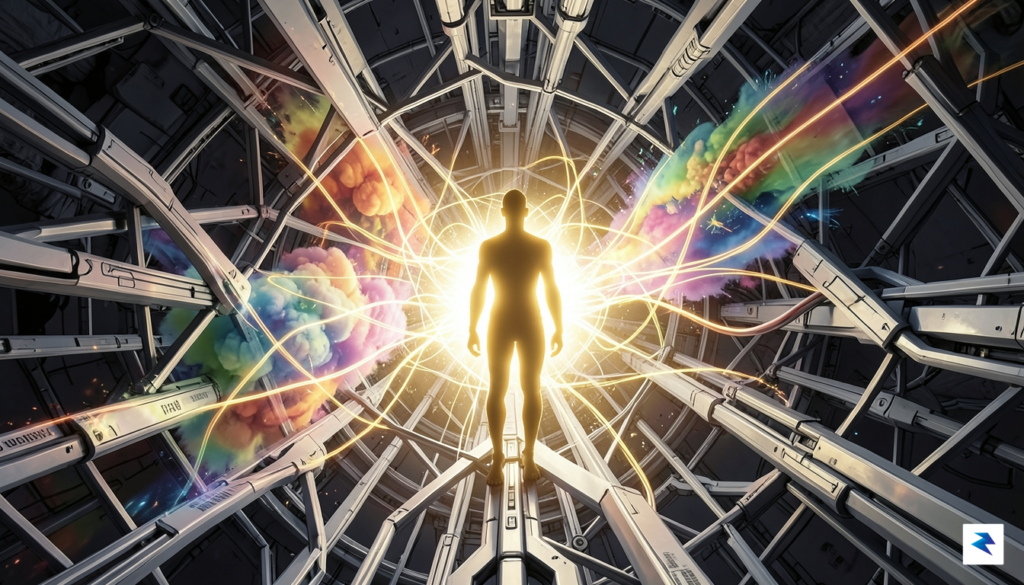
The goal is not to compete with the machine on its own terms, but to operate in a dimension where the machine’s efficiency becomes a tool for your vision rather than a replacement for your effort.
To future-proof your career, you must recognize that AI is essentially a master of the “known.” It thrives on patterns of the past and the optimization of existing workflows. Your Zone of Genius, by contrast, is the realm of the “unknown”—where innovation, disruptive problem-solving, and emotional intelligence provide value that cannot be predicted by a prompt. By consciously shifting your focus toward high-level strategy, creative storytelling, and complex interpersonal navigation, you effectively insulate yourself from the encroachment of automation. In this new era, your greatest asset is not what you can do faster than a machine, but what you can do that a machine never will: define the purpose, choose the direction, and infuse your work with the uniquely human imprint that makes it truly indispensable.
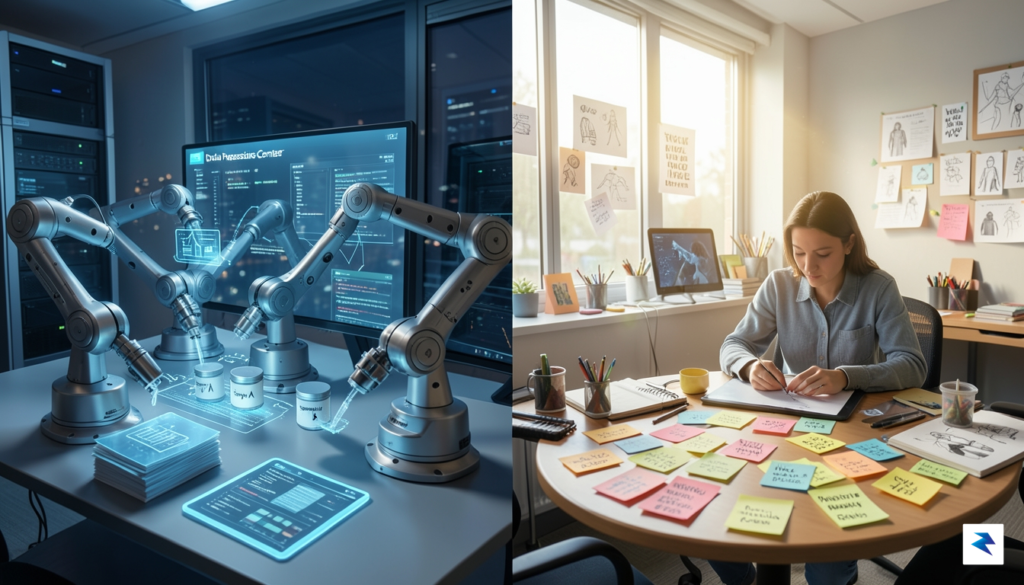
For decades, the standard path to career security was built on the accumulation of technical competence and the reliable execution of procedural tasks. However, the rise of generative artificial intelligence has fundamentally altered this landscape, ushering in an era defined by the commoditization of competence. When an algorithm can draft a functional email, summarize dense legal documents, or write basic code in seconds, the market value of “average” execution plummets. We are entering a phase where technical proficiency—once the gold standard for employability—is becoming a baseline expectation rather than a competitive advantage. If your daily workflow consists primarily of tasks that follow a predictable, repeatable pattern, you are inadvertently training your own replacement.

This shift forces a necessary migration away from being a “task-doer” toward becoming a “value-synthesizer.” To remain relevant in an AI-driven economy, professionals must stop competing with machines on speed and output volume, as those are battles that logic-based systems will always win. Instead, your career longevity now depends on your ability to leverage human-centric traits that AI cannot replicate: deep empathy, nuanced strategic intuition, and the capacity to navigate ethical ambiguity. While a machine can process vast amounts of data to identify a trend, it cannot understand the cultural context, emotional stakes, or moral implications of that trend in the way a human leader can.
The most secure professionals of the future will not be those who work the fastest, but those who ask the most insightful questions and provide the most human judgment to the outputs created by technology.
Ultimately, your unique value proposition lies in the intersection of your lived experience and your ability to synthesize disparate ideas into a coherent, actionable strategy. AI is excellent at pattern recognition, but it struggles with pattern breaking—the creative act of challenging conventions to build something entirely new. Technical skills are merely the tools in your shed; your true worth is your ability to decide which tool to use, when to discard the rulebook, and how to communicate complex value to other human beings. By leaning into these high-level capabilities, you move your work into a “Zone of Genius” where you are not merely processing information, but providing the human wisdom that makes that information meaningful.
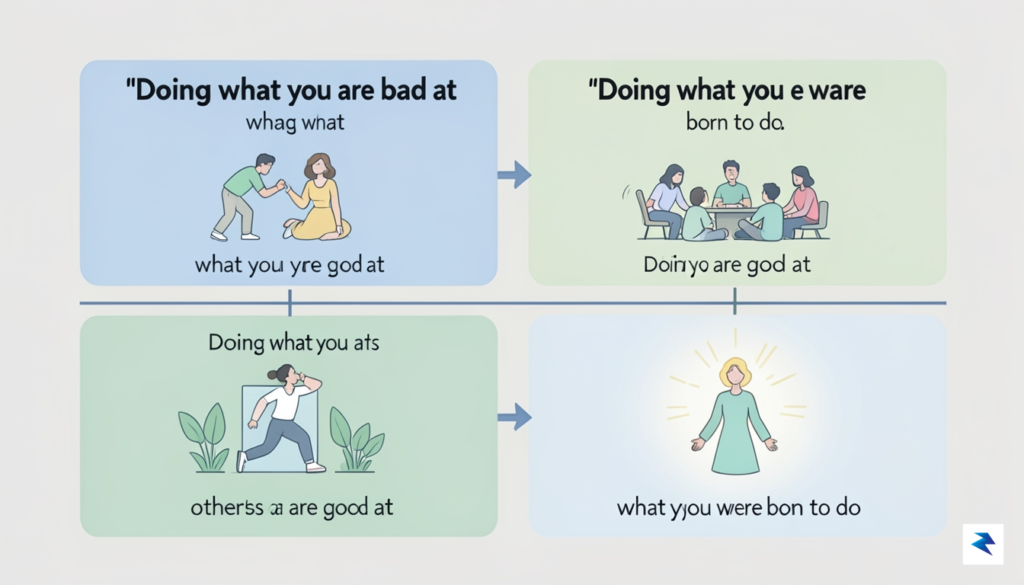
To understand how to pivot toward a career that is truly irreplaceable by algorithms, we must first map the landscape of our daily output. Most professionals operate within a four-tiered framework that dictates not only their productivity but their long-term psychological sustainability. At the bottom lies the Zone of Incompetence, where we struggle with tasks that feel alien or draining, often because they fall outside our natural aptitude. Above this sits the Zone of Competence, a space where we possess the baseline skills to complete assignments accurately, yet we are easily replaced by anyone with similar training—or, increasingly, by automated software.
The true trap for the modern professional is the Zone of Excellence. In this tier, you are highly skilled, consistently praised, and well-compensated for your efforts. However, this is precisely where many people become “stuck.” While you are undeniably good at these tasks, they often lack the spark of genuine curiosity or passion. You may be an expert at managing complex spreadsheets or navigating bureaucratic workflows, but if these activities leave you feeling depleted at the end of the day, you are merely trading your time for a paycheck rather than expressing your unique value. The psychological cost of living here is high; it fosters a slow-burning resentment and a feeling that your true potential is being held hostage by your own proficiency.
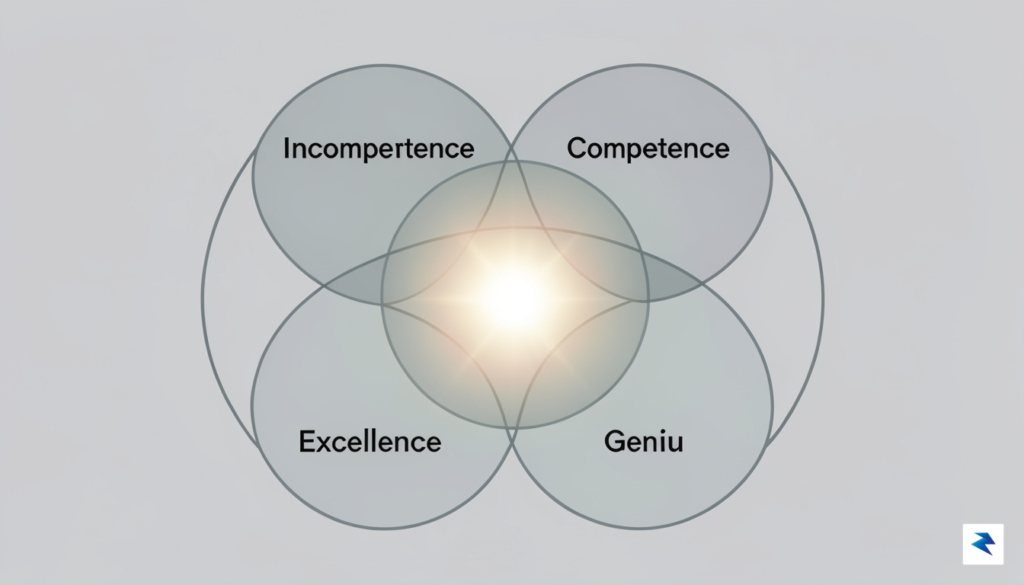
Moving into the Zone of Genius requires a radical shift in perspective. Unlike the Zone of Excellence, which is defined by what you have learned to do, the Zone of Genius is defined by the intersection of your innate, natural gifts and the specific problems that the world is desperate to have solved. This is the realm of high-level creativity, deep intuition, and effortless contribution. When you operate here, the work does not feel like labor; it feels like an extension of your identity.
True professional longevity in the age of AI isn’t found in being “better” at a task than a machine—it is found in being uniquely you, applying your natural gifts to problems that require a human heartbeat to solve.
To transcend the comfort of Excellence, you must be willing to delegate or abandon the tasks that you are merely “good at” to create space for the work you are uniquely born to do. While Excellence is a destination that satisfies your bank account, Genius is a trajectory that satisfies your purpose. By distinguishing between these zones, you stop treating your career as a series of obligations and start treating it as a curated expression of your highest value. This transition is not merely a lifestyle choice; it is the most effective strategy for future-proofing your career in an era where technical proficiency alone is no longer a competitive advantage.

Identifying your unique value proposition is not a sudden epiphany; it is the result of deliberate, systematic observation. To begin this audit, you must first track your daily energy levels against specific tasks for at least one work week. Most professionals fall into the trap of measuring their day by “time spent” rather than “energy invested.” By keeping a simple log—marking each hour as either draining, neutral, or energizing—you will begin to notice a pattern. If you find that complex problem-solving leaves you feeling invigorated while administrative upkeep leaves you mentally exhausted, you have discovered the first fundamental pillar of your creative edge.

Once you have mapped your energy fluctuations, the next step is to distinguish between high-value output and high-effort maintenance. High-effort maintenance tasks are the activities that keep the lights on but rarely move the needle; they are often repetitive, predictable, and, crucially, the first tasks to be automated by artificial intelligence. Conversely, high-value output involves synthesis, nuance, emotional intelligence, and strategic vision—areas where humans still possess a significant advantage. Ask yourself: “If an AI could perform this task to 80% of my current quality, is it worth my limited human bandwidth?” If the answer is yes, you are likely operating in a zone of commodity labor rather than your zone of genius.
True creative power lies at the intersection of what you do best and what the world values most. If you are working hard on tasks that don’t leverage your innate strengths, you are not just wasting time—you are making yourself replaceable.
The final phase of this audit involves mapping your energizing, high-value findings against current and future market demand. You must look beyond your current job description to identify the specific problems your industry is struggling to solve. Perhaps your zone of genius is not just “writing code,” but “translating technical complexity into human-centric product design.” By reframing your internal strengths through the lens of external market needs, you transform yourself from a task-doer into a solution-architect. When you align your natural flow state with high-leverage business objectives, you create a career moat that is difficult for even the most sophisticated algorithm to bridge.

The most effective way to secure your professional relevance in an era of rapid automation is not to outpace the machine, but to redefine your relationship with it. Currently, most professionals spend the majority of their day trapped in their Zone of Competence—the collection of administrative, repetitive, or logistical tasks that you are good at, but that do not necessarily require your unique creative spark. By strategically offloading these responsibilities to artificial intelligence, you effectively clear the intellectual “noise” that prevents deep, focused work. Think of AI not as a competitor vying for your desk, but as an infinitely scalable assistant that handles the mundane labor, allowing you to reclaim the cognitive bandwidth required to solve complex problems and innovate.

To successfully shift toward a human-centric workflow, you must adopt a rigorous framework for evaluating your daily activities. Every task on your agenda should be subjected to a simple filter: Delegate, Automate, or Delete. If a task is essential but requires low creative judgment—such as scheduling meetings, summarizing lengthy email chains, or organizing raw data—it is a prime candidate for AI automation. By delegating these “competence” tasks to specialized software, you create a vacuum of time that is specifically reserved for the “genius” work that machines cannot replicate, such as high-level strategy, empathetic leadership, and nuanced creative conceptualization.
The goal of integrating AI into your workflow is not to do more work, but to do work that is more meaningful. When you automate the trivial, you make space for the essential.
Setting boundaries on your time allocation is equally critical to this transition. It is easy to fall into the trap of using the time saved by AI to simply pack more administrative tasks into your day, which ultimately leads to burnout rather than professional evolution. Instead, intentionally block out “Genius Hours” in your calendar—dedicated segments of the day where you disconnect from the automated loop and focus exclusively on high-value outputs. During these periods, treat your creative output as your primary product, and treat the AI-managed tasks as mere background infrastructure. By consistently prioritizing your Zone of Genius over the comfort of your Zone of Competence, you build a unique professional identity that remains not only secure in the age of AI but significantly more impactful.

We are currently witnessing a fundamental transition in the global labor market: the move from task-based work to outcome-based work. For decades, many professional roles were defined by repetitive processes, data entry, and procedural execution—the very domains where artificial intelligence now excels. However, as these rote tasks are increasingly automated, the value of human labor is migrating toward high-level strategy, creative synthesis, and emotional intelligence. This shift is not merely a change in job descriptions; it is an evolution of what it means to be a professional. By offloading the mechanical aspects of your career to intelligent systems, you are finally liberated to focus on the unique outcomes that only your specific, human intuition can provide.
Rather than fearing the rise of sophisticated algorithms, we should view this technological disruption as a necessary catalyst for our own professional maturation. When AI handles the “how” of our daily operations, we are forced to double down on the “why.” This creates a powerful feedback loop where machines handle the efficiency, and we provide the meaning, the moral compass, and the vision. This is where your Zone of Genius becomes your greatest competitive advantage. By centering your career around your inherent strengths—those activities that feel effortless to you but provide immense value to others—you create a level of professional durability that a lines-of-code algorithm simply cannot replicate. You are no longer competing against software; you are moving into a realm where software is your infrastructure, and your humanity is the product.
The ultimate form of job security in the age of artificial intelligence is not found in technical proficiency, but in the relentless pursuit of your own unique, human-centric value.
Maintaining long-term agility in this changing landscape requires a shift in mindset from “worker” to “architect.” You must be willing to continuously audit your daily tasks, ruthlessly automating the mundane to make room for the deep, complex work that requires empathy, nuance, and subjective judgment. This is the path to true career resilience. When you align your professional life with your Zone of Genius, you stop chasing the shifting tides of market trends and start building a foundation on your internal, immutable assets. Ultimately, this pursuit offers more than just a paycheck; it offers a profound sense of purpose and career happiness. When you show up as your most authentic, human self, you are doing work that is not only future-proof but deeply fulfilling, ensuring that your career path remains vibrant and meaningful for years to come.
You must be logged in to post a comment.