The $25,000 EV Truck: Is the Slate Truck the Future of Affordable Utility?
The Promise of Affordable Electric Utility For years, the electric vehicle market has been a playground primarily for the affluent, with…


MicroStrategy has undeniably carved out a unique position in the corporate world, pioneering the adoption of Bitcoin as a primary treasury reserve asset. Under the visionary leadership of Michael Saylor, the business intelligence firm made headlines by becoming the first publicly traded company to convert a significant portion of its cash reserves into Bitcoin, a move that ignited both fervent praise and intense skepticism across financial markets. Saylor’s bold thesis posited Bitcoin as a superior store of value, a robust hedge against inflation, and a long-term growth asset, fundamentally altering how traditional companies might view their balance sheet management in an increasingly digital and uncertain economic landscape.
Saylor’s original investment philosophy was rooted in the belief that fiat currencies were subject to inflationary pressures and devaluation, making traditional cash holdings an increasingly poor long-term strategy for preserving corporate wealth. Bitcoin, with its decentralized nature, finite supply, and programmatic issuance schedule, was presented as “digital gold,” a scarce asset immune to central bank manipulation. This conviction spurred MicroStrategy to embark on an aggressive acquisition spree, not just by reallocating existing cash but also by raising capital through convertible notes and equity offerings specifically to purchase more Bitcoin. The strategy was clear: accumulate as much Bitcoin as possible, viewing the cryptocurrency not merely as an investment, but as the company’s core strategic asset.
Today, MicroStrategy’s balance sheet tells a compelling story of this unwavering commitment. The company now holds a colossal amount of Bitcoin, making it one of the largest corporate holders of the digital asset globally. These holdings significantly overshadow the firm’s traditional software business in terms of market value and influence its stock performance profoundly. Each price swing in Bitcoin reverberates directly through MicroStrategy’s valuation, transforming the company into a de facto Bitcoin ETF for many investors. The scale of this bet, leveraging both internal capital and external financing, has made MicroStrategy a fascinating case study in corporate finance and digital asset integration.
However, the very strategy that propelled MicroStrategy to prominence and generated substantial returns during Bitcoin’s bull runs is now facing an intensifying spotlight. Recent shifts in market dynamics, coupled with evolving macroeconomic conditions, are prompting serious questions about the sustainability and prudence of continuous, aggressive Bitcoin accumulation. While the long-term bullish outlook for Bitcoin remains strong for many, the practicalities of managing a corporate treasury heavily weighted in a volatile asset are becoming more complex. This emerging tension highlights a critical juncture for MicroStrategy, forcing a re-evaluation of its pioneering approach.
The core of the controversy lies in balancing aggressive growth ambitions with sound treasury liquidity management. While Saylor’s vision remains focused on the long-term appreciation of Bitcoin, market observers are increasingly scrutinizing the immediate implications of MicroStrategy’s debt obligations and the potential impact of sustained Bitcoin price volatility on the company’s financial health. There’s a fine line between a strategic, leveraged bet and exposing the company to undue risk, particularly if Bitcoin experiences prolonged downturns or significant periods of stagnation. This is not merely an academic debate; it delves into the fundamental principles of corporate finance and risk assessment for a company whose fortunes are so intimately tied to a single, albeit revolutionary, asset.
MicroStrategy therefore stands at a strategic crossroads. The path forward demands a careful calibration of its Bitcoin acquisition strategy, weighing the potential for continued exponential growth against the imperatives of maintaining robust financial resilience and managing market-induced pressures. The decision to either halt, slow down, or continue its aggressive buying will undoubtedly set a precedent for other corporations contemplating similar forays into the digital asset space, making MicroStrategy’s next moves a pivotal moment for both the company and the broader institutional adoption of Bitcoin.


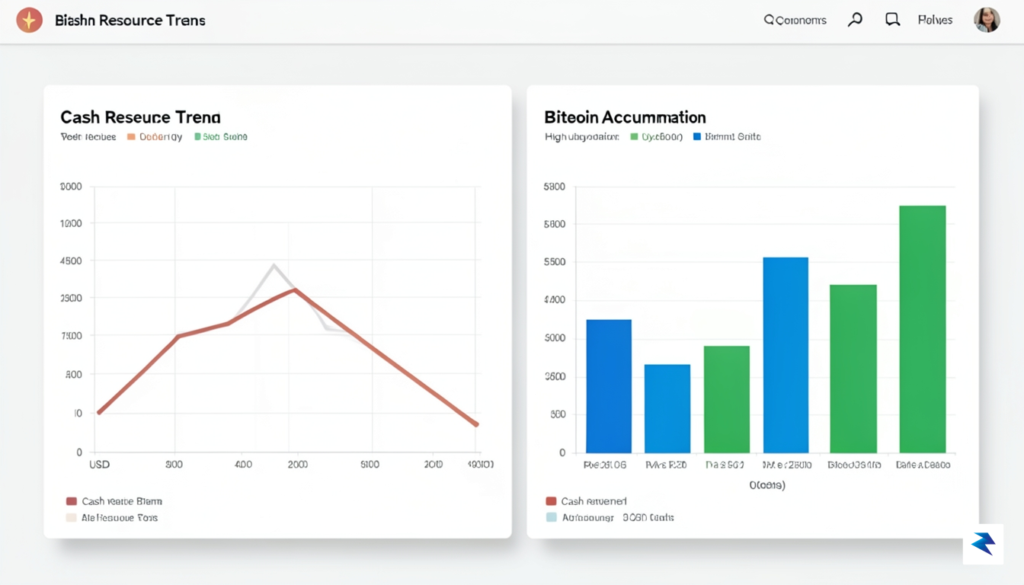
Liquidity serves as the foundational pulse of any corporate treasury strategy, acting as the primary buffer against the inherent volatility of global financial markets. When a company hinges its entire operational stability on a highly speculative asset like Bitcoin, the ability to maintain a robust cash position becomes more than just a matter of good accounting—it is a critical survival mechanism. Recent data points toward a concerning trend for MicroStrategy, as the company’s “cash cushion”—the liquid assets available to cover debt obligations and operational expenses—has thinned significantly. This decline in reserve strength raises urgent questions regarding the firm’s capacity to navigate prolonged market downturns without being forced into unfavorable capital decisions.
The shift in MicroStrategy’s financial posture is best illustrated by the stark contraction in its debt coverage capability. Historically, the company maintained a substantial buffer, with analysis suggesting its cash reserves were once sufficient to cover debt obligations for up to seven years. However, recent aggressive acquisitions have accelerated the depletion of these liquid assets, with current estimates indicating that this coverage window has plummeted to approximately 14 months. This rapid compression is not merely a statistical curiosity; it represents a fundamental change in the company’s risk profile. When the timeline for debt servicing shrinks so dramatically, the margin for error in market timing vanishes, leaving the firm highly sensitive to any prolonged stagnation in the crypto markets.
The strength of a corporate treasury is defined not by the assets it holds in a bull market, but by the liquidity it retains to survive the winter.
In the realm of corporate treasury management, liquidity risk is the silent threat that emerges when a company’s assets are illiquid while its liabilities remain fixed and due. Because MicroStrategy has effectively tied its operational survival to the performance of Bitcoin, it lacks the traditional diversification that usually protects a firm from sector-specific shocks. If Bitcoin prices were to enter a multi-year bear cycle, the company would be unable to rely on its digital hoard for day-to-day liquidity without triggering a taxable event or a market-depressing sell-off. This creates a precarious feedback loop where debt obligations might eventually necessitate the liquidation of the very asset the company was built to accumulate, potentially locking in losses at the worst possible moment.
Furthermore, the correlation between cash reserves and credit ratings cannot be overstated. Credit rating agencies and institutional lenders closely monitor the ratio of cash-on-hand to debt service requirements to determine the solvency of an organization. As the cash cushion thins, the cost of borrowing typically rises, reflecting an increased risk premium that creditors demand for the uncertainty of the company’s future cash flows. By pushing the limits of its liquidity, MicroStrategy risks a downgrade in its creditworthiness, which would not only make future debt financing more expensive but could also trigger restrictive covenants in existing debt agreements. Maintaining a conservative cash buffer is not an indictment of Bitcoin’s long-term potential, but rather a necessary discipline to ensure the company remains a going concern regardless of market sentiment.
The allure of market dominance often blinds even the most seasoned institutions to the harsh reality of cycle peaks. When MicroStrategy committed to an aggressive dollar-cost averaging strategy, the market was in a state of euphoria, leading to significant capital deployments at elevated price points. However, the recent market correction has starkly highlighted the risks inherent in this approach, manifesting in a staggering $10.6 billion paper loss. This figure is not merely a number on a balance sheet; it represents the volatility premium paid for constant accumulation without regard for local market tops, forcing investors to grapple with the difference between long-term conviction and short-term capital erosion.

At its core, the mechanics of this massive paper loss stem from the sheer volume of assets purchased during periods of extreme price appreciation. While dollar-cost averaging is traditionally touted as a way to mitigate volatility, it effectively forces an institution to buy the “top” as much as it buys the “bottom” if the purchasing schedule remains rigid. Unlike tactical market timing, which attempts to identify overextended price levels to wait for a correction, MicroStrategy’s mandate prioritizes total Bitcoin accumulation above all else. Consequently, the firm is currently experiencing a profound disconnect between the rising price of their holdings and the reality of their cost basis, testing the resolve of stakeholders who must now distinguish between a temporary drawdown and a structural shift in the asset’s trajectory.
The true test of an institutional strategy is not how it performs during a bull market, but how it maintains credibility and financial stability when the initial thesis faces a heavy market correction.
This persistent decline in portfolio value inevitably shapes investor perception and institutional confidence, often creating a feedback loop of skepticism. When paper losses reach the magnitude of $10.6 billion, market participants begin to question whether the accumulation strategy is a stroke of visionary genius or a reckless disregard for risk management. For retail investors and institutional peers alike, such a dramatic shift in valuation can trigger concerns about liquidity and the long-term sustainability of the firm’s balance sheet. Ultimately, while MicroStrategy remains steadfast in its mission, the current market climate serves as a sobering reminder that even the most well-funded entities are not immune to the cyclical gravity of the crypto market, proving that the price of aggressive growth is often paid in the currency of public doubt and intense volatility.


The aggressive accumulation strategy employed by MicroStrategy has fundamentally reshaped corporate treasury management, yet it relies heavily on the complex machinery of debt instruments. By utilizing convertible notes—a form of debt that can be exchanged for company equity—the firm has effectively turned its balance sheet into a massive, leveraged bet on the underlying price of Bitcoin. While this approach served as a powerful engine for exponential growth during the early stages of the bull market, it introduces profound structural risks as market conditions shift. When asset prices are climbing, leverage acts as a multiplier for gains; however, in a period of heightened volatility, this same mechanism can rapidly erode the company’s financial flexibility if the market experiences a sustained downturn.
At the core of this financial balancing act is the interest coverage ratio, a metric that measures a company’s ability to pay interest on its outstanding debt. Because MicroStrategy’s debt load is fixed while the value of its primary asset—Bitcoin—is prone to wild, unpredictable price swings, the margin for error narrows significantly during bearish cycles. If the price of Bitcoin drops precipitously, the company does not face a traditional margin call in the same way a retail trader might, but it does encounter mounting pressure regarding its debt-servicing obligations. The institutional reliance on debt necessitates that the firm maintain a robust cash flow or additional capital raises to ensure that interest payments remain manageable, regardless of the current mark-to-market value of its digital asset holdings.
Leverage is a double-edged sword: it magnifies the upside during favorable market conditions but acts as a heavy anchor when liquidity tightens and volatility spikes.
The risk-reward profile of debt-fueled asset accumulation is inherently asymmetric and requires a level of precision that few corporations are accustomed to managing. Investors must consider that by choosing to finance Bitcoin purchases through borrowed capital, MicroStrategy is essentially layering financial risk on top of market risk. While the company has successfully navigated these waters to date, the transition into a more uncertain macroeconomic environment suggests that the traditional “buy at any price” mentality may no longer be sustainable. For institutional players, the focus must eventually shift from pure accumulation to the preservation of capital, ensuring that the debt structure remains resilient even if the digital asset market enters a prolonged period of stagnation or correction.

The suggestion that MicroStrategy should transition from an aggressive accumulation phase to a more conservative treasury management posture does not signal a retreat from its core conviction. Instead, it represents a sophisticated evolution in corporate finance. By pausing the relentless acquisition of Bitcoin, the company could pivot toward optimizing its existing holdings and strengthening its balance sheet against unforeseen volatility. Such a move would allow the firm to build substantial cash reserves, providing a buffer that ensures operational resilience regardless of short-term market cycles. This shift in focus acknowledges that institutional maturity requires balancing high-conviction growth assets with the stability needed to navigate the inevitable turbulence of the digital asset landscape.

A strategic pivot could involve exploring more diversified methods for treasury yield generation, rather than relying solely on price appreciation. For instance, the company might investigate decentralized finance (DeFi) protocols or institutional-grade lending platforms that allow for the deployment of idle assets without sacrificing long-term ownership. Furthermore, prioritizing cash reserves would grant the firm the flexibility to act as a liquidity provider or strategic investor during major market corrections. By intentionally slowing the pace of acquisition, MicroStrategy would demonstrate to shareholders that its treasury strategy is not a rigid dogma, but a dynamic framework designed to maximize long-term shareholder value through disciplined capital allocation.
True institutional leadership in the Bitcoin space is defined not just by the volume of assets held, but by the ability to sustain that position through varying economic climates.
Ultimately, a more balanced treasury management approach could actually strengthen the broader narrative of institutional Bitcoin adoption. When a market leader exhibits financial prudence, it validates the asset class for more conservative institutional players who have been waiting on the sidelines. Rather than viewing a pause as a loss of momentum, the market might interpret it as a sign of operational maturity and risk management excellence. As the digital asset ecosystem continues to integrate with traditional finance, companies that successfully blend the innovative potential of decentralized assets with the time-tested principles of corporate treasury management will likely emerge as the most resilient leaders in the long run.
You must be logged in to post a comment.