
Why SBI Holdings is Betting Big on Solana for Tokenization
The Strategic Shift: Why SBI Holdings Chose Solana For years, SBI Holdings has been a trailblazer in the Japanese financial sector,…

In the early days of generative AI, deployment was often synonymous with experimentation. Developers could afford the luxury of waiting seconds for a response or absorbing high token costs because the primary objective was simply proving that a workflow could function. However, as AI transitions from a novelty to the backbone of mission-critical business operations, the requirements for production-grade agents have shifted dramatically. Today, upgrading a model is no longer a matter of simply swapping an API identifier; it is a calculated engineering maneuver that dictates the long-term viability of the entire stack. When we talk about migrating to a newer iteration like GPT-5.6, we are discussing the necessary maturation of infrastructure to meet the relentless demands of high-concurrency environments.
The lifecycle of a production AI agent is inherently iterative, but it eventually reaches a point where technical debt—in the form of excessive latency and bloated operational expenses—begins to cannibalize the user experience. Waiting for the right model update is a strategic exercise in patience and precision. By holding out for a release that offers a tangible leap in performance, teams can avoid the “model treadmill,” where constant, incremental migrations lead to diminishing returns. Instead, a targeted migration to a more efficient architecture allows for a total recalibration of the application’s throughput, effectively turning a bottleneck into a competitive advantage.

The transition to GPT-5.6 serves as a perfect case study for this shift toward operational maturity. By achieving a 2.2x increase in speed and a 27% reduction in costs, the migration demonstrates how infrastructure upgrades are fundamentally tied to business growth. When an agent responds twice as fast, the perceived intelligence of the application rises, leading to higher user retention and increased task completion rates. Simultaneously, the drastic reduction in token expenditure unlocks budget that can be reallocated toward further feature development or scaling the agent to reach a wider customer base.
True production-grade AI is defined not just by its output quality, but by the efficiency and reliability of the underlying infrastructure that delivers that intelligence at scale.
Ultimately, moving beyond the experimental phase requires a disciplined approach to model lifecycle management. It is about recognizing that every millisecond of latency saved and every cent shaved off the cost-per-query contributes to a more sustainable, scalable, and robust AI ecosystem. As we move forward, the ability to successfully execute these migrations will separate organizations that treat AI as an expensive prototype from those that successfully embed it as a core, high-performance component of their technological infrastructure.

In the world of AI-driven applications, latency is often the silent killer of user adoption. When an interface forces a user to wait for several seconds before the first character appears, the “magic” of the experience evaporates, replaced by the friction of a technological bottleneck. By migrating our production agent to GPT-5.6, we achieved a 2.2x increase in throughput, which fundamentally alters the rhythm of human-computer interaction. This isn’t merely a technical milestone; it is the bridge between a clunky, robotic tool and a fluid, conversational partner that feels like it is thinking in real-time alongside the user.
The core of this improvement lies in the drastic reduction of Time-To-First-Token (TTFT). Previously, our agents would pause noticeably while the model performed its initial inference, creating a jarring delay that frequently caused users to look away or assume the system had hung. With the 2.2x speed boost, the response begins appearing almost instantaneously. This immediacy changes the psychology of the interaction, as users are more likely to stay engaged when the dialogue flows at a pace consistent with human speech. Consequently, we have seen a measurable uptick in session duration and task completion rates, proving that speed is a critical feature, not just a performance metric.
Beyond the user-facing responsiveness, this performance leap provides a substantial strategic advantage for our backend architecture. Because we have effectively reclaimed so much time within our latency budget, our agents can now execute more complex “chains of thought” without exceeding the threshold where a user perceives a delay. Where older models forced us to choose between brevity and reasoning depth, GPT-5.6 allows us to implement multi-step validation and more robust internal logic. We can now afford to run additional verification loops or perform deeper contextual analysis in the background, knowing that the total generation time will still feel faster to the end user than it did with our previous, less capable model.
The true value of a 2.2x speed increase is not just getting the same result in less time; it is the ability to provide a significantly higher quality of intelligence within the exact same window of user patience.
Comparing our previous performance baseline to our current reality highlights just how restrictive the old constraints were. Previously, high-latency periods during peak traffic often forced us to throttle back the complexity of our agents’ prompts to keep the application usable. Today, we are no longer tethered to those compromises. By optimizing the throughput, we have transformed our AI agent from a system that simply answers questions into a dynamic assistant that can process nuance and ambiguity at a speed that feels natural, intuitive, and, most importantly, professional.

In the landscape of production AI, operational expenditure is rarely a static variable; it is the primary constraint that dictates the depth and complexity of a product roadmap. For many engineering teams, the unit economics of token consumption acts as a hard ceiling, forcing compromises between intelligence and affordability. By achieving a 27% reduction in costs through the migration to GPT-5.6, we have fundamentally shifted the financial equilibrium of our architecture. This isn’t merely a line-item improvement on a balance sheet; it is a strategic expansion of our operational bandwidth, allowing us to pivot from defensive cost-cutting to aggressive feature development.
When operating at scale, even fractional improvements in token efficiency compound into massive annual savings. A 27% reduction allows teams to transition from a mindset of scarcity—where every prompt must be optimized for brevity—to a mindset of capability. With this newfound budgetary flexibility, we can now afford longer context windows, which are essential for maintaining coherence in complex, multi-step agentic workflows. Instead of forced summarization, which often leads to the loss of critical nuance, our agents can now ingest significantly more raw data, leading to higher accuracy and better decision-making outcomes.

The true value of a 27% cost reduction is not the money saved, but the complexity we are now empowered to build without breaking our unit economics.
Furthermore, the economics of AI ROI depend heavily on the ability to iterate through failure. Agentic systems are inherently probabilistic, and frequent retries—where an agent attempts a task again after a logic error—are vital for production reliability. Historically, the cost of these retries often made them prohibitive for high-volume use cases. By lowering the cost per request, we have de-risked the deployment of more robust, fault-tolerant logic. We can now prioritize system resilience over simple token conservation, enabling our agents to self-correct more frequently without triggering an alert in our cloud infrastructure budget.
Ultimately, this shift allows us to reallocate capital toward higher-level agentic capabilities that provide tangible value to the end user. Rather than spending our budget on the raw overhead of inference, we can invest in specialized fine-tuning, retrieval-augmented generation (RAG) enhancements, and deeper integration with external APIs. This evolution transforms our AI from a reactive query-processor into a proactive assistant capable of handling sophisticated, end-to-end workflows that were previously deemed too expensive to scale in a production environment.

Migrating a production-grade AI agent is rarely as simple as swapping out an API endpoint. While the promise of GPT-5.6—specifically its 2.2x speed increase and 27% reduction in overhead—is alluring, the reality of implementation involves a meticulous process of regression testing and behavioral recalibration. We discovered early on that model architectures, even within the same lineage, possess distinct “personalities.” A prompt that yielded precise, structured JSON output in previous versions occasionally resulted in verbose, conversational filler when processed by the new model, necessitating a rigorous audit of our existing system instructions.
The primary challenge lay in prompt sensitivity. Because newer models are often trained on different datasets or optimized for different reasoning patterns, our legacy system prompts were prone to “instruction drift,” where the agent would prioritize the wrong parts of the prompt or misinterpret task constraints. To mitigate this, we implemented a comprehensive regression suite that compared the outputs of the old model against the new one across thousands of historical user queries. This allowed us to identify subtle deviations in tone and logic before they reached our end users, ensuring that we weren’t trading quality for speed.

Handling edge cases required a surgical approach to our prompt engineering. When the model encountered ambiguous inputs, its error-handling behavior had changed; where the older iteration might have defaulted to a safe “I don’t know” response, the new model occasionally attempted to hallucinate a path forward. We countered this by strengthening our few-shot prompting examples and explicitly defining constraints within the system message to enforce stricter boundaries. We also introduced a structured validation layer that programmatically checks the output against a schema before it is ever returned to the end user, acting as a final fail-safe for unexpected model behaviors.
The goal of migration is not just to maintain parity, but to leverage the new model’s improved reasoning capabilities to fix long-standing edge case failures that the previous version struggled to resolve.
Before moving to a full-scale deployment, we executed a phased A/B testing strategy. We routed five percent of our live traffic to the new model, monitoring latency metrics and user feedback loops in real-time. This “canary” deployment was essential for identifying performance bottlenecks that didn’t appear in our staging environment, such as how the model handled concurrent high-volume requests during peak hours. By carefully measuring the delta between the old and new performance, we were able to tune our temperature settings and token limits, eventually confirming that the performance gains were stable and the user experience remained superior to our previous baseline.

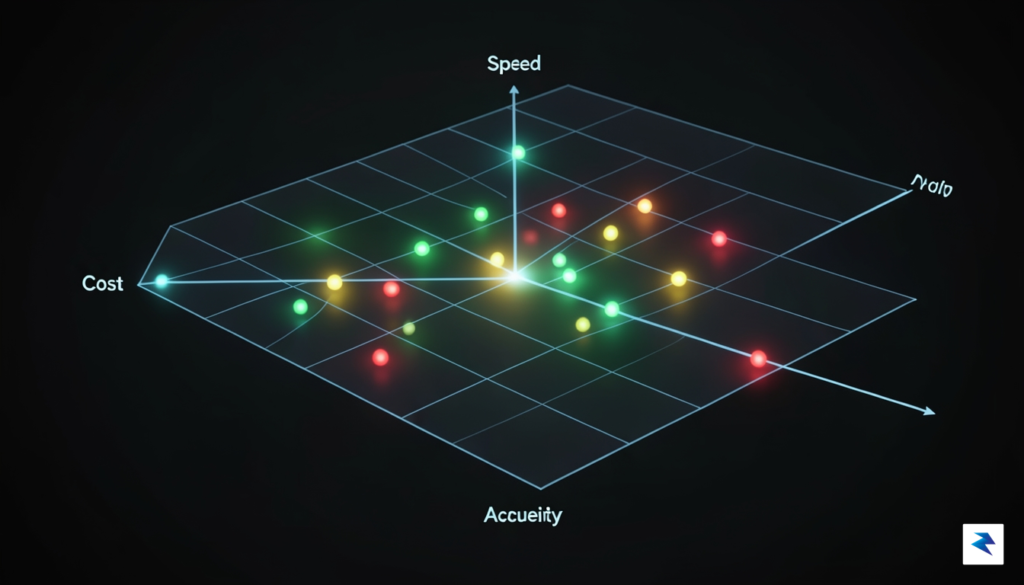
True optimization in the age of rapid AI advancement is rarely about chasing the single highest benchmark; instead, it is a delicate balancing act between latency, operational costs, and output fidelity. When migrating a production-grade agent to a newer iteration like GPT-5.6, the primary challenge lies in quantifying the trade-offs before they impact the end user. To navigate this, engineering teams should adopt a decision matrix that weighs the magnitude of performance gains against the inherent risks of breaking existing workflows. A 2.2x speed increase is objectively impressive, but if it comes at the cost of a 5% drop in logical consistency, the net value to the business might actually be negative. Therefore, every migration must be preceded by a rigorous regression suite that tests for edge cases, ensuring that speed improvements do not mask a degradation in complex reasoning tasks.
To institutionalize this balancing act, we recommend evaluating potential upgrades against three core pillars: Systemic Latency, Unit Economics, and Deterministic Accuracy. A high-performing upgrade should ideally check at least two of these boxes significantly without compromising the third. For instance, if a new model offers the same accuracy but with a 27% reduction in spend, it becomes a “no-brainer” fiscal optimization. Conversely, if a model is faster but requires extensive prompt engineering to maintain current accuracy levels, the “migration tax”—the labor hours required to refactor prompts and test outputs—must be amortized over the projected lifetime of the agent to determine if the move is truly worth the engineering effort.
Effective model migration is not just about adopting the latest technology; it is about ensuring that the infrastructure remains resilient enough to absorb performance shifts without disrupting the customer experience.
Beyond the initial migration, the long-term sustainability of an AI system depends heavily on proactive monitoring of production logs. Post-migration, it is vital to track not just performance metrics, but also “semantic drift.” By comparing the agent’s reasoning paths across the old and new models, teams can identify subtle shifts in how the model interprets complex instructions. We utilize automated observability tools that flag anomalous outputs in real-time, allowing us to catch regressions before they cascade into downstream services. As we look toward the future of agentic workflows, this feedback loop becomes the most critical asset in our stack. In a landscape where models evolve monthly rather than yearly, building a framework that treats model upgrades as a continuous, iterative process—rather than a one-off event—is the only way to maintain a competitive advantage while keeping costs under control.
You must be logged in to post a comment.