
The Digital Fortress: How Palestinians Are Saving Their History from Erasure
The Digital Imperative: Why Memory Matters in Conflict For populations living under the shadow of existential threat, the archive is far more…
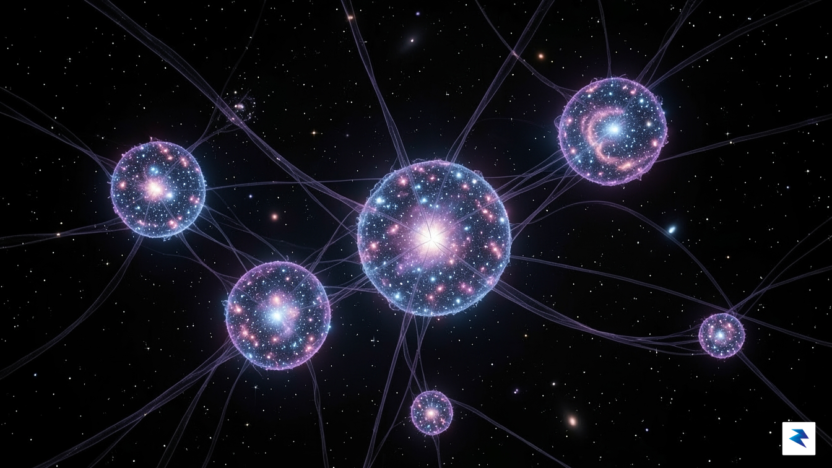
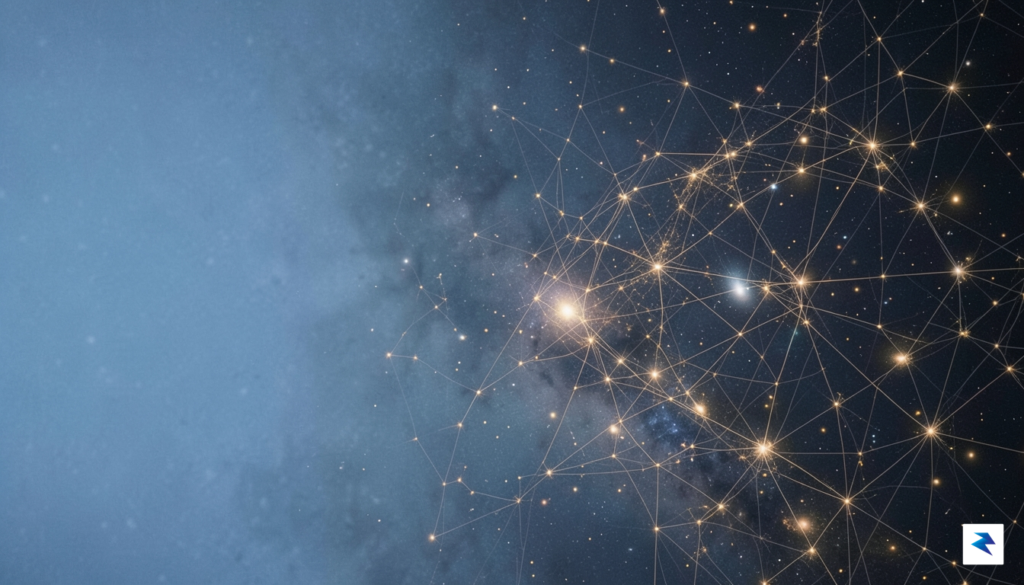
For nearly a century, the architectural blueprint of modern astronomy has rested upon a single, elegant assumption known as the Cosmological Principle. At its core, this principle posits that on a sufficiently large scale, the universe is both homogeneous and isotropic—meaning it looks essentially the same in every direction and possesses a uniform density of matter throughout space. While our immediate neighborhood in the cosmos is undeniably chaotic, populated by swirling galaxies, dense nebulae, and jagged clusters of stars, cosmologists view these features as mere local irregularities. By zooming out far enough, this perspective suggests that the “lumpiness” of our corner of space smooths out into a featureless, balanced tapestry, providing the necessary foundation for our mathematical models of reality.
The importance of this assumption cannot be overstated; it is the essential mathematical shortcut that allows physicists to solve the notoriously complex equations of General Relativity. Without the Cosmological Principle, the gravitational interactions of every individual particle, star, and galaxy would create an intractable web of variables, making it impossible to calculate the evolution of the cosmos. By assuming the universe is uniform, scientists can simplify the equations of space-time to a manageable state, essentially treating the universe as a smooth fluid rather than a collection of billions of distinct, interacting objects. This simplification served as the bedrock for the Lambda-CDM model—the Standard Model of Cosmology—which successfully explains everything from the expansion rate of the universe to the distribution of the Cosmic Microwave Background radiation.
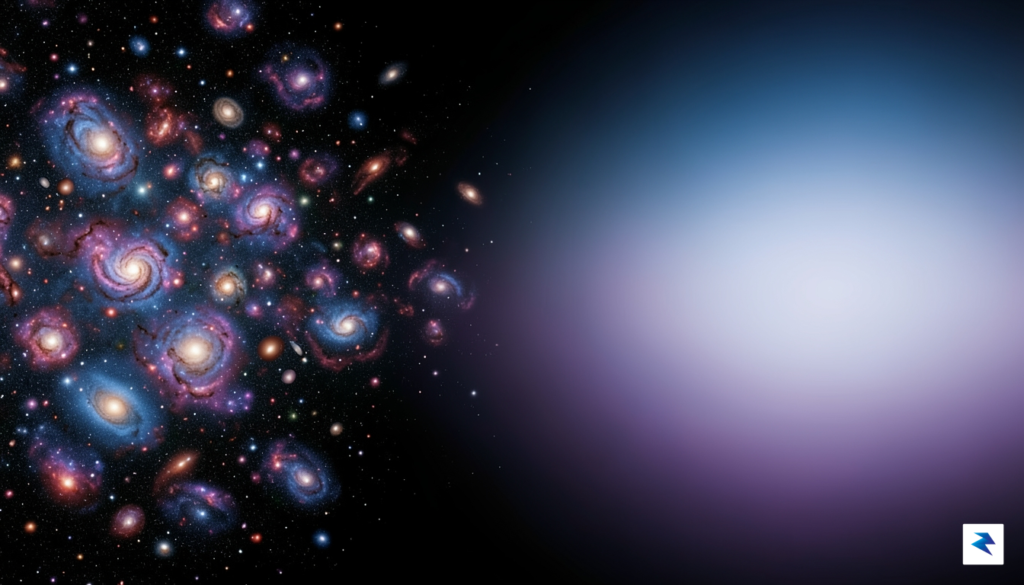
The Cosmological Principle is not just an observation; it is a simplifying necessity that transforms the chaotic history of the universe into a predictable, testable narrative.
Furthermore, this expectation of uniformity is deeply woven into the prevailing narrative of the Big Bang. In the immediate aftermath of the initial expansion, the universe was a hot, dense, and opaque plasma where matter was distributed with remarkable evenness. As the cosmos expanded and cooled, the subtle quantum fluctuations that existed in that early epoch were stretched across vast distances, eventually seeding the structures we see today. Because this origin story begins with near-perfect symmetry, the default expectation for scientists has always been that the universe should maintain a degree of statistical balance. However, as our observational technology reaches deeper into the history of time, we are beginning to encounter structures—such as enormous galaxy filaments and massive voids—that seem to defy this expectation of smoothness, forcing us to question whether our foundational assumption is a reflection of reality or simply a convenient mathematical illusion.

For decades, the bedrock of modern cosmology has rested upon the Cosmological Principle, a foundational assumption asserting that on a sufficiently large scale, the universe is both homogeneous and isotropic. In simple terms, scientists have long operated under the belief that if you zoom out far enough, the cosmos loses its distinct features and smoothes out into a uniform, featureless tapestry. However, this elegant theoretical framework is currently facing an existential crisis as modern mapping techniques reveal a reality that is far more chaotic and structured than our models ever anticipated. We are no longer looking at a smooth, predictable evolution of matter; instead, we are witnessing the emergence of cosmic giants that defy the statistical limits of our current understanding.
The tension began to surface as astronomers pushed the limits of deep-space surveys, repeatedly stumbling upon gargantuan structures that simply should not exist according to the standard model. From the discovery of the Sloan Great Wall—a gargantuan filament of galaxies stretching over a billion light-years—to the more recent revelation of the “Big Ring,” a structure so vast it challenges our comprehension of spatial distribution, the evidence for “lumpiness” is mounting. These massive configurations of matter represent significant statistical anomalies; they are far too large and too densely packed to have formed within the relatively short lifespan of our universe if matter were distributed as uniformly as the standard model dictates. When these structures appear, they act like a crack in the foundation of a building, forcing us to ask whether our entire blueprint for the cosmos is fundamentally flawed.
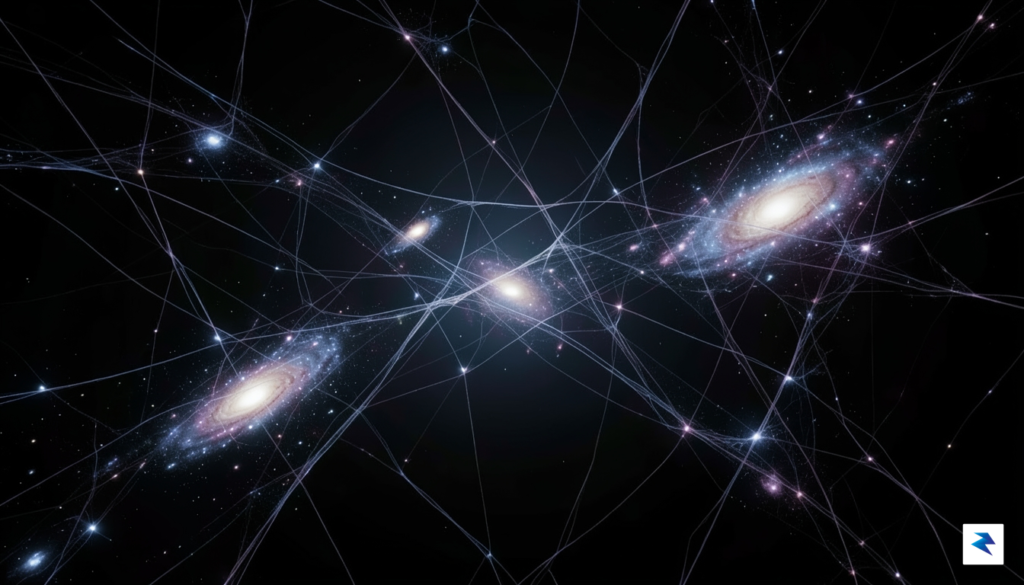
The discovery of structures exceeding the theoretical limit of homogeneity suggests that we may be misinterpreting the very fabric of cosmic history.
There is a natural, albeit understandable, psychological and scientific resistance to overturning such a long-standing paradigm. Cosmology is a discipline built on the comfort of mathematical consistency, and the prospect of discarding the Cosmological Principle is akin to navigating a ship without a compass. Many researchers are understandably hesitant to embrace these findings, often searching for observational biases or data artifacts to explain away the clustering. Yet, as the resolution of our telescopic surveys improves, the “lumpiness” remains persistent and undeniable. This friction between empirical observation and entrenched theory is precisely what drives scientific progress, even when it requires us to confront the uncomfortable possibility that the universe is far more complex, and perhaps more mysterious, than we ever dared to imagine.
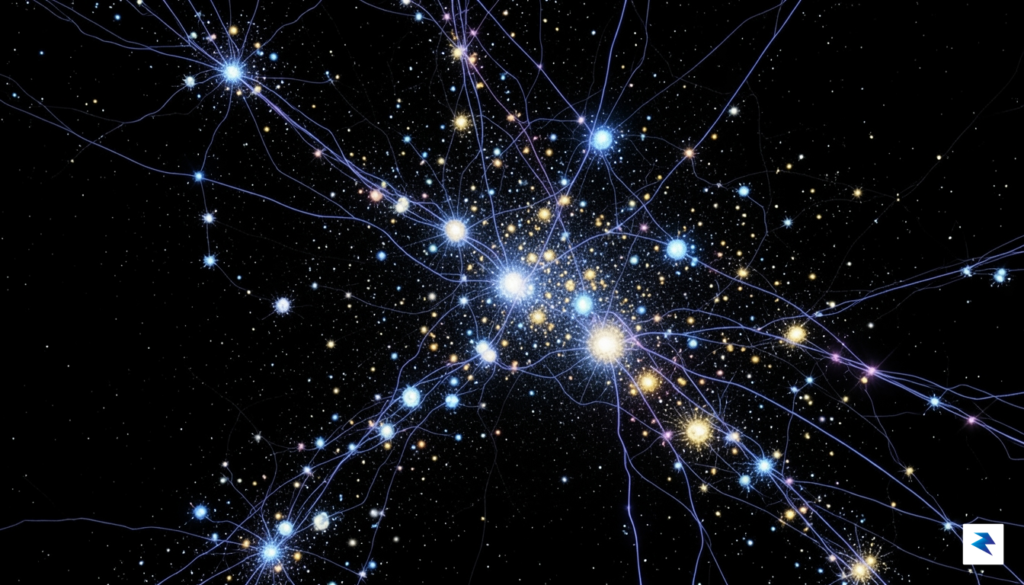
To map the vast, intricate architecture of our universe, researchers have moved beyond localized observations, opting instead for a panoramic approach that encompasses a staggering 47 million galaxies. This monumental dataset serves as a high-resolution window into the “cosmic web”—the filamentary structure of dark matter and luminous galaxies that bridges the voids of space. By synthesizing data from state-of-the-art sky surveys, scientists were able to trace the positions and velocities of these galaxies with unprecedented precision. This process is not merely an exercise in counting; it is a rigorous statistical endeavor aimed at differentiating between random spatial noise and genuine, persistent patterns that suggest the universe is organized in ways our standard models fail to predict.
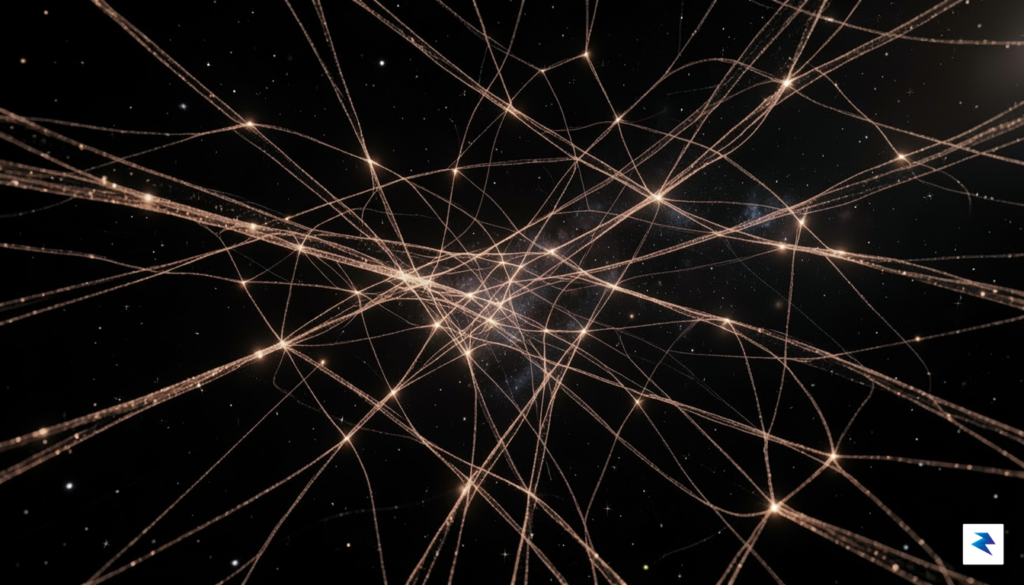
The sheer scale of this 47-million-galaxy dataset allows for a level of statistical confidence that was previously unattainable. Traditional cosmological models, specifically the Lambda Cold Dark Matter (ΛCDM) model, rely on the “Cosmological Principle”—the assumption that on a sufficiently large scale, the universe is homogeneous and isotropic, meaning it looks roughly the same in every direction. However, when researchers applied advanced spatial correlation algorithms to this massive data pool, they uncovered clustering patterns that appear far more structured than the standard model permits. By rigorously vetting these clusters against potential observational biases, the team ensured that what they were seeing was not a fluke of instrument resolution, but a structural reality embedded in the fabric of space itself.
The statistical weight of 47 million data points acts as a ‘smoking gun,’ forcing us to confront the possibility that the universe possesses a inherent ‘lumpiness’ that challenges our most fundamental assumptions about its evolution.
This study is being treated as a potential paradigm-shifter precisely because the patterns identified defy the mathematical expectations of randomness. If the universe were truly uniform, we would expect to see a smooth, predictable distribution of matter across these massive scales. Instead, the data reveals significant deviations—pockets of density and structural alignments that suggest the early universe did not expand with the perfect, even-handed uniformity we once assumed. As we continue to refine these maps, the evidence forces a critical re-evaluation of the core pillars of modern cosmology, hinting that the “lumpiness” we observe might be the key to understanding phenomena currently labeled as dark energy or unexplained gravitational anomalies.
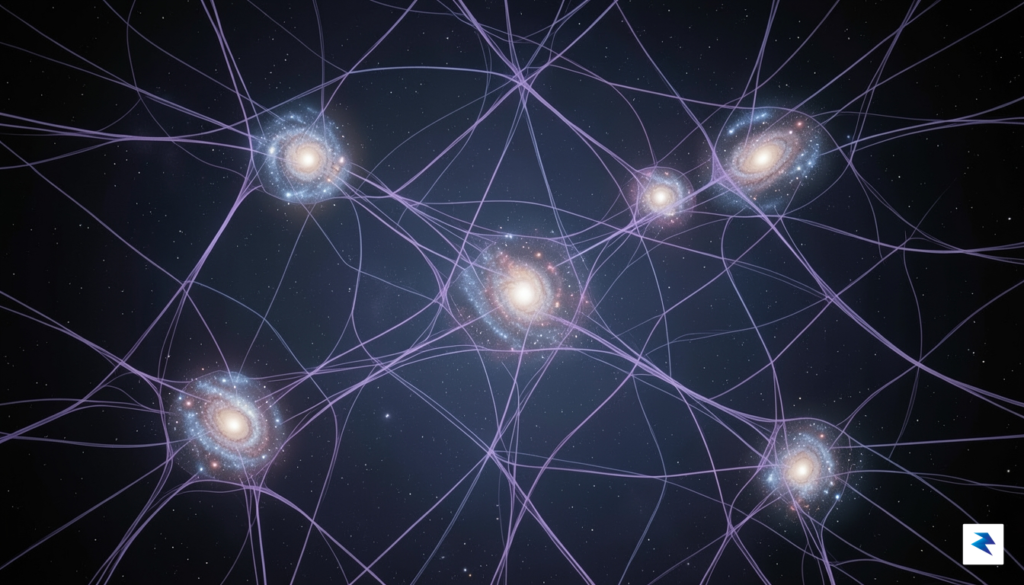
If the universe is indeed more structured—or “lumpy”—than our current standard models suggest, the implications for dark matter are nothing short of transformative. For decades, the Cold Dark Matter (CDM) paradigm has served as the invisible scaffolding of the cosmos, providing the gravitational heavy lifting required to pull gas and dust together into the first stars and galaxies. However, if observations reveal that matter is clumping together at rates or scales inconsistent with this model, it suggests that dark matter may not be the “cold,” slow-moving, and featureless substance we once assumed. Instead, we might be forced to reconsider whether dark matter possesses its own complex internal dynamics, or perhaps, if it interacts with itself in ways that accelerate the formation of these massive, dense structures.

The discrepancy between our current theoretical framework and these potential findings raises a fundamental question: can our current models of gravity actually account for such profound inhomogeneity? Within the standard ΛCDM model, gravity acts as a consistent force across the vast stretches of space-time, but if the universe displays unexpected clustering, it may be a sign that we need to look beyond the particle-based view of dark matter. Some theorists are already pointing toward Modified Newtonian Dynamics (MOND) or other alternative gravity theories as potential solutions. These frameworks suggest that gravity behaves differently on galactic scales than it does within our own solar system, effectively creating “extra” gravitational influence without needing to invent exotic new particles to fill the void.
The discovery of unexpected cosmic lumpiness acts as a stress test for our 13.8-billion-year timeline of cosmic growth, forcing us to reconcile the early, smooth state of the Big Bang with the hyper-structured reality we observe today.
Looking at the broader picture, the rate at which the universe has matured over its 13.8-billion-year lifespan is intimately tied to this distribution of matter. If the universe matured into a lumpy, complex web faster than our simulations predict, our understanding of cosmic expansion—and the “dark energy” that drives it—might be incomplete. If dark matter clusters more aggressively, it could be effectively fighting the expansion of the universe in localized pockets, creating a tug-of-war that significantly alters the history of cosmic evolution. Refining these theories isn’t just an academic exercise; it is a necessary step toward understanding whether our universe is a predictable, smooth progression or a far more chaotic, structural anomaly that defies our most cherished cosmological pillars.
Science has a storied history of moving forward not through steady accumulation, but through sudden, jarring leaps that force us to abandon comfortable assumptions. For decades, the Standard Model of cosmology has served as our North Star, painting a picture of a universe that is fundamentally smooth and uniform on its largest scales. Yet, as new data begins to suggest that the cosmos may be far “lumpier” than these foundational theories allow, we find ourselves on the precipice of a genuine paradigm shift. This is not a failure of the scientific method, but rather its greatest triumph; when the data no longer fits the map, it is time to redraw the map entirely.
The coming years promise to be a golden age of discovery as we deploy a new generation of sophisticated tools designed to probe these anomalies with unprecedented precision. Upcoming missions, most notably the Euclid space telescope and the Vera Rubin Observatory, are poised to map the distribution of galaxies and dark matter across vast swaths of the sky. By capturing a more granular look at the cosmic web, these observatories will act as the ultimate arbiters, determining whether the perceived irregularities are mere statistical flukes or the first whispers of “new physics” that lie beyond our current understanding of gravity and dark energy.
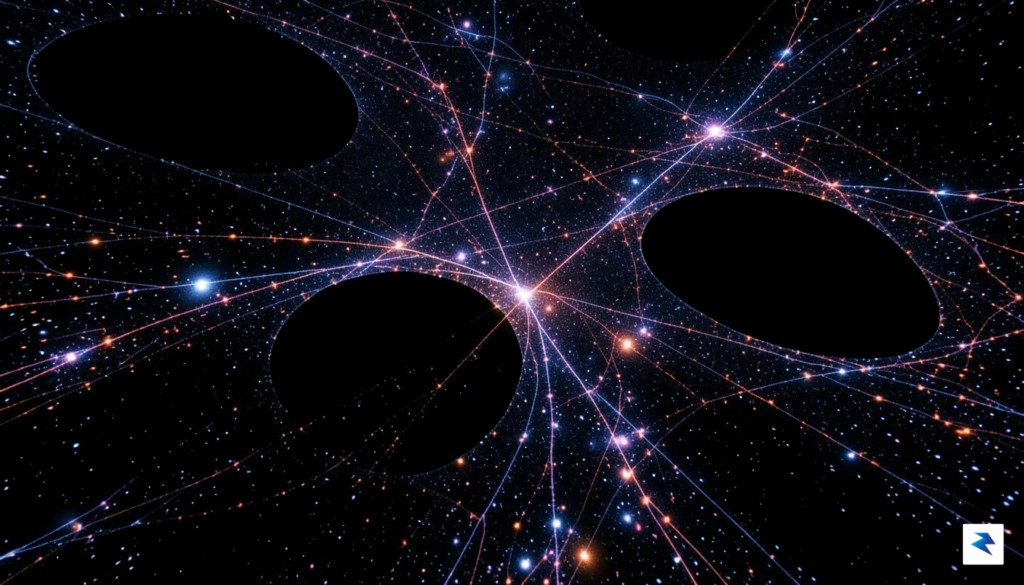
The beauty of cosmology lies in the fact that every time we think we have reached the edge of the map, the universe reveals that the territory is far more expansive and mysterious than we ever dared to dream.
Far from signaling an end to scientific inquiry, this potential shift in our understanding serves as a profound invitation to look closer. If the universe does not conform to the principles of homogeneity, we are forced to grapple with a more complex, nuanced, and dynamic reality. We must consider the possibility that our current equations are merely local approximations of a much deeper, more intricate cosmic architecture. This transition—from a universe that is predictable and uniform to one that is vibrant, structured, and perhaps even chaotic—challenges us to rethink our own place within it.
Ultimately, embracing this uncertainty is what drives the human spirit of exploration. We are moving toward a future where our textbooks will likely require major revisions, but that is a small price to pay for a more accurate reflection of the cosmos. As we peel back the layers of the early universe, we find that the mystery is not a void to be feared, but a treasure to be uncovered. The realization that the universe is less uniform than we imagined is not a cause for dismay; rather, it is a testament to the fact that we are only just beginning to grasp the true, magnificent complexity of our home in space.
You must be logged in to post a comment.