
Are Those Soldiers Real? How AI-Generated Images Are Swarming Your Feed
The Rise of Synthetic Patriotism A curious and increasingly pervasive trend has taken hold across the digital landscape, transforming the way…

When headlines circulate claiming that a developer is pushing 37,000 lines of code (LoC) into a production environment every single day, the immediate reaction is often a mixture of disbelief and existential dread. In the traditional software engineering paradigm, writing 37,000 lines of code would require a small army of developers working for months, if not years. However, this metric reflects a fundamental misunderstanding of what modern AI-driven development looks like. We are no longer operating in an era where every line is meticulously hand-crafted by a human; instead, we are witnessing the rise of agentic systems that operate at a velocity and volume that make legacy productivity metrics largely obsolete.
To grasp the reality behind these figures, one must first recognize that LoC has long been considered a “vanity metric” in software engineering. In the past, managers often used line counts to measure developer productivity, a practice widely criticized because it incentivizes verbosity over elegance and efficiency. With the introduction of LLMs and autonomous coding agents, this metric has become even more deceptive. When an AI generates 37,000 lines, it is rarely “writing” complex business logic from scratch. Rather, it is generating vast swaths of boilerplate code, configuration files, automated scaffolding, and expansive data structures that a human developer would have spent hours—or days—typing out manually.
The value of a software engineer is increasingly defined by their ability to architect systems and verify output, rather than their raw typing speed or volume of syntax produced.
Furthermore, the term “shipping” in this context requires a nuanced interpretation. When an AI system pushes thousands of lines to a codebase, it often includes comprehensive test suites, documentation, and interface declarations that are mechanically derived from the core functional requirements. If a developer uses an agent to build a new feature, that agent might generate a thousand lines of supporting code for every ten lines of actual, unique business logic. Consequently, the 37,000-line figure is less a measure of human creative labor and more a measure of the developer’s capacity to orchestrate high-level systems that output massive amounts of predictable, machine-readable syntax.
Ultimately, judging modern development by the sheer volume of code produced is like judging an architect by the number of individual bricks laid rather than the structural integrity of the building. We must pivot our focus away from the raw quantity of lines and toward the quality of the outcomes. The true superpower of AI-enabled development is not that it allows us to churn out more code than ever before, but that it allows us to bypass the drudgery of implementation to focus on the high-level strategy and system design. By automating the mechanical aspects of programming, these tools allow developers to operate at the speed of thought, even if the resulting “code count” remains a misunderstood artifact of the automated process.
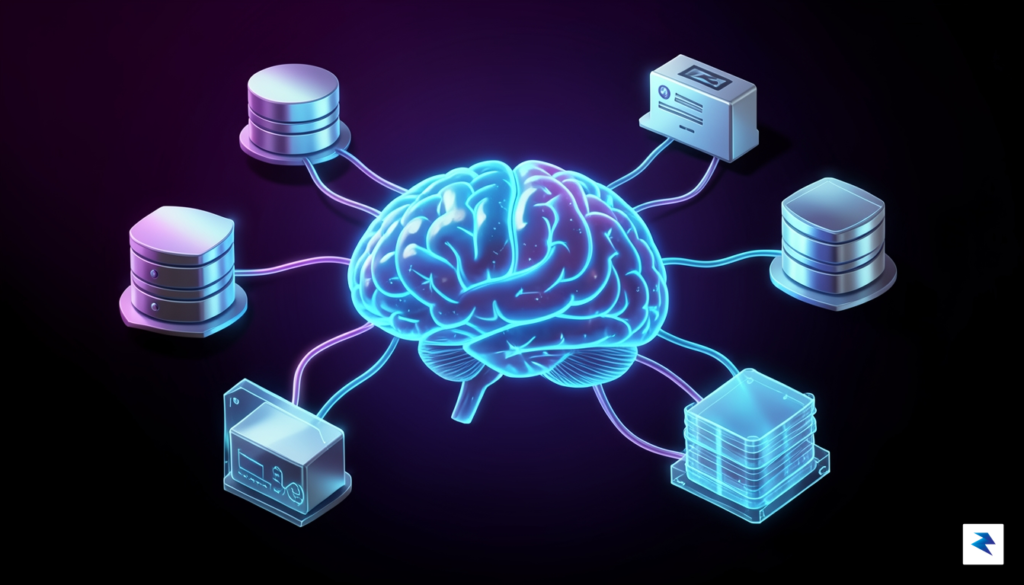
To grasp how a single developer or a small team can produce tens of thousands of lines of code in a single day, one must first discard the outdated notion of “AI as a fancy autocomplete.” Traditional coding assistants, like standard Copilot-style tools, function primarily as predictive text engines for developers. They operate on a reactive basis, waiting for a human to type a function signature or a comment before suggesting the next few lines of boilerplate. In this conventional workflow, the human remains the primary architect, the debugger, and the orchestrator of the software lifecycle, while the AI acts merely as a speed-enhancing scribe.
Agentic AI, by contrast, shifts the paradigm from passive assistance to autonomous execution. An agentic system is defined by its ability to act as an independent operator that possesses a specific goal rather than a prompt-based task. Instead of simply predicting the next token, these agents are equipped with a “reasoning loop” that allows them to break down high-level requirements into actionable sub-tasks, execute those tasks, and—most importantly—evaluate the results. It is this transition from generation to agency that allows for such massive scale; the machine is no longer waiting for permission to write, but is actively navigating a project’s codebase to achieve a stated outcome.
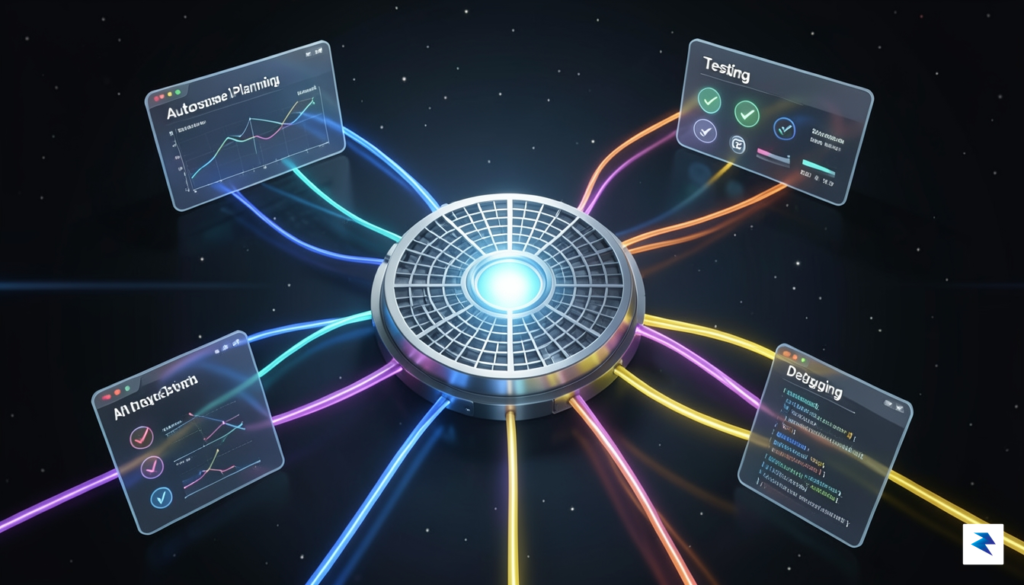
The true power of this architecture lies in its iterative feedback loops, which replace the traditional human-in-the-loop bottleneck. When an agentic system writes code, it does not simply drop it into the repository and hope for the best; it initiates a self-correcting cycle. The agent automatically runs unit tests, parses compiler errors, and analyzes stack traces to identify where its initial logic failed. If a bug is detected, the agent autonomously reverts the change, reformulates its approach, and attempts a new solution. This recursive process—plan, execute, test, fix, and repeat—happens in milliseconds, allowing the system to iterate through hundreds of potential implementations in the time it would take a human to manually debug a single block of code.
The core differentiator of agentic AI is not the speed of typing, but the ability to perform closed-loop problem solving without constant human intervention.
This autonomy fundamentally changes how we view software maintenance. Because these agents are capable of integrating their own work into a larger codebase, they can handle the tedious, “glue” work that typically consumes the majority of a software engineer’s time. They are designed to respect existing design patterns, import necessary dependencies, and maintain consistency across large-scale projects. By delegating these repetitive, logic-heavy chores to an agent, developers are freed to act as high-level system architects, overseeing the strategic direction of the product rather than getting bogged down in the minute technical debt of daily implementation.

The sheer velocity at which modern AI agents can churn out lines of code is undeniably impressive, yet this rapid output introduces a significant tension between raw productivity and long-term codebase health. When an AI generates thousands of lines of code in mere minutes, the risk of “code bloat” becomes a primary concern for engineering teams. Unlike human developers, who are often constrained by cognitive load and the time-intensive nature of typing, AI agents lack the built-in hesitation that typically acts as a filter for unnecessary complexity. If left unchecked, this can lead to a repository filled with redundant functions, overly verbose logic, and a lack of stylistic consistency, transforming what should be a streamlined asset into a brittle, unmanageable mess.
To mitigate the accumulation of technical debt in an agentic workflow, teams must fundamentally rethink their code review processes. Relying on traditional line-by-line human reviews is no longer feasible when the volume of incoming code matches the output speed of an automated system. Instead, organizations are shifting toward “architectural governance,” where human engineers act less as proofreaders and more as system architects. This involves using automated linters, static analysis tools, and suite-based testing frameworks to act as the first line of defense. By enforcing strict architectural boundaries and modular design patterns before the code is even generated, developers can ensure that the AI operates within well-defined, safe parameters rather than creating an unnavigable labyrinth of logic.
The true value of an engineer in the AI era is not in the ability to write syntax, but in the ability to curate, validate, and maintain the structural integrity of the software ecosystem.
Maintaining a clean architecture requires a disciplined approach to how AI is integrated into the development lifecycle. Rather than allowing agents to generate entire, disconnected modules, effective teams are delegating granular, repetitive, and structural tasks to AI, such as writing boilerplate code, boilerplate unit tests, or repetitive data transformation layers. By restricting the AI to these low-level tasks, human engineers retain control over the high-level design patterns and business logic that define the system’s longevity. This “human-in-the-loop” model ensures that while the grunt work is automated, the strategic decisions regarding system scalability and maintainability remain firmly under human stewardship.
Ultimately, the goal is to view AI-generated code as a draft that requires a rigorous “polishing” phase. Just as a professional writer needs an editor to refine a manuscript, a codebase requires a human touch to ensure it adheres to evolving security standards and performance requirements. By fostering a culture where code quality is prioritized over mere output metrics, engineering teams can harness the speed of AI without sacrificing the robustness of their applications. The future of software engineering will not be defined by who can generate the most lines of code, but by who can most effectively synthesize AI-assisted speed with the enduring principles of clean, maintainable, and secure architecture.

The sheer velocity of code generation made possible by autonomous agents is undeniably impressive, yet it creates a common misconception that the developer’s value is tethered to their output in lines of code. In reality, we are witnessing a fundamental transition where the engineer is evolving from a manual laborer of syntax into an architect of complex systems. When an AI can churn out thousands of lines in mere minutes, the bottleneck of software development shifts away from implementation speed and toward architectural integrity. The human developer is no longer just the person typing the code; they are the strategic director, the systems auditor, and the final arbiter of product-market fit.
As the burden of writing boilerplate and routine logic moves to the machine, the professional skill set must adapt accordingly. Proficiency in syntax remains a foundation, but it is now secondary to the mastery of prompt engineering, system design, and deep-level debugging. Developers must become adept at defining the constraints and guardrails within which an AI operates, ensuring that the generated code is not only functional but also maintainable and scalable. The ability to decompose a massive business requirement into discrete, logical modules that an AI can successfully execute is a higher-order skill that requires a deep understanding of computer science principles that no algorithm can fully replicate.

The true challenge for the modern developer is not keeping up with the speed of AI generation, but ensuring that what is being built actually solves the right problem for the end user.
Human intuition remains the most critical filter for the nuances that often escape artificial intelligence. While an agent can efficiently construct a feature based on a prompt, it often lacks the contextual awareness required to navigate the messy reality of edge cases, security vulnerabilities, and shifting business requirements. A developer’s role now involves acting as a vigilant inspector, performing rigorous security audits and logic checks on the automated output. If an AI generates 37,000 lines of code, the human engineer must be capable of verifying the intent, performance, and reliability of that output, as the cost of a systemic failure in an automated codebase is significantly higher than in one written line-by-line.
Ultimately, the era of agentic AI does not signal the end of the developer; it signals the end of the developer as a mere typist. By offloading the heavy lifting of implementation, engineers are finally freed to tackle the higher-level challenges that have historically been sidelined by tight deadlines and technical debt. This shift empowers the human to focus on the “why” and the “how” of software architecture, leaving the “what” of execution to the agents. We are moving toward a future where the most successful engineers are those who view AI not as a replacement for their craft, but as a force-multiplier for their own problem-solving capabilities.

The recent discussions around AI-driven development, particularly claims of generating tens of thousands of lines of code daily, present a profound shift for startups and established tech companies alike. For a burgeoning startup, this isn’t merely about the raw quantity of code produced; it signifies an unprecedented acceleration of the entire development lifecycle. The true promise lies in augmenting developer capabilities, compressing iteration cycles, and allowing smaller teams to achieve disproportionately larger outputs. However, this transformative potential comes with a critical caveat: leaders must strategically integrate these powerful AI tools into their existing CI/CD pipelines and development workflows without ceding control over their product’s vision, quality, or strategic roadmap.
Integrating AI agents into existing startup workflows requires a thoughtful and phased approach. Rather than viewing AI as a direct replacement for human developers, forward-thinking founders and CTOs should position these tools as intelligent co-pilots and powerful automation assistants. This means identifying specific, high-leverage areas where AI can truly excel, such as generating boilerplate code, writing initial test cases, suggesting refactorings, or even drafting preliminary documentation. The goal is to offload repetitive, time-consuming tasks, freeing up human engineers to focus on complex problem-solving, architectural design, and innovative feature development that truly differentiates the product.

A cornerstone of successful AI integration is maintaining a robust ‘human-in-the-loop’ approach, particularly for critical deployment phases and core product logic. While AI can generate code at an astonishing pace, its outputs are not infallible. Hallucinations, subtle bugs, or security vulnerabilities can easily creep into AI-generated code, especially when the prompts are ambiguous or the context is highly nuanced. Therefore, every significant piece of AI-generated code, particularly anything touching production systems or sensitive data, must undergo rigorous human review and validation. This ensures that the code aligns with architectural standards, meets security requirements, and, most importantly, accurately reflects the product’s intended functionality and user experience.
Establishing clear documentation and rigorous testing protocols becomes even more paramount when AI agents are contributing to the codebase. Comprehensive documentation, both for the AI’s inputs and its generated outputs, is crucial for maintainability and debugging. Developers need to understand not only *what* the AI produced, but also *why* and under *what conditions*. Similarly, while AI can assist in generating tests, human-defined test strategies and thorough test suites—including unit, integration, and end-to-end tests—are indispensable. These tests act as critical guardrails, ensuring that AI-generated contributions maintain the required level of quality and do not inadvertently introduce regressions or break existing functionality.
For startups specifically, the journey into AI-driven workflows should begin with experimentation and iteration, rather than a wholesale overhaul. Start by piloting AI tools on less critical, well-defined tasks or internal tools, gathering data, and refining your prompting techniques. This allows teams to build confidence, understand the AI’s strengths and weaknesses, and develop best practices without jeopardizing core product development. Cultivating a culture where developers are empowered to experiment with these tools, share their findings, and collectively define the most effective integration strategies will be key to unlocking the true potential of agentic AI in development.
The essence of integrating AI into development is not merely to produce more code, but to engineer a smarter, faster, and more resilient development process where human ingenuity is amplified by intelligent automation.
Ultimately, the goal is not to chase a numerical target like 37,000 lines of code per day, but to leverage AI to achieve faster time-to-market, higher code quality, and more innovative solutions. By adopting a pragmatic, human-centric approach that emphasizes control, quality assurance, and continuous learning, startup leaders can harness the power of AI to build exceptional products and outmaneuver competitors in today’s rapidly evolving tech landscape.
You must be logged in to post a comment.