Midjourney Challenges Hollywood: Why Studios Are Being Forced to Reveal AI Secrets
The Collision of Generative AI and Entertainment Law The rapidly evolving landscape of generative artificial intelligence has moved beyond the…

In a bold move that blurs the lines between historical reverence and modern innovation, Google’s latest commercial campaign presents a provocative premise: what if the architects of American democracy had access to the high-powered generative tools of the 21st century? The advertisement envisions Thomas Jefferson and his contemporaries not with quills and parchment, but navigating collaborative documents, utilizing real-time suggestions, and streamlining their rhetoric with the aid of artificial intelligence. By placing sophisticated software into the hands of 18th-century revolutionaries, Google isn’t merely showcasing a product suite; it is actively inviting us to reconsider the very mechanics of creativity and the evolution of collaborative thought.
Choosing the Declaration of Independence as the centerpiece for this narrative is a strategic, albeit daring, creative decision. This document represents the pinnacle of human consensus, a high-stakes draft that required intense editing, nuanced negotiation, and the synthesis of disparate political philosophies. By framing this monumental task within the context of a modern Workspace environment, Google highlights the inherent friction and difficulty of the original writing process, while suggesting that the tools we use today are essentially force-multipliers for our collective intent. It posits that if Jefferson had been able to organize his thoughts, iterate on drafts instantly, and synthesize ideas through cloud-based collaboration, the birth of a nation might have been an even more seamless, albeit technologically augmented, endeavor.

This juxtaposition of the digital age against the revolutionary era serves as a powerful mirror for our own relationship with technology. It forces viewers to confront the tension between the “organic” genius we associate with historical icons and the “augmented” intelligence we are increasingly reliant upon today. While some may argue that such a comparison risks trivializing the grueling intellectual labor of the Founding Fathers, others might see it as a celebration of the enduring nature of human purpose. Ultimately, the advertisement suggests that while the medium of expression changes—evolving from ink-stained quills to generative AI prompts—the fundamental human desire to articulate ideals, organize communities, and draft a better future remains a constant, driving force of human progress.
The true power of technology lies not in the replacement of human thought, but in the amplification of our ability to communicate, collaborate, and refine the ideas that define our society.
By bringing these two worlds together, Google effectively asks us to reflect on how our own tools shape our milestones. We are living through a period where the barrier between a fleeting thought and a polished piece of writing is thinner than ever before. Whether we view this shift as a liberation of creative potential or a departure from authentic effort, the commercial serves as a stark reminder that we are all, in our own way, participating in an ongoing draft of history, constantly editing and refining the world we intend to leave behind.

Imagine the stifling summer heat of Philadelphia in 1776, not just from the weather, but from the immense pressure on the Continental Congress. The act of declaring independence was monumental, yet the methods available for crafting such a critical document were painstakingly slow and labor-intensive. Delegates like Thomas Jefferson, John Adams, and Benjamin Franklin were not only masterminds of political philosophy but also scribes, relying on quill and parchment. The process involved multiple drafts, hand-copied versions, messengers traversing the city to gather feedback, and arduous debates over every single word. Each revision meant re-copying sections, often entire pages, a cumbersome task that consumed precious time and energy, diverting focus from the profound implications of their work.
Now, fast-forward to a hypothetical 21st-century scenario where AI tools and modern digital collaboration platforms were at their disposal. The logistical hurdles that once defined the creation of the Declaration of Independence would vanish. Instead of ink-stained fingers and countless hours spent on transcription, the Committee of Five could have leveraged real-time cloud collaboration. Imagine Jefferson drafting the initial text in a shared document, with Adams and Franklin simultaneously providing comments, suggesting edits, and refining phrases directly within the same interface. Every change would be instantly visible to all collaborators, eliminating the need for physical drafts and time-consuming messenger trips across colonial Philadelphia.
Beyond mere collaboration, AI-driven drafting assistance would have offered profound efficiencies. A sophisticated AI could have maintained a comprehensive version history, tracking every single alteration, who made it, and when. This feature alone would have been revolutionary, providing an infallible audit trail and allowing delegates to easily revert to earlier versions or compare proposed changes side-by-side. Furthermore, AI could have summarized lengthy congressional debates, presenting key arguments and counterpoints in concise bullet points, saving delegates hours of deliberation and ensuring everyone was aligned on the core issues. This would have allowed the delegates to focus their intellectual capital on the philosophical underpinnings and strategic implications of their declaration, rather than getting bogged down in the mechanics of document production.
Consider the power of AI to refine the document’s language and impact. An AI could have analyzed the tone and persuasiveness of the Declaration, suggesting alternative phrasing to strengthen arguments for international allies or to more effectively rally support among hesitant colonists. It could have performed instantaneous grammar and style checks, ensuring consistency and clarity across the entire document. More critically, an advanced AI could have accessed and cross-referenced vast databases of Enlightenment philosophy, historical grievances against the Crown, and legal precedents, instantly pulling relevant quotes or suggesting powerful analogies to bolster the Declaration’s intellectual and moral authority. This kind of immediate, intelligent feedback would have dramatically accelerated the drafting and revision cycle, potentially reducing weeks of intense labor to mere days.
The acceleration of the drafting process would have had far-reaching consequences. A quicker finalized Declaration might have meant earlier diplomatic overtures to foreign powers, potentially altering the timeline of alliances and foreign aid. More importantly, it would have freed up the brilliant minds of the Continental Congress to dedicate themselves to other pressing matters of state, such as forming a national government, organizing military strategy, or securing vital resources for the nascent war effort. The shift from the arduous, manual labor of the quill to the instantaneous, intelligent assistance of AI would not just be a matter of convenience; it would be a fundamental transformation in how a nation could be forged, streamlining the very creation of the foundational text of liberty.

At its core, the intersection of generative artificial intelligence and the bedrock of American democracy presents a profound philosophical tension. While Google’s latest marketing campaign uses the Declaration of Independence as a canvas for demonstrating the creative capabilities of its AI tools, the stunt inevitably blurs the precarious line between playful creative expression and the normalization of historical revisionism. When we invite algorithms to draft or refine the rhetoric of our founding documents, we risk sanitizing the visceral, high-stakes human struggle that birthed them. The drafting of such texts was never merely a linguistic exercise; it was a process defined by profound personal risk, intense philosophical friction, and the weight of revolutionary consequence that no machine, regardless of its computational power, can truly comprehend.
Critics of this approach argue that by simplifying the creation of sacred texts into a series of AI-assisted prompts, we inadvertently dilute the gravity of human achievements. There is a tangible danger in reducing the impassioned, often agonizing debates of the Continental Congress to an output generated by predictive text models. When we treat the Declaration of Independence as a template that could be “optimized” or “assisted” by software, we risk fostering a cultural indifference toward the specific, human-centric contexts in which these documents were forged. If the public begins to perceive foundational history as something malleable or easily generated, we may lose the essential appreciation for the human agency, courage, and intellectual sacrifice that defined those pivotal moments in time.
The danger of AI-assisted history is not the loss of accuracy, but the loss of human struggle; a machine can mimic the vocabulary of freedom, but it cannot know the cost of fighting for it.
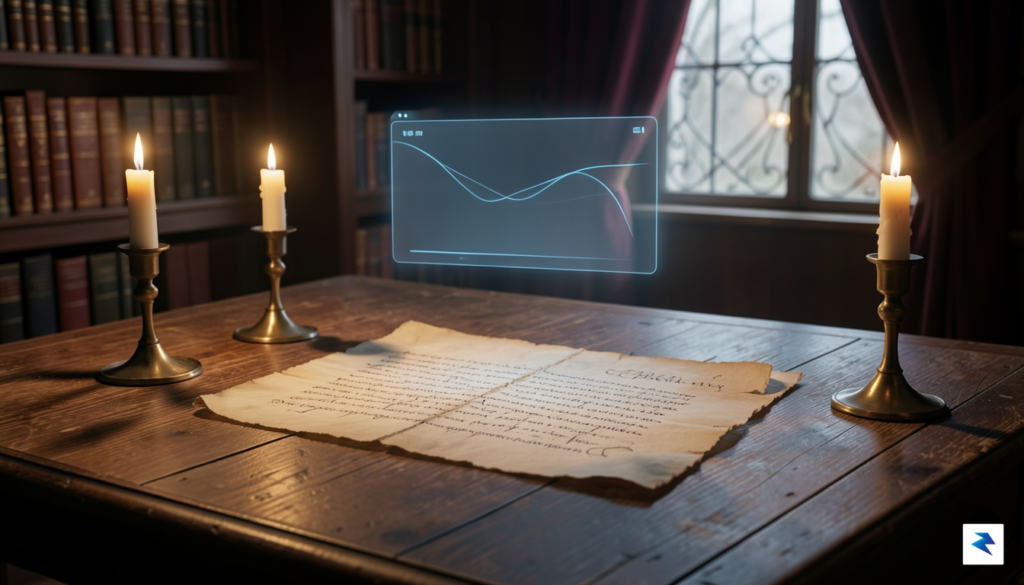
Public reaction to these advertisements has been deeply polarized, reflecting a growing societal unease regarding the encroachment of automated tools into the spheres of history and cultural heritage. Many observers feel that applying modern, frictionless technology to tasks traditionally characterized by profound human deliberation feels inherently disrespectful, if not altogether tone-deaf. This sentiment stems from a belief that our history is not “content” to be curated or improved, but a testament to human experience that should remain untouched by the deterministic logic of artificial intelligence. As we continue to integrate these tools into our daily lives, we must critically evaluate whether the convenience offered by generative AI is worth the potential erosion of our connection to the authentic, unautomated realities of our collective past.

At its core, the fascination with using generative tools to draft historical documents highlights a fundamental shift in how we perceive the act of creation. There is a distinct philosophical chasm between the labor of writing and the tactical convenience of prompting. When we write, we are performing a physical and cognitive synthesis of lived experience, emotional depth, and moral conviction. Conversely, prompting an AI is an exercise in curation and orchestration; it is the act of directing a machine to pull from a vast statistical probability of language. While a generative model can simulate the cadence of 18th-century prose with remarkable accuracy, it lacks the lived reality of political oppression or the visceral risk of treason that defined the original Declaration of Independence.
The efficiency that AI brings to the table—streamlining syntax, refining structural flow, and expanding vocabulary—is undeniably transformative. However, we must distinguish between the mechanics of composition and the soul of the message. If we view the Declaration of Independence through a purely technical lens, it becomes a series of logical premises and rhetorical flourishes. But if we view it as a revolutionary act, it becomes a document defined by its weight, its consequence, and the immense personal cost borne by its signatories. AI can provide the polished framework, but it cannot shoulder the moral burden or the intellectual gravity required to justify a revolution. It is an instrument of velocity, not an instrument of conviction.
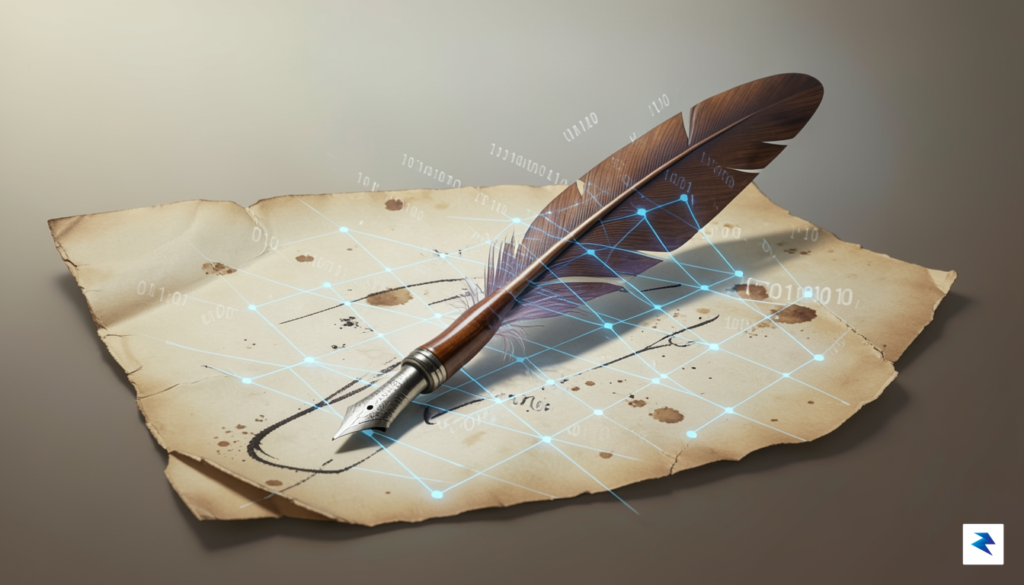
The true value of creative work lies not in the final output, but in the human intent that dictates the direction of the machine.
This brings us to the essential “human-in-the-loop” paradigm that defines the modern creative landscape. Rather than replacing the author, AI functions as a sophisticated sounding board, a partner that can offer infinite permutations of a thought. The human creator remains the ultimate arbiter, selecting which threads of logic to weave into the narrative and which to discard. By guiding the AI, the human imbues the text with a specific intent that the machine, in its neutrality, could never generate on its own. In this partnership, the machine handles the heavy lifting of language processing, while the human provides the heartbeat, the context, and the final, irrevocable stamp of authenticity.
Ultimately, the role of the creator in the age of algorithms is to be the architect of meaning. If we rely solely on AI to generate our foundational ideas, we risk diluting the very spirit that makes such documents enduring. Instead, by leveraging these tools to refine our expression while keeping our human values at the helm, we can expand the boundaries of our own creativity. The synergy between human intent and machine efficiency is not about replacing the voice of the author; it is about amplifying it, provided we remember that the machine is only as profound as the human who directs it.

The contemporary workplace has undergone a profound transformation, shifting dramatically from the siloed, sequential workflows of the past to an interconnected, dynamic ecosystem. Gone are the days when a single author meticulously crafted a document in isolation, passing it along for review and revision in a slow, often cumbersome chain. Today, teams scattered across different time zones can co-create, iterate, and refine complex projects in real-time, leveraging digital platforms that dissolve geographical barriers. This evolution isn’t merely about speed; it’s about fundamentally rethinking how ideas are born, nurtured, and brought to fruition, embracing a fluidity that was unimaginable just a couple of decades ago. This paradigm shift sets the stage for a new era where intelligent tools are not just supportive but integral to the creative process, reshaping institutional innovation at its core.
Tools like Google Workspace stand at the vanguard of this revolution, redefining the very essence of “collaborative work.” Far beyond simple document sharing, these platforms now integrate sophisticated AI capabilities that act as intelligent co-pilots, offering real-time grammar suggestions, summarizing lengthy discussions, or even generating initial drafts based on user prompts. What once required hours of solitary brainstorming or manual data compilation can now be accelerated and enriched through AI-powered insights, allowing teams to focus their precious human intellect on higher-level strategic thinking and nuanced problem-solving. This seamless integration of AI into everyday applications empowers diverse teams to achieve unprecedented levels of synchronicity and efficiency, transforming complex document creation and broader projects into manageable, deeply collaborative endeavors.

Yet, as we embrace these powerful advancements, it becomes increasingly clear that AI’s greatest strength lies not in replacement but in augmentation. While artificial intelligence can process vast datasets, identify patterns, and generate content with remarkable speed, it lacks the uniquely human attributes of empathy, ethical judgment, strategic foresight, and genuine creativity that truly drive innovation and meaningful communication. The nuanced understanding of human values, the ability to discern unspoken context, and the capacity for truly original thought remain firmly within the human domain. Therefore, the future of collaborative creation hinges on a symbiotic relationship: AI serving as an invaluable assistant, a tireless researcher, and a meticulous editor, while human minds provide the vision, the emotional intelligence, and the ultimate direction, ensuring that our collective endeavors remain grounded in purpose and authenticity. This partnership promises to unlock new frontiers of productivity and creativity, provided we remember that the compass, though aided by advanced navigation, must always be guided by a human hand.
You must be logged in to post a comment.