What If the Founding Fathers Used AI? Inside Google’s Bold New Ad
The AI-Augmented Founding: A Creative Thought Experiment In a bold move that blurs the lines between historical reverence and modern…
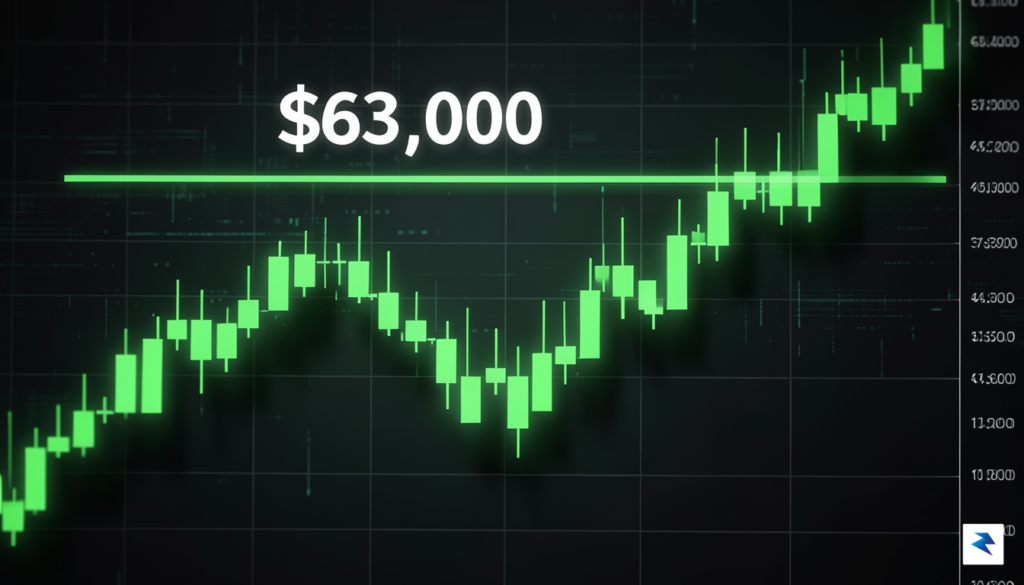
The recent surge that propelled Bitcoin back above the $63,000 threshold represents a pivotal shift in the cryptocurrency’s mid-year trajectory. After navigating a grueling end to June, characterized by persistent selling pressure and a pervasive sense of bearish caution, the market appears to have found a renewed sense of stability. This reclaiming of the $63,000 level is not merely a numerical milestone; it serves as a critical psychological barrier that, once breached, effectively invalidates the prevailing downtrend that had dominated the closing days of the previous month. By stabilizing above this point, Bitcoin has successfully neutralized the momentum of the bears, signaling that the supply side is finally finding equilibrium with a re-emerging appetite for risk.

Technically, the $63,000 mark acts as a significant pivot point that investors watch closely to gauge the strength of underlying trend reversals. During the late-June dip, the asset struggled to maintain footing, leaving many to wonder if a deeper correction into the mid-$50,000 range was inevitable. However, the bounce back demonstrates a strong defensive posture from buyers who view current price levels as a favorable entry point. This recovery suggests that the “dip-buying” sentiment is alive and well, reflecting a recalibration of expectations among both retail participants and institutional players. As liquidity flows back into the market, the resistance zones that previously capped growth are being tested with far greater conviction than they were just a week ago.
The reclamation of the $63,000 level functions as a vital signal of market resilience, suggesting that the recent volatility was a temporary shakeout rather than a structural breakdown of the bullish cycle.
Furthermore, the shift in sentiment is underscored by a noticeable reduction in forced liquidations and a stabilization of funding rates across major exchanges. Throughout the latter half of June, fear-driven selling created a cascade of negative pressure, but the current consolidation indicates that the “weak hands” have largely exited their positions. With the market landscape now clearer, investors are shifting their focus toward upcoming macroeconomic indicators and potential shifts in monetary policy. If Bitcoin can maintain this support level, it sets the stage for a potential retest of higher resistance zones, provided that the current influx of institutional interest continues to bolster the order books. The transition from a period of heavy liquidation to one of cautious optimism highlights the inherent volatility of the crypto space, yet it also underscores the enduring strength of the asset when sentiment pivots in its favor.

The recent climb of Bitcoin back above the $63,000 threshold occurred against the backdrop of the July 4th holiday weekend, a period typically defined by “thin” trading environments. In financial markets, thin trading refers to a situation where there is a noticeable lack of active participants, leading to significantly lower overall volume. Because fewer buyers and sellers are placing orders, the market’s “order book” becomes shallower, meaning there is less liquidity to absorb large trades. Consequently, even modest buying pressure can move the price of an asset much more aggressively than it would during a standard business week when institutional desks and high-frequency trading algorithms are fully active.
Institutional participation often acts as a stabilizing force, providing the deep liquidity necessary to prevent erratic, outsized price swings. During major national holidays, however, many traditional financial institutions and professional trading firms scale back their operations, leaving the market largely to retail traders and automated bots. This reduction in the “big money” presence creates a vacuum where market sentiment can swing rapidly based on relatively small shifts in supply and demand. Traders should therefore view this recent upward momentum with a degree of cautious optimism; while the price recovery is undoubtedly a positive signal for sentiment, the lack of robust institutional volume suggests that the move may not yet have the conviction of a structural trend reversal.

When liquidity evaporates during holiday periods, the market becomes susceptible to “whipsaw” volatility, where price discovery is driven by thin order books rather than sustained fundamental buying.
Looking back at historical market data, Bitcoin and other digital assets have frequently exhibited similar behavior during holiday lulls. Whether it is the quiet days between Christmas and New Year or the mid-summer break of Independence Day, the crypto market often experiences amplified price action that diverges from the broader trend. In previous cycles, these holiday-driven spikes have sometimes been followed by a “mean reversion” as professional traders return to their desks and re-evaluate the price levels established in their absence. While the reclaim of the $63,000 level is a welcome development for those holding long positions, it is essential for investors to look for follow-through volume in the coming days to confirm whether this rally possesses the strength to hold its ground against upcoming macroeconomic pressures.

While Bitcoin’s impressive rally above the $63,000 mark deservedly captured the lion’s share of headlines, the broader cryptocurrency market exhibited a robust resurgence, signaling renewed investor confidence. This positive momentum wasn’t solely confined to the flagship cryptocurrency; indeed, several major alternative assets, or altcoins, mirrored Bitcoin’s upward trajectory, demonstrating the interconnectedness of the digital asset ecosystem. Among these, XRP stood out with a notable performance, climbing approximately 5% during this period, thereby leading gains among its large-cap peers and providing a clear indicator of the market’s expanding health beyond just Bitcoin.
XRP’s ascent is particularly significant as it often serves as a barometer for institutional sentiment and broader market participation, given its substantial market capitalization and ongoing legal developments. Technically, this 5% gain allowed XRP to reclaim important support levels, suggesting a potential shift in momentum from consolidation to a more bullish outlook. This movement, alongside Bitcoin’s surge, illustrates a strong correlation where Bitcoin’s stability and growth frequently lay the groundwork for altcoins to follow, albeit often with amplified volatility. The market’s current state suggests a healthy environment where Bitcoin’s strength is not overshadowing altcoins but rather uplifting them.
The relationship between Bitcoin’s dominance and altcoin performance is a critical aspect to consider in these market conditions. Historically, when Bitcoin experiences a significant price increase, its market dominance tends to grow, sometimes pulling capital away from altcoins temporarily. However, once Bitcoin stabilizes at a new, higher price range, or when institutional interest broadens, capital often rotates back into altcoins, seeking higher percentage gains. This current cycle appears to be following the latter pattern, where Bitcoin’s strong performance has instilled enough confidence for investors to venture further out on the risk curve, actively seeking opportunities in established altcoins like XRP and others.
Investors are increasingly rotating back into risk-on assets, a trend underscored by the recent market movements. This shift is typically driven by a renewed optimism and a perception of reduced systemic risk within the crypto space, often following a period of correction or sideways trading. Bitcoin’s ability to reclaim a significant psychological and technical level like $63,000 acts as a powerful catalyst, signaling to the market that the prior downtrend or consolidation phase might be over. This renewed confidence encourages capital allocation towards assets with higher growth potential, as investors become more comfortable taking on increased risk in pursuit of greater returns, rather than sitting on the sidelines.
However, despite the recent positive performance, potential risks for altcoins remain, especially if Bitcoin fails to consolidate its current gains. Altcoins, by their nature, are generally more volatile and susceptible to Bitcoin’s price movements. If Bitcoin were to experience a sharp reversal or fail to hold key support levels, such as $60,000, it could trigger a broader market correction, disproportionately impacting altcoins. Their higher beta means that while they can offer greater upside during rallies, they also face steeper declines during pullbacks. Therefore, while the current outlook for altcoins is generally positive, vigilance remains crucial as the market navigates these dynamic conditions, with Bitcoin’s sustained stability being paramount for continued altcoin health.

As markets slowly reawaken from the summer holiday lull, a palpable shift in liquidity is underway, setting the stage for what could be a particularly dynamic period for Bitcoin and the broader cryptocurrency landscape. With the world’s leading digital asset having decisively reclaimed the $63,000 mark after its end-June dip, investors are now keenly focused on whether this rebound has genuine momentum or if it merely represents a temporary reprieve. The coming weeks will be crucial, demanding a vigilant eye on both overarching macroeconomic currents and precise technical indicators that could dictate the market’s trajectory. Understanding these intertwined forces will be paramount for navigating the potential volatility that often accompanies the return of institutional capital and retail engagement.
The immediate horizon is dotted with several significant macroeconomic data releases that could profoundly influence risk appetite. Critical among these will be the upcoming inflation reports, such as the Consumer Price Index (CPI) and Producer Price Index (PPI) data. Should inflation prove stickier than anticipated, it could prompt central banks, particularly the U.S. Federal Reserve, to maintain a hawkish stance for longer, potentially dampening enthusiasm for growth assets like Bitcoin. Conversely, signs of moderating inflation could pave the way for more dovish monetary policies, injecting optimism into the market. Furthermore, employment figures and Purchasing Managers’ Index (PMI) readings will offer insights into economic health, with strong data potentially bolstering confidence in a “soft landing” scenario, which tends to be favorable for Bitcoin. Investors should also pay close attention to any public statements or meeting minutes from major central banks, as these often contain subtle clues about future interest rate policy.
Beyond the macro picture, Bitcoin’s chart itself offers vital clues. While the recent surge past $63,000 is a positive development, confirming a sustained trend reversal requires observing several key technical signals. Firstly, maintaining support above critical levels, particularly the psychological $60,000 mark and the 50-day moving average, will be essential. A strong retest of these levels followed by a bounce would signal robust buying interest. Traders should also monitor volume accompanying price movements; a rally on increasing volume suggests conviction, whereas a move on declining volume might indicate weakness. Key resistance levels to watch include the previous highs around $65,000 and $68,000. Breaking these with conviction could open the door towards higher targets. Conversely, a failure to hold current support could see a swift retreat, invalidating the bullish narrative. Candlestick patterns, such as bullish engulfing or hammer formations on daily or weekly charts, could also provide additional confirmation of buyer strength.
As liquidity returns and potential volatility looms, employing sound risk management strategies becomes non-negotiable for all types of investors. For long-term holders, now might be an opportune time to revisit portfolio allocations, ensuring diversification not just within crypto but across different asset classes to mitigate idiosyncratic risks. Dollar-cost averaging (DCA) remains a timeless strategy, allowing investors to accumulate assets over time without trying to time the market perfectly. Short-term traders, on the other hand, should prioritize setting clear stop-loss orders to limit potential downsides and avoid emotional decision-making. Position sizing is equally critical; never allocate more capital to a single trade than you are comfortable losing. Over-leveraging in a volatile period can lead to rapid liquidations and significant capital loss. Remember, the goal is not just to capture gains but, more importantly, to preserve capital.
The market’s immediate future can unfold in various ways, and investors should prepare for both optimistic and cautious scenarios.
Should the macroeconomic data align favorably – perhaps with cooling inflation and a sustained narrative of economic resilience – and Bitcoin continue to attract significant institutional inflows, especially through spot ETFs, the current rally could extend considerably. A decisive break above previous resistance levels, coupled with strong on-chain metrics indicating accumulation, could propel Bitcoin towards new all-time highs. Renewed interest from retail investors, often spurred by positive price action, could further fuel this upward momentum.
Conversely, unexpected macroeconomic headwinds, such as a resurgence in inflation prompting a more aggressive Fed, or a broader market correction in traditional equities, could quickly reverse Bitcoin’s gains. Significant outflows from spot ETFs, failure to hold key technical support levels, or the emergence of negative regulatory news could trigger a swift downturn. In such a scenario, Bitcoin might retest lower support zones, potentially revisiting the mid-$50,000 range or even lower, as investors de-risk their portfolios.
Ultimately, the coming weeks demand a flexible and informed approach. By closely monitoring macroeconomic developments, understanding key technical signals, and adhering to robust risk management principles, investors can better position themselves to navigate the evolving landscape and make informed decisions whether the market extends its current rally or faces renewed challenges.
You must be logged in to post a comment.