
Google Pixel 11 Storage Leak: What the Move to 256GB Means for Your Wallet
The Shift Toward Premium Storage Tiers For nearly a decade, 128GB has served as the industry-standard "sweet spot" for entry-level flagship…


The recent $25 billion bond issuance by Amazon stands as a watershed moment in corporate finance, effectively underscoring the company’s unyielding commitment to the artificial intelligence revolution. By tapping into debt markets to raise such an extraordinary sum, Amazon is not merely looking to bolster its cash reserves; it is strategically positioning itself to outpace competitors in a high-stakes infrastructure arms race. This infusion of capital represents one of the largest corporate debt offerings in recent memory, signaling to investors and analysts alike that the cost of entry into the future of generative AI is measured in tens of billions of dollars, rather than mere millions.

At the core of this financial maneuver is the necessity to quench an insatiable thirst for specialized hardware and physical capacity. A significant portion of these funds is earmarked for the procurement of high-end graphics processing units (GPUs) and custom-designed AI chips, which have become the primary bottleneck for tech giants aiming to train large language models. Beyond the hardware itself, Amazon faces the monumental task of scaling its physical footprint. Building state-of-the-art data centers is an energy-intensive and time-consuming endeavor that requires deep pockets to secure real estate, power grids, and advanced cooling systems capable of sustaining the high-density computing loads required by Amazon Web Services (AWS).
The scale of this investment demonstrates that Amazon views AI not as a peripheral product, but as the foundational layer upon which the next decade of cloud computing will be built.
This aggressive capital expenditure strategy highlights the shift in AWS’s business model from a provider of basic storage and compute to a full-stack AI powerhouse. By securing this debt now, Amazon is locking in the resources required to offer enterprise-grade AI infrastructure that its competitors will struggle to match in terms of reliability and scale. As the industry moves from experimental AI models to widespread industrial application, the companies that own the underlying infrastructure—the servers, the chips, and the massive data centers—will inevitably hold the keys to the kingdom. Amazon’s $25 billion gamble is a clear declaration that it intends to be the primary landlord of the AI era, ensuring that its infrastructure remains the bedrock upon which the world’s most advanced digital services are constructed.


At first glance, it might seem counterintuitive for a company with a massive cash reserve to borrow $25 billion, particularly in an environment where interest rates remain elevated. However, Amazon’s decision to tap the bond market is a masterclass in strategic capital allocation. By choosing debt over selling equity, Amazon avoids diluting the value for existing shareholders, ensuring that current investors retain their full stake in the company’s future growth. Furthermore, relying on debt rather than depleting liquid cash reserves serves as a vital insurance policy. Maintaining a deep pool of cash allows the retail and cloud giant to remain agile, providing the flexibility to navigate unforeseen market volatility, fund day-to-day operations, or pivot quickly if a new technological opportunity arises.
The appetite from institutional investors for these bonds underscores a profound market confidence in Amazon’s long-term trajectory. Even with the cost of borrowing being higher than it was a few years ago, large-scale investors view Amazon as an exceptionally safe haven. They recognize that the capital raised is not merely being spent on routine maintenance, but is being funneled into the high-stakes, high-reward arena of generative AI and cloud infrastructure. This willingness to lend at scale suggests that the financial sector views Amazon’s AI roadmap as a critical pillar of the future economy, effectively subsidizing the company’s innovation cycle at a manageable cost.
By leveraging debt, Amazon is essentially treating its cash reserves as a strategic stockpile while allowing the bond market to fuel the aggressive expansion of its compute capacity.
This financial maneuver is fundamentally about speed and scale. Developing advanced AI capabilities requires a staggering amount of capital expenditure, from the procurement of specialized hardware like NVIDIA GPUs to the construction of massive, energy-intensive data centers. By locking in debt financing now, Amazon accelerates its development timelines, ensuring they do not fall behind in the global arms race for AI supremacy. It is a calculated gamble: by borrowing now, the company can deploy infrastructure at a rate that would be impossible if they relied solely on organic cash flow. If the returns on their AI-integrated services—such as Amazon Web Services (AWS) enhancements and internal logistics optimization—outpace the interest payments, the strategy will prove to be a highly profitable use of leverage that propels the company into its next decade of dominance.
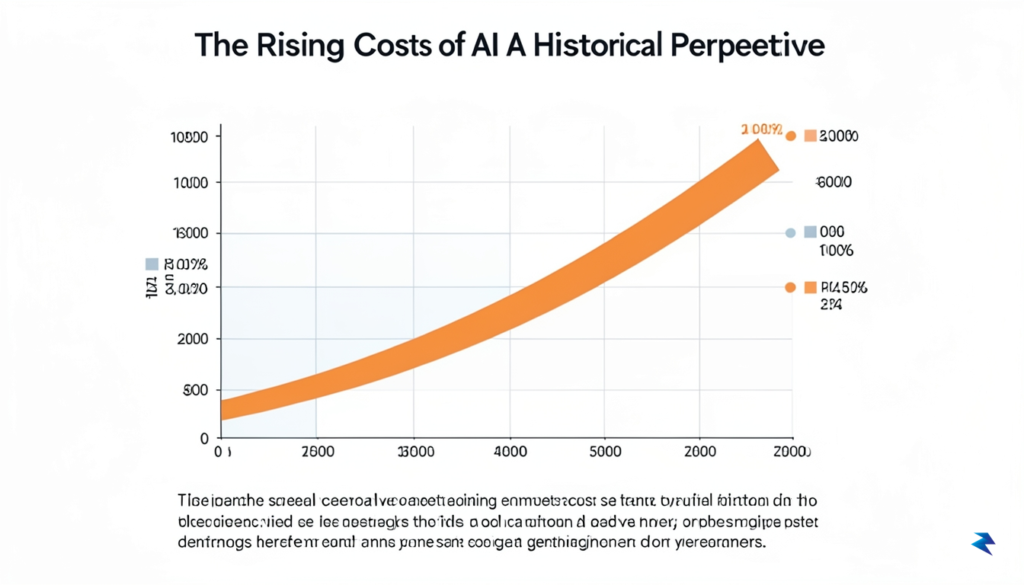
For decades, the software industry operated under a lean, scalable model where the primary barrier to entry was human capital. Traditional Software-as-a-Service (SaaS) companies thrived on the ability to write code once and deploy it to millions of users with negligible incremental costs. However, the current artificial intelligence revolution has shattered this paradigm, shifting the competitive advantage from clever algorithms to the sheer brute force of physical infrastructure. Today, developing a state-of-the-art foundation model is no longer just a challenge of engineering talent; it is a monumental feat of industrial engineering that requires billions of dollars in upfront investment before a single line of profitable code can be deployed.
The core of this financial shift lies in the staggering cost of training Large Language Models (LLMs). Unlike traditional software, which runs efficiently on standard cloud servers, training modern AI requires thousands of high-performance graphics processing units (GPUs) running in parallel for months at a time. These specialized chips are not only prohibitively expensive to purchase in bulk, but they also demand a constant, high-capacity supply of electricity and sophisticated liquid-cooling systems to prevent catastrophic overheating. As firms attempt to build increasingly larger models to achieve superior reasoning capabilities, these hardware requirements scale exponentially, turning the once-fluid world of software development into a capital-intensive race reminiscent of traditional heavy manufacturing or utility infrastructure.

The barrier to entry for modern AI development has shifted from the talent pool to the energy grid and the supply chain, forcing tech giants to secure massive financing just to maintain their seat at the table.
Beyond the hardware itself, the ecosystem required to support these models introduces hidden costs that were non-existent in previous software cycles. Companies must now account for the massive real estate footprints required for data centers, the long-term power purchase agreements needed to ensure a stable energy supply, and the specialized networking equipment required to move vast amounts of data between thousands of processors without latency. This is why a $25 billion bond sale is no longer an outlier; it is the new baseline for firms that intend to remain competitive. When the software of the future depends entirely on the physical capacity of the present, the companies that control the most capital—and the most efficient infrastructure—will inevitably set the terms of the market, leaving smaller players struggling to bridge the widening gap between innovation and the sheer expense of execution.

This massive capital infusion underscores a pivotal shift in the cloud computing hierarchy, where the barrier to entry has moved from basic infrastructure to the exorbitant costs of artificial intelligence. By securing $25 billion, Amazon is effectively signaling that AWS is not merely maintaining its market share, but aggressively fortifying its lead against the “Big Three” incumbents—Microsoft and Google. For investors, this move demonstrates that the primary battlefield in the tech sector has become the capacity for sustained, high-volume investment in specialized silicon, data centers, and the vast energy requirements needed to power large language models.
The competitive landscape is increasingly resembling an oligopoly where only those with the deepest pockets can survive the transition to an AI-first paradigm. Smaller cloud providers and regional data center operators are finding it nearly impossible to keep pace with the sheer financial scale of this arms race. Consequently, this heavy investment acts as a formidable moat, protecting Amazon from disruptive startups that lack the balance sheet strength to build out their own proprietary AI stacks. As the capital requirement to remain relevant balloons, we can expect further consolidation in the industry, leaving the cloud ecosystem dominated by a handful of entities that can afford to subsidize massive innovation cycles.

Furthermore, this capital allocation strategy will inevitably influence pricing models for enterprise cloud services in the coming years. While these investments are designed to enhance capability, they also create immense pressure to monetize AI features at scale to justify the interest costs associated with such large debt issuances. We may see a transition from traditional consumption-based pricing to more complex, value-based models as Amazon seeks to recoup its R&D and infrastructure expenses. Investors should be mindful that while this spending reinforces Amazon’s dominance, it also ties the company’s long-term financial health more closely to the unpredictable success of the AI revolution.
The ability to raise debt at this scale in a high-interest-rate environment serves as a testament to Amazon’s creditworthiness and the market’s enduring confidence in the long-term profitability of cloud-based AI services.
Ultimately, the battle between Amazon, Microsoft, and Google is no longer just about storage or compute; it is about who can best integrate generative AI into the fabric of the modern enterprise. By aggressively investing now, Amazon is betting that its scale will lead to superior economies of scope, allowing it to offer services that competitors simply cannot replicate. For the broader market, this signals a period of intensified capital expenditure that will likely drive significant hardware demand while simultaneously pushing cloud software to new heights of functional complexity.

The decision to secure $25 billion in fresh debt underscores a pivotal moment for Amazon, representing a calculated gamble that the current era of heavy capital expenditure will eventually yield transformative returns. While the sheer scale of this borrowing might alarm conservative investors focused on balance sheet leverage, Amazon’s leadership views this capital not as a sunken cost, but as essential fuel for the next industrial revolution. By aggressively expanding its data center footprint and investing in proprietary silicon, the company is attempting to outpace competitors in the race to provide the underlying infrastructure for generative AI. However, this strategy carries the inherent risk that the pace of AI adoption among enterprise clients could fail to match the company’s massive infrastructure build-out, potentially leading to a period of compressed margins if the demand for cloud-based intelligence does not materialize as forecasted.

To mitigate these risks, Amazon is leaning heavily into the “AI-as-a-service” model through Amazon Web Services (AWS), which remains the company’s most reliable engine for long-term profitability. By integrating advanced machine learning tools directly into the cloud ecosystem, Amazon is effectively lowering the barrier to entry for businesses looking to automate complex workflows or develop proprietary applications. The long-term thesis is that these companies will become permanently tethered to the AWS ecosystem, creating a recurring revenue stream that justifies the upfront debt. Furthermore, the productivity gains realized within Amazon’s own retail and logistics operations—driven by internal AI optimization—serve as a powerful proof-of-concept. As these systems become more efficient at managing inventory, predicting consumer demand, and streamlining the supply chain, the operational savings will likely offset the interest payments associated with their recent debt issuance.
The long-term value for shareholders hinges not on the volume of current spending, but on Amazon’s ability to transition from being a simple provider of server space to an indispensable partner in corporate AI strategy.
Ultimately, the company’s path to profitability is paved with the expectation that AI will eventually move from an experimental phase to a foundational utility, much like cloud computing did a decade ago. If Amazon can successfully monetize its custom-built AI chips and its Bedrock platform, the current capital outlay will appear minuscule in hindsight compared to the market share it secures. Nevertheless, the company must maintain a delicate equilibrium; it must spend enough to remain at the technological vanguard while simultaneously demonstrating to Wall Street that its core businesses can generate the cash flow necessary to service this debt. For the long-term investor, the narrative remains clear: Amazon is trading short-term liquidity for a dominant position in the next generation of global commerce and technology infrastructure.
You must be logged in to post a comment.