The Private Credit Crunch: Why Investors Are Heading for the Exits
Understanding the Private Credit Liquidity Crunch For over a decade, private credit funds have enjoyed a golden era, positioning themselves as…

The traditional model of password management relies heavily on the “cloud vault,” a centralized architecture that has become increasingly precarious in recent years. When you entrust a third-party service with your credentials, you are effectively shifting the burden of security from your own control to the opaque infrastructure of a venture-backed firm. This model introduces significant systemic risks, most notably the “honeypot” effect: by aggregating millions of user credentials in a single accessible location, these servers become high-value targets for sophisticated cyber-attacks. Even when encryption is touted, the metadata—such as the frequency of logins, the services you use, and your IP address history—remains exposed to the provider, creating a digital trail that can be subpoenaed, leaked, or sold.
Beyond the immediate threat of server-side vulnerabilities, the cloud-based model suffers from a lack of transparency regarding how your data is handled. History has shown that even well-intentioned companies can fail to disclose the full scope of a breach until months after it occurs, leaving users defenseless in the interim. Furthermore, the “company-managed” approach is subject to the whims of corporate policy, including sudden price hikes, service sunsetting, or shifts in data privacy terms that favor monetization over security. When your digital identity is tethered to a proprietary cloud, you are essentially renting access to your own secrets, an arrangement that becomes untenable as trust in centralized tech conglomerates continues to erode.

This is where the “local-first” paradigm offers a fundamental shift in philosophy and practice. Local-first software is built on the premise that your data should reside primarily on your own hardware, with synchronization occurring only at your discretion and under your direct control. By moving the vault from a remote server to your local machine, you reclaim ownership of your sensitive information. In this user-managed model, there is no central database for a hacker to infiltrate; a breach of one user’s device does not equate to the catastrophic compromise of an entire service provider’s user base. The security boundary is no longer the provider’s firewall, but the physical and cryptographic integrity of your personal device.
True digital sovereignty is achieved only when the user—not the service provider—retains the master key to their own data architecture.
Adopting a local-first approach is not merely a technical preference; it is a defensive necessity in an era where data privacy is constantly under siege. By decoupling password management from the cloud, you eliminate the risks associated with third-party server management, metadata tracking, and involuntary data sharing. This pivot toward local-first architecture ensures that your credentials remain yours, providing a level of resilience that centralized platforms simply cannot match. When you control the storage, the encryption, and the access points, you transform your password manager from a potential liability into a robust, personal fortification.
In an era where password management is dominated by subscription-based, cloud-centric entities often beholden to venture capital, Bramble emerges as a necessary correction to the status quo. Rather than relying on centralized servers that act as a single point of failure—or a honeypot for potential attackers—Bramble embraces a local-first philosophy. By utilizing peer-to-peer (P2P) synchronization, the platform ensures that your sensitive credentials remain under your exclusive control, moving between your devices without ever touching a third-party server. This architecture effectively bridges the gap between the convenience we expect from modern password managers and the absolute privacy required for true digital autonomy.

The feature set of Bramble is surprisingly robust, punching well above its weight class while maintaining a strictly transparent, open-source codebase. It arrives fully equipped to handle the modern web, including comprehensive support for passkeys, which are rapidly replacing traditional, vulnerable alphanumeric passwords. Whether you are navigating the desktop browser extensions or utilizing the mobile application, the user experience remains seamless and consistent. Because the software is open-source, the community can verify every line of code, ensuring that there are no hidden backdoors, telemetry hooks, or secret data-mining practices lurking beneath the interface.
Bramble is built on the belief that your credentials belong to you, not a service provider. By stripping away the monetization incentives that plague mainstream security tools, Bramble offers a permanent, privacy-first sanctuary for your digital identity.
The motivation behind Bramble is rooted in a fundamental resistance to the trends of private-equity influence and data commodification that have corrupted many popular security tools. Developers have prioritized longevity and trust over rapid growth or advertising revenue, creating a tool designed for users who want to be the sole custodians of their own secrets. By opting for P2P sync, the platform eliminates the inherent privacy trade-offs of the cloud; you no longer have to wonder if your password database is being scanned, sold, or exposed due to a server-side breach at a massive corporation. Instead, you gain a sophisticated, cross-platform utility that respects your boundaries, providing the high-end functionality of an enterprise-grade manager without the strings attached to traditional corporate infrastructure.

At the heart of Bramble lies a fundamental shift in how sensitive data is synchronized across your personal devices. Traditional password managers rely on a centralized “vault” server, which acts as a single point of failure and a massive target for cyberattacks. Bramble abandons this model entirely by utilizing a peer-to-peer (P2P) architecture. Instead of uploading your encrypted database to a third-party cloud, Bramble establishes direct, encrypted communication channels between your own hardware, ensuring that your sensitive information remains exclusively under your physical control at all times.
The system utilizes the Nostr protocol, but in a capacity that might surprise those familiar with its social media origins. In this architecture, Nostr relays function strictly as a signaling mechanism for device discovery. When you want to sync a new phone or laptop, the relay acts as a digital handshake coordinator, allowing your devices to “find” each other without revealing the contents of your vault. Because the relay only handles the metadata required to establish a connection, it never sees, stores, or processes a single byte of your actual password data. This separation of signaling from data transmission is the key to maintaining true zero-knowledge privacy.
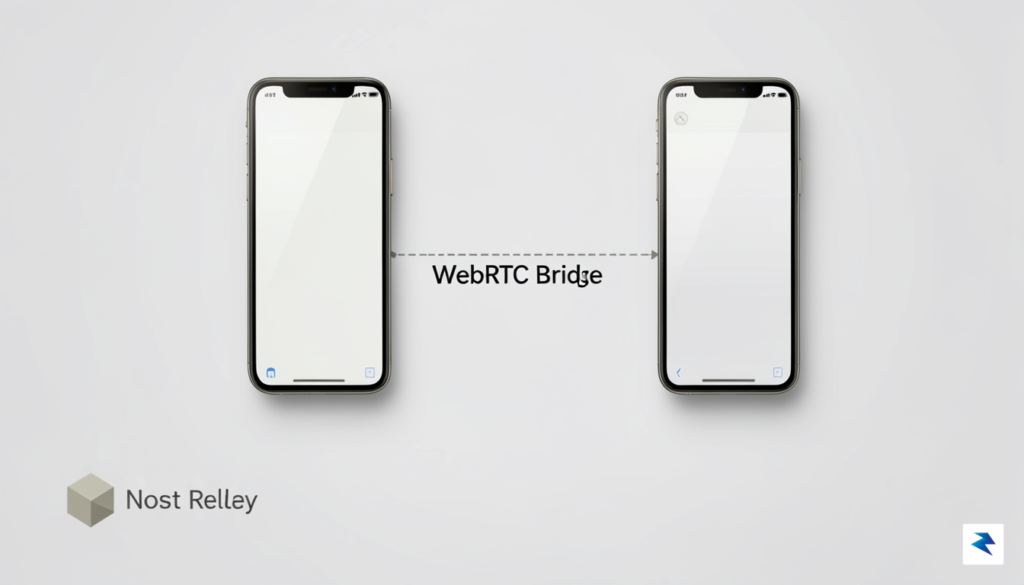
Once the initial handshake is successfully completed, Bramble pivots to WebRTC to facilitate the actual data transfer. WebRTC allows your devices to establish a direct, peer-to-peer connection that bypasses intermediate servers entirely. Data flows directly from your desktop to your mobile device, or vice-versa, through an end-to-end encrypted tunnel. Because the data never traverses a centralized server, the classic “honeypot” risk—where a cloud provider’s database could be breached to leak millions of passwords—is effectively eliminated. Even if a relay provider were compromised or malicious, they would possess no way to intercept or decrypt the data stream, as the encryption keys exist only on the devices you own.
By removing the server from the equation, Bramble ensures that your data exists only where you put it: on your own trusted hardware.
This decentralized approach also provides a robust defense against Man-in-the-Middle (MITM) attacks. In a traditional cloud environment, you must trust that the server operator is not intercepting your traffic or that their infrastructure hasn’t been compromised by a third party. With Bramble’s P2P model, the security of the connection is verified cryptographically between your own devices. Since the relay is never involved in the decryption or storage process, it cannot inject malicious code or view the contents of the synchronization packet. By moving the intelligence to the edge of the network, Bramble transforms password management from a vulnerable service into a private, local-first utility.

In the landscape of modern digital security, the strength of an application is fundamentally dictated by the integrity of its underlying code. Bramble distinguishes itself by choosing Rust as its primary engine, a programming language renowned for its rigorous enforcement of memory safety. Unlike languages that rely on manual memory management or complex garbage collection processes, Rust utilizes a strict ownership model that prevents common vulnerabilities such as buffer overflows and dangling pointers at compile time. By eliminating these classes of bugs, Bramble ensures that the foundation of your sensitive data remains resilient against the memory-based exploits that frequently plague older, C-based software architectures.
Beyond the inherent safety of the language, Bramble implements a meticulous approach to data lifecycle management that goes far beyond standard industry practices. A critical vulnerability in many password managers is the tendency for sensitive secrets—such as master keys or decrypted passwords—to linger in RAM long after they have served their purpose. To counter this, Bramble executes explicit memory-wiping procedures, effectively zeroing out memory buffers the moment a secret is no longer required. By ensuring that these secrets are not just “abandoned” but actively scrubbed from physical storage, the application prevents unauthorized memory scraping, providing a robust defensive layer that protects users even in the unlikely event of an isolated system compromise.

Achieving this level of security across multiple platforms requires a unified core, which is why Bramble utilizes a sophisticated cross-platform architecture. By centralizing the encryption logic and memory management within a single Rust-based core, the developers ensure that security policies are applied consistently, whether the application is running on a desktop, a mobile device, or within a web browser. The team leverages WebAssembly (Wasm) to bring this high-performance, memory-safe core to browsers, while utilizing uniffi to create seamless, high-speed bindings for native mobile builds. This architecture ensures that the complex task of cryptographic operations is never fragmented; instead, every platform benefits from the exact same battle-tested, audit-friendly code.
The core philosophy of Bramble is that privacy should not be a feature, but a structural guarantee. By bridging the gap between native mobile performance and browser accessibility through a singular, memory-safe core, the application creates a consistent security posture that is as transparent as it is impenetrable.
Ultimately, this architectural rigor is what sets a local-first password manager apart from cloud-reliant alternatives. Because the cryptographic heavy lifting happens in a controlled, memory-managed environment, Bramble minimizes the attack surface to an absolute minimum. Users can trust that their credentials are not only protected by industry-standard encryption algorithms but are also handled by a system that actively manages its own memory footprint with surgical precision. This commitment to technical excellence ensures that your digital identity remains under your exclusive control, shielded by the most modern safeguards available in software engineering.

In an era where major technology corporations are increasingly tightening their grip on mobile ecosystems, the shift toward restrictive operating systems and the erosion of sideloading capabilities represent a significant threat to digital autonomy. Bramble emerges not merely as a utility for managing credentials, but as a deliberate act of digital sovereignty. By consciously eschewing proprietary Play APIs and tethering itself to a local-first architecture, the project provides a necessary safeguard against the creeping surveillance inherent in modern mobile platforms. This design philosophy ensures that your most sensitive data remains tethered to your hardware rather than drifting into the opaque silos of corporate cloud infrastructure.

The commitment to supporting privacy-focused Android builds, such as GrapheneOS, underscores a broader vision of independence. Many mainstream applications are now inextricably linked to proprietary frameworks that track user behavior, report analytics, and enforce platform-specific dependencies that compromise anonymity. Bramble rejects this model, demonstrating that it is entirely possible to deliver a seamless, high-performance experience without sacrificing the underlying integrity of the user’s device. By operating outside these walled gardens, the project empowers users to choose their operating environment based on security requirements rather than software compatibility constraints.
True digital freedom is found when your tools function as extensions of your own intent, rather than as conduits for third-party platform control.
Balancing extreme user autonomy with the convenience expected by modern consumers is a delicate challenge, yet Bramble manages to bridge this gap through thoughtful engineering. The project proves that privacy-centric software does not have to be cumbersome or inaccessible; rather, it can be refined and intuitive while remaining inherently transparent. As the industry pushes for more restrictive “walled garden” environments, the existence of community-driven, local-first projects becomes vital. These tools act as a resilient foundation for a future where the user remains the ultimate owner of their digital identity. By prioritizing open standards and local data persistence, Bramble serves as a blueprint for a more private, decentralized technological landscape, ensuring that your keys remain yours, regardless of how the mobile ecosystem evolves.
You must be logged in to post a comment.