
Samsung Galaxy Z Fold 8 Leaks: Is a Wider Design Finally Here?
The Evolution of the Foldable Form Factor When Samsung first introduced the foldable category to the global market, the primary challenge was…


For too long, the narrative surrounding artificial intelligence has been dominated by a fascination with raw computational scale—a race to see which model can process the most data or mimic human reasoning with the greatest statistical precision. This “AI for AI’s sake” mentality risks losing sight of the very people these tools are intended to serve. When we prioritize pure efficiency over human impact, we risk building systems that are technically brilliant yet socially hollow. True innovation is not found in the elegance of a neural network’s architecture, but in its tangible ability to expand the scope of human agency, creativity, and well-being. By shifting our focus from modeling intelligence to empowering human potential, we can ensure that technology remains a servant to our values rather than a disruptor of them.
The danger of dehumanization in this technological gold rush is real and multifaceted. If we treat AI development merely as a pursuit of autonomous performance, we inevitably distance the machine from the nuanced, ethical, and messy reality of human life. Algorithms optimized solely for engagement or speed often flatten the complexities of our lived experiences, leading to outcomes that may be logically sound within the code but morally bankrupt in practice. To prevent this, we must consciously design systems that respect human autonomy. This means viewing AI as a partner that enhances our capabilities—such as aiding in complex decision-making or accelerating scientific discovery—rather than a replacement that seeks to render human input obsolete.

Adopting a “human-in-the-loop” framework is not merely a technical safeguard; it is a fundamental moral imperative. Integrating human oversight ensures that accountability remains anchored in our society, where it belongs, rather than diffusing it into the inscrutable logic of a black-box model. This approach necessitates a shift in how we conceive of system design, moving away from the goal of total automation toward a model of meaningful collaboration.
The true measure of progress in the artificial intelligence era will not be how closely a machine can replicate a human, but how much more human we become through the thoughtful application of these tools.
By keeping a human pulse at the center of the development lifecycle, we foster a future where technology is inherently aligned with our collective well-being. This requires developers, policymakers, and users to engage in a continuous dialogue about what we value most. When we stop asking what AI can do and start asking what AI *should* do to improve our lives, we transform from passive observers of a technological revolution into active architects of a future that is intentionally, and undeniably, human.

The prevailing anxiety surrounding artificial intelligence often stems from a fundamental fear of obsolescence—the unsettling suspicion that as machines become more capable, our own capacity for meaningful action will shrink. Yet, this perspective relies on a narrow, outdated definition of agency as mere manual execution. If we instead redefine agency as the capacity to orchestrate, curate, and direct complex systems, the integration of automation becomes an expansion of our reach rather than a replacement of our role. In this new paradigm, we are not passive observers of a machine’s output; we are the high-level architects of intent, defining the goals, constraints, and ethical boundaries within which autonomous agents operate.
The psychological toll of feeling “out of the loop” is a legitimate concern, as the opaque nature of algorithmic decision-making can lead to a sense of alienation from our own work. When we abdicate our critical thinking to a black-box model, we risk losing the nuance that defines human expertise. To counteract this, we must adopt an “active oversight” model, where the human remains the final arbiter of truth and value. This involves cultivating a high degree of AI literacy, not just in how to prompt a system, but in understanding how to rigorously audit its results. Maintaining control requires us to treat AI tools as highly skilled, yet fallible, apprentices who require constant guidance and feedback to remain aligned with our objectives.

True agency in the age of automation is not found in doing the work itself, but in the wisdom required to govern the systems that do the work for us.
Integrating these tools effectively requires a shift in how we structure our workflows. Rather than handing off entire projects, we should break down processes into layers where the heavy lifting of data processing, drafting, and synthesis is handled by automation, while the high-level synthesis, emotional resonance, and strategic decision-making remain firmly in human hands. This collaborative approach ensures that we remain deeply engaged with the substance of our work. By intentionally designing workflows that force us to pause and evaluate the machine’s output, we turn automation into a catalyst for deeper critical engagement rather than a shortcut that leads to intellectual atrophy. Ultimately, the future worth building is one where our tools amplify our intent, ensuring that even as the systems around us become more autonomous, the hand on the steering wheel remains distinctly human.

Moving from abstract ethical frameworks to the tangible reality of AI engineering requires a fundamental shift in how we conceive of software development. It is no longer sufficient to treat ethics as a post-hoc compliance checklist; instead, we must weave these values into the very fabric of our technical architecture. This transition demands a commitment to radical transparency, where the “black box” nature of complex algorithms is replaced by explainable models that allow stakeholders to understand why a specific decision was reached. When a system impacts someone’s access to credit, healthcare, or employment, the ability to trace the logic behind that outcome is not merely a technical feature—it is a moral imperative that preserves human agency and trust.
A critical component of this structural overhaul is the rigorous curation of diverse, representative datasets. AI models act as mirrors of the data they consume, and if that data contains historical inequities, the resulting systems will inevitably codify and amplify those biases. To build for the public good, engineers must actively seek out and include marginalized perspectives, ensuring that the training sets reflect the full spectrum of human experience. This process goes beyond simple data collection; it requires a proactive effort to identify and neutralize historical prejudice, ensuring that the technology serves the entire population rather than reinforcing the narrow, often exclusionary interests of a privileged few.

Furthermore, we must transition toward systems that are inherently auditable and subject to consistent human oversight. By building “human-in-the-loop” protocols directly into the system design, we ensure that automated processes never operate in a vacuum of accountability. This means creating robust logging mechanisms that track decision-making pathways and establishing clear protocols for human intervention when an AI’s output deviates from ethical standards or societal needs. Accountability, in this context, means that there is always a clear line of responsibility back to the human creators and operators, preventing the dangerous diffusion of blame that often occurs when algorithms fail.
True innovation in the age of intelligence is measured not by how fast we can scale, but by how effectively we can align our computational power with the protection and enhancement of human dignity.
Ultimately, the goal is to create a digital infrastructure that is as sustainable as it is equitable. This involves optimizing algorithms to reduce the environmental cost of heavy computation, ensuring that our pursuit of progress does not come at the expense of the planet. By prioritizing transparency, inclusivity, and accountability, we can construct AI systems that act as genuine extensions of human values. This is the scaffolding of a future worth building—one where technology is a reliable partner in public progress, rather than a disruption to the societal foundations we rely on every day.

The prevailing anxiety surrounding artificial intelligence often fixates on the fear of displacement, yet this narrow perspective ignores the historical reality of technological progress. Throughout human history, our most significant leaps in productivity have emerged not when machines replaced us, but when they functioned as extensions of our own capabilities. By shifting our focus toward the concept of Augmented Intelligence, we begin to see AI not as a competitor, but as an intellectual exoskeleton. This framework suggests that the future of work is not a zero-sum game between humans and algorithms, but a partnership where each participant focuses on their inherent strengths to achieve outcomes that were previously impossible.

Consider the transformative impact of this synergy within specialized professional fields. In medicine, for example, diagnostic AI can scan thousands of high-resolution images in seconds to identify anomalies that the human eye might overlook; however, it lacks the clinical intuition and empathetic communication necessary to guide a patient through a complex treatment plan. Similarly, in the realm of software engineering, generative tools can handle the repetitive syntax of coding, freeing the developer to focus on high-level system architecture, user experience, and ethical security considerations. When we integrate these tools, the machine handles the data processing, while the human provides the context, values, and strategic direction required to turn that data into meaningful solutions.
The true potential of the technological age lies in the synthesis of machine precision and human purpose. When AI handles the “how,” humans remain free to focus on the “why.”
As we transition into this collaborative landscape, the skill sets demanded by the workforce are undergoing a profound evolution. The ability to perform rote, predictable tasks is rapidly losing its market value, replaced by a premium on uniquely human traits: deep empathy, nuanced judgment, and ethical decision-making. In a world saturated with machine-generated content and data, the capacity to think critically, frame complex problems, and foster genuine human connection becomes the ultimate competitive advantage. Strategic thinking—the ability to synthesize disparate pieces of information into a coherent vision—will be the defining competency for leaders and professionals alike. By embracing AI as a partner, we are not merely outsourcing our work; we are upgrading our capacity to create, innovate, and solve the grand challenges of our time.
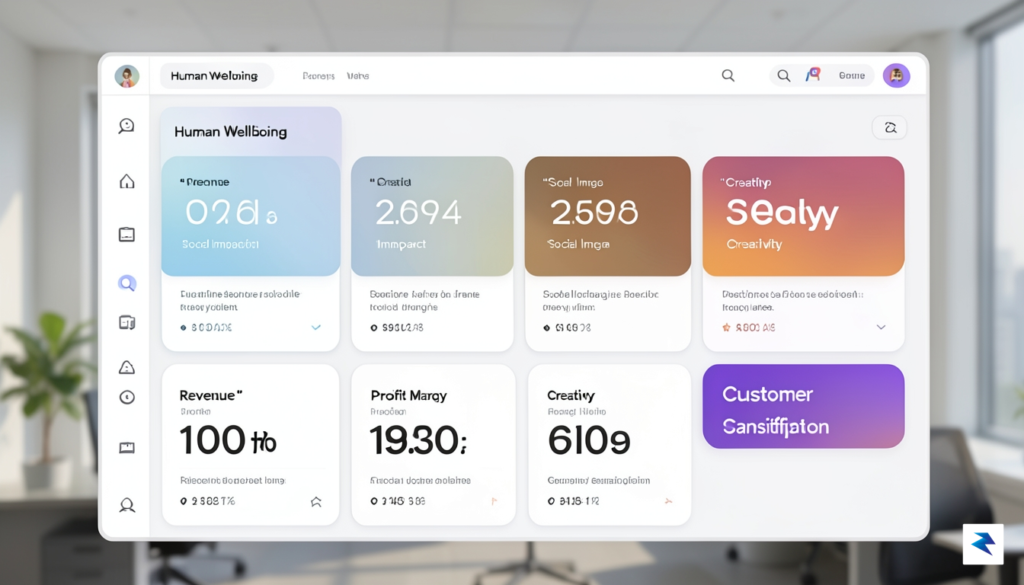
In our relentless pursuit of technological advancement, a fundamental question often gets sidelined: what truly constitutes success? For too long, the default answer in the realm of artificial intelligence has revolved around quantifiable metrics of efficiency. We’ve optimized algorithms for minimal latency, celebrated breakthroughs in throughput, and prioritized solutions that promise significant cost reductions or faster processing speeds. While these benchmarks are undeniably crucial for the operational performance and economic viability of AI systems, they represent a dangerously narrow lens through which to view progress. Focusing solely on how fast or how cheaply an AI can execute a task risks missing the profound, often qualitative, impact it has on the human experience and the broader societal fabric.
To genuinely build a future that is rich, equitable, and sustainable, we must move beyond this reductive view. It is imperative that we update our key performance indicators for the AI era, shifting our focus from mere machine efficiency to genuine human flourishing, robust community health, and the overall quality of our collective experiences. This means consciously designing and evaluating AI not just for what it can do, but for what it enables humans to become, and how it shapes the world we inhabit. The future worth building demands a holistic perspective, one that recognizes technology as a powerful tool to serve humanity’s highest aspirations, not just its most immediate transactional needs.
One critical new metric must be Human Satisfaction and Well-being. This goes far beyond superficial user experience (UX) metrics like click-through rates or time spent on a platform. Instead, it delves into the deeper psychological and emotional impact of AI interaction. We should measure if AI reduces cognitive load, fosters creativity, enhances personal agency, or genuinely contributes to a sense of contentment and purpose. For instance, an AI-powered assistant that not only completes tasks quickly but also intuitively anticipates needs, reduces stress, and allows individuals more time for meaningful activities, offers far greater value than one that merely boasts superior processing speed. Success here means AI that genuinely elevates the human spirit and supports mental and emotional health, rather than merely optimizing for engagement or task completion.
Another indispensable metric for the AI age is Societal Value Add and Equity. This necessitates a broader perspective, evaluating how AI contributes to the public good, addresses systemic challenges, and promotes a more just and inclusive society. Instead of exclusively asking “how much profit did this AI generate?”, we must also inquire “how much societal well-being did this AI enhance?” and “to what extent did it reduce inequalities or improve access for marginalized communities?” This could involve assessing AI’s role in sustainable resource management, improving access to quality healthcare, enhancing civic participation, or mitigating the impacts of climate change. An AI that optimizes corporate bottom lines but inadvertently exacerbates social divides or environmental degradation cannot be considered a true success in a future worth building.
Finally, we must prioritize Decision Quality and Ethical Alignment. AI is increasingly used to inform, or even make, critical decisions across various sectors, from finance to healthcare to criminal justice. Therefore, evaluating AI success must encompass the integrity and fairness of the decisions it influences. This goes beyond mere accuracy; it scrutinizes the transparency, explainability, and bias inherent in AI-driven recommendations. An AI might efficiently process vast datasets to arrive at a conclusion, but if that conclusion is discriminatory, lacks a clear ethical justification, or cannot be understood by human stakeholders, its efficiency is a liability. Our metrics must reflect whether AI helps humans make more informed, ethical, and responsible choices, ensuring that technological progress aligns with our deepest moral principles and societal values.
Ultimately, a holistic view of technological progress demands that we move beyond the simplistic allure of speed and cost. By embracing these more profound, human-centric metrics – focusing on individual well-being, collective societal benefit, and the quality of our decisions – we can guide AI development towards truly meaningful outcomes. This isn’t about abandoning efficiency altogether; rather, it’s about integrating it within a grander vision where innovation genuinely serves the flourishing of humanity and helps construct a future that is not just technologically advanced, but fundamentally better for all.

You must be logged in to post a comment.