
Meta Sued Over Claims AI Targeted Employees on Leave for Layoffs
The Intersection of AI and Employment Law The transition toward "algorithmic management" marks a fundamental shift in how corporations govern…


The rapid ascent of generative artificial intelligence has fundamentally altered the digital landscape, transforming how information is indexed, synthesized, and consumed. While tech giants have heralded this evolution as a breakthrough in human productivity, the foundation upon which these sophisticated models are built has increasingly become a subject of intense scrutiny and legal fire. At the heart of this friction lies a simple, yet profoundly complex dilemma: the vast datasets fueling AI engines are composed of billions of words, images, and creative works that belong to authors, journalists, and publishing houses who never granted explicit permission for such use.
Major publishing titans, including Hachette, Cengage, and Elsevier, have now collectively moved to challenge Google’s data-scraping practices, marking a definitive shift from private grievances to a high-stakes courtroom confrontation. These publishers serve as the bedrock of our information ecosystem, curating peer-reviewed research, educational materials, and high-quality literature that maintain the integrity of human knowledge. By asserting that Google has leveraged their proprietary content to train its AI models without compensation or authorization, these organizations are framing the lawsuit as a fight to preserve the economic viability of the creative industries in an era of automated content generation.

This legal battle is not merely a dispute over licensing fees; it is a fundamental challenge to the ‘fair use’ doctrine in the age of machine learning, threatening to redefine the rights of content creators for decades to come.
The implications of this litigation extend far beyond the immediate financial interests of the plaintiffs involved. As artificial intelligence becomes inextricably woven into search engines and digital workspaces, the outcome of this case will likely establish a critical precedent for how intellectual property is protected in the digital age. If courts decide that the mass ingestion of copyrighted material for AI training constitutes a violation of copyright, the tech industry may be forced to completely overhaul its development pipelines. Conversely, a ruling in favor of the AI developers could effectively strip copyright holders of the ability to control how their life’s work is used to “teach” the very machines that might one day replace them. This showdown serves as a landmark moment, forcing society to decide whether the future of the internet will be built on the principle of fair compensation or the unfettered harvesting of human ingenuity.

At the center of this burgeoning legal battle is the technical process known as “training data” ingestion. In simple terms, think of a large language model (LLM) as a student that learns how to write and reason by reading virtually everything available on the internet. To build these sophisticated systems, tech giants like Google scrape massive volumes of text, which includes news articles, books, and investigative reporting protected by copyright. While Google maintains that this process is akin to a human reading a book to learn, the plaintiffs—a coalition of major publishers—argue that the scale and purpose of this ingestion are fundamentally different, constituting a systematic appropriation of intellectual property for commercial gain.
The core grievance raised by the publishers centers on the distinction between “reading” and “reproducing.” They contend that when Google copies billions of articles into its proprietary databases to fuel its AI models, it is not merely analyzing information but creating unauthorized derivative works. Unlike a search engine that directs users to an original source, these AI models often synthesize information to provide direct answers, effectively replacing the need for a user to visit the publisher’s website. This, the plaintiffs argue, undermines the economic foundation of journalism, as the very content that provides the value is being used to train a competitor that does not share the same overhead costs or ethical responsibilities.

Furthermore, the lawsuit challenges the legal shield of “Fair Use,” which Google frequently cites as its primary defense. The publishers assert that this doctrine was never intended to cover the mass-scale ingestion of copyrighted works for the purpose of building a commercial product that directly competes with the copyright holders. By failing to seek licensing agreements or provide financial compensation, Google is accused of treating the entire output of the professional publishing industry as a free, public-domain resource. This argument highlights a significant tension in copyright law: whether the transformative nature of AI technology justifies the wholesale consumption of protected media without the consent of the creators.
The plaintiffs argue that the massive, automated scraping of their proprietary content serves as the engine for Google’s commercial success, effectively turning years of journalistic investment into raw material for an unregulated, profit-driven machine.
To support their claims, the publishers are leaning on established legal precedents concerning digital copyright, particularly those involving the unauthorized reproduction of creative works. They draw parallels to cases where courts have strictly protected the rights of authors against mass digitization projects, arguing that the intent behind Google’s data scraping is not for private, non-commercial analysis but for the development of high-value AI services. Ultimately, the outcome of this litigation could redefine the boundaries of intellectual property in the digital age, determining whether tech corporations must pay for the data that powers their innovations or if the current “scrape-first, ask-later” model will remain the standard for the future of artificial intelligence.
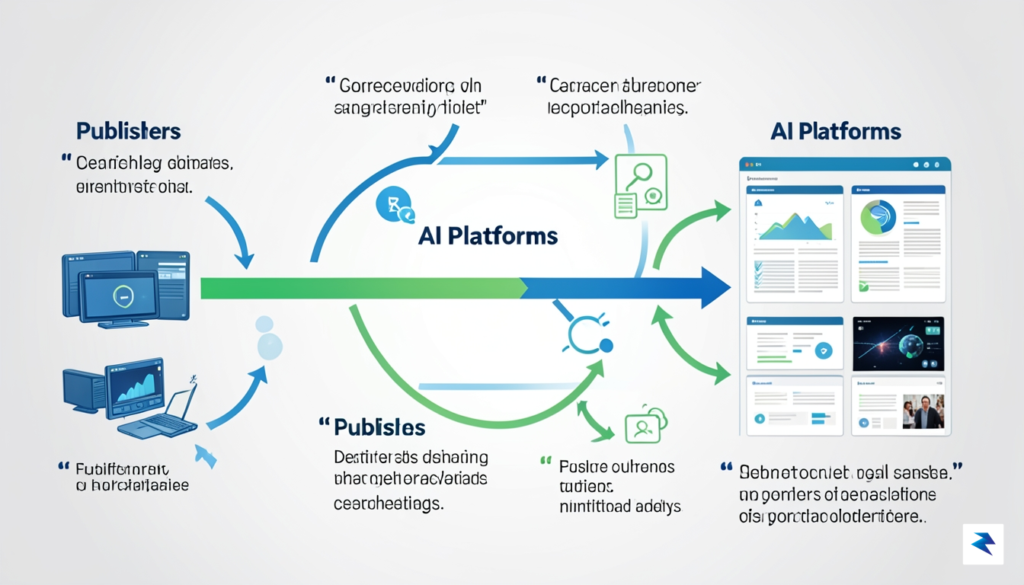
At the heart of this legal confrontation lies a fundamental existential crisis for the modern publishing industry: the decoupling of content creation from content consumption. For decades, the digital economy has operated on a symbiotic, albeit imperfect, bargain where platforms directed traffic to publisher websites, allowing those outlets to monetize their expertise through advertisements and subscriptions. However, generative AI models threaten to dismantle this infrastructure entirely. By scraping vast troves of high-quality journalism, proprietary research, and creative literature, these systems can synthesize answers and provide comprehensive summaries directly to the user. This creates a friction-less experience for the consumer that effectively renders the original source redundant, stripping publishers of their primary mechanism for capturing value.
The strategic motivation driving this lawsuit is not merely a reactionary attempt to protect existing intellectual property; it is a proactive push to define the economic rules of the next digital era. If AI developers are permitted to ingest premium content without oversight or compensation, the long-term incentive to invest in rigorous, investigative reporting and expert analysis will inevitably diminish. High-quality content requires significant human capital, time, and financial resources to produce, yet AI models can mimic the output of that labor at a marginal cost. Without a framework that mandates licensing and fair usage, publishers fear a “race to the bottom” where original creators are squeezed out of the ecosystem by the very tools trained on their own hard work.
The core of the dispute rests on whether the output of a generative AI engine constitutes a transformative use of data or a parasitic replacement that hollows out the business models of those who actually fund and produce the information.

Furthermore, the plaintiffs are seeking to establish a legal precedent that recognizes the intrinsic worth of their data as a foundational asset for the artificial intelligence industry. Just as musicians and filmmakers have fought for royalties in the streaming age, publishers are now demanding that their archives be treated as proprietary resources rather than public domain scraps. By seeking formal licensing agreements, these organizations hope to institutionalize a model where AI companies contribute directly to the financial sustainability of the sources they rely upon. Should they succeed, it would force a massive shift in how AI firms approach model training, moving away from an era of unchecked scraping toward a more structured, compensated environment that acknowledges the essential role of human authorship in powering the future of intelligence.

At the heart of Google’s legal strategy lies the cornerstone of American copyright law: the doctrine of “fair use.” The company consistently maintains that training large language models is not an act of reproduction in the traditional sense, but rather a transformative process that creates an entirely new kind of analytical engine. By ingesting vast swaths of internet data—including copyrighted books, articles, and journalism—Google argues that its models are not “copying” content for redistribution, but instead “learning” the underlying statistical patterns, syntax, and conceptual relationships inherent in human language. From this perspective, the AI acts as a sophisticated tool for synthesis rather than a digital duplicator, effectively generating a net benefit for human knowledge by making information more accessible and actionable.
Google’s legal team is expected to lean heavily on the precedent established during the long-running Authors Guild v. Google case, which centered on the Google Books project. In that instance, the courts ultimately ruled that digitizing millions of books to create a searchable database was a transformative use, as it provided a public benefit without usurping the market for the original works. Google will likely attempt to extend this logic to generative AI, arguing that just as indexing books allows for discovery, training models allows for the extraction of facts and insights that were previously buried in static text. By framing AI training as a functional, non-expressive use of data, the company seeks to position its technology as an evolution of search, rather than a threat to the intellectual property rights of publishers.

The fundamental tension in this litigation rests on whether the law views AI training as a process of “reading” and “learning”—activities that are inherently non-infringing—or as a form of unauthorized data mining that effectively repackages protected expression for commercial gain.
However, the definition of what constitutes “transformative” is currently being stress-tested in courts across the globe, and the outcome of this dispute will likely force a much-needed clarification on where human-like learning ends and digital copying begins. Critics argue that unlike the Google Books project, which directed users back to the original source material, generative AI often produces outputs that compete directly with the very content used to train it. If a model can generate a detailed summary or a journalistic report that negates the need for a user to visit a publisher’s website, the “market harm” component of the fair use test becomes significantly more difficult for Google to dismiss. Ultimately, this case serves as a high-stakes litmus test for whether existing legal frameworks can accommodate the rapid emergence of generative technologies without compromising the incentive structures that sustain creative and journalistic industries.

The resolution of this legal confrontation will serve as a definitive blueprint for the future of information architecture and artificial intelligence development. Should the courts rule in favor of the publishers, we may witness the emergence of a mandatory, industry-wide licensing standard that requires technology firms to compensate creators for the intellectual labor fueling their models. Conversely, a victory for Google could solidify the current “fair use” interpretation, potentially leaving content creators without a seat at the table as their life’s work is ingested into massive, opaque datasets. This binary outcome represents more than just a fiscal dispute; it is a fundamental debate over who owns the building blocks of human knowledge in the digital age.
While a prolonged court battle seems inevitable given the high stakes for both parties, history suggests that such litigation often acts as a catalyst for a negotiated settlement. Tech giants and media conglomerates are both acutely aware that gridlock benefits neither; Google requires a reliable stream of high-quality, verified information to maintain the accuracy of its models, while publishers require the visibility and revenue that the digital ecosystem provides. A settlement could pave the way for a more sustainable, mutually beneficial framework where AI companies gain legal access to training data in exchange for transparent revenue-sharing models or equity stakes that allow journalism to thrive even as consumer habits shift toward AI-driven search.
The path forward requires a transition from an extractive model to a partnership model, ensuring that the technology meant to organize human knowledge does not inadvertently hollow out the very institutions responsible for creating it.

Ultimately, the industry must move toward a future where innovation and protection are not viewed as mutually exclusive. If the current trajectory remains unchecked, we risk creating a restrictive environment where information access is fractured, or alternatively, a landscape where original content creation becomes economically unviable due to the devaluation of human expertise. By establishing clear guidelines for data attribution and compensation, the stakeholders involved have the opportunity to transform this current friction into a robust foundation for the next generation of digital media. A balanced, cooperative approach will be essential to ensure that AI continues to evolve as a tool that amplifies human discovery rather than one that diminishes the value of the individuals who dedicate their lives to documenting our world.
You must be logged in to post a comment.