
Why Bitcoin’s BIP 110 Proposal Is Failing to Gain Miner Support
Understanding the BIP 110 Proposal and the Data Spam Debate The Bitcoin network, at its core, is a decentralized ledger designed to record…


Today’s groundbreaking advancements in Artificial Intelligence, especially the large language models (LLMs) that power our chatbots and creative tools, come with a hidden cost and an increasingly visible bottleneck. Behind every instant response or generated image lies a fortress of powerful graphics processing units (GPUs), housed in colossal, centralized data centers. These facilities are the current backbone of AI, consuming staggering amounts of electricity and requiring immense capital investment in specialized hardware. As the demand for AI inference skyrockets, driven by widespread adoption across industries and daily life, the industry faces critical challenges: a perpetual scarcity of high-end GPUs, the exorbitant cost of acquiring and maintaining them, and the ever-growing environmental footprint associated with their energy consumption.
This centralized architecture, while powerful in its early stages, is increasingly unsustainable. The reliance on a handful of cloud providers and a limited supply chain for cutting-edge GPUs creates chokepoints that hinder innovation, drive up operational expenses, and limit accessibility for smaller developers and research initiatives. Furthermore, the immense power requirements not only inflate costs but also raise serious questions about the long-term ecological impact of scaling AI in this manner. The industry desperately seeks alternatives that can scale AI inference sustainably, efficiently, and with greater resilience, moving beyond the current model of concentrated compute power.
But what if the future of AI wasn’t locked away in these digital fortresses? What if the collective computing power of everyday devices, lying dormant for significant portions of the day, could be harnessed? This is the revolutionary promise of Mesh LLM: a paradigm shift designed to distribute AI inference across a vast, interconnected network of consumer hardware. Rather than funneling all computational tasks to a few massive server farms, Mesh LLM envisions a world where your laptop, smartphone, smart TV, or even dedicated edge devices contribute their idle processing power to the global AI effort. This decentralized model is made possible by the innovative Iroh protocol, which provides the secure, efficient, and peer-to-peer connectivity layer necessary for devices to share computational tasks and data directly, without relying on centralized intermediaries.
The prevailing model of AI, which we can call ‘server-heavy,’ relies on immense capital investment in specialized hardware and infrastructure, leading to high fixed costs and a system prone to single points of failure. In stark contrast, Mesh LLM champions a ‘network-heavy’ approach. Instead of concentrating compute power in a few monolithic locations, it distributes it across an interconnected mesh of devices – from your personal computer to edge nodes equipped with AI accelerators. This fundamental shift transforms AI infrastructure from a capital-intensive, centralized service into a distributed, resilient, and potentially more democratic resource. By leveraging the existing, underutilized computational capacity of millions of devices, Mesh LLM offers a path towards significantly lower marginal costs for inference, enhanced robustness against outages, and a more sustainable model for scaling AI to meet future demands.

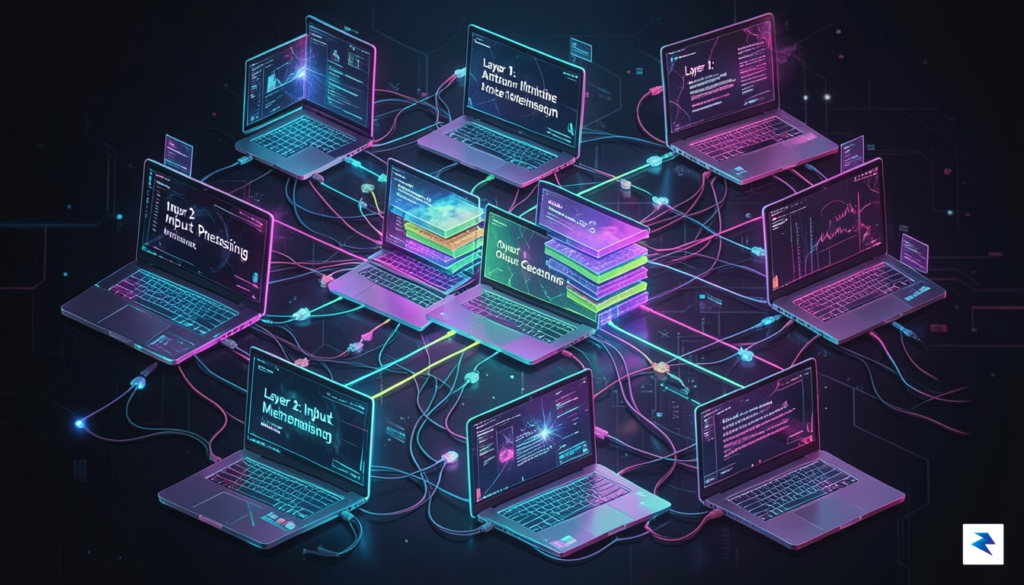
The conventional approach to running Large Language Models (LLMs) often involves colossal, centralized data centers, leading to bottlenecks in accessibility, latency, and cost. Mesh LLM offers a compelling alternative, fundamentally re-architecting how these powerful models execute their tasks. Rather than relying on a single, monolithic server, Mesh LLM ingeniously distributes the computational burden across a network of disparate devices. This innovative paradigm allows individual machines, ranging from powerful workstations to edge devices, to collaborate seamlessly on a single inference task, thereby democratizing access to advanced AI capabilities without the overhead or single point of failure inherent in a centralized authority.
At the core of this distributed architecture lies an elegant concept known as pipeline parallelism. Imagine an LLM not as one giant brain, but as a series of interconnected processing layers, much like an assembly line. In a Mesh LLM setup, the complete model is partitioned into smaller, sequential segments, with each segment assigned to a different participating device, or “node,” within the mesh. As input data, typically a prompt, enters the system, it first passes through the initial segment on one device. Upon completion, the intermediate output (or “activations”) is then automatically transmitted to the next device in the pipeline, which processes its assigned segment, and so forth, until the final output is generated. This ensures that multiple devices are actively working in parallel on different stages of the same inference task, significantly accelerating processing times and leveraging distributed computational power efficiently.
Facilitating this intricate dance of data and computation is Iroh, which serves as the indispensable connectivity glue for the entire Mesh LLM ecosystem. Iroh provides the robust, secure, and peer-to-peer data transmission layer that allows devices to communicate directly, bypassing the need for central servers or complex network configurations. It intelligently handles the complexities of network traversal, enabling nodes located behind different NATs and firewalls to establish direct, encrypted connections. Consequently, activations flow seamlessly and securely from one device to the next in the pipeline, maintaining low latency and high throughput, which are critical for real-time LLM inference. This direct communication model not only enhances performance but also significantly boosts privacy and resilience, as data does not need to traverse intermediary cloud infrastructure.
Beyond simple data transfer, the system also necessitates sophisticated node discovery and network management capabilities. When a device joins the Mesh LLM, it needs to announce its presence and capabilities to other potential collaborators. This often involves decentralized discovery mechanisms, such as distributed hash tables or gossip protocols, allowing new nodes to quickly find existing peers and integrate into the network. Furthermore, as devices can dynamically join or leave the mesh, the system must continuously monitor network health and resource availability. This dynamic awareness ensures that new inference tasks can be optimally distributed among available nodes, and that the pipeline can adapt to changes in the network topology without disruption, making the entire system highly flexible and scalable.
Managing state in such a volatile and decentralized network presents unique challenges, yet Mesh LLM addresses this with robust design principles. Unlike traditional client-server models where a central server holds the authoritative state, each node in a Mesh LLM maintains its local state and contributes to the overall task without a single point of truth. The system is engineered for fault tolerance; if a device unexpectedly drops out, mechanisms are in place to either re-route the processing to another available node or to recover from a previous checkpoint, ensuring that the inference task can still complete successfully. This distributed resilience means that the overall system remains operational and reliable, even if individual components experience transient failures, ultimately delivering a dependable and efficient distributed AI computing experience.
Moving heavy computational workloads across a decentralized network presents a unique set of engineering realities and trade-offs. While the promise of distributed AI on a peer-to-peer (P2P) mesh is compelling, the physical limitations of internet connectivity — primarily latency, bandwidth, and the complexities of synchronization — pose significant hurdles that must be strategically addressed. Unlike centralized cloud environments where infrastructure is controlled and optimized, a P2P network consists of diverse nodes with varying capabilities and connection qualities, demanding a more resilient and adaptive approach to distributed computing.
One of the most immediate challenges is the “ping” problem, which encapsulates the inherent latency in network communications. When an inference task for a large language model (LLM) is broken down and distributed across multiple peer nodes, each sub-task often depends on the results or model parameters residing on another node. Every time data needs to traverse the network from one peer to another, even within a local area, there’s a delay. Across the global internet, these individual delays accumulate rapidly, transforming a theoretically fast computation into a noticeably slower process. This compounding latency means that the total inference time is not merely the sum of individual computation times, but is heavily inflated by the unavoidable network round-trip times, necessitating careful architectural design to minimize inter-node communication dependencies and maximize parallel execution.
To combat the variability and limitations of network capacity, platforms like Iroh employ sophisticated strategies for optimizing bandwidth usage. Recognizing that raw bandwidth differs wildly across users and geographical locations, the focus shifts from merely requiring fast connections to intelligently utilizing whatever bandwidth is available. Iroh leverages content-addressed data, meaning data is identified by its hash rather than its location, allowing peers to efficiently determine exactly what data they need from others. Techniques like data deduplication prevent redundant transfers, while delta encoding ensures that only the changes between data versions are sent. Furthermore, intelligent caching at the peer level reduces repeated requests for the same information, and robust data compression algorithms shrink the size of data packets before transmission, all contributing to a more efficient use of the network’s finite resources.
Synchronization also stands as a critical engineering challenge in ensuring the cohesive operation of a distributed inference pipeline. With multiple nodes processing different parts of an LLM, it’s paramount that inputs are correctly ordered, intermediate results are processed in the right sequence, and final outputs are accurately assembled from disparate contributions. Strategies here often involve a blend of asynchronous processing with eventual consistency, where parts of the model can operate somewhat independently and then merge results, minimizing explicit wait states. For more critical state changes or task assignments, lightweight consensus protocols might be employed to ensure all relevant nodes agree on the current state. Additionally, time-stamping and versioning of data packets are crucial for helping nodes correctly order information and resolve any potential conflicts that arise from concurrent operations, maintaining data integrity without imposing overly restrictive bottlenecks.
Finally, ensuring that node failure does not lead to the total collapse of the inference pipeline is paramount for any robust distributed system. In a P2P network, individual nodes can go offline unexpectedly due to hardware issues, network disconnections, or user actions, posing a significant threat if a critical model segment or an intermediate result is lost. To mitigate this, fault tolerance is built in through various mechanisms. Redundancy and replication are key, where critical model segments or intermediate results are duplicated across multiple peers, allowing a backup to seamlessly take over if one node fails. Dynamic task re-assignment mechanisms quickly detect offline peers and re-assign their pending tasks to available, healthy nodes. Furthermore, periodic checkpointing of the computation state means that if a failure occurs, the process doesn’t have to restart from scratch, greatly enhancing resilience. These strategies collectively ensure that the mesh can adapt and continue functioning, much like a self-healing organism, even when individual components fail.

The current landscape of artificial intelligence is dominated by hyperscalers, creating a digital environment where data privacy is often treated as an afterthought. By funneling massive datasets into centralized cloud servers, users inadvertently surrender control over their most sensitive information. Mesh LLM flips this paradigm by prioritizing local-first processing, ensuring that data remains on the user’s hardware rather than being transmitted across the public web to a third-party server. This architectural shift creates a “zero-trust” environment where the AI models come to the data, rather than the data being shipped off to a black-box environment. Consequently, individuals and enterprises can leverage the power of advanced large language models without the lingering anxiety that their proprietary information is being used to train the next iteration of a corporate model.

Beyond the critical concerns of privacy, the economic implications of moving away from centralized infrastructure are equally compelling. Historically, accessing high-performance AI has required paying exorbitant premiums to cloud providers for compute time and storage. Mesh LLM challenges this reliance by tapping into the vast, untapped reservoir of idle consumer hardware already sitting in homes and offices around the world. Instead of paying a centralized entity for access to their proprietary server farms, developers and users can orchestrate distributed resources to perform complex tasks at a fraction of the cost. This democratizes AI access, lowering the barrier to entry for independent developers and smaller organizations that are currently priced out of the hyperscaler ecosystem.
The environmental footprint of centralized AI is becoming increasingly unsustainable as the demand for compute power skyrockets. Traditional data centers are massive, energy-intensive facilities that require constant cooling and dedicated power grids, often leading to a significant carbon impact. By contrast, decentralized AI utilizes existing hardware that is already powered and connected to the internet, effectively repurposing the “hidden” capacity of our global digital infrastructure. This distributed approach minimizes the need for building new, dedicated data centers, thereby reducing the environmental strain associated with large-scale hardware manufacturing and continuous facility maintenance.
Moving computation to the edge is not just a technical optimization; it is a fundamental reclamation of digital sovereignty that favors efficiency, privacy, and long-term sustainability over centralized control.
Ultimately, the transition toward decentralized AI computing represents a maturation of the internet itself. By fostering a peer-to-peer ecosystem, we are moving toward a future where high-performance intelligence is a utility provided by the collective strength of distributed hardware, rather than a privilege guarded by a handful of corporations. This transition ensures that the next generation of AI development is not only more affordable and secure but also inherently more resilient against the outages and policy shifts that plague centralized platforms.

Imagine a world where powerful AI isn’t tethered to distant data centers, but lives right where you need it, instantly accessible and under your full control. This vision is rapidly becoming reality with distributed AI infrastructure, bringing immediate and tangible value across a spectrum of applications. One of the most compelling examples is the emergence of truly offline local AI clusters. For individuals and small organizations, this means running sophisticated language models, image generators, or specialized analytical tools directly on their own devices – be it a home server, a cluster of old laptops, or even a network of edge devices. This paradigm shift not only enhances data privacy by keeping sensitive information entirely within a user’s control, never touching the public cloud, but also ensures uninterrupted access to AI capabilities even in the absence of an internet connection, fostering greater autonomy and security.

Beyond personal productivity and privacy, the robust nature of distributed AI makes it an invaluable asset for building resilient emergency communication networks. In disaster-stricken areas where traditional infrastructure collapses, or in remote regions lacking reliable connectivity, Mesh LLM frameworks can facilitate localized information processing and exchange. Imagine first responders leveraging AI-powered translation or summarization tools on their devices, coordinating efforts and sharing critical data peer-to-peer, all without relying on a central server that might be down or inaccessible. This capability extends to creating self-healing, ad-hoc communication grids that can route vital messages and even run predictive models locally, offering a lifeline when conventional systems fail and traditional systems are compromised or offline.
The economic implications of Mesh LLM infrastructure are particularly transformative for startups and small to medium-sized enterprises (SMEs). The exorbitant costs associated with cloud-based AI inference and, to a lesser extent, training, often present a formidable barrier to innovation. By enabling the distribution of AI workloads across a network of readily available, often underutilized, computing resources – whether private servers, community-contributed nodes, or edge devices – startups can dramatically reduce their operational expenditures. This decentralized approach democratizes access to advanced AI capabilities, allowing new ventures to prototype, deploy, and scale their AI-driven products and services without incurring the prohibitive cloud bills that typically stifle early-stage growth. It shifts the power dynamic, allowing innovation to flourish outside the confines of a few hyperscale providers.
Ultimately, the proliferation of Mesh LLM infrastructure serves to democratize AI, making powerful computational intelligence accessible to a much broader audience and for a wider array of purposes. This decentralization fosters an environment ripe for innovation, breaking down the traditional barriers of cost and connectivity. For open-source developers eager to contribute to this paradigm shift and harness its potential, the <a href="https://iroh.computer" target="_blank

The emergence of Mesh LLM on the Iroh protocol signifies a fundamental shift in how we conceive of digital infrastructure, moving us away from the era of hyper-centralized server farms toward a truly sovereign internet. By transforming individual devices into nodes within a collaborative intelligence network, we are effectively decentralizing the very foundation of modern AI. This is not merely a technical optimization; it is a democratization of power. When compute resources are liberated from the silos of dominant tech corporations, the barrier to entry for innovation lowers significantly, allowing developers and users to harness sophisticated models without being tethered to the intermittent reliability or the restrictive policies of a single provider.
As this ecosystem matures, the implications for resilience and censorship resistance become profound. A distributed network is inherently harder to shutter, censor, or manipulate, as there is no single point of failure or central authority to influence. By leveraging Iroh’s peer-to-peer capabilities, Mesh LLM ensures that AI services can persist in environments where traditional cloud access might be throttled or denied. This resilience is critical for the future of global information exchange, where the ability to run performant, private models locally ensures that the intelligence fueling our daily tasks remains under our own control rather than being subject to the whims of remote, proprietary black boxes.

The roadmap for Iroh in this space is defined by a commitment to community-driven development, which is essential for ensuring that these tools remain open and accessible. Unlike closed-source development models, a distributed approach invites contributions from a diverse array of engineers and researchers, accelerating the optimization of decentralized inference and training protocols. This collaborative spirit ensures that the underlying technology is transparent and auditable, fostering a level of trust that centralized cloud services struggle to provide. As more nodes join the mesh, the collective capacity of the network grows, creating a self-sustaining cycle where the infrastructure becomes more robust and capable with every participant.
True sovereignty in the digital age requires that we not only own our data but also command the compute power necessary to process that data autonomously and without external interference.
Ultimately, the transition toward distributed AI computing represents a pivotal moment in the evolution of the internet. By rethinking the relationship between the user and the machine, Iroh is helping to build a future where technological autonomy is the default rather than the exception. As we continue to refine these mesh architectures, we are laying the groundwork for a digital landscape that is more equitable, resilient, and inherently aligned with the needs of its users. This movement is not just about building a faster or cheaper way to run models; it is about reclaiming the digital commons and ensuring that the next generation of intelligence serves humanity as a distributed utility rather than a centralized commodity.
You must be logged in to post a comment.