
Why I Built Bashumerate: A Better Way to Handle Shell Loops
The Limitations of Standard Bash Iteration For most shell enthusiasts, xargs is the go-to utility for transforming input streams into…


For decades, the humble password has served as the primary gatekeeper to our digital lives, yet its inherent weaknesses have become increasingly apparent. From the burden of memorizing complex, unique strings for every service to the constant threat of phishing attacks, data breaches, and credential stuffing, passwords have proven to be a fragile foundation for digital security. This landscape of vulnerability spurred the development of a revolutionary alternative: passkeys. Built upon the robust FIDO2 and WebAuthn standards, passkeys represent a fundamental paradigm shift, moving authentication away from “something you know” (a password) towards a more secure combination of “something you have” (your device) and “something you are” (biometrics like a fingerprint or face scan) or “something you know” (a device PIN).
The security benefits of passkeys are profound and multi-faceted. Crucially, they eliminate the most common attack vector: phishing. Unlike passwords, passkeys are cryptographically bound to specific websites or applications, meaning they cannot be tricked into authenticating on a fraudulent site. This inherent resistance to phishing, combined with their reliance on hardware-backed security modules and biometric verification, dramatically elevates the security posture for users. Each passkey is a unique cryptographic key pair, with the public key stored on the server and the private key securely held on the user’s device. This architecture ensures that even if a server is breached, the private keys remain safe, making passkeys a far more resilient and user-friendly security solution than traditional passwords.

Despite their undeniable security advantages and growing adoption by major tech players like Apple, Google, and Microsoft, passkeys currently face a significant practical hurdle: fragmentation in storage and management. While the underlying FIDO2 standard is interoperable, the *records* of these passkeys are often deeply integrated and siloed within specific platform ecosystems. For instance, a passkey created on an iPhone might be seamlessly synchronized across all your Apple devices via iCloud Keychain, but using that same passkey directly on an Android phone or a Windows PC without additional setup or specific workarounds can be challenging. This creates a situation where users are effectively locked into their chosen ecosystem, hindering true cross-platform portability and limiting user autonomy.
This ecosystem-specific storage, while convenient within a single platform, undermines the broader promise of universal, secure login. It forces users to manage distinct passkey sets across different device types or to rely on vendor-specific bridges, which may not always be available or seamless. The current state prevents users from having a truly unified, self-managed collection of their digital credentials that can be easily accessed and utilized regardless of their chosen hardware or operating system. To fully realize the vision of a password-less future, where users can effortlessly and securely access their accounts from any device they own, an interoperable standard for managing and transferring these passkey records is not just desirable but absolutely essential. It’s about empowering users with control over their digital identities, rather than having them tied to a single vendor’s cloud.

At its core, an opaque passkey record represents a paradigm shift in how we approach identity management. In the world of cryptography, opacity refers to data that is stored as a blob—an indecipherable sequence of bits—that remains completely unintelligible to the system holding it. While traditional authentication models often require servers to inspect or validate specific metadata to manage user credentials, the opaque approach treats the passkey as a strictly client-side asset. By ensuring that the service provider acts merely as a blind conduit for these records, we eliminate the risk of a central authority peering into the sensitive cryptographic material that governs your digital identity.
The technical necessity for this level of abstraction arises from a simple reality: if a server can read your credentials, it can potentially compromise them. By enforcing a strict boundary where the server cannot parse the contents of a passkey record, we move toward a model of true privacy-by-design. This means that even if a storage provider suffers a data breach, the attacker would gain access only to an encrypted, opaque blob that is useless without the user’s private master key. Consequently, the service provider is effectively neutralized as a point of failure, shifting the control back to the end-user while maintaining the convenience of cloud-based synchronization.
The true power of an opaque record lies in its ability to be both universally portable and inherently private, ensuring that your digital keys remain yours alone, regardless of the infrastructure hosting them.
Achieving this balance between high-level security and cross-platform interoperability is the primary challenge for modern developers. For passkeys to be truly useful, they must move seamlessly between devices and operating systems, yet they must also resist any form of server-side surveillance. This requirement necessitates a standardized, encrypted format that can be stored in an agnostic cloud environment—such as a password manager or a generic sync service—without the host ever needing the keys to decrypt or understand the payload. By decoupling the storage infrastructure from the cryptographic logic, we enable a future where users can migrate their credentials across providers without ever exposing the underlying secret material to prying eyes.

Ultimately, this architectural choice creates a robust foundation for user autonomy. When we treat passkey records as opaque entities, we effectively remove the service provider from the trust equation entirely. This is not merely a technical preference; it is a fundamental requirement for building a more resilient internet. By adopting this rigorous standard, developers ensure that the convenience of modern authentication does not come at the cost of long-term privacy or data sovereignty, paving the way for a more secure and interoperable digital landscape.

The current landscape of digital authentication is often characterized by walled gardens, where passkeys generated within one ecosystem remain effectively trapped there. This lack of portability creates a significant friction point for users, forcing them into a state of vendor lock-in that discourages the adoption of more secure authentication methods. When users feel that their credentials are tethered to a specific device or service provider, they are far more likely to retain older, less secure habits—such as reusing weak passwords—simply because the migration process for passkeys feels overly opaque or technically insurmountable. True interoperability shifts this dynamic by transforming passkeys from proprietary assets into portable, user-controlled credentials that can move seamlessly across platforms.

Beyond simple convenience, the ability to transfer passkeys via a standardized, opaque record format is a critical security imperative. When providers lack an interoperable pathway, users are often tempted to resort to insecure “workarounds,” such as storing sensitive key data in plain-text notes or relying on unencrypted cloud backups that lack robust protection against interception. By establishing a standardized, encrypted format for passkey records, we can facilitate automated, secure migrations that eliminate the human error inherent in manual handling. This ensures that the cryptographic integrity of the credential remains intact from the moment of export to the point of re-import, effectively neutralizing the risks associated with ad-hoc migration methods.
Standardization is not merely a feature of convenience; it is the fundamental architecture required to build a resilient, user-centric ecosystem where security does not come at the cost of accessibility.
Furthermore, interoperability serves as a vital safeguard against the risks of total account loss. In the event that a primary device is stolen, destroyed, or a service provider undergoes a catastrophic failure, the absence of a standardized recovery or migration path can result in permanent loss of access. Standardized records empower users to maintain their own backups or transition to new providers without losing their cryptographic identity. By moving away from proprietary, black-box implementations toward transparent, standardized formats, developers can build systems that prioritize user sovereignty. This transition ultimately fosters greater trust in the authentication ecosystem, as users gain the confidence that their most critical security credentials remain portable, verifiable, and under their complete control regardless of the platform they choose to utilize.

Building a robust infrastructure for passkey management requires a programming environment that balances high-level safety abstractions with low-level performance efficiency. Go has emerged as a premier choice for this domain, primarily because its memory management model and static type system drastically reduce the common vulnerabilities associated with manual pointer arithmetic found in other systems languages. By leveraging Go’s strongly-typed interfaces, developers can define clear boundaries for sensitive cryptographic payloads, ensuring that passkey records remain opaque—meaning the server handles the data without needing to interpret or inspect its internal structure. This approach fundamentally minimizes the attack surface, as the API acts as a secure, blind relay for encrypted artifacts rather than an application-layer processor.
The primary benefit of utilizing Go for cryptographic API development lies in its native support for concurrency and its standard library’s rigorous approach to security. When managing high-throughput authentication requests, Go’s goroutines allow an API to handle thousands of concurrent record retrievals and verifications without the overhead typically associated with thread-based models. Furthermore, Go’s crypto package provides vetted, industry-standard implementations of primitives like AES-GCM for encryption-at-rest and Ed25519 for digital signatures. By avoiding third-party dependencies for core cryptographic operations, developers can maintain a smaller, auditable codebase that is significantly easier to secure against supply-chain attacks.
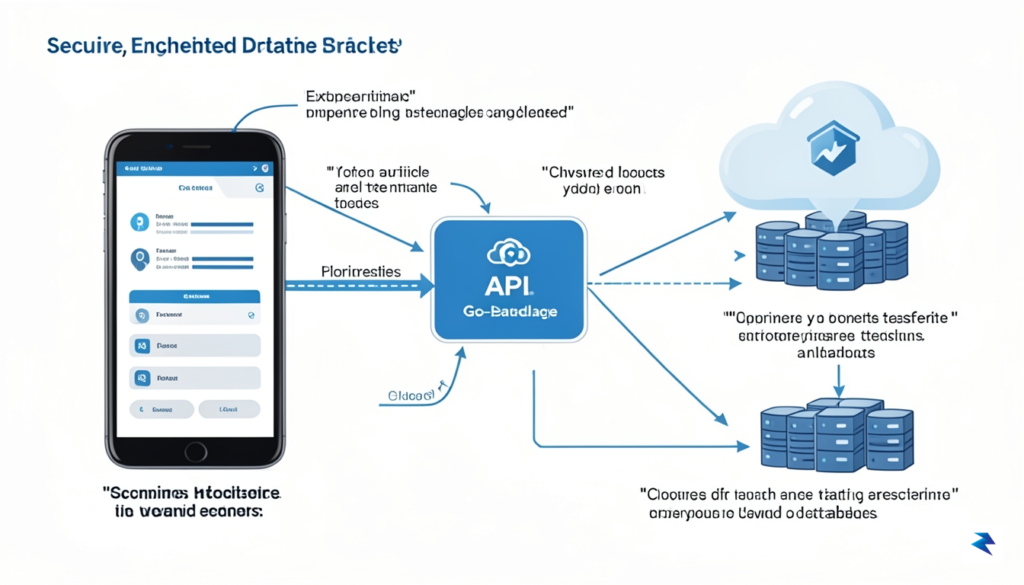
A well-architected Go API treats the lifecycle of a passkey record as a strictly defined state machine, spanning from initial registration to secure long-term storage. The process typically begins with rigorous serialization, where the raw binary data of the passkey is transformed into a portable format—often using Protocol Buffers or CBOR—to ensure interoperability across different platforms. Once serialized, the record is subjected to authenticated encryption before it ever touches a persistent disk or cloud storage bucket. This ensures that even in the event of a database compromise, the attacker is left with nothing but high-entropy ciphertext that cannot be decrypted without the ephemeral, HSM-backed keys managed by the Go service.
The core of a secure passkey implementation is not just encrypting the data, but ensuring that the API layer never gains visibility into the underlying private credentials.
During the verification phase, the Go API performs a critical client-side validation check. Rather than trusting the incoming payload blindly, the service re-validates the cryptographic signature against the registered public key, effectively closing the loop on potential tampering attempts. By enforcing these checks within the application logic, the API ensures that only valid, well-formed records are ever processed, thereby preserving the integrity of the system. This layered defense-in-depth strategy, combined with Go’s efficient error handling and interface design, creates a resilient foundation for the next generation of passwordless authentication systems.

As the digital identity landscape shifts toward passwordless authentication, developers must prioritize long-term architectural stability over the convenience of quick, proprietary integrations. Building a robust passkey system today requires a commitment to open, vendor-neutral standards that prevent your infrastructure from becoming a walled garden. By prioritizing interoperable protocols—such as those supported by the FIDO Alliance and emerging Opaque record standards—you ensure that your authentication logic remains portable and resilient. This approach not only protects your users from vendor lock-in but also guarantees that your application can adapt to new hardware and software authentication shifts without requiring a complete overhaul of your backend security model.
The most significant risk in modern identity management is the tendency to rely on platform-specific APIs that lack cross-device compatibility. To future-proof your implementation, focus on adopting standardized Go APIs and libraries that emphasize data portability, allowing passkey metadata to be moved or reconciled between systems as needed. When you utilize open standards, you gain the flexibility to migrate your user base to improved security providers or infrastructure stacks without forcing them to re-register their credentials. Furthermore, relying on community-driven specifications ensures that your implementation benefits from the collective scrutiny of the security industry, rather than depending on the opaque, proprietary roadmaps of a single vendor.

The hallmark of a sustainable authentication strategy is the ability to maintain user access across diverse ecosystems without sacrificing the integrity of the underlying cryptographic records.
Beyond the technical implementation, maintaining long-term trust necessitates a rigorous commitment to ongoing security audits and lifecycle management. It is not enough to simply launch a passkey integration; developers should regularly review their authentication workflows against evolving threat models and updated FIDO requirements. Incorporating automated testing suites that validate your implementation against interoperability benchmarks will help identify potential friction points before they impact your users. Furthermore, active participation in open-source discussions regarding Go-based authentication standards allows your team to stay ahead of vulnerabilities and performance bottlenecks, ensuring that your security posture evolves in tandem with the broader digital identity community. By adopting these forward-thinking habits today, you transform authentication from a static compliance check into a durable, user-centric foundation that will serve your application for years to come.
You must be logged in to post a comment.