QuadRF: The Breakthrough Tech That Sees Through Walls and Spots Drones
Introduction: The New Era of RF Sensing For decades, the radio frequency (RF) spectrum was viewed primarily as a invisible highway for data—a…
When Pokémon Go first arrived on mobile devices in the summer of 2016, it did far more than simply introduce a new way to play; it fundamentally shifted the public perception of what a smartphone could do. For a few fleeting, magical months, the world seemed to transform into a living, breathing landscape where digital creatures hid behind local landmarks and within neighborhood parks. What began as a viral sensation—a digital scavenger hunt that pulled millions of people out of their homes and into the streets—quickly solidified into a robust, enduring infrastructure for social interaction. By mapping the world’s geography onto a fantasy ecosystem, the developers created a shared reality that bridged the gap between solitary screen time and genuine, face-to-face community building.

The journey from that initial, chaotic launch to the refined experience we see today has been marked by remarkable technological maturation. In the early days, the augmented reality (AR) features were often considered a novelty, a battery-draining gimmick that players frequently toggled off to ensure a smoother experience. However, a decade of consistent innovation has turned that rudimentary overlay into a sophisticated spatial engine. Through advancements in depth-sensing camera technology and improved geolocation precision, the game has evolved from merely placing a sprite on a flat surface into an immersive experience where Pokémon can realistically interact with physical obstacles, shadows, and terrain. This progress reflects a broader shift in the tech industry, as the game transitioned from being a mere trend into the gold standard for how location-based services can foster real-world engagement.
The true magic of the last ten years hasn’t been the code running on our screens, but the invisible social architecture built by players who transformed street corners into meeting grounds.
As we reach this ten-year milestone, it is clear that Pokémon Go has transcended its origins as a viral hit to become a staple of modern gaming culture. It has survived the inevitable decline of initial hype by pivoting toward a long-term model of community events, specialized raids, and global connectivity. The game has successfully navigated the complexities of international play, ensuring that whether a player is in a small rural town or the dense heart of Times Square, the core loop of exploration remains rewarding. By prioritizing social cohesion over purely competitive mechanics, the platform has cultivated a unique legacy: it is a rare example of a digital space that consistently encourages its users to look up from their devices and engage with the world—and each other—in ways that were unimaginable a decade ago.
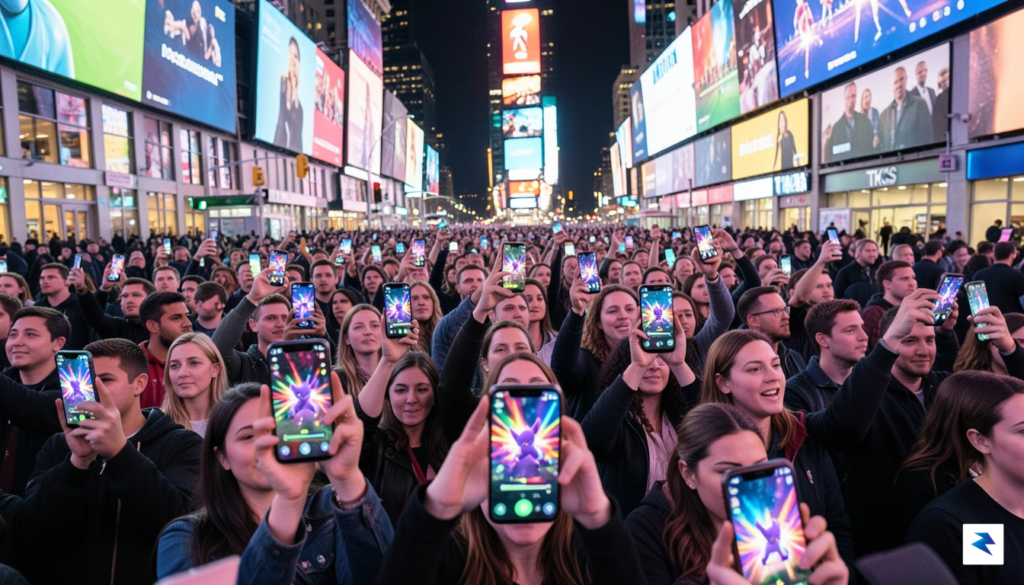
When the original Pokémon GO launch trailer debuted in 2016, it captivated the world with a vision of crowds gathering in iconic urban centers, phones in hand, to collectively battle a legendary Pokémon. For years, that cinematic sequence served as both an inspiration and a point of contention for a community that often felt limited by the realities of mobile gaming infrastructure. However, the recent gathering in the heart of Times Square transformed that abstract ambition into a tangible, high-energy reality. As thousands of trainers converged beneath the towering digital billboards, the atmosphere crackled with the kind of synchronized excitement that the developers had originally envisioned nearly a decade ago.
The sheer logistical scale of the event was a marvel to behold, functioning as a massive, real-time stress test for the game’s social mechanics. Coordinating over a thousand players to simultaneously challenge Mewtwo required more than just digital proximity; it demanded a unified effort from the community to organize into manageable raid lobbies. The streets of New York, usually bustling with commuters and tourists, became a temporary hub of focused collaboration, where strangers stood shoulder-to-shoulder, united by the singular goal of capturing a mythical creature. This wasn’t merely a gameplay session; it was a testament to the game’s enduring ability to pull players out of their homes and into public spaces to share a singular, momentous experience.
Beyond the gameplay mechanics, the event held a profound symbolic significance for long-term fans who remembered the initial promise of the franchise’s augmented reality future. Watching the crowd erupt in cheers as the raid timer hit zero felt like the closing of a circle that began with that first, aspirational trailer. By successfully facilitating such a dense, localized gathering, Niantic finally delivered on the core philosophy of Pokémon GO: that the world itself is the game board. This Times Square raid did more than just reward participants with a high-tier digital asset; it validated the belief that when mobile technology is leveraged correctly, it can turn an ordinary city street into a theater of shared human achievement.
The Times Square event served as a definitive proof of concept, demonstrating that the ‘collective raid’ experience is not just a feature on a screen, but a vibrant, living social phenomenon that requires the physical presence and cooperation of a global community.
Ultimately, this gathering proved that the magic of the game lies not in the code itself, but in the social friction and collective triumph that occurs when thousands of individuals occupy the same space. As the event concluded and the crowds dispersed back into the city, the sense of accomplishment remained palpable. It was a clear signal that even after ten years, the vision of bringing people together through play remains a powerful, driving force that can turn the most crowded places on Earth into personal milestones for gamers everywhere.
Coordinating a raid in a bustling metropolitan hub like Times Square is a logistical feat that stretches the boundaries of mobile AR technology. When thousands of players converge on a single digital coordinate, the primary challenge shifts from simple gameplay mechanics to complex backend stability. Niantic must maintain a seamless synchronization between individual client devices and the central server, ensuring that every participant’s input—whether a dodge, a charge move, or a ball throw—registers in real-time. In high-density environments, the sheer volume of data packets can threaten to overwhelm local cellular towers, leading to potential latency spikes that could ruin the experience for an entire lobby.
To mitigate these technical hurdles, the game utilizes sophisticated server-side load balancing that dynamically shifts resources to accommodate localized spikes in traffic. By splitting the massive crowd into smaller, manageable raid lobbies, the system prevents a single instance from crashing due to an overflow of active entities. This architectural approach is essential; without it, the game’s “state of play” would quickly devolve into a desynchronized mess where players see different health bars for the boss or miss out on the final capture phase entirely. Furthermore, the reliance on local network handshakes ensures that players within the immediate physical vicinity are prioritized, maintaining the integrity of the augmented reality experience even when bandwidth is stretched thin.
Success in a massive raid isn’t just about high-level Pokémon; it is about the invisible, high-speed digital handshake occurring between thousands of devices and the cloud.
Beyond the raw technical infrastructure, the triumph of such an event relies heavily on community coordination tools that bridge the gap between digital interface and physical reality. Players often utilize third-party messaging apps or localized Discord servers to organize “split lobbies” by team color or experience level, ensuring that the raid boss is defeated efficiently without exceeding the game’s capacity limits. This human layer of management complements the backend engineering, transforming a potential bottleneck into a structured, collaborative success. As mobile technology continues to evolve, the ability to host such large-scale AR gatherings will depend on a delicate balance: the raw power of Niantic’s server architecture meeting the organized, tactical discipline of the player base.

Maintaining a massive, active player base for over a decade is the absolute “holy grail” of the mobile gaming industry, where trends often flicker and die within months. Niantic has achieved this longevity by masterfully shifting the core experience from a simple digital collection game into a foundational social ecosystem. By transforming solitary screen time into a shared, physical activity, the developers have successfully woven the game into the fabric of daily life. This isn’t merely about pushing software updates; it is about fostering a sense of belonging where players feel that their physical presence in a city square—like the recent, overwhelming convergence in Times Square—is a tangible contribution to a global collective mission.
The strategy relies heavily on a rhythmic cadence of engagement that keeps the player base constantly anticipating the next milestone. Regular seasonal events and the highly anticipated Community Days serve as reliable anchors in the player’s calendar, ensuring that there is always a compelling reason to head outside. These events are strategically designed to rotate through different Pokémon generations, providing a constant stream of discovery for veterans while lowering the barrier to entry for newcomers. By layering these limited-time incentives over the existing gameplay loop, Niantic creates a “fear of missing out” that is rooted not in vanity, but in the genuine, shared experience of participating in a local community event.
The true genius of the game lies in its ability to gamify physical exploration, turning mundane commutes and city walks into high-stakes treasure hunts that require real-world collaboration.
Furthermore, the psychological impact of location-based rewards cannot be overstated. When players are required to travel to specific landmarks or monuments to secure rare rewards, the game validates the player’s effort in the physical world, reinforcing the habit of movement. This design philosophy bridges the gap between digital achievement and physical fitness, making the act of “playing” synonymous with “exploring.” By consistently pairing rare digital encounters with real-world geographical requirements, Niantic ensures that the game remains a living, breathing entity that responds to the world around it rather than existing in a static, isolated vacuum. This blend of community-driven social pressure and the satisfaction of physical conquest is precisely what keeps the game relevant long after its initial cultural phenomenon has settled into a stable, enduring lifestyle for millions.
The sheer scale of the gathering in Times Square serves as more than just a nostalgic celebration; it acts as a proof-of-concept for the next decade of augmented reality. As Niantic continues to iterate on its Lightship platform, we are witnessing the transition from simple location-based markers to a more sophisticated, persistent digital layer that overlays our physical environments with unprecedented precision. This evolution suggests that the future of mobile gaming will not be restricted to looking down at a smartphone screen, but rather interacting with a world that reacts to our presence in real-time. By refining how digital assets anchor to real-world architecture, the boundary between our daily commute and the game world is becoming increasingly porous.
As we look toward the horizon, the introduction of consumer-grade AR hardware promises to fundamentally redefine the social mechanics that made this phenomenon a global success. When these experiences migrate from handheld devices to wearable glasses, the “heads-up” nature of the gameplay will encourage natural social interaction rather than forcing players to remain tethered to their screens. This shift is critical; it turns a solitary hunt into a communal, shared reality where visual cues and digital entities are perceived simultaneously by everyone in a public space. Consequently, the social friction of traditional mobile gaming will dissolve, replaced by a seamless integration of play into the fabric of urban life.
The true legacy of this decade-long experiment is the realization that location-based technology can transform public spaces into vibrant, shared playgrounds that foster genuine human connection.
Ultimately, the lessons learned from ten years of trial and error in the field will serve as the foundation for the next generation of location-based experiences. Developers now understand that sustainability in AR gaming relies on fostering strong local communities that are capable of self-organizing for massive events, much like the raid we witnessed in the heart of New York City. By combining this human element with the rapid advancement of spatial computing, we are moving toward a digital ecosystem where the environment itself becomes the game board. We are no longer just playing a game; we are participating in a persistent, collective narrative that bridges the gap between digital fantasy and physical reality, ensuring that the legacy of this experience will influence the trajectory of interactive entertainment for years to come.
You must be logged in to post a comment.