Are Health Insurance Giants Too Big? The Fight to Reform PBMs
The Vertical Integration Dilemma: Examining the Healthcare Giants The modern American healthcare landscape has undergone a profound…


For many knowledge workers, the initial integration of Large Language Models (LLMs) into daily workflows felt like a superpower. Whether you are a software developer using AI to scaffold boilerplate code or a content strategist leveraging models to draft outlines, the promise of immediate, high-quality output seemed like the ultimate productivity unlock. However, as the novelty has worn off, a subtle yet pervasive form of cognitive exhaustion has begun to settle in. This is not the familiar fatigue that comes from a long day of focused work; rather, it is a specific type of mental friction born from the constant necessity of managing an algorithmic partner that requires endless supervision.
The phenomenon of “LLM burnout” is fundamentally rooted in the transition from being a creator to becoming an editor-in-chief. Instead of simply performing a task, we are now trapped in a loop of prompt engineering, output verification, and iterative refining. We are no longer just writing or coding; we are constantly context-switching between human intent and machine logic, attempting to translate our complex thoughts into rigid, model-friendly instructions. This perpetual state of “middle-man” management forces the brain to operate in a high-alert state of monitoring, where every generated sentence or line of code must be scrutinized for hallucination, bias, or stylistic misalignment.

LLM burnout is not a sign of technological incompetence; it is an inevitable consequence of the cognitive load required to translate human nuance into machine-readable commands throughout an entire workday.
This experience is increasingly widespread, as evidenced by the growing chorus of developers and writers in professional forums who report feeling “AI-drained” by midday. It is a shared struggle where the efficiency gains of the tool are slowly offset by the emotional and mental toll of constant micro-adjustments. When you spend more time correcting a model’s output than you would have spent doing the task yourself, the sense of accomplishment begins to evaporate. Ultimately, we are finding that the seamless flow state we once cherished is being interrupted by a new, persistent layer of digital bureaucracy, leaving us to wonder if the tools we adopted to save time are actually consuming our cognitive capacity in ways we never anticipated.
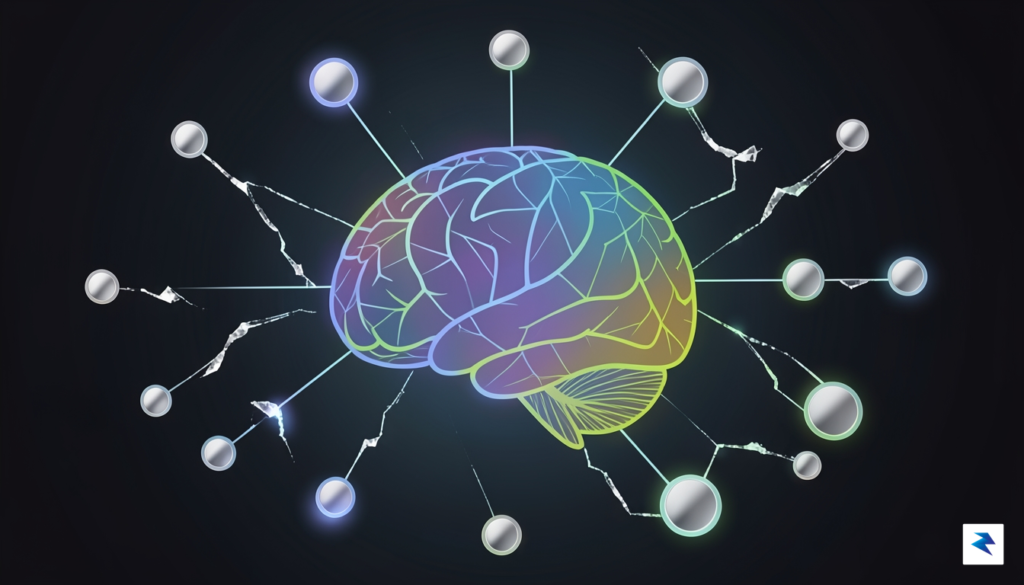
We often enter the world of generative AI under the seductive pretense of efficiency, believing that if we delegate our drafting and brainstorming to a machine, our mental fatigue will vanish. Yet, the reality is frequently the opposite. We find ourselves paying what experts call a “prompt tax”—a hidden cognitive cost incurred every time we attempt to translate a nuanced, messy human idea into the rigid, structured language required by an LLM. Instead of simply performing the task, we must first deconstruct our own internal logic, identify the specific parameters of the request, and then monitor the output for hallucinations or tonal inconsistencies. This translation process is not effortless; it is a high-level executive function that drains the very mental reserves we were hoping to conserve.
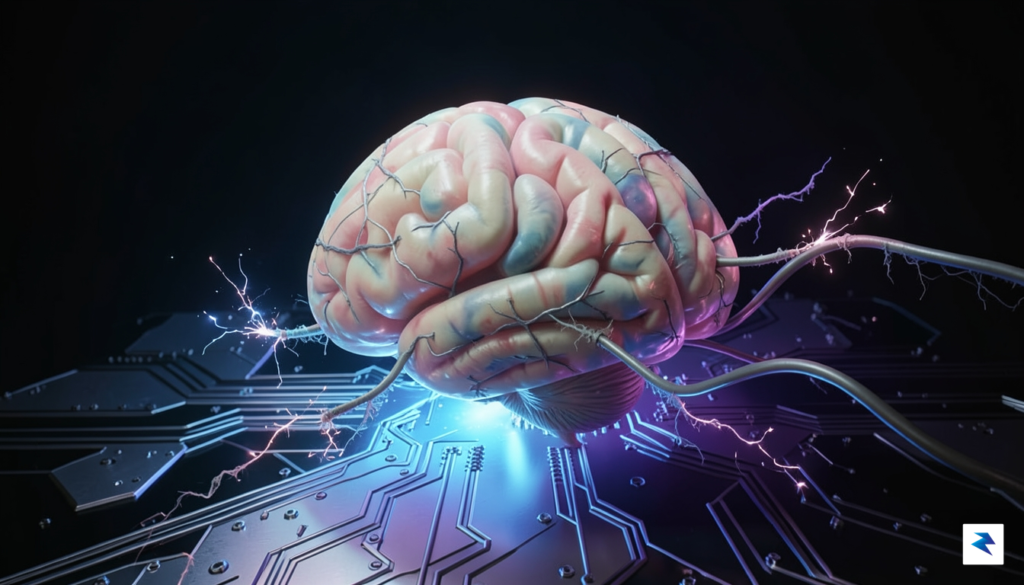
When we pivot from deep, autonomous work to constant prompting, we shift our role from “creator” to “editor” and “manager.” While editing might seem less taxing than writing from scratch, it actually keeps our brains in a perpetual state of shallow vigilance. We are not fully immersed in the subject matter; rather, we are constantly scanning for errors, evaluating the validity of machine-generated suggestions, and pivoting our strategy when the model misses the mark. This fragmented attention prevents us from entering a flow state, where deep cognitive work usually takes place. Over time, this creates a superficial relationship with our projects, as we prioritize the speed of production over the depth of understanding.
The prompt tax isn’t just about the time spent typing; it is about the fragmentation of intent. Every time you stop to refine a prompt, you are interrupting the natural rhythm of your own creative process.
Furthermore, there is a subtle erosion of critical thinking that happens when we outsource the “heavy lifting” of synthesis to an AI. By constantly relying on LLMs to structure our arguments or summarize our findings, we lose the mental muscle memory required to organize complex thoughts on our own. We become dependent on the model’s scaffolding, and when that scaffolding is shaky or misaligned, we experience a secondary layer of frustration—the need to “fix” the machine’s work, which is often more cognitively demanding than simply doing the work correctly the first time. Ultimately, the illusion of efficiency masks a deeper exhaustion: we are not just tired from working; we are tired from managing the interface between our intent and the tool’s interpretation.

The core of the issue lies in the fundamental shift from being a creator to becoming an editor. When you sit down to write a document or build a piece of software from scratch, your brain enters a generative mode, forming internal mental models that guide the output. This process is deeply satisfying because it allows for a coherent flow of thought. However, interacting with a Large Language Model (LLM) forces you into a state of constant, reactive verification. You are no longer the architect of your own ideas; instead, you are the quality control inspector for a machine that often sounds authoritative but lacks genuine understanding.
This phenomenon, which we might call the Verification Gap, is the primary driver of cognitive exhaustion. When you write a paragraph yourself, you know exactly why every sentence exists because you built the logic step-by-step. Conversely, when an AI provides a draft, you must parse every clause to ensure it isn’t hallucinating facts, repeating itself, or adopting a tone that misses the mark. This rigorous fact-checking and logic-debugging process is significantly more mentally taxing than the original act of creation. You are essentially spending your limited reservoir of mental energy cleaning up someone else’s mess, which leaves little room for the deep, creative thinking that actually fuels progress.
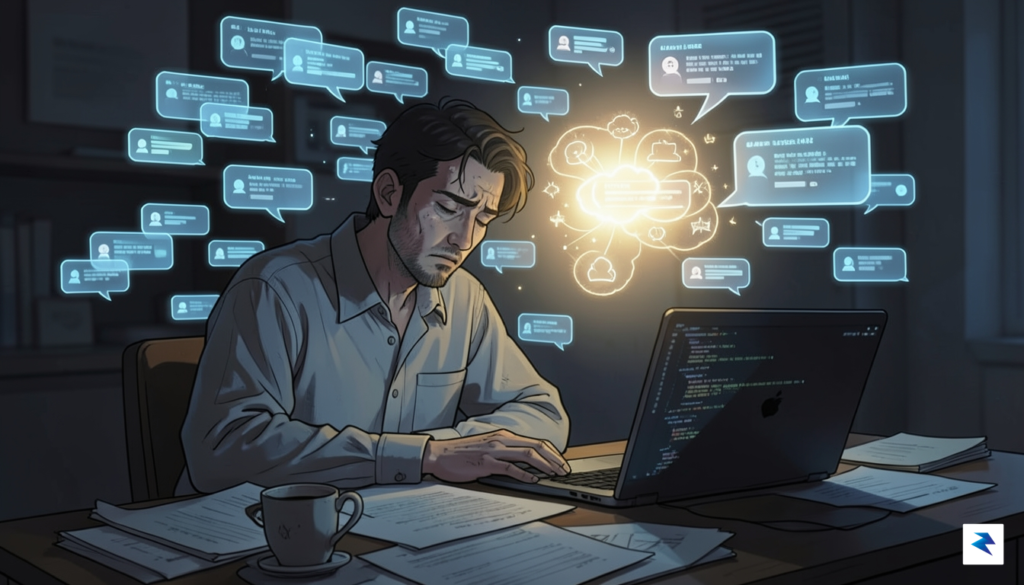
Furthermore, the reliance on LLMs frequently shatters the elusive flow state—that psychological peak where work feels effortless and time seems to dissolve. In traditional work, we enter a rhythm of thought that persists for hours. When we integrate AI into this workflow, we are subjected to a stop-start cycle: prompt the model, wait, analyze the output, identify the errors, rewrite the prompt, and repeat. Each of these micro-interruptions forces the brain to switch contexts, and every context switch incurs a heavy cognitive tax. By the end of a session, you haven’t just produced content; you have exhausted your executive function by constantly jumping between the role of a user and an auditor.
The mental cost of verifying AI output is often higher than the creative cost of generating it yourself. When you spend more time fixing the tool than using it, you are no longer productive—you are merely busy.
Ultimately, this feedback loop creates a paradoxical feeling of exhaustion. You might feel as though you have “done less” work, yet you end the day feeling more drained than if you had tackled the problem from a blank page. The fatigue is not derived from hard work, but from the relentless, low-level vigilance required to keep the AI on track. To reclaim your focus, it is essential to recognize that AI should be a partner in your process, not the gatekeeper of your intellect. When the tool starts to dictate the pace and quality of your thought, it is time to step back and reassert your role as the primary driver of your creative output.

To break the cycle of dependency, you must fundamentally shift your relationship with artificial intelligence from that of an omnipresent assistant to a surgical, deliberate instrument. The first step in reclaiming your creative agency is establishing strict “AI-free hours” within your workflow. During these windows, you should commit to engaging solely with your own intellect, allowing your brain to wrestle with the friction of difficult problems without the immediate, frictionless relief of a prompt window. By protecting your deep-thinking time from the intrusion of algorithms, you create the necessary cognitive space to develop original insights that are uniquely your own.
Implementing a “human-first” drafting method is equally vital for maintaining your creative autonomy. Instead of defaulting to an LLM to generate your initial ideas or structure, force yourself to write the first draft—no matter how messy or imperfect—entirely on your own. This practice ensures that your authentic voice, personal biases, and unique perspective remain the primary foundation of your work. Once you have established the core essence of your project, you can then invite the AI to play a secondary, supportive role, such as proofreading for clarity, suggesting alternative phrasing, or expanding on secondary points. By relegating the machine to the role of an editor rather than an architect, you ensure that you remain the driver of your creative process.

Furthermore, it is essential to recognize that the goal of using these advanced tools is to enhance human intelligence, not to outsource the thinking process entirely. When you disconnect from the machine, you are not merely taking a break; you are actively exercising your cognitive muscles, which inevitably atrophy when they are rarely challenged. Consider these actionable steps to maintain your independence:
The true measure of your creative agency isn’t how efficiently you can prompt a machine, but how effectively you can maintain your own critical voice in a world of automated content.
Ultimately, reclaiming your focus requires a disciplined commitment to being present in your own work. When you allow your brain to sit with discomfort and navigate the nuances of a creative challenge without external assistance, you build the resilience necessary to innovate. By treating your cognitive independence as a finite resource that requires protection, you ensure that your work remains a reflection of your lived experience rather than a synthesis of statistical probabilities.

The path forward is not defined by how many prompts we can generate in a day, but by how effectively we curate our engagement with these tools. As we move past the initial novelty and the subsequent exhaustion of constant AI integration, we must pivot toward a philosophy of intentionality. This means viewing large language models not as the architects of our work, but as highly specialized assistants that serve our specific goals. When we treat AI as an extension of our workflow rather than the driver, we reclaim the agency necessary to direct our own creative and professional output.
Transitioning toward a sustainable model of collaboration requires us to establish firm boundaries around where human judgment begins and machine assistance ends. Deep, critical thinking is a finite resource, and it is far too precious to be outsourced entirely to an algorithm that excels at pattern recognition but falters at genuine, nuanced insight. By consciously designating tasks that require our unique perspective—such as high-level strategy, ethical evaluation, and emotional resonance—we ensure that our most valuable cognitive skills remain sharp and un-atrophied. This approach transforms the act of working with AI from a passive, draining dependency into a deliberate exercise in cognitive enhancement.
The most successful professionals of the future will not be those who can out-prompt the machine, but those who best understand when to close the browser and trust their own intellect.
Ultimately, reclaiming your focus is about recognizing that your value is not tied to the speed of your output, but to the depth of your contribution. If you find yourself experiencing the symptoms of burnout, start by intentionally scheduling “analog hours” where you solve problems, draft outlines, or brainstorm concepts without any digital assistance. These moments of quiet reflection are essential for maintaining the clarity required to oversee AI-driven tasks effectively. By prioritizing your internal cognitive health over the relentless pace of automation, you can foster a symbiotic relationship with technology that supports your productivity without compromising your humanity.

As you move forward, challenge yourself to evaluate every AI interaction: Is this tool truly adding value to the project, or is it merely accelerating a process that would benefit from more human reflection? Moving toward intentional integration is a continuous process of calibration. It requires the courage to say no to efficiency when that efficiency comes at the cost of your clarity. By protecting your deep thinking skills, you ensure that you remain the master of your craft, using the power of artificial intelligence to amplify your voice rather than replace the very thoughts that make your work meaningful.
You must be logged in to post a comment.