
Blue Origin Eyes $130 Billion Valuation in Major Funding Shift
The Shift Toward External Capital For over two decades, Blue Origin occupied a unique position in the aerospace sector, functioning as a…


The U.S. Food and Drug Administration (FDA) has officially reached a definitive, albeit controversial, decision regarding the regulation of per- and polyfluoroalkyl substances (PFAS) in the American food supply. In a move that has sent ripples through the public health community, the agency denied a formal citizen petition that sought to establish mandatory, legally enforceable limits for these “forever chemicals” in various food products. The petition had argued that given the persistent nature of PFAS and their documented accumulation in both the environment and human biology, the FDA was obligated to set concrete tolerance levels to protect consumers from potential long-term health risks. By rejecting this request, the agency has maintained its current regulatory posture, signaling a preference for targeted mitigation strategies over broad, across-the-board federal mandates.
To understand the gravity of this decision, one must look at the FDA’s long-standing philosophy regarding chemical safety, which largely relies on a voluntary approach. Rather than setting rigid, pre-emptive exposure caps for every chemical compound that might enter the food chain, the agency typically manages risks through iterative testing, monitoring programs, and collaborative efforts with food manufacturers. This strategy focuses on identifying specific instances of contamination and working with industry stakeholders to reduce exposure on a case-by-case basis. While the FDA maintains that this flexible model allows them to respond dynamically to emerging science, critics argue that such an approach is fundamentally insufficient for chemicals as pervasive and hazardous as PFAS.

This rejection has ignited a burgeoning tension between federal regulators and independent health advocacy groups, who view the decision as a significant missed opportunity for public health protection. Organizations pushing for stricter oversight argue that the current voluntary system places the burden of safety on consumers rather than on the corporations responsible for the presence of these substances in packaging or supply chains. They contend that without clear, enforceable regulatory limits, manufacturers lack the necessary legal impetus to invest in safer alternatives or to implement more rigorous decontamination processes. Consequently, the divide between the FDA’s reliance on its existing risk-management framework and the public’s demand for aggressive, precautionary regulation continues to widen.
The FDA’s refusal to set formal limits reflects a fundamental disagreement over how to balance scientific uncertainty with the imperative of public safety in an era of widespread industrial contamination.
As the debate moves forward, the FDA emphasizes that it is continuing to conduct extensive testing and is actively engaging in research to better understand the pathways through which PFAS enter the food supply. Agency officials have pointed to their ongoing efforts to phase out the use of specific PFAS in food packaging as evidence that they are taking the issue seriously. However, for those who believe that the current level of contamination warrants immediate and standardized intervention, the FDA’s recent denial serves as a stark reminder of the bureaucratic and legal hurdles that remain in the path toward comprehensive chemical regulation in the American diet.

Per- and polyfluoroalkyl substances, commonly known as PFAS, represent a vast family of thousands of synthetic chemicals that have become ubiquitous in modern life. At the molecular level, these compounds are defined by an exceptionally strong bond between carbon and fluorine atoms. This chemical structure is one of the most stable in organic chemistry, making the substances incredibly resistant to heat, water, oil, and degradation. Because they do not break down easily in natural environments—or within the human body—they have earned the chilling moniker of “forever chemicals,” persisting for decades and traveling vast distances through air, water, and soil.
The infiltration of these compounds into our food supply occurs through a complex web of industrial exposure and environmental contamination. Historically, PFAS were widely utilized in food packaging materials, such as grease-resistant coatings for fast-food wrappers, microwave popcorn bags, and pizza boxes. When these materials come into contact with heat or moisture, the chemicals can leach directly into the food being consumed. Furthermore, the manufacturing processes that create these consumer goods often release PFAS into the air and wastewater, leading to significant contamination of local ecosystems. This systemic pollution eventually finds its way into agricultural irrigation systems, where contaminated water is applied directly to crops, allowing the chemicals to be absorbed into the plant tissue itself.
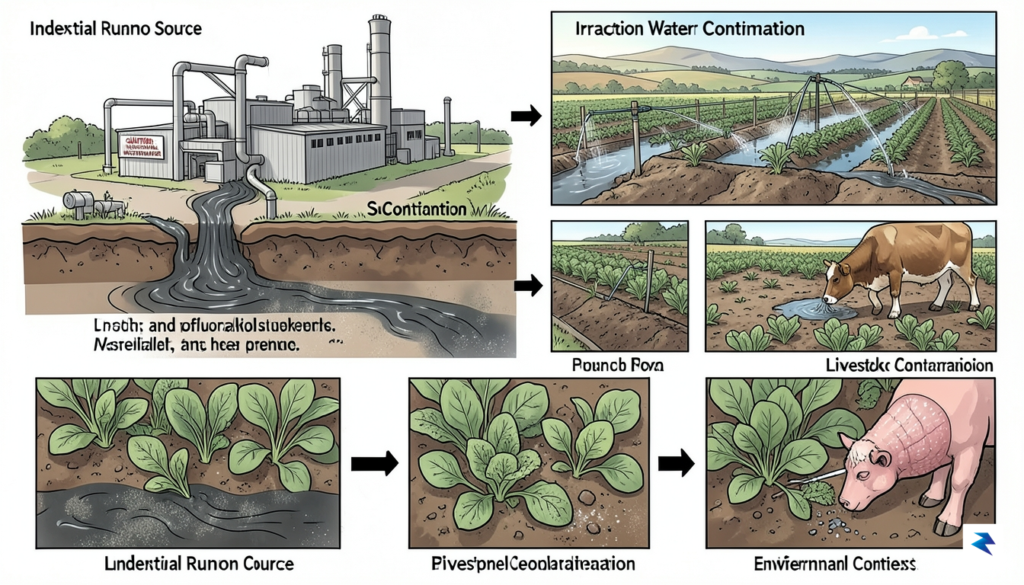
Beyond direct contact with packaging, the bioaccumulation of PFAS in the food chain presents a more insidious challenge. When industrial runoff contaminates soil and groundwater, these substances accumulate in the tissues of livestock, particularly in dairy and meat products. As animals graze on land irrigated with contaminated water or consume feed grown in tainted soil, the PFAS concentration within their bodies increases over time through a process known as biomagnification. Because these chemicals bind to proteins in the blood rather than just fat, they are easily transferred through the food chain, ultimately reaching the human consumer. This cycle is further complicated by the fact that PFAS are now found in virtually every corner of the globe, meaning that even produce grown far from industrial sites can contain trace amounts due to atmospheric deposition.
The extreme persistence of the carbon-fluorine bond means that once these chemicals enter the environment, they do not dissipate; instead, they cycle through the food chain, creating a long-term exposure pathway that is difficult to disrupt through standard agricultural practices.
Understanding these mechanisms is essential for grasping why the regulation of these substances has become such a contentious public health issue. Because PFAS are not just an isolated additive but a persistent environmental pollutant, removing them from the diet is not as simple as avoiding a specific brand or type of packaging. The complexity of their movement—from factories to soil, to crops, and finally to our dinner plates—highlights why the scientific community and regulatory bodies remain deeply divided on the most effective path forward for mitigating human exposure.
The mounting pressure on the FDA to establish enforceable limits on per- and polyfluoroalkyl substances (PFAS)—often referred to as “forever chemicals”—is rooted in a substantial and alarming body of toxicological research. These synthetic compounds, which resist degradation in both the environment and the human body, have been linked to a wide array of severe health consequences that go far beyond simple irritation. Recent peer-reviewed studies have consistently associated chronic PFAS exposure with endocrine disruption, which can interfere with the body’s hormone signaling systems, as well as significant immune system suppression, making individuals more susceptible to infections and reducing the effectiveness of vaccines. Furthermore, the evidence connecting long-term ingestion to heightened cancer risks, particularly kidney and testicular cancers, has spurred a sense of urgency among medical professionals and environmental scientists alike.
Vulnerable populations, especially children and pregnant women, face the most profound risks from these contaminants. During critical developmental windows, even trace amounts of PFAS can interfere with fetal growth and neurological development, potentially leading to long-term health complications that manifest well into adulthood. Because these chemicals bioaccumulate—meaning they build up in the body over time—the cumulative exposure through common food packaging and contaminated agricultural products presents a silent, ongoing crisis. Families are increasingly concerned that the current regulatory landscape fails to account for the unique physiological vulnerabilities of the youngest members of society, who are consuming these chemicals at a time when their bodies are most susceptible to permanent damage.

Advocates argue that the FDA’s reliance on voluntary guidance for industry compliance is fundamentally insufficient to safeguard the public. While voluntary measures allow companies to phase out harmful materials at their own pace, they lack the legal teeth required to ensure universal accountability across the vast and complex food supply chain. Critics point out that when safety measures are merely suggested rather than mandated, the most cost-effective—and often most hazardous—packaging materials remain in circulation. For health advocates, the rejection of a petition to set strict legal limits is a missed opportunity to transition from a reactive approach to a proactive, protective standard that prioritizes consumer safety over industrial convenience.
The persistence of PFAS in the environment means that every day of regulatory delay potentially increases the body burden of these toxic chemicals in the general population, compounding the risk for future health crises.
Ultimately, the demand for regulation is not merely about testing; it is about establishing a clear, enforceable threshold that forces manufacturers to innovate toward safer, PFAS-free alternatives. Without mandatory limits, the responsibility currently falls on consumers to navigate an opaque marketplace, often without the necessary information to identify which food products might be contaminated. By codifying safety standards, the government would provide the transparency and protection that citizens expect, ensuring that the food on their tables is not contributing to a long-term public health epidemic.

The Food and Drug Administration’s decision to decline a formal petition for establishing concrete, across-the-board limits on per- and polyfluoroalkyl substances (PFAS) in food stems from a complex intersection of scientific uncertainty and regulatory practicality. While public health advocates have long pushed for a standardized, enforceable threshold, the agency contends that the current state of scientific data is not yet robust enough to support a “one-size-fits-all” regulatory standard. Because there are thousands of distinct chemicals within the PFAS umbrella—each possessing different chemical structures, environmental persistence rates, and potential toxicity profiles—the FDA argues that creating a single limit could be dangerously oversimplified or fundamentally ineffective at capturing the true scope of dietary exposure.

Instead of implementing rigid, blanket mandates, the agency advocates for a more nuanced, case-by-case approach. The FDA maintains that its current strategy of targeted monitoring and voluntary industry cooperation allows for greater flexibility as new analytical methods emerge. By focusing on identifying specific sources of contamination within the food supply chain, the agency believes it can address localized risks more aggressively than a broad regulatory ceiling might allow. Furthermore, the FDA emphasizes that it is actively expanding its testing capabilities, working closely with international partners and federal agencies to bridge the current gaps in toxicological data that prevent the establishment of universal safety thresholds.
“The complexity of PFAS chemistry requires a sophisticated, evidence-based strategy that evolves alongside our scientific understanding, rather than a singular regulatory limit that may not account for the diversity of these compounds.”
This preference for industry collaboration is central to the agency’s current mitigation framework. Rather than waiting for a lengthy and potentially litigious rulemaking process, the FDA has prioritized working with manufacturers to identify and phase out food-contact materials that contain PFAS. This collaborative model is designed to encourage transparency and rapid innovation in packaging alternatives, which the agency views as a more proactive way to reduce consumer exposure. While critics argue that this approach lacks the teeth of enforceable legal limits, the FDA asserts that its data-driven surveillance, combined with aggressive industry engagement, creates a more responsive system that can adapt to new findings in real-time, ultimately providing a more meaningful shield against chemical risks in the long term.


With the federal regulatory framework currently holding steady, the responsibility for managing chemical exposure increasingly shifts toward a patchwork of state-level initiatives and individual consumer vigilance. Several states have already begun to take matters into their own hands, moving to ban PFAS in food packaging materials entirely. These legislative efforts serve as a vital laboratory for policy, demonstrating that market shifts can occur even when federal agencies are hesitant to set binding limits. For policymakers, the path forward involves balancing the urgent need for public health protections with the logistical realities of the global food supply chain. As momentum builds at the local level, we may eventually see a ripple effect that forces a more standardized, national approach to chemical safety, mirroring how many environmental regulations have evolved historically in the United States.
For the average household, navigating this environment requires a proactive approach to minimizing exposure. While it is nearly impossible to eliminate all contact with per- and polyfluoroalkyl substances given their ubiquity in modern manufacturing, consumers can significantly reduce their risk through intentional purchasing habits. Prioritizing fresh, whole foods over heavily processed or pre-packaged items is one of the most effective strategies, as the latter often utilize PFAS-treated containers to prevent grease or moisture from seeping through. Additionally, opting for glass, stainless steel, or ceramic containers for food storage—rather than non-stick surfaces or plastic wraps—can mitigate the likelihood of chemical leaching during heating or long-term storage.
“The absence of a federal mandate does not mean that the conversation regarding food safety has ended; rather, it signals an era where transparency and independent scientific inquiry become our strongest tools for protection.”
Ultimately, the future of food safety rests on a foundation of continued, independent scientific research that operates independently of industry influence. We must advocate for increased funding into toxicology studies that examine the long-term, low-dose impacts of PFAS accumulation in the human body. As researchers peel back the layers of how these “forever chemicals” interact with our biology, the resulting data will provide the evidence base necessary for future regulatory reform. Until then, transparency remains the consumer’s best ally. By supporting brands that commit to third-party testing and demanding clear labeling regarding packaging materials, the public can exert significant pressure on the industry to prioritize health over convenience, ensuring that the dialogue around food safety remains robust and persistent.
You must be logged in to post a comment.